
Verwandte Artikel zu The Map and the Territory: Risk, Human Nature, and...
Inhaltsangabe
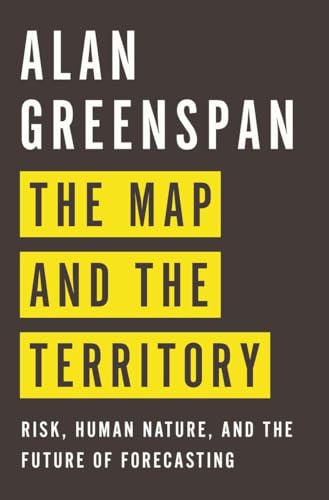
From the bestselling author of The Age of Turbulence and Capitalism in America
Like all of us, though few so visibly, Alan Greenspan was forced by the financial crisis of 2008 to question some fundamental assumptions about risk management and economic forecasting. No one with any meaningful role in economic decision making in the world saw beforehand the storm for what it was. How had our models so utterly failed us?
To answer this question, Alan Greenspan embarked on a rigorous and far-reaching multiyear examination of how Homo economicus predicts the economic future, and how it can predict it better. Economic risk is a fact of life in every realm, from home to business to government at all levels. Whether we’re conscious of it or not, we make wagers on the future virtually every day, one way or another. Very often, however, we’re steering by out-of-date maps, when we’re not driven by factors entirely beyond our conscious control.
The Map and the Territory is nothing less than an effort to update our forecasting conceptual grid. It integrates the history of economic prediction, the new work of behavioral economists, and the fruits of the author’s own remarkable career to offer a thrillingly lucid and empirically based grounding in what we can
know about economic forecasting and what we can’t.The book explores how culture is and isn't destiny and probes what we can predict about the world's biggest looming challenges, from debt and the reform of the welfare state to natural disasters in an age of global warming.
No map is the territory, but Greenspan’s approach, grounded in his trademark rigor, wisdom, and unprecedented context, ensures that this particular map will assist in safe journeys down many different roads, traveled by individuals, businesses, and the state.
Die Inhaltsangabe kann sich auf eine andere Ausgabe dieses Titels beziehen.
Über die Autorin bzw. den Autor
Alan Greenspan was born in 1926 and reared in the Washington Heights neighborhood of New York City. After studying the clarinet at Juilliard and working as a professional musician, he earned his B.A., M.A., and Ph.D. in economics from New York University. From 1974 to 1977, he served as chair of the Council of Economic Advisers under President Ford. In 1987, President Reagan appointed him chairman of the Federal Reserve Board, a position he held until his retirement in 2006. He is the author of The New York Times bestsellers The Age of Turbulence, The Map and the Territory. and Capitalism in America.
Auszug. © Genehmigter Nachdruck. Alle Rechte vorbehalten.
From The Map and the Territory by Alan Greenspan. Reprinted by arrangement with The Penguin Press, a member of Penguin Group (USA) LLC, A Penguin Random House Company. Copyright © Alan Greenspan, 2013.
Chapter 13
BUFFERS
Not a day goes by that does not reveal deterioration in some aspect of our nation’s public infrastructure, followed by a call for immediate action. The average age of highways and streets, as estimated by the Bureau of Economic Analysis, has increased from sixteen years to twenty-five years since the early 1970s. To those of us who have to drive over our increasingly pockmarked streets, numbers shouldn’t be necessary. Sewer systems and public hospital buildings have aged similarly. Even our national parks are falling behind in maintenance.
But the most visible aging of government assets, and possibly the most consequential, is that of our military. Had we not had excess manufacturing capacity and infrastructure as we entered World War II, we could not have countered our enemies with overwhelming capacity to produce. The size of budget deficits that prevailed during the war was a measure of the extent to which we marshaled the savings of the private sector to help fund the purchase of war materials. But in order to get consumption down and savings up, rationing proved necessary.
Since the end of the war, the average age of military buildings and other facilities has tripled. If there is such a thing as a poster child of aged military equipment, it surely must be the fleet of B-52s, the long-range strategic bomber. It has a long distinguished history. As I wrote in 1952, “The long-range intercontinental bomber tasks will be in the hands of a new swept-wing eight-jet bomber now undergoing test—the B-52.” Its latest version, the B-52H, whose final production run ended in 1964, did yeoman service as recently as 2003 in Iraq. It is scheduled to remain in service beyond 2040. I am certain that there are innumerable current B-52 pilots whose fathers, and conceivably grandfathers, flew earlier models of this renowned aircraft. There are still eighty-five H models, fitted with modern avionics, in our active inventory.
The aging of naval ships has gained even greater prominence in the press. Our aircraft carriers are expected to have a fifty-year service life, and many of them are well up in nautical adulthood. I hesitate to include the USS Constitution (“Old Ironsides”), the oldest commissioned warship afloat, a wooden-hulled frigate celebrated for its exploits in the War of 1812. It is in a class of its own. It was first deployed in October 1797 and most assuredly is the most renowned piece of military equipment still in our inventory. Its propulsion system is identified by the navy with mock seriousness as 42,710 square feet of sail on three masts.
If “Old Ironsides” is the oldest naval vessel in our arsenal, the newest, scheduled to be delivered in 2015, is the aircraft carrier Gerald R. Ford, the first in the Ford class of carriers that are being added to the aging Nimitz and Enterprise class carriers. I can think of no more appropriate tribute to my old boss, President Ford, than to have a leading edge of our military power named after him.
The Abrams tank, the main battle tank of the army, is more than thirty years old, as is the Bradley armored infantry carrier. Much of the army’s equipment, however, is new, fashioned largely for its operations in Iraq and Afghanistan. Some of it, such as the large special trucks engineered to meet the devastation of roadside mines in many sensitive combat areas, may not be relevant in the future.
It is not quite clear, however, how important the aging is to our national security. It all depends on a forecast of who our enemies are going to be five to fifteen years from today. Most analysts believe that the probability of head-to-head superpower confrontations like those that dominated the first four decades following World War II is very small, but no one seems sure. Our military structure cannot significantly change quickly—the very long delivery lead times preclude it. But the type of military hardware we procure in the years immediately ahead will depend very much on our longer-term balance of power perspectives.
The issue of equipment aging divides military and political tacticians and will likely continue to do so for the intermediate future. I would hope that this debate is not resolved by another conflict in which American military capabilities are sorely tested.
SO, TOO, THE PRIVATE SECTOR
The private sector has not been immune from the aging of infrastructure. Since the 1970s, the average age of manufacturing industry assets, for example, has increased from under eleven years to more than sixteen years. Similar aging is evident in wholesale trade, utilities, and air transport.
The share of private nonresidential buildings in real GDP has been in long-term decline since 1981, and those buildings are not being replaced, probably reflecting the slowdown in growth of the working-age population (fewer workers, fewer buildings), as well as the recent increased discounting since 2008 of expected incomes from very long-lived assets.
THE TASK AHEAD
There can be little doubt that a major modernization of our infrastructure is long overdue. It is easy to demonstrate the time and motor fuel wasted in traffic jams owing to failure to keep road capacity growing in line with the number of vehicles on the road. But fixing the public infrastructure is no easy task. Funding is the major obstacle. Our fiscal position is daunting. To balance the budget, we need to raise revenue by a fourth or cut outlays by a fifth, or some combination of the two. We are unlikely to get close to balancing the budget even within ten years. Increasing federal outlays on infrastructure will increase the deficit (negative savings) and must be matched, ex post, by a comparable rise in savings less capital investment by households and private business or by increasing our rate of borrowing from abroad. To the extent that increased deficit spending curtails capital investment in other sectors, it is a depressant to economic growth in the short term and productivity in the long term. But unaddressed is the question of the effect of infrastructure on productivity. Rising outlays on infrastructure will, of course, increase nominal GDP, which, in turn, should increase the level of gross domestic private savings, but not nearly enough to be significant.
We are no longer the nation that we were coming out of World War II, which built a visible public (and private) infrastructure while still diverting a large part of our GDP to Cold War defense. We did it then by maintaining a savings rate out of household income of 10 percent. Today, as I’ve noted, that rate is in low single digits.
THE LARGER ISSUE
Our infrastructure deficiencies are part of a larger problem confronting the United States—the amount of our resources we set aside for contingencies. There are some inventories that sit unused for years—the Strategic Petroleum Reserves, for one. Some resources we produce stand idle for protracted periods and may in fact never be used: vaccine stockpiles for epidemics that never happen and dykes along rivers that never reach flood levels. By far our largest standby asset is, of course, our military.
Such assets serve as guarantees against, for example, foreign invasion, flu epidemics, tsunamis, and hurricanes, none of which are predictable and may never happen. They nonetheless require the building up of buffers of idle resources that are not otherwise engaged in the production of consumable goods and services. They are employed only if and when a crisis emerges. Such buffers address contingencies...
„Über diesen Titel“ kann sich auf eine andere Ausgabe dieses Titels beziehen.
Suchergebnisse für The Map and the Territory: Risk, Human Nature, and...

Beispielbild für diese ISBN
The Map and the Territory: Risk, Human Nature, and the Future of Forecasting
Anbieter: World of Books (was SecondSale), Montgomery, IL, USA
Verkäuferbewertung 5 von 5 Sternen

Hardback. Zustand: Good. From the bestselling author of>The Age of Turbulence and>Capitalism in America> Like all of us, though few so visibly, Alan Greenspan was forced by the financial crisis of 2008 to question some fundamental assumptions about risk management and economic forecasting. No one with any meaningful role in economic decision making in the world saw beforehand the storm for what it was. How had our models so utterly failed us? To answer this question, Alan Greenspan embarked on a rigorous and far-reaching multiyear examination of how Homo economicus predicts the economic future, and how it can predict it better. Economic risk is a fact of life in every realm, from home to business to government at all levels. Whether we're conscious of it or not, we make wagers on the future virtually every day, one way or another. Very often, however, we're steering by out-of-date maps, when we're not driven by factors entirely beyond our conscious control.The Map and the Territory is nothing less than an effort to update our forecasting conceptual grid. It integrates the history of economic prediction, the new work of behavioral economists, and the fruits of the author's own remarkable career to offer a thrillingly lucid and empirically based grounding in what we can know about economic forecasting and what we can't.The book explores how culture is and isn't destiny and probes what we can predict about the world's biggest looming challenges, from debt and the reform of the welfare state to natural disasters in an age of global warming.No map is the territory, but Greenspan's approach, grounded in his trademark rigor, wisdom, and unprecedented context, ensures that this particular map will assist in safe journeys down many different roads, traveled by individuals, businesses, and the state. Artikel-Nr. 00109442148
Gebraucht kaufen
EUR 4,41
Versand gratis
Versand innerhalb von USA
Versand innerhalb von USA
Anzahl: 6 verfügbar
Beispielbild für diese ISBN
The Map and the Territory : Risk, Human Nature, and the Future of Forecasting
Verlag:
Penguin Publishing Group, 2013
ISBN 10: 1594204810
ISBN 13: 9781594204814
Gebraucht
Hardcover
Erstausgabe
Anbieter: Better World Books, Mishawaka, IN, USA
Verkäuferbewertung 5 von 5 Sternen
Zustand: Very Good. First Edition. Former library copy. Pages intact with possible writing/highlighting. Binding strong with minor wear. Dust jackets/supplements may not be included. Includes library markings. Stock photo provided. Product includes identifying sticker. Better World Books: Buy Books. Do Good. Artikel-Nr. 3779982-6
Gebraucht kaufen
EUR 6,36
Versand gratis
Versand innerhalb von USA
Versand innerhalb von USA
Anzahl: 2 verfügbar
Beispielbild für diese ISBN
The Map and the Territory : Risk, Human Nature, and the Future of Forecasting
Verlag:
Penguin Publishing Group, 2013
ISBN 10: 1594204810
ISBN 13: 9781594204814
Gebraucht
Hardcover
Erstausgabe
Anbieter: Better World Books, Mishawaka, IN, USA
Verkäuferbewertung 5 von 5 Sternen
Zustand: Good. First Edition. Former library copy. Pages intact with minimal writing/highlighting. The binding may be loose and creased. Dust jackets/supplements are not included. Includes library markings. Stock photo provided. Product includes identifying sticker. Better World Books: Buy Books. Do Good. Artikel-Nr. GRP102246549
Gebraucht kaufen
EUR 6,36
Versand gratis
Versand innerhalb von USA
Versand innerhalb von USA
Anzahl: 1 verfügbar
Beispielbild für diese ISBN
The Map and the Territory: Risk, Human Nature, and the Future of Forecasting
Verlag:
Penguin Press (edition First Edition), 2013
ISBN 10: 1594204810
ISBN 13: 9781594204814
Gebraucht
Hardcover
Erstausgabe
Anbieter: BooksRun, Philadelphia, PA, USA
Verkäuferbewertung 5 von 5 Sternen
Hardcover. Zustand: Very Good. First Edition. With dust jacket. It's a well-cared-for item that has seen limited use. The item may show minor signs of wear. All the text is legible, with all pages included. It may have slight markings and/or highlighting. Artikel-Nr. 1594204810-11-22-29
Gebraucht kaufen
EUR 6,50
Versand gratis
Versand innerhalb von USA
Versand innerhalb von USA
Anzahl: 1 verfügbar
Beispielbild für diese ISBN
The Map and the Territory: Risk, Human Nature, and the Future of Forecasting
Anbieter: ThriftBooks-Atlanta, AUSTELL, GA, USA
Verkäuferbewertung 5 von 5 Sternen
Hardcover. Zustand: Very Good. No Jacket. May have limited writing in cover pages. Pages are unmarked. ~ ThriftBooks: Read More, Spend Less. Artikel-Nr. G1594204810I4N00
Gebraucht kaufen
EUR 7,13
Versand gratis
Versand innerhalb von USA
Versand innerhalb von USA
Anzahl: 1 verfügbar
Beispielbild für diese ISBN
The Map and the Territory: Risk, Human Nature, and the Future of Forecasting
Anbieter: ThriftBooks-Reno, Reno, NV, USA
Verkäuferbewertung 5 von 5 Sternen
Hardcover. Zustand: Very Good. No Jacket. May have limited writing in cover pages. Pages are unmarked. ~ ThriftBooks: Read More, Spend Less. Artikel-Nr. G1594204810I4N00
Gebraucht kaufen
EUR 7,13
Versand gratis
Versand innerhalb von USA
Versand innerhalb von USA
Anzahl: 1 verfügbar
Beispielbild für diese ISBN
The Map and the Territory: Risk, Human Nature, and the Future of Forecasting
Anbieter: ThriftBooks-Dallas, Dallas, TX, USA
Verkäuferbewertung 5 von 5 Sternen
Hardcover. Zustand: Very Good. No Jacket. May have limited writing in cover pages. Pages are unmarked. ~ ThriftBooks: Read More, Spend Less. Artikel-Nr. G1594204810I4N00
Gebraucht kaufen
EUR 7,13
Versand gratis
Versand innerhalb von USA
Versand innerhalb von USA
Anzahl: 1 verfügbar
Beispielbild für diese ISBN
The Map and the Territory: Risk, Human Nature, and the Future of Forecasting
Anbieter: ThriftBooks-Phoenix, Phoenix, AZ, USA
Verkäuferbewertung 5 von 5 Sternen
Hardcover. Zustand: Very Good. No Jacket. May have limited writing in cover pages. Pages are unmarked. ~ ThriftBooks: Read More, Spend Less. Artikel-Nr. G1594204810I4N00
Gebraucht kaufen
EUR 7,13
Versand gratis
Versand innerhalb von USA
Versand innerhalb von USA
Anzahl: 1 verfügbar
Beispielbild für diese ISBN
The Map and the Territory: Risk, Human Nature, and the Future of Forecasting
Anbieter: Wonder Book, Frederick, MD, USA
Verkäuferbewertung 5 von 5 Sternen
Zustand: Good. Good condition. Good dust jacket. A copy that has been read but remains intact. May contain markings such as bookplates, stamps, limited notes and highlighting, or a few light stains. Artikel-Nr. P08R-00149
Gebraucht kaufen
EUR 7,35
Versand gratis
Versand innerhalb von USA
Versand innerhalb von USA
Anzahl: 1 verfügbar
Beispielbild für diese ISBN
The Map and the Territory: Risk, Human Nature, and the Future of Forecasting
Anbieter: Anybook.com, Lincoln, Vereinigtes Königreich
Verkäuferbewertung 5 von 5 Sternen
Zustand: Fair. This is an ex-library book and may have the usual library/used-book markings inside.This book has hardback covers. Book contains pencil markings. In fair condition, suitable as a study copy. Dust jacket in good condition. Please note the Image in this listing is a stock photo and may not match the covers of the actual item,750grams, ISBN:9781594204814. Artikel-Nr. 9920511
Gebraucht kaufen
EUR 7,69
EUR 15,38 Versand
Versand von Vereinigtes Königreich nach USA
Versand von Vereinigtes Königreich nach USA
Anzahl: 1 verfügbar