
Verwandte Artikel zu Who Needs the Fed?: What Taylor Swift, Uber, and Robots...
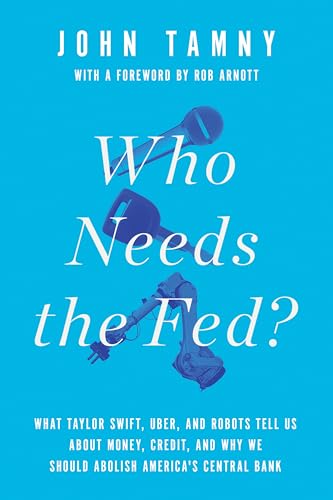
Who Needs the Fed?: What Taylor Swift, Uber, and Robots Tell Us About Money, Credit, and Why We Should Abolish America's Central Bank - Hardcover
Inhaltsangabe
The Federal Reserve is one of the most disliked entities in the United States at present, right alongside the IRS. Americans despise the Fed, but they&;re also generally a bit confused as to why they distrust our central bank.
Their animus is reasonable, though, because the Fed&;s most famous function—targeting the Fed funds rate—is totally backwards. John Tamny explains this backwardness in terms of a Taylor Swift concert followed by a ride home with Uber.
In modern times, he points out, the notion of credit has been perverted, so that most people believe it&;s money and that the supply of it can therefore be increased. This false notion has aggrandized the Fed with power that it can&;t possibly use wisely. The contrast between the grinding poverty of Baltimore and the abundance of Silicon Valley helps illustrate the problem, along with stories about Donald Trump, Robert Downey Jr., Jim Harbaugh (the Michigan football coach), and robots.
Who Needs the Fed? makes a sober case against the Federal Reserve by explaining what credit really is, and why the Fed&;s existence is inimical to its creation. Readers will come away entertained, much more knowledgeable, and prepared to argue that the Fed is merely superfluous on its best days but perilous on its worst.
Their animus is reasonable, though, because the Fed&;s most famous function—targeting the Fed funds rate—is totally backwards. John Tamny explains this backwardness in terms of a Taylor Swift concert followed by a ride home with Uber.
In modern times, he points out, the notion of credit has been perverted, so that most people believe it&;s money and that the supply of it can therefore be increased. This false notion has aggrandized the Fed with power that it can&;t possibly use wisely. The contrast between the grinding poverty of Baltimore and the abundance of Silicon Valley helps illustrate the problem, along with stories about Donald Trump, Robert Downey Jr., Jim Harbaugh (the Michigan football coach), and robots.
Who Needs the Fed? makes a sober case against the Federal Reserve by explaining what credit really is, and why the Fed&;s existence is inimical to its creation. Readers will come away entertained, much more knowledgeable, and prepared to argue that the Fed is merely superfluous on its best days but perilous on its worst.
Die Inhaltsangabe kann sich auf eine andere Ausgabe dieses Titels beziehen.
Über die Autorin bzw. den Autor
John Tamny is the Political Economy editor at Forbes, editor of RealClearMarkets, a senior economic adviser to Toreador Research & Trading, and a senior economic fellow at Reason Foundation. He is a weekly panelist on Forbes on Fox, and his columns have appeared in the Wall Street Journal, Investor's Business Daily, National Review, the Financial Times, and London&;s Daily Telegraph. His first book was Popular Economics: What the Rolling Stones, Downton Abbey, and LeBron James Can Teach You about Economics. Tamny and his wife, Kendall, live in Washington, D.C.
Auszug. © Genehmigter Nachdruck. Alle Rechte vorbehalten.
Chapter One: The Rate Setters at the Fed Should Attend More Taylor Swift Concerts
On July 15, 2015, pop singer Taylor Swift performed for two straight nights at Nationals Park in Washington, D.C. Globally popular thanks to catchy songs that sometimes describe past romantic relationships with the famous, Swift is one of the most important acts in music.
To properly understand the power that Swift wields, it’s useful to first travel back a little less than a month before her arrival in D.C. It was then that Apple, the creator of the iPod, iPhone, and iPad, and the most valuable company by market capitalization in the world, announced its new Apple Music Streaming service.
Amid its rollout, and with the idea of luring customers away from popular competitors such as Pandora and Spotify, Apple offered a free, three-month trial. Enter Taylor Swift.
Understandably offended that Apple would presume to build a new business on the backs of the musicians who had created the music it was streaming, Swift struck back on Tumblr. “Apple Music will not be paying writers, producers, or artists for those three months,” she wrote. “I find it to be shocking, disappointing, and completely unlike this historically progressive and generous company.” She added: “We don’t ask you for free iPhones. Please don’t ask us to provide you with our music for no compensation.” Swift backed up her words with a threat to withhold streaming rights to 1989, her mega-selling album released ahead of her 2015 tour.
Ever fearful of the bad PR that would blemish their new business line, Apple caved. Within hours the technology giant announced a reversal of its initial offer of free music to its early adapters. Apple promised to pay the artists for music streamed during the trial period.
So newsworthy was Swift’s response to the technology colossus that even the Wall Street Journal’s editorial page, the holy grail of public policy opinion, saw fit to comment with unrestrained awe. The page’s editors marveled at how Swift taught them “a good lesson about intellectual property rights—and the danger of taking on a woman who knows what she’s worth.”
Swift also provided the world with a great lesson about credit. Economists frequently act as though cheap credit can be decreed through an announcement from the Fed of a “low” interest rate. Swift’s pointedly open letter to Apple was a reminder that when it comes to credit there’s always and everywhere a buyer and a seller.
Apple learned in embarrassing fashion that which doesn’t seem to concern central bankers who are apparently less sensitive to ridicule. It’s one thing to declare the supply of a market good inexpensive from the commanding heights of government, but it’s the height of folly to assume those in possession of the market good will give it to buyers for nothing. Going back to Swift’s threat to withhold songs from 1989, eager buyers of Apple Music were going to experience 1989 “scarcity” absent Apple’s reversal.
Importantly, the lessons provided by Swift don’t end there. Everything anyone could ever want to know about the economy and credit is there for the taking. Knowledge is simply a function of keenly observing the world around us.
Mentioned at this chapter’s outset was Swift’s two nights at Nationals Park. When filled to capacity, the cavernous stadium can hold over 40,000 attendees. Swift filled the stadium both nights. Among the attendees were my wife Kendall and some of her friends.
Reaching the baseball stadium proved rather easy, but upon the conclusion of Swift’s concert, there was a mad rush among attendees to get back home. While Washington, D.C.’s Metro serves Nationals Park, the lines to get on a train after the music stopped were endless. Word was that while the Metro would remain in service well past midnight, it would take several hours to transport Swift’s many fans home.
With the Metro an unrealistic option for concertgoers eager to get home before midnight, cabs were the second option. Unfortunately, the District of Columbia Taxi Commission regulates the fares that its cabdrivers can charge. While the Commission allows for slightly higher rates during periods of heavy demand, it can’t be stressed enough that the area around Nationals Park was a madhouse. The cab fares allowed by the Commission weren’t enough to lure drivers (sellers) into a clogged area full of desperate buyers.
Notable about the above is that it’s long been the norm in Washington, D.C. While cabs are similarly allowed to charge passengers extra during major snowstorms, as anyone who has lived in the District long enough knows well, the paltry increase in regulated rates by the Commission has rarely made it worth the time of drivers to be out on frequently perilous roads; as in when passengers (buyers) are most in need of drivers (sellers).
To state the obvious, prices that are set at artificially low levels to please buyers ignore that every transaction has a seller too. Indeed, artificially low prices also ignore the purpose of prices in the first place. In a free market, prices are regulation par excellence.
In a free market, prices reflect not just the desires of buyers and sellers, but also the weather, the news, what’s scheduled to happen next week, etc. Prices frequently fluctuate in a free market as a way of taking into account the ever-changing wants and needs of buyers and sellers in the dynamic world around us. Prices in the information-pregnant markets are the necessary tool to bring together the buyer and seller.
Government regulation of prices doesn’t always fail because people who toil in government are inherently bad. Instead, they fail because no bureaucrat, no matter how smart, can ever possibly divine a price that will reflect a constantly changing marketplace. That’s why government regulation of prices frequently leads to scarcity of supply when it’s needed most. It’s impossible for an individual or a collection of individuals to know even a fraction of the information that the market itself is constantly processing.
As if the proverbial cab-shortage fire on that steamy evening in July needed even more gasoline, it’s against the law for cabdrivers not in possession of a Washington, D.C. cabdriver’s “medallion” to pick up passengers there. This rule is meant to protect the market for D.C. drivers already unable to charge what the market will bear, but for Taylor Swift fans it meant that getting home from her concert could potentially take hours.
So, despite a great concert enjoyed by her many fans, the evening had the potential to end badly thanks to the fatal conceit of government officials that they can successfully plan prices. Was a good evening ruined? No.
This story has a happy ending thanks to the intense entrepreneurialism that continues to define the American economy despite the barriers placed in front of this country’s dreamers. Specifically, the story ends well thanks to Uber. Founded in 2009 by Travis Kalanick, Uber’s business model is rooted in the correct understanding of commerce that there are no buyers without sellers, and vice versa.
Kalanick devised an “app” that people around the world are adding to their smartphones in increasingly high numbers as evidenced by a private valuation of the San Francisco company that has risen to over $50 billion. Whereas it used to be that only the superrich had the means to ring a bell and summon a driver, thanks to Kalanick’s app anyone with a smartphone can tap...
On July 15, 2015, pop singer Taylor Swift performed for two straight nights at Nationals Park in Washington, D.C. Globally popular thanks to catchy songs that sometimes describe past romantic relationships with the famous, Swift is one of the most important acts in music.
To properly understand the power that Swift wields, it’s useful to first travel back a little less than a month before her arrival in D.C. It was then that Apple, the creator of the iPod, iPhone, and iPad, and the most valuable company by market capitalization in the world, announced its new Apple Music Streaming service.
Amid its rollout, and with the idea of luring customers away from popular competitors such as Pandora and Spotify, Apple offered a free, three-month trial. Enter Taylor Swift.
Understandably offended that Apple would presume to build a new business on the backs of the musicians who had created the music it was streaming, Swift struck back on Tumblr. “Apple Music will not be paying writers, producers, or artists for those three months,” she wrote. “I find it to be shocking, disappointing, and completely unlike this historically progressive and generous company.” She added: “We don’t ask you for free iPhones. Please don’t ask us to provide you with our music for no compensation.” Swift backed up her words with a threat to withhold streaming rights to 1989, her mega-selling album released ahead of her 2015 tour.
Ever fearful of the bad PR that would blemish their new business line, Apple caved. Within hours the technology giant announced a reversal of its initial offer of free music to its early adapters. Apple promised to pay the artists for music streamed during the trial period.
So newsworthy was Swift’s response to the technology colossus that even the Wall Street Journal’s editorial page, the holy grail of public policy opinion, saw fit to comment with unrestrained awe. The page’s editors marveled at how Swift taught them “a good lesson about intellectual property rights—and the danger of taking on a woman who knows what she’s worth.”
Swift also provided the world with a great lesson about credit. Economists frequently act as though cheap credit can be decreed through an announcement from the Fed of a “low” interest rate. Swift’s pointedly open letter to Apple was a reminder that when it comes to credit there’s always and everywhere a buyer and a seller.
Apple learned in embarrassing fashion that which doesn’t seem to concern central bankers who are apparently less sensitive to ridicule. It’s one thing to declare the supply of a market good inexpensive from the commanding heights of government, but it’s the height of folly to assume those in possession of the market good will give it to buyers for nothing. Going back to Swift’s threat to withhold songs from 1989, eager buyers of Apple Music were going to experience 1989 “scarcity” absent Apple’s reversal.
Importantly, the lessons provided by Swift don’t end there. Everything anyone could ever want to know about the economy and credit is there for the taking. Knowledge is simply a function of keenly observing the world around us.
Mentioned at this chapter’s outset was Swift’s two nights at Nationals Park. When filled to capacity, the cavernous stadium can hold over 40,000 attendees. Swift filled the stadium both nights. Among the attendees were my wife Kendall and some of her friends.
Reaching the baseball stadium proved rather easy, but upon the conclusion of Swift’s concert, there was a mad rush among attendees to get back home. While Washington, D.C.’s Metro serves Nationals Park, the lines to get on a train after the music stopped were endless. Word was that while the Metro would remain in service well past midnight, it would take several hours to transport Swift’s many fans home.
With the Metro an unrealistic option for concertgoers eager to get home before midnight, cabs were the second option. Unfortunately, the District of Columbia Taxi Commission regulates the fares that its cabdrivers can charge. While the Commission allows for slightly higher rates during periods of heavy demand, it can’t be stressed enough that the area around Nationals Park was a madhouse. The cab fares allowed by the Commission weren’t enough to lure drivers (sellers) into a clogged area full of desperate buyers.
Notable about the above is that it’s long been the norm in Washington, D.C. While cabs are similarly allowed to charge passengers extra during major snowstorms, as anyone who has lived in the District long enough knows well, the paltry increase in regulated rates by the Commission has rarely made it worth the time of drivers to be out on frequently perilous roads; as in when passengers (buyers) are most in need of drivers (sellers).
To state the obvious, prices that are set at artificially low levels to please buyers ignore that every transaction has a seller too. Indeed, artificially low prices also ignore the purpose of prices in the first place. In a free market, prices are regulation par excellence.
In a free market, prices reflect not just the desires of buyers and sellers, but also the weather, the news, what’s scheduled to happen next week, etc. Prices frequently fluctuate in a free market as a way of taking into account the ever-changing wants and needs of buyers and sellers in the dynamic world around us. Prices in the information-pregnant markets are the necessary tool to bring together the buyer and seller.
Government regulation of prices doesn’t always fail because people who toil in government are inherently bad. Instead, they fail because no bureaucrat, no matter how smart, can ever possibly divine a price that will reflect a constantly changing marketplace. That’s why government regulation of prices frequently leads to scarcity of supply when it’s needed most. It’s impossible for an individual or a collection of individuals to know even a fraction of the information that the market itself is constantly processing.
As if the proverbial cab-shortage fire on that steamy evening in July needed even more gasoline, it’s against the law for cabdrivers not in possession of a Washington, D.C. cabdriver’s “medallion” to pick up passengers there. This rule is meant to protect the market for D.C. drivers already unable to charge what the market will bear, but for Taylor Swift fans it meant that getting home from her concert could potentially take hours.
So, despite a great concert enjoyed by her many fans, the evening had the potential to end badly thanks to the fatal conceit of government officials that they can successfully plan prices. Was a good evening ruined? No.
This story has a happy ending thanks to the intense entrepreneurialism that continues to define the American economy despite the barriers placed in front of this country’s dreamers. Specifically, the story ends well thanks to Uber. Founded in 2009 by Travis Kalanick, Uber’s business model is rooted in the correct understanding of commerce that there are no buyers without sellers, and vice versa.
Kalanick devised an “app” that people around the world are adding to their smartphones in increasingly high numbers as evidenced by a private valuation of the San Francisco company that has risen to over $50 billion. Whereas it used to be that only the superrich had the means to ring a bell and summon a driver, thanks to Kalanick’s app anyone with a smartphone can tap...
„Über diesen Titel“ kann sich auf eine andere Ausgabe dieses Titels beziehen.
Suchergebnisse für Who Needs the Fed?: What Taylor Swift, Uber, and Robots...

Beispielbild für diese ISBN
Who Needs the Fed?: What Taylor Swift, Uber, and Robots Tell Us About Money, Credit, and Why We Should Abolish America's Central Bank
Anbieter: World of Books (was SecondSale), Montgomery, IL, USA
Verkäuferbewertung 5 von 5 Sternen

Hardback. Zustand: Good. The Federal Reserve is one of the most disliked entities in the United States at present, right alongside the IRS. Americans despise the Fed, but they're also generally a bit confused as to why they distrust our central bank. Their animus is reasonable, though, because the Fed's most famous function--targeting the Fed funds rate--is totally backwards. John Tamny explains this backwardness in terms of a Taylor Swift concert followed by a ride home with Uber. In modern times, he points out, the notion of credit has been perverted, so that most people believe it's money and that the supply of it can therefore be increased. This false notion has aggrandized the Fed with power that it can't possibly use wisely. The contrast between the grinding poverty of Baltimore and the abundance of Silicon Valley helps illustrate the problem, along with stories about Donald Trump, Robert Downey Jr., Jim Harbaugh (the Michigan football coach), and robots. Who Needs the Fed? makes a sober case against the Federal Reserve by explaining what credit really is, and why the Fed's existence is inimical to its creation. Readers will come away entertained, much more knowledgeable, and prepared to argue that the Fed is merely superfluous on its best days but perilous on its worst. Artikel-Nr. 00096287312
Gebraucht kaufen
EUR 4,96
Versand gratis
Versand innerhalb von USA
Versand innerhalb von USA
Anzahl: 1 verfügbar
Beispielbild für diese ISBN
Who Needs the Fed?: What Taylor Swift, Uber, and Robots Tell Us About Money, Credit, and Why We Should Abolish America's Central Bank
Verlag:
Encounter Books (edition ), 2016
ISBN 10: 1594038317
ISBN 13: 9781594038310
Gebraucht
Hardcover
Anbieter: BooksRun, Philadelphia, PA, USA
Verkäuferbewertung 5 von 5 Sternen
Hardcover. Zustand: Very Good. With dust jacket. It's a well-cared-for item that has seen limited use. The item may show minor signs of wear. All the text is legible, with all pages included. It may have slight markings and/or highlighting. Artikel-Nr. 1594038317-11-1-29
Gebraucht kaufen
EUR 5,75
Versand gratis
Versand innerhalb von USA
Versand innerhalb von USA
Anzahl: 1 verfügbar
Beispielbild für diese ISBN
Who Needs the Fed? : What Taylor Swift, Uber, and Robots Tell Us about Money, Credit, and Why We Should Abolish America's Central Bank
Anbieter: Better World Books, Mishawaka, IN, USA
Verkäuferbewertung 5 von 5 Sternen
Zustand: Good. Pages intact with minimal writing/highlighting. The binding may be loose and creased. Dust jackets/supplements are not included. Stock photo provided. Product includes identifying sticker. Better World Books: Buy Books. Do Good. Artikel-Nr. 14721097-20
Gebraucht kaufen
EUR 6,34
Versand gratis
Versand innerhalb von USA
Versand innerhalb von USA
Anzahl: 1 verfügbar
Beispielbild für diese ISBN
Who Needs the Fed? : What Taylor Swift, Uber, and Robots Tell Us about Money, Credit, and Why We Should Abolish America's Central Bank
Anbieter: Better World Books, Mishawaka, IN, USA
Verkäuferbewertung 5 von 5 Sternen
Zustand: Very Good. Pages intact with possible writing/highlighting. Binding strong with minor wear. Dust jackets/supplements may not be included. Stock photo provided. Product includes identifying sticker. Better World Books: Buy Books. Do Good. Artikel-Nr. 9873552-6
Gebraucht kaufen
EUR 6,34
Versand gratis
Versand innerhalb von USA
Versand innerhalb von USA
Anzahl: 1 verfügbar
Beispielbild für diese ISBN
Who Needs the Fed?: What Taylor Swift, Uber, and Robots Tell Us about Money, Credit, and Why We Should Abolish America's Central Bank
Anbieter: ThriftBooks-Dallas, Dallas, TX, USA
Verkäuferbewertung 5 von 5 Sternen
Hardcover. Zustand: As New. No Jacket. Pages are clean and are not marred by notes or folds of any kind. ~ ThriftBooks: Read More, Spend Less. Artikel-Nr. G1594038317I2N00
Gebraucht kaufen
EUR 7,74
Versand gratis
Versand innerhalb von USA
Versand innerhalb von USA
Anzahl: 1 verfügbar
Beispielbild für diese ISBN
Who Needs the Fed?: What Taylor Swift, Uber, and Robots Tell Us about Money, Credit, and Why We Should Abolish America's Central Bank
Anbieter: ThriftBooks-Dallas, Dallas, TX, USA
Verkäuferbewertung 5 von 5 Sternen
Hardcover. Zustand: Very Good. No Jacket. May have limited writing in cover pages. Pages are unmarked. ~ ThriftBooks: Read More, Spend Less. Artikel-Nr. G1594038317I4N00
Gebraucht kaufen
EUR 7,74
Versand gratis
Versand innerhalb von USA
Versand innerhalb von USA
Anzahl: 1 verfügbar
Beispielbild für diese ISBN
Who Needs the Fed?: What Taylor Swift, Uber, and Robots Tell Us about Money, Credit, and Why We Should Abolish America's Central Bank
Anbieter: ThriftBooks-Dallas, Dallas, TX, USA
Verkäuferbewertung 5 von 5 Sternen
Hardcover. Zustand: Very Good. No Jacket. Former library book; May have limited writing in cover pages. Pages are unmarked. ~ ThriftBooks: Read More, Spend Less. Artikel-Nr. G1594038317I4N10
Gebraucht kaufen
EUR 7,74
Versand gratis
Versand innerhalb von USA
Versand innerhalb von USA
Anzahl: 1 verfügbar
Beispielbild für diese ISBN
Who Needs the Fed?: What Taylor Swift, Uber, and Robots Tell Us about Money, Credit, and Why We Should Abolish America's Central Bank
Anbieter: ThriftBooks-Phoenix, Phoenix, AZ, USA
Verkäuferbewertung 5 von 5 Sternen
Hardcover. Zustand: Very Good. No Jacket. May have limited writing in cover pages. Pages are unmarked. ~ ThriftBooks: Read More, Spend Less. Artikel-Nr. G1594038317I4N00
Gebraucht kaufen
EUR 7,74
Versand gratis
Versand innerhalb von USA
Versand innerhalb von USA
Anzahl: 1 verfügbar
Beispielbild für diese ISBN
Who Needs the Fed?: What Taylor Swift, Uber, and Robots Tell Us about Money, Credit, and Why We Should Abolish America's Central Bank
Anbieter: ThriftBooks-Atlanta, AUSTELL, GA, USA
Verkäuferbewertung 5 von 5 Sternen
Hardcover. Zustand: Very Good. No Jacket. Former library book; May have limited writing in cover pages. Pages are unmarked. ~ ThriftBooks: Read More, Spend Less. Artikel-Nr. G1594038317I4N10
Gebraucht kaufen
EUR 7,74
Versand gratis
Versand innerhalb von USA
Versand innerhalb von USA
Anzahl: 1 verfügbar
Beispielbild für diese ISBN
Who Needs the Fed?; What Taylor Swift, Uber, and Robots Tell Us About Money, Credit, and Why We Should Abolish America's Central Bank
Verlag:
Encounter Books, New York, 2016
ISBN 10: 1594038317
ISBN 13: 9781594038310
Gebraucht
Hardcover
Erstausgabe
Anbieter: Ground Zero Books, Ltd., Silver Spring, MD, USA
Verkäuferbewertung 5 von 5 Sternen
Hardcover. Zustand: Very good. Zustand des Schutzumschlags: Very good. xviii, 202, [4] pages. Notes. Index. Foreword by Rob Arnott. John Tamny is vice president at FreedomWorks, and director of its Center for Economic Freedom. He's also editor of RealClearMarkets, and senior economic adviser to mutual fund firm Applied Finance Group. Past books by Tamny include Popular Economics (Regnery, 2015), a primer on economics, Who Needs the Fed? (Encounter, 2016), about the central bank's onrushing irrelevance, The End of Work (Regnery, 2018), which discusses the exciting evolution of jobs that don't feel at all like work, and They're Both Wrong: A Policy Guide for America's Frustrated Independent Thinkers (AIER, 2019). Robert D. Arnott (born June 29, 1954) is an American entrepreneur, investor, editor and writer who focuses on articles about quantitative investing. He is the founder and chairman of the board of Research Affiliates, an asset management firm. Arnott has published over 130 academic papers in refereed journals.[4] Topics of these papers have included the following: mutual fund returns, the equity risk premium, tactical asset allocation, and alternative index investing. The Federal Reserve is one of the most disliked entities in the United States at present, right alongside the IRS. Americans despise the Fed, but they're also generally a bit confused as to why they distrust our central bank. Their animus is reasonable, though, because the Fed's most famous function targeting the Fed funds rate is totally backwards. John Tamny explains this backwardness in terms of a Taylor Swift concert followed by a ride home with Uber. In modern times, he points out, the notion of credit has been perverted, so that most people believe it's money and that the supply of it can therefore be increased. This false notion has aggrandized the Fed with power that it can't possibly use wisely. The contrast between the grinding poverty of Baltimore and the abundance of Silicon Valley helps illustrate the problem, along with stories about Donald Trump, Robert Downey Jr., Jim Harbaugh (the Michigan football coach), and robots. Who Needs the Fed? makes a sober case against the Federal Reserve by explaining what credit really is, and why the Fed's existence is inimical to its creation. Readers will come away entertained, much more knowledgeable, and prepared to argue that the Fed is merely superfluous on its best days but perilous on its worst. First American Edition [stated], Presumed First printing. Artikel-Nr. 84203
Gebraucht kaufen
EUR 34,37
EUR 4,45 Versand
Versand innerhalb von USA
Versand innerhalb von USA
Anzahl: 1 verfügbar