
Verwandte Artikel zu Smart but Scattered: The Revolutionary "Executive...
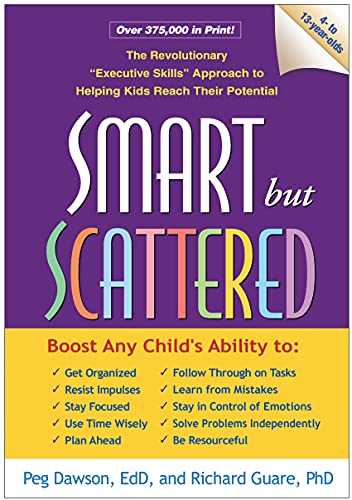
Smart but Scattered: The Revolutionary "Executive Skills" Approach to Helping Kids Reach Their Potential - Softcover
Inhaltsangabe
There's nothing more frustrating than watching your bright, talented son or daughter struggle with everyday tasks like finishing homework, putting away toys, or following instructions at school. Your "smart but scattered" 4- to 13-year-old might also have trouble coping with disappointment or managing anger. Drs. Peg Dawson and Richard Guare have great news: there's a lot you can do to help. The latest research in child development shows that many kids who have the brain and heart to succeed lack or lag behind in crucial "executive skills"--the fundamental habits of mind required for getting organized, staying focused, and controlling impulses and emotions. Learn easy-to-follow steps to identify your child's strengths and weaknesses, use activities and techniques proven to boost specific skills, and problem-solve daily routines. Helpful worksheets and forms can be downloaded and printed in a convenient 8 1/2" x 11" size. Small changes can add up to big improvements--this empowering book shows how.
See also the authors' Smart but Scattered Teens and their self-help guide for adults. Plus, an academic planner for middle and high school students and related titles for professionals.
See also the authors' Smart but Scattered Teens and their self-help guide for adults. Plus, an academic planner for middle and high school students and related titles for professionals.
Die Inhaltsangabe kann sich auf eine andere Ausgabe dieses Titels beziehen.
Über die Autorinnen und Autoren
Peg Dawson, EdD, is a psychologist on the staff of the Center for Learning and Attention Disorders at Seacoast Mental Health Center in Portsmouth, New Hampshire. She also does professional development training on executive skills for schools and organizations nationally and internationally. Dr. Dawson is a past president of the New Hampshire Association of School Psychologists, the National Association of School Psychologists (NASP), and the International School Psychology Association, and a recipient of the Lifetime Achievement Award from NASP. She is coauthor of bestselling books for general readers, including Smart but Scattered, Smart but Scattered Teens, Smart but Scattered--and Stalled (with a focus on emerging adults), and The Smart but Scattered Guide to Success (with a focus on adults). Dr. Dawson is also coauthor of The Work-Smart Academic Planner, Revised Edition, and books for professionals including Executive Skills in Children and Adolescents, Third Edition.
Richard Guare, PhD, is Director of the Center for Learning and Attention Disorders at Seacoast Mental Health Center in Portsmouth, New Hampshire. Dr. Guare's research and publications focus on the understanding and treatment of learning and attention difficulties. He is a neuropsychologist and board-certified behavior analyst who frequently consults to schools and agencies. He is coauthor of bestselling books for general readers, including Smart but Scattered, Smart but Scattered Teens, Smart but Scattered--and Stalled (with a focus on emerging adults), and The Smart but Scattered Guide to Success (with a focus on adults). Dr. Guare is also coauthor of The Work-Smart Academic Planner, Revised Edition, and books for professionals including Executive Skills in Children and Adolescents, Third Edition.
Richard Guare, PhD, is Director of the Center for Learning and Attention Disorders at Seacoast Mental Health Center in Portsmouth, New Hampshire. Dr. Guare's research and publications focus on the understanding and treatment of learning and attention difficulties. He is a neuropsychologist and board-certified behavior analyst who frequently consults to schools and agencies. He is coauthor of bestselling books for general readers, including Smart but Scattered, Smart but Scattered Teens, Smart but Scattered--and Stalled (with a focus on emerging adults), and The Smart but Scattered Guide to Success (with a focus on adults). Dr. Guare is also coauthor of The Work-Smart Academic Planner, Revised Edition, and books for professionals including Executive Skills in Children and Adolescents, Third Edition.
Peg Dawson, EdD, is a psychologist on the staff of the Center for Learning and Attention Disorders at Seacoast Mental Health Center in Portsmouth, New Hampshire. She also does professional development training on executive skills for schools and organizations nationally and internationally. Dr. Dawson is a past president of the New Hampshire Association of School Psychologists, the National Association of School Psychologists (NASP), and the International School Psychology Association, and a recipient of the Lifetime Achievement Award from NASP. She is coauthor of bestselling books for general readers, including Smart but Scattered, Smart but Scattered Teens, Smart but Scattered--and Stalled (with a focus on emerging adults), and The Smart but Scattered Guide to Success (with a focus on adults). Dr. Dawson is also coauthor of The Work-Smart Academic Planner, Revised Edition, and books for professionals including Executive Skills in Children and Adolescents, Third Edition.
Richard Guare, PhD, is Director of the Center for Learning and Attention Disorders at Seacoast Mental Health Center in Portsmouth, New Hampshire. Dr. Guare's research and publications focus on the understanding and treatment of learning and attention difficulties. He is a neuropsychologist and board-certified behavior analyst who frequently consults to schools and agencies. He is coauthor of bestselling books for general readers, including Smart but Scattered, Smart but Scattered Teens, Smart but Scattered--and Stalled (with a focus on emerging adults), and The Smart but Scattered Guide to Success (with a focus on adults). Dr. Guare is also coauthor of The Work-Smart Academic Planner, Revised Edition, and books for professionals including Executive Skills in Children and Adolescents, Third Edition.
Auszug. © Genehmigter Nachdruck. Alle Rechte vorbehalten.
Smart but Scattered
The Revolutionary "Executive Skills" Approach to Helping Kids Reach Their Potential
By Peg Dawson, Richard GuareThe Guilford Press
Copyright © 2013 The Guilford Press
All rights reserved.
ISBN: 978-1-59385-445-4All rights reserved.
Contents
Introduction,
PART I What Makes Your Child Smart but Scattered,
1 How Did Such a Smart Kid End Up So Scattered?,
2 Identifying Your Child's Strengths and Weaknesses,
3 How Your Own Executive Skill Strengths and Weaknesses Matter,
4 Matching the Child to the Task,
PART II Laying a Foundation That Can Help,
5 Ten Principles for Improving Your Child's Executive Skills,
6 Modifying the Environment: A Is for Antecedent,
7 Teaching Executive Skills Directly: B Is for Behavior,
8 Motivating Your Child to Learn and Use Executive Skills: C Is for Consequence,
PART III Putting It All Together,
9 Advance Organizer,
10 Ready-Made Plans for Teaching Your Child to Complete Daily Routines,
11 Building Response Inhibition,
12 Enhancing Working Memory,
13 Improving Emotional Control,
14 Strengthening Sustained Attention,
15 Teaching Task Initiation,
16 Promoting, Planning, and Prioritizing,
17 Fostering Organization,
18 Instilling Time Management,
19 Encouraging Flexibility,
20 Increasing Goal-Directed Persistence,
21 Cultivating Metacognition,
22 When What You Do Is Not Enough,
23 Working with the School,
24 What's Ahead?,
Resources,
Index,
About the Authors,
Copyright,
About Guilford Press,
Discover Related Guilford Titles,
Free Excerpt: Smart but Scattered Teens,
CHAPTER 1
How Did Such a Smart Kid End Up So Scattered?
Katie is 8 years old. It's Saturday morning, and her mother has sent her to clean her room, with the admonition that she can't go across the street to play with her girlfriend until everything is picked up. Katie reluctantly leaves the living room where her younger brother is engrossed in Saturday morning cartoons and climbs the stairs. She stands in the doorway and surveys the scene: Her Barbie dolls are scattered in one corner, a tangle of dolls and outfits and accessories that look from a distance like a colorful gypsy ragbag. Books are piled every which way in her bookcase, with some spilling out on the floor. Her closet door is open, and she sees that clothes have fallen off hangers and drifted to the floor of her closet, covering several pairs of shoes and some board games and puzzles she hasn't played with recently. Some dirty clothes have been kicked under her bed but are visible in the space between the bedspread and the floor. And there's a pile of clean clothes strewn around the floor by her bureau, left there after a mad search for a favorite sweater she wanted to wear to school yesterday. Katie sighs and goes to the doll corner. She places a couple of dolls on her toy shelf, then picks up a third doll and holds it at arm's length to inspect the outfit she's wearing. She remembers she was getting the doll ready for the prom and decides she doesn't like the dress she chose. She scrabbles around in the pile of miniature clothing to find a dress she likes better. She's just snapping the last fastener on the dress when her mother pops her head in the door. "Katie!" she says, a note of impatience in her voice. "It's been half an hour and you haven't done a thing!" Her mother comes over to the doll corner and together she and Katie pick up dolls and clothes, placing the dolls on toy shelves and the clothes in the plastic bin that serves as a clothes chest. The work goes quickly. Mom stands up to leave. "Now, see what you can do with those books," she says. Katie walks to the bookshelf and begins organizing her books. In the midst of the pile on the floor, she finds the latest in the Boxcar Children series, the one she's in the middle of reading. She opens the book to the bookmarked page and begins reading. "I'll just finish this chapter," she tells herself. When she's finished, she closes the book and looks around the room. "Mom!" she cries out plaintively. "This is way too much work! Can I go play and finish this later? Please?!"
Downstairs, Katie's mother sighs heavily. This happens every time she asks her daughter to get something done: she gets distracted, discouraged, and off track, and the job doesn't get done unless Mom sticks around and walks her through each and every little step—or caves in and does it all herself. How can her daughter be so unfocused and irresponsible? Why can't she put off just a little of what she'd prefer to do until she finishes what she has to do? Shouldn't a third grader be expected to take care of some things on her own?
Katie has been in the 90th percentile on the Iowa achievement tests since she began taking them. Her teachers report that she's imaginative, a whiz at math, and has a good vocabulary. She's a nice girl, too. That's why they hate to keep reporting to Katie's parents that their daughter can be disruptive in class because she can't stay on task during a group activity or that the teacher has to keep reminding her during quiet reading time to get back to the book and stop rummaging around in her desk, fiddling with her shoelaces, or whispering to her neighbors. Katie's teachers have suggested more than once that it might help if her parents tried to impress upon her the importance of following directions and sticking to assigned activities. At this point her parents can only reply sheepishly that they've tried every way they know to get through to their daughter and that Katie sincerely promises to try but then can't seem to hold on to her vow any more than she can follow through on cleaning her room or setting the table.
Katie's parents are at their wits' end, and their daughter is at risk of falling behind at school. How can someone so smart be so scattered?
As we mentioned in the Introduction, kids who are smart often end up scattered because they lack the brain-based skills we all need to plan and direct activities and to regulate behavior. It's not that they have any problem receiving and organizing the input they get from their senses—what we might ordinarily consider "intelligence." When it comes to smarts, they've got plenty. This is why they may have little trouble comprehending division or fractions or learning how to spell. The trouble shows up when they need to organize output—deciding what to do when and then controlling their own behavior to get there. Because they have what it takes to absorb information and learn math and language and other school subjects, you may assume that much simpler tasks like making a bed or taking turns should be a no-brainer. But that's not the case because your child may have intelligence but lack the executive skills to put it to best use.
What Are Executive Skills?
Let's correct one possible misunderstanding right off the bat. When people hear the term executive skills, they assume it refers to the set of skills required of good business executives—skills like financial management, communication, strategic planning, and decision making. There is some overlap—executive skills definitely include decision making, planning, and management of all kinds of data, and like the skills used by a business executive, executive skills help kids get done what needs to get done—but in fact the term executive skills comes from the neurosciences literature and refers to the...
„Über diesen Titel“ kann sich auf eine andere Ausgabe dieses Titels beziehen.
Suchergebnisse für Smart but Scattered: The Revolutionary "Executive...

Beispielbild für diese ISBN
Smart but Scattered, First Edi
Anbieter: World of Books (was SecondSale), Montgomery, IL, USA
Verkäuferbewertung 5 von 5 Sternen

Zustand: Acceptable. Item in acceptable condition! Textbooks may not include supplemental items i.e. CDs, access codes etc. Artikel-Nr. 00108813887
Gebraucht kaufen
EUR 3,66
Versand gratis
Versand innerhalb von USA
Versand innerhalb von USA
Anzahl: 1 verfügbar
Beispielbild für diese ISBN
Smart but Scattered, First Edi
Anbieter: World of Books (was SecondSale), Montgomery, IL, USA
Verkäuferbewertung 5 von 5 Sternen
Zustand: Very Good. Item in very good condition! Textbooks may not include supplemental items i.e. CDs, access codes etc. Artikel-Nr. 00108689728
Gebraucht kaufen
EUR 3,66
Versand gratis
Versand innerhalb von USA
Versand innerhalb von USA
Anzahl: 1 verfügbar
Beispielbild für diese ISBN
Smart but Scattered, First Edi
Anbieter: World of Books (was SecondSale), Montgomery, IL, USA
Verkäuferbewertung 5 von 5 Sternen
Zustand: Good. Item in good condition. Textbooks may not include supplemental items i.e. CDs, access codes etc. Artikel-Nr. 00105753989
Gebraucht kaufen
EUR 3,66
Versand gratis
Versand innerhalb von USA
Versand innerhalb von USA
Anzahl: Mehr als 20 verfügbar
Foto des Verkäufers
Smart but Scattered: The Revolutionary "Executive Skills" Approach to Helping Kids Reach Their Potential
Anbieter: Dream Books Co., Denver, CO, USA
Verkäuferbewertung 5 von 5 Sternen
Zustand: acceptable. This copy has clearly been enjoyedâ"expect noticeable shelf wear and some minor creases to the cover. Binding is strong, and all pages are legible. May contain previous library markings or stamps. Artikel-Nr. 4EKGRJ007M2W_ns
Gebraucht kaufen
EUR 3,73
Versand gratis
Versand innerhalb von USA
Versand innerhalb von USA
Anzahl: 2 verfügbar
Beispielbild für diese ISBN
Smart but Scattered First Edit
Anbieter: World of Books (was SecondSale), Montgomery, IL, USA
Verkäuferbewertung 5 von 5 Sternen
Zustand: Good. Item in good condition. Textbooks may not include supplemental items i.e. CDs, access codes etc. Artikel-Nr. 00098156880
Gebraucht kaufen
EUR 4,00
Versand gratis
Versand innerhalb von USA
Versand innerhalb von USA
Anzahl: Mehr als 20 verfügbar
Beispielbild für diese ISBN
Smart But Scattered: The Revolutionary Executive Skills Approach to Helping Kids Reach Their Potential
Anbieter: ThriftBooks-Dallas, Dallas, TX, USA
Verkäuferbewertung 5 von 5 Sternen
Paperback. Zustand: Good. No Jacket. Pages can have notes/highlighting. Spine may show signs of wear. ~ ThriftBooks: Read More, Spend Less. Artikel-Nr. G1593854455I3N00
Gebraucht kaufen
EUR 5,72
Versand gratis
Versand innerhalb von USA
Versand innerhalb von USA
Anzahl: Mehr als 20 verfügbar
Beispielbild für diese ISBN
Smart But Scattered: The Revolutionary Executive Skills Approach to Helping Kids Reach Their Potential
Anbieter: ThriftBooks-Atlanta, AUSTELL, GA, USA
Verkäuferbewertung 5 von 5 Sternen
Paperback. Zustand: Good. No Jacket. Pages can have notes/highlighting. Spine may show signs of wear. ~ ThriftBooks: Read More, Spend Less. Artikel-Nr. G1593854455I3N00
Gebraucht kaufen
EUR 5,72
Versand gratis
Versand innerhalb von USA
Versand innerhalb von USA
Anzahl: Mehr als 20 verfügbar
Beispielbild für diese ISBN
Smart But Scattered: The Revolutionary Executive Skills Approach to Helping Kids Reach Their Potential
Anbieter: ThriftBooks-Dallas, Dallas, TX, USA
Verkäuferbewertung 5 von 5 Sternen
Paperback. Zustand: Good. No Jacket. Former library book; Pages can have notes/highlighting. Spine may show signs of wear. ~ ThriftBooks: Read More, Spend Less. Artikel-Nr. G1593854455I3N10
Gebraucht kaufen
EUR 5,72
Versand gratis
Versand innerhalb von USA
Versand innerhalb von USA
Anzahl: 1 verfügbar
Beispielbild für diese ISBN
Smart But Scattered: The Revolutionary Executive Skills Approach to Helping Kids Reach Their Potential
Anbieter: ThriftBooks-Phoenix, Phoenix, AZ, USA
Verkäuferbewertung 5 von 5 Sternen
Paperback. Zustand: Good. No Jacket. Pages can have notes/highlighting. Spine may show signs of wear. ~ ThriftBooks: Read More, Spend Less. Artikel-Nr. G1593854455I3N00
Gebraucht kaufen
EUR 5,72
Versand gratis
Versand innerhalb von USA
Versand innerhalb von USA
Anzahl: Mehr als 20 verfügbar
Beispielbild für diese ISBN
Smart But Scattered: The Revolutionary Executive Skills Approach to Helping Kids Reach Their Potential
Anbieter: ThriftBooks-Dallas, Dallas, TX, USA
Verkäuferbewertung 5 von 5 Sternen
Paperback. Zustand: Fair. No Jacket. Readable copy. Pages may have considerable notes/highlighting. ~ ThriftBooks: Read More, Spend Less. Artikel-Nr. G1593854455I5N00
Gebraucht kaufen
EUR 5,72
Versand gratis
Versand innerhalb von USA
Versand innerhalb von USA
Anzahl: 3 verfügbar