
Verwandte Artikel zu Helping Adolescents at Risk: Prevention of Multiple...
Inhaltsangabe
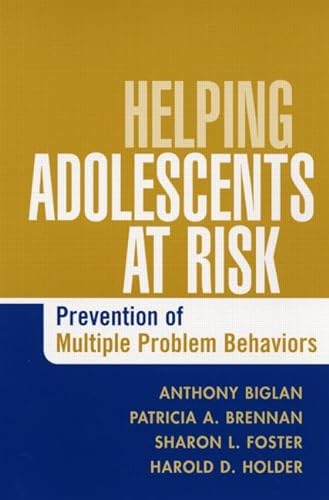
Written by leading authorities, this comprehensive volume reviews current knowledge about multiple problem behaviors in adolescence, focusing on ""what works"" in prevention and treatment. Cutting-edge research is presented on the epidemiology, development, and social costs of four youth problems that frequently co-occur: serious antisocial behavior, drug and alcohol misuse, tobacco smoking, and risky sexual behavior. A framework for reducing these behaviors is outlined, drawing on both clinical and public health perspectives, and empirically supported prevention and treatment programs are identified. Also addressed are ways to promote the development, dissemination, and effective implementation of research-based intervention practices.
Die Inhaltsangabe kann sich auf eine andere Ausgabe dieses Titels beziehen.
Über die Autorin bzw. den Autor
Anthony Biglan, PhD, is Senior Scientist at Oregon Research Institute, where he conducts research on the prevention of child and adolescent problem behavior and on the childrearing practices that affect child and adolescent development. His current work focuses on contextual analyses of childrearing practices in communities.
Patricia A. Brennan, PhD, is on the faculty of the Department of Psychology at Emory University. Her research interests include the study of etiological factors of aggression and violence from a biological perspective, and parental psychopathology (depression/schizophrenia) and its effect on child diagnostic, neurological, and behavioral outcomes.
Sharon L. Foster, PhD, is Professor in the California School of Professional Psychology at Alliant International University. Dr. Foster is the author of three books as well as numerous articles and book chapters on children's peer relations, assessment and treatment of parent/n-/adolescent conflict, and research methodology.
Harold D. Holder, PhD, is Senior Research Scientist at the Prevention Research Center, Berkeley, California. His research has explored two major areas: prevention of alcohol problems and costs and benefits of alcoholism treatment. Dr. Holder was the 1995 recipient of the Jellinek Memorial Award for his research on social and economic factors in alcohol consumption.
Patricia A. Brennan, PhD, is on the faculty of the Department of Psychology at Emory University. Her research interests include the study of etiological factors of aggression and violence from a biological perspective, and parental psychopathology (depression/schizophrenia) and its effect on child diagnostic, neurological, and behavioral outcomes.
Sharon L. Foster, PhD, is Professor in the California School of Professional Psychology at Alliant International University. Dr. Foster is the author of three books as well as numerous articles and book chapters on children's peer relations, assessment and treatment of parent/n-/adolescent conflict, and research methodology.
Harold D. Holder, PhD, is Senior Research Scientist at the Prevention Research Center, Berkeley, California. His research has explored two major areas: prevention of alcohol problems and costs and benefits of alcoholism treatment. Dr. Holder was the 1995 recipient of the Jellinek Memorial Award for his research on social and economic factors in alcohol consumption.
Auszug. © Genehmigter Nachdruck. Alle Rechte vorbehalten.
Helping Adolescents at Risk
Prevention of Multiple Problem BehaviorsBy Anthony BiglanGuilford Publications
Copyright © 2005 Anthony BiglanAll right reserved.
ISBN: 9781593852399
Chapter One
Youth with Multiple Problems
Sixteen-year-old Michael has just ended a stay in a juvenile detention center. Arrested twice-once for breaking and entering and once for an assault that followed a night of heavy drinking-Michael has problems other than his encounters with the legal system. He attends high school erratically and no doubt will soon drop out entirely. He smokes almost a pack of cigarettes a day and smokes marijuana frequently. Recently he has begun to experiment with harder drugs. Now, Michael has another surprise in store for him-his girlfriend is pregnant and she plans to tell him this as soon as she sees him after his release.
We have written this book for Michael and for the many other young people headed for deeply troubled lives. Research has helped us understand much about young people with multiple behavior problems and the cost of their actions to themselves and society. Research and clinical work have also helped us to identify numerous promising strategies to work with these multiproblem youth and to begin to reduce the number of teens who end up on a downward spiral. In this book, we lay out what we know about these young people. Our goal is to demonstrate actions that are more effective in order to alter the destructive path these children travel.
The existence of a small group of multiproblem youth has been clear, at least since Jessor and Jessor (1977) first described the phenomenon of deviance-prone youth. However, despite literally hundreds of studies showing that delinquency, substance use, and high-risk sexual behavior co-occur, the implications of this phenomenon for policy, practice, and research are not clear. They have been unclear because no one has brought all this information together and spelled out its significance for research and practice. Prevention and treatment strategies typically focus only on a subset of problems. For example, we have programs to prevent academic failure, but we know little about whether these programs can prevent delinquency or drug abuse. In addition, we know that the family, schools, peers, and the community may (either positively or negatively) influence what happens to these teens. For example, with protective factors, such as a stable home life, involved parents, and teachers at school who never give up, even a teen beginning to get involved in problematic behavior can pull out of the downward spiral. Yet, when the child's father abandons the family, the mother works two jobs, and the child's acting out in school lands him or her in the principal's office more often than not, avenues narrow for the opportunity to resist the negative pull. We know that influences on the development of the multiproblem pattern begin while the child is still in the womb. Obviously, the time to intervene is when the potential for the developmental of problems is in its infancy. Despite our knowledge, we have not instituted widespread comprehensive, evidence-based approaches geared to deal with these problems before they lead to a cascade of increasingly destructive behavior patterns.
In Chapter 2, we document the extent to which multiproblem youth account for a large proportion of the occurrence of serious antisocial behavior, risky sexual behavior, drug and alcohol misuse, and tobacco use. In that chapter, we also show how multiple behavior problems lead to many problematic outcomes such as suicide and unwanted pregnancy. In Chapter 3, we show how to estimate the social costs attributable to the behavior of multiproblem youth. In Chapter 4, we identify the major factors that influence young people to develop these problems. Chapters 5-8 describe empirically evaluated interventions shown to reduce one or more of the problems that concern us. Chapter 5 focuses on interventions that target preadolescent influences on the development of multiple problem behaviors. It documents numerous strategies to follow for prevention of these problems and to promote successful adolescent development. Chapter 6 describes interventions designed to prevent problem behaviors among all adolescents. Chapters 7 and 8 describe interventions focused on helping adolescents who are already showing signs of problematic behavior. The final chapter examines issues involved in applying these scientific findings to help communities develop programs and policies to help not only youths in trouble but also those headed in that direction.
ADOLESCENT PROBLEM BEHAVIORS
We have chosen to focus on five adolescent problem behaviors: antisocial behavior (including aggressive social behavior and more serious acts such as stealing and assault), cigarette smoking, alcohol and drug misuse, and sexual behavior that risks pregnancy or disease. We chose these behaviors for several reasons. First, they represent the five most costly problems our society faces. Second, young people who engage in any one of these problem behaviors are highly likely to engage in the others. Third, many of the same biological and environmental factors influence the development of each these problems. Fourth, many of the prevention and treatment interventions previously developed have an impact on more than one of these problems. It is clear to us, therefore, that our society's efforts to lower the rates and costly consequences of each of these problems will benefit from comprehensive and coordinated strategies that simultaneously address the entire set of problems.
Most typical adolescents engage in some of these behaviors to some extent. For example, the majority of adolescents report committing some form of delinquent behavior at some point in their adolescence (Elliott, Huizinga, & Menard, 1989). Similarly, by the age of 17, 70-75% of adolescents drink alcohol, 25% have smoked marijuana, and 80% have engaged in sexual intercourse (Huizinga, Loeber, & Thornberry, 1993). Although we may argue about the desirability of these behaviors in any form, we would all have to concur that, at serious levels, these behaviors are deeply problematic for everyone concerned and can only lead to more difficulties. Therefore, we focus on types of behavior that most would agree are problematic because of the serious consequences they can and often do produce.
We call youth who engage in two or more of these behaviors "multiproblem youth." Because large numbers of youth begin to engage in these serious behavior problems only after they reach adolescence, our primary focus is on children between the ages of 11 and 18, although we look also at early precursors of these problems and the corresponding prevention strategies for use with younger children.
Serious Antisocial Behavior
Antisocial behavior consists of aggressive and criminal acts. The most serious forms of antisocial behavior are so-called index crimes, identified by the FBI as murder, aggravated assault, sexual assault, gang fights, car theft, theft of something worth more than $50, breaking and entering, or strong arming someone (Elliott et al., 1989). In addition, antisocial behavior is generally defined to include less severe delinquent offenses, such as buying stolen goods; carrying a hidden weapon; stealing something worth less than $5; prostitution; selling marijuana; hitting a teacher, parent, or student; disorderly conduct; selling hard drugs; joyriding; stealing something worth $5 to $50; and panhandling (Elliott...
„Über diesen Titel“ kann sich auf eine andere Ausgabe dieses Titels beziehen.
Suchergebnisse für Helping Adolescents at Risk: Prevention of Multiple...

Beispielbild für diese ISBN
Helping Adolescents at Risk: Prevention of Multiple Problem Behaviors
Anbieter: ThriftBooks-Dallas, Dallas, TX, USA
Verkäuferbewertung 5 von 5 Sternen

Paperback. Zustand: Good. No Jacket. Pages can have notes/highlighting. Spine may show signs of wear. ~ ThriftBooks: Read More, Spend Less. Artikel-Nr. G1593852398I3N00
Gebraucht kaufen
EUR 5,85
Versand gratis
Versand innerhalb von USA
Versand innerhalb von USA
Anzahl: 1 verfügbar
Beispielbild für diese ISBN
Helping Adolescents at Risk : Prevention of Multiple Problem Behaviors
Anbieter: Better World Books, Mishawaka, IN, USA
Verkäuferbewertung 5 von 5 Sternen
Zustand: Very Good. Former library copy. Pages intact with possible writing/highlighting. Binding strong with minor wear. Dust jackets/supplements may not be included. Includes library markings. Stock photo provided. Product includes identifying sticker. Better World Books: Buy Books. Do Good. Artikel-Nr. GRP96982877
Gebraucht kaufen
EUR 6,43
Versand gratis
Versand innerhalb von USA
Versand innerhalb von USA
Anzahl: 1 verfügbar
Beispielbild für diese ISBN
Helping Adolescents at Risk : Prevention of Multiple Problem Behaviors
Anbieter: Better World Books Ltd, Dunfermline, Vereinigtes Königreich
Verkäuferbewertung 5 von 5 Sternen
Zustand: Very Good. Former library copy. Pages intact with possible writing/highlighting. Binding strong with minor wear. Dust jackets/supplements may not be included. Includes library markings. Stock photo provided. Product includes identifying sticker. Better World Books: Buy Books. Do Good. Artikel-Nr. GRP96982877
Gebraucht kaufen
EUR 5,63
EUR 5,83 Versand
Versand von Vereinigtes Königreich nach USA
Versand von Vereinigtes Königreich nach USA
Anzahl: 1 verfügbar
Beispielbild für diese ISBN
Helping Adolescents at Risk: Prevention of Multiple Problem Behaviors
Anbieter: Anybook.com, Lincoln, Vereinigtes Königreich
Verkäuferbewertung 5 von 5 Sternen
Zustand: Good. This is an ex-library book and may have the usual library/used-book markings inside.This book has soft covers. In good all round condition. Please note the Image in this listing is a stock photo and may not match the covers of the actual item,550grams, ISBN:9781593852399. Artikel-Nr. 2945594
Gebraucht kaufen
EUR 26,60
EUR 15,85 Versand
Versand von Vereinigtes Königreich nach USA
Versand von Vereinigtes Königreich nach USA
Anzahl: 1 verfügbar
Beispielbild für diese ISBN
Helping Adolescents at Risk: Prevention of Multiple Problem Behaviors
Anbieter: Anybook.com, Lincoln, Vereinigtes Königreich
Verkäuferbewertung 5 von 5 Sternen
Zustand: Good. This is an ex-library book and may have the usual library/used-book markings inside.This book has soft covers. In good all round condition. Please note the Image in this listing is a stock photo and may not match the covers of the actual item,550grams, ISBN:9781593852399. Artikel-Nr. 2945596
Gebraucht kaufen
EUR 26,60
EUR 15,85 Versand
Versand von Vereinigtes Königreich nach USA
Versand von Vereinigtes Königreich nach USA
Anzahl: 1 verfügbar
Beispielbild für diese ISBN
Helping Adolescents at Risk: Prevention of Multiple Problem Behaviors
Anbieter: Anybook.com, Lincoln, Vereinigtes Königreich
Verkäuferbewertung 5 von 5 Sternen
Zustand: Fair. This is an ex-library book and may have the usual library/used-book markings inside.This book has soft covers. In fair condition, suitable as a study copy. Please note the Image in this listing is a stock photo and may not match the covers of the actual item,550grams, ISBN:9781593852399. Artikel-Nr. 2945595
Gebraucht kaufen
EUR 26,60
EUR 15,85 Versand
Versand von Vereinigtes Königreich nach USA
Versand von Vereinigtes Königreich nach USA
Anzahl: 1 verfügbar