
Verwandte Artikel zu Ethan Frome & Selected Stories (Barnes & Noble...
Inhaltsangabe
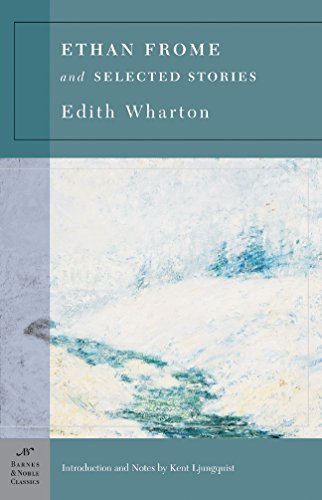
&&LDIV&&R&&LDIV&&R&&LI&&REthan Frome and Selected Stories&&L/I&&R, by &&LB&&REdith Wharton&&L/B&&R, is part of the &&LI&&RBarnes & Noble Classics&&L/I&&R&&LI&&R &&L/I&&Rseries, which offers quality editions at affordable prices to the student and the general reader, including new scholarship, thoughtful design, and pages of carefully crafted extras. Here are some of the remarkable features of &&LI&&RBarnes & Noble Classics&&L/I&&R: &&LDIV&&R
- New introductions commissioned from todays top writers and scholars
- Biographies of the authors
- Chronologies of contemporary historical, biographical, and cultural events
- Footnotes and endnotes
- Selective discussions of imitations, parodies, poems, books, plays, paintings, operas, statuary, and films inspired by the work
- Comments by other famous authors
- Study questions to challenge the readers viewpoints and expectations
- Bibliographies for further reading
- Indices & Glossaries, when appropriate
Die Inhaltsangabe kann sich auf eine andere Ausgabe dieses Titels beziehen.
Über die Autorin bzw. den Autor
Kent P. Ljungquist, Professor of English at Worcester Polytechnic Institute, is the author of The Grand and the Fair: Poe’s Landscape Aesthetics and Pictorial Techniques, co-editor of the SUNY Press edition of James Fenimore Cooper's The Deerslayer, and editor of several reference works of American fiction.
Auszug. © Genehmigter Nachdruck. Alle Rechte vorbehalten.
From Kent P. Ljungquist's Introduction to Ethan Frome and Selected Stories
Wharton tended to measure her literary achievements against those of male writers; in her introduction, she further distinguished her efforts from previous treatments of New England by discounting her role as a mere recorder of the more superficial or external features of her setting. She thus emphasized the steps in the construction of Ethan Fromethat is, her role as a conscious literary craftsman. She noted that her initial conception derived from an academic exercise intended to polish her proficiency in the French language. Developed in Paris in 1907, the French sketch of "Ethan Frome" contained three characters (the male was named Hart) and achieved a length that encompassed two scenes, or vignettes, that survived in the published version. The fragment contained a triangular relationship among a husband, his sick wife, and the wife's niece, to whom the "Ethan-character" is attracted; but it lacked the structure that would give focus as well as depth to the narrative. Wharton eventually hit upon the device of a storyteller, but she did not choose one steeped in the lore and history of New England. Rather than a character like the herbalist and healer Mrs. Todd in Jewett's The Country of the Pointed Firs (1896), a native authority on the region's legends and values, Wharton chose someone from outside New England to narrate the story-a looker-on, an observer.
In her desire for "roundness"Wharton seemed to resort recurrently to the terminology of the "plastic arts" or visual mediashe would supplement the narrator's perspective with those of her minor characters. The fresh, acute perspective derived from the narrator's growing insight and awareness would compensate for what he lacked in inside background knowledge of the Frome household. While the device of an observer might lend "an air of artificiality" to a tale of sophisticated characters, Wharton noted, this defect might be mitigated if the narrator brought a sophisticated perspective to a tale of simple people. Her narrator would thus serve as a kind of intermediary between the reticent and reserved villagers and Wharton's readers, giving "voice" to characters nearly inarticulate or resigned to silence.
Wharton's use of an observer eases the reader's entry into Ethan's story. In the opening of the novel the narrator recaptures his first arresting glimpse of Wharton's central character, when he had been struck by Frome's physiognomy and bearing. Harmon Gow, who had driven the stage between Starkfield and other towns in the region's pre-trolley days, provides further background on Frome. From Gow the narrator learns of Ethan's age and of his reluctance to escape Starkfield because of obligations to care for his failing parents. The narrator also hears not only Gow's chilling comment on Ethan's endurance"Ethan'll likely touch a hundred"but also his opinion that Ethan's stay in Starkfield constituted a kind of imprisonment: "Guess he's been in Starkfield too many winters. Most of the smart ones get away". The narrator's interview of Gow develops the tale only "as far as his [Gow's] mental and moral reach permitted", and he hopes that the more educated, sophisticated Mrs. Ned Hale, with whom he is staying, will provide greater insight. He cannot cut through her reserve and reticence, however, even though she has more firsthand knowledge of the aftermath of the accident that scarred Frome's forehead. Implying a suffering too great for words, her only comment is: "It was awful".
The narrator infers that he must piece together Ethan's story from different sources, and that consequently each retelling will be a little bit different. The meaning of the story, he infers, will be found even in gaps or silences after he has accumulated a succession of hints, suggestions, and clues that surround Frome. For all the narrator's curiosity about the Frome household, this technique gives his telling an elliptical effect, a sense that much has been left unsaid or not fully articulated. When the winter snows prevent the narrator's return to Starkfield after Frome volunteers to drive him to his business appointment, he is granted a night's shelter at the farm. Enveloped by the severe storm, the narrator experiences a "soft universal diffusion more confusing than the gusts and eddies of the morning." In the "formless night" his disorientation temporarily intensifies, and "even [Ethan's] sense of direction, and the bay's homing instinct, finally ceased to serve". The narrator's perplexity and bewilderment imply a need to reorient himself, to jolt himself, so to speak, into a perspective that demands clearer sight and more acute insight. It is at this point that Wharton effects the transition back to the period of Ethan's youth. Although some critics have quarreled with the subjective nature of her narrator's perceptions, there seems little doubt that Wharton intended his narrative to be more than one version of events among others. Accordingly, it is a "vision"; in her 1922 introduction she noted: "Only the narrator has scope to see it all, to resolve it back into simplicity, and to put it in its rightful place among his larger categories."
„Über diesen Titel“ kann sich auf eine andere Ausgabe dieses Titels beziehen.
Suchergebnisse für Ethan Frome & Selected Stories (Barnes & Noble...

Beispielbild für diese ISBN
Ethan Frome and Selected Stories
Anbieter: World of Books (was SecondSale), Montgomery, IL, USA
Verkäuferbewertung 5 von 5 Sternen

Paperback. Zustand: Fair. Xingu' is a short story about a woman's luncheon club devised as a means of keeping its members up to date with the latest goings on in the world. After the glamorous novelist Osric Dane stuns the other women with her bored disposition and blunt questions, the conversation is left stale - that is, until the previously quiet Mrs. Roby mentions the topic of Xingu. Thought mad by the rest of her peers, Mrs. Roby is suddenly engaged by a now-inquisitive Ms. Dane, and subsequently the rest of the party becomes entirely engrossed with the mystery of Xingu. A witty and veritably comical narrative sure to entertain all who read it, 'Xingu' is a masterpiece of short story-writing and is a must-read for fans of Wharton's seminal work. Edith Wharton (1862 - 1937) was a Pulitzer Prize-winning novelist, short story writer, and designer. This antique book was originally published in 1916, and we are proud to republish it now, complete with a new introductory biography of the author. Artikel-Nr. 00080335060
Gebraucht kaufen
EUR 3,90
Versand gratis
Versand innerhalb von USA
Versand innerhalb von USA
Anzahl: 1 verfügbar
Beispielbild für diese ISBN
Ethan Frome and Selected Stories
Anbieter: World of Books (was SecondSale), Montgomery, IL, USA
Verkäuferbewertung 5 von 5 Sternen
Paperback. Zustand: Good. Xingu' is a short story about a woman's luncheon club devised as a means of keeping its members up to date with the latest goings on in the world. After the glamorous novelist Osric Dane stuns the other women with her bored disposition and blunt questions, the conversation is left stale - that is, until the previously quiet Mrs. Roby mentions the topic of Xingu. Thought mad by the rest of her peers, Mrs. Roby is suddenly engaged by a now-inquisitive Ms. Dane, and subsequently the rest of the party becomes entirely engrossed with the mystery of Xingu. A witty and veritably comical narrative sure to entertain all who read it, 'Xingu' is a masterpiece of short story-writing and is a must-read for fans of Wharton's seminal work. Edith Wharton (1862 - 1937) was a Pulitzer Prize-winning novelist, short story writer, and designer. This antique book was originally published in 1916, and we are proud to republish it now, complete with a new introductory biography of the author. Artikel-Nr. 00081306022
Gebraucht kaufen
EUR 3,90
Versand gratis
Versand innerhalb von USA
Versand innerhalb von USA
Anzahl: 5 verfügbar
Beispielbild für diese ISBN
Ethan Frome & Selected Stories (Barnes & Noble Classics)
Verlag:
Sterling Publishing (edition First Edition), 2004
ISBN 10: 1593080905
ISBN 13: 9781593080907
Gebraucht
Paperback
Erstausgabe
Anbieter: BooksRun, Philadelphia, PA, USA
Verkäuferbewertung 5 von 5 Sternen
Paperback. Zustand: Very Good. First Edition. It's a well-cared-for item that has seen limited use. The item may show minor signs of wear. All the text is legible, with all pages included. It may have slight markings and/or highlighting. Artikel-Nr. 1593080905-11-6
Gebraucht kaufen
EUR 4,66
Versand gratis
Versand innerhalb von USA
Versand innerhalb von USA
Anzahl: 1 verfügbar
Beispielbild für diese ISBN
Ethan Frome and Selected Stories
Verlag:
Barnes & Noble, Incorporated, 2004
ISBN 10: 1593080905
ISBN 13: 9781593080907
Gebraucht
Softcover
Anbieter: Better World Books, Mishawaka, IN, USA
Verkäuferbewertung 5 von 5 Sternen
Zustand: Good. 1 Edition. Pages intact with minimal writing/highlighting. The binding may be loose and creased. Dust jackets/supplements are not included. Stock photo provided. Product includes identifying sticker. Better World Books: Buy Books. Do Good. Artikel-Nr. 1504510-75
Gebraucht kaufen
EUR 6,19
Versand gratis
Versand innerhalb von USA
Versand innerhalb von USA
Anzahl: 2 verfügbar
Beispielbild für diese ISBN
Ethan Frome & Selected Stories (Barnes & Noble Classics Series)
Verlag:
Barnes & Noble Classics, 2004
ISBN 10: 1593080905
ISBN 13: 9781593080907
Gebraucht
Paperback
Anbieter: ThriftBooks-Phoenix, Phoenix, AZ, USA
Verkäuferbewertung 5 von 5 Sternen
Paperback. Zustand: As New. No Jacket. Pages are clean and are not marred by notes or folds of any kind. ~ ThriftBooks: Read More, Spend Less. Artikel-Nr. G1593080905I2N00
Gebraucht kaufen
EUR 6,20
Versand gratis
Versand innerhalb von USA
Versand innerhalb von USA
Anzahl: 1 verfügbar
Beispielbild für diese ISBN
Ethan Frome & Selected Stories (Barnes & Noble Classics Series)
Verlag:
Barnes & Noble Classics, 2004
ISBN 10: 1593080905
ISBN 13: 9781593080907
Gebraucht
Paperback
Anbieter: ThriftBooks-Reno, Reno, NV, USA
Verkäuferbewertung 5 von 5 Sternen
Paperback. Zustand: As New. No Jacket. Pages are clean and are not marred by notes or folds of any kind. ~ ThriftBooks: Read More, Spend Less. Artikel-Nr. G1593080905I2N00
Gebraucht kaufen
EUR 6,20
Versand gratis
Versand innerhalb von USA
Versand innerhalb von USA
Anzahl: 1 verfügbar
Beispielbild für diese ISBN
Ethan Frome & Selected Stories (Barnes & Noble Classics Series)
Verlag:
Barnes & Noble Classics, 2004
ISBN 10: 1593080905
ISBN 13: 9781593080907
Gebraucht
Paperback
Anbieter: ThriftBooks-Atlanta, AUSTELL, GA, USA
Verkäuferbewertung 5 von 5 Sternen
Paperback. Zustand: As New. No Jacket. Pages are clean and are not marred by notes or folds of any kind. ~ ThriftBooks: Read More, Spend Less. Artikel-Nr. G1593080905I2N00
Gebraucht kaufen
EUR 6,20
Versand gratis
Versand innerhalb von USA
Versand innerhalb von USA
Anzahl: 1 verfügbar
Beispielbild für diese ISBN
Ethan Frome & Selected Stories (Barnes & Noble Classics Series)
Verlag:
Barnes & Noble Classics, 2004
ISBN 10: 1593080905
ISBN 13: 9781593080907
Gebraucht
Paperback
Anbieter: ThriftBooks-Dallas, Dallas, TX, USA
Verkäuferbewertung 5 von 5 Sternen
Paperback. Zustand: As New. No Jacket. Pages are clean and are not marred by notes or folds of any kind. ~ ThriftBooks: Read More, Spend Less. Artikel-Nr. G1593080905I2N00
Gebraucht kaufen
EUR 6,20
Versand gratis
Versand innerhalb von USA
Versand innerhalb von USA
Anzahl: 1 verfügbar
Beispielbild für diese ISBN
Ethan Frome & Selected Stories (Barnes & Noble Classics)
Anbieter: Wonder Book, Frederick, MD, USA
Verkäuferbewertung 5 von 5 Sternen
Zustand: Very Good. Very Good condition. A copy that may have a few cosmetic defects. May also contain light spine creasing or a few markings such as an owner's name, short gifter's inscription or light stamp. Artikel-Nr. E02A-01772
Gebraucht kaufen
EUR 6,43
Versand gratis
Versand innerhalb von USA
Versand innerhalb von USA
Anzahl: 7 verfügbar
Beispielbild für diese ISBN
Ethan Frome & Selected Stories (Barnes & Noble Classics)
Anbieter: Roundabout Books, Greenfield, MA, USA
Verkäuferbewertung 4 von 5 Sternen

paperback. Zustand: Near Fine. Condition Notes: Excellent, unmarked copy with little wear and tight binding. We ship in recyclable American-made mailers. 100% money-back guarantee on all orders. Artikel-Nr. 1779927
Gebraucht kaufen
EUR 9,61
Versand gratis
Versand innerhalb von USA
Versand innerhalb von USA
Anzahl: 1 verfügbar