
Verwandte Artikel zu The Age of Innocence (Barnes & Noble Classics Series)...
Inhaltsangabe
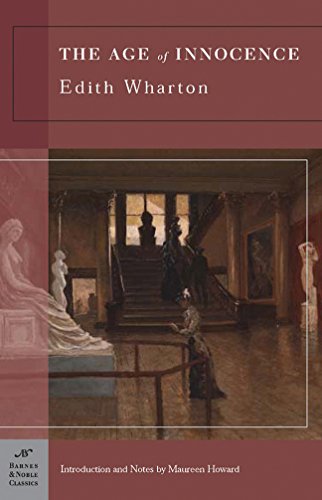
&&LDIV&&R&&LDIV&&R&&LI&&RAge of Innocence&&L/I&&R, by &&LB&&REdith Wharton&&L/B&&R, is part of the &&LI&&RBarnes & Noble Classics&&L/I&&R&&LI&&R &&L/I&&Rseries, which offers quality editions at affordable prices to the student and the general reader, including new scholarship, thoughtful design, and pages of carefully crafted extras. Here are some of the remarkable features of &&LI&&RBarnes & Noble Classics&&L/I&&R: &&LDIV&&R
- New introductions commissioned from today's top writers and scholars
- Biographies of the authors
- Chronologies of contemporary historical, biographical, and cultural events
- Footnotes and endnotes
- Selective discussions of imitations, parodies, poems, books, plays, paintings, operas, statuary, and films inspired by the work
- Comments by other famous authors
- Study questions to challenge the reader's viewpoints and expectations
- Bibliographies for further reading
- Indices & Glossaries, when appropriate
Die Inhaltsangabe kann sich auf eine andere Ausgabe dieses Titels beziehen.
Über die Autorin bzw. den Autor
Maureen Howard is a critic, teacher, and writer of fiction. Her seven novels include Bridgeport Bus, Natural History, and A Lover’s Almanac. Her memoir, Facts of Life, won the National Book Critics’ Circle Award. She has taught at Yale and Columbia University.
Auszug. © Genehmigter Nachdruck. Alle Rechte vorbehalten.
The Bncmm
Age of InnocenceBy Edith WhartonBarnes & Noble Books-Imports
Copyright © 2004 Edith WhartonAll right reserved.
ISBN: 9781593080747
Book One
Chapter One
On a January evening of the early seventies, Christine Nilsson was singing in Faust at the Academy of Music in New York.
Though there was already talk of the erection, in remote metropolitan distances "above the Forties," of a new Opera House which should compete in costliness and splendour with those of the great European capitals, the world of fashion was still content to reassemble every winter in the shabby red and gold boxes of the sociable old Academy. Conservatives cherished it for being small and inconvenient, and thus keeping out the it new people" whom New York was beginning to dread and yet be drawn to; and the sentimental clung to it for its historic associations, and the musical for its excellent acoustics, always so problematic a quality in halls built for the hearing of music.
It was Madame Nilsson's first appearance that winter, and what the daily press had already learned to describe as "an exceptionally brilliant audience " had gathered to hear her, transported through the slippery snow streets in private broughams, in the spacious family landau, or in the humbler but more convenient "Brown coupe"' To come to the Opera in a Brown coupe was almost as honourable a way of arriving as in one 's own carriage; and departure by the same means had the immense advantage of enabling one (with a playful allusion to democratic principles) to scramble into the first Brown conveyance in the line, instead of waiting till the cold and--gin congested nose of one's own coachman gleamed under the portico of the Academy. It was one of the great livery-lstableman's most masterly intuitions to have discovered that Americans want to get away from amusement even more quickly than they want to get to it.
When Newland Archer opened the door at the back of the club box the curtain had just gone up on the garden scene. There was no reason why the young man should not have come earlier, for he had dined at seven, alone with his mother and sister, and had lingered afterward over a cigar in the Gothic library with glazed black-walnut bookcases and finial-topped chairs which was the only room in the house where Mrs. Archer allowed smoking. But, in the first place, New York was a metropolis, and perfectly aware that in metropolises it was "not the thing" to arrive early at the opera; and what was or was not "the thing" played a part as important in Newland Archer's New York as the inscrutable totem terrors that had ruled the destinies of his forefathers thousands of years ago.
The second reason for his delay was a personal one. He had dawdled over his cigar because he was at heart a dilettante, and thinking over a pleasure tocome often gave him a subtler satisfaction than its realisation. This was especially the case when the pleasure was a delicate one, as his pleasures mostly were; and on this occasion the moment he looked forward to was so rare and exquisite in quality that-well, if he had timed his arrival in accord with the prima donna's stage-manager he could not have entered the Academy at a more significant moment than just as she was singing: "He loves me-he loves me not-he loves me!" and sprinkling the falling daisy petals with notes as clear as dew.
She sang, of course, "Mama!" and not "he loves me," since an unalterable and unquestioned law of the musical world required that the German text of French operas sung by Swedish artists should be translated into Italian for the clearer understanding of English-speaking audiences. This seemed as natural to Newland Archer as all the other conventions on which his life was moulded: such as the duty of using two silver-backed brushes with his monogram in blue enamel to part his hair, and of never appearing in society without a flower (preferably a gardenia) in his buttonhole.
"Mama . . . non mama the prima donna sang, and "Mama!", with a final burst of love triumphant, as she pressed the dishevelled daisy to her lips and lifted her large eyes to the sophisticated countenance of the little brown Faust-Capoul, who was vainly trying, in a tight purple velvet doublet and plumed cap, to look as pure and true as his artless victim.
Newland Archer, leaning against the wall at the back of the club box, turned his eyes from the stage and scanned the opposite side of the house. Directly facing him was the box of old Mrs. Manson Mingott, whose monstrous obesity had long since made it impossible for her to attend the Opera, but who was always represented on fashionable nights by some of the younger members of the family. On this occasion, the front of the box was filled by her daughter-in-law, Mrs. Lovell Mingott, and her niece, Mrs. Welland; and slightly withdrawn behind these brocaded matrons sat a young girl in white with eyes ecstatically fixed on the stagelovers. As Madame Nilsson's "M'ama!" thrilled out above the silent house (the boxes always stopped talking during the Daisy Song) a warm pink mounted to the girl's cheek, mantled her brow to the roots of her fair braids, and suffused the young slope of her breast to the line where it met a modest tulle tucker fastened with a single gardenia. She dropped her eyes to the immense bouquet of lilies of-the-valley on her knee, and Newland Archer saw her white-gloved finger-tips touch the flowers softly. He drew a breath of satisfied vanity and his eyes returned to the stage.
No expense had been spared on the setting, which was acknowledged to be very beautiful even by people who shared his acquaintance with the Opera houses of Paris and Vienna. The foreground, to the footlights, was covered with emerald green cloth.
Continues...
Excerpted from The Bncmmby Edith Wharton Copyright © 2004 by Edith Wharton. Excerpted by permission.
All rights reserved. No part of this excerpt may be reproduced or reprinted without permission in writing from the publisher.
Excerpts are provided by Dial-A-Book Inc. solely for the personal use of visitors to this web site.
„Über diesen Titel“ kann sich auf eine andere Ausgabe dieses Titels beziehen.
Suchergebnisse für The Age of Innocence (Barnes & Noble Classics Series)...

Beispielbild für diese ISBN
The Age of Innocence
Anbieter: World of Books (was SecondSale), Montgomery, IL, USA
Verkäuferbewertung 5 von 5 Sternen

Zustand: Good. Item in good condition. Textbooks may not include supplemental items i.e. CDs, access codes etc. Artikel-Nr. 00105182786
Gebraucht kaufen
EUR 4,45
Versand gratis
Versand innerhalb von USA
Versand innerhalb von USA
Anzahl: 1 verfügbar
Beispielbild für diese ISBN
The Age of Innocence
Anbieter: World of Books (was SecondSale), Montgomery, IL, USA
Verkäuferbewertung 5 von 5 Sternen
Zustand: Acceptable. Item in acceptable condition! Textbooks may not include supplemental items i.e. CDs, access codes etc. Artikel-Nr. 00108516158
Gebraucht kaufen
EUR 4,45
Versand gratis
Versand innerhalb von USA
Versand innerhalb von USA
Anzahl: 1 verfügbar
Beispielbild für diese ISBN
The Age of Innocence (Barnes & Noble Classics Series)
Verlag:
Barnes & Noble Classics, 2004
ISBN 10: 1593080743
ISBN 13: 9781593080747
Gebraucht
Mass Market Paperback
Anbieter: ThriftBooks-Dallas, Dallas, TX, USA
Verkäuferbewertung 5 von 5 Sternen
Mass Market Paperback. Zustand: Very Good. No Jacket. May have limited writing in cover pages. Pages are unmarked. ~ ThriftBooks: Read More, Spend Less. Artikel-Nr. G1593080743I4N00
Gebraucht kaufen
EUR 5,87
Versand gratis
Versand innerhalb von USA
Versand innerhalb von USA
Anzahl: 2 verfügbar
Beispielbild für diese ISBN
The Age of Innocence (Barnes & Noble Classics Series)
Verlag:
Barnes & Noble Classics, 2004
ISBN 10: 1593080743
ISBN 13: 9781593080747
Gebraucht
Mass Market Paperback
Anbieter: ThriftBooks-Phoenix, Phoenix, AZ, USA
Verkäuferbewertung 5 von 5 Sternen
Mass Market Paperback. Zustand: Fair. No Jacket. Readable copy. Pages may have considerable notes/highlighting. ~ ThriftBooks: Read More, Spend Less. Artikel-Nr. G1593080743I5N00
Gebraucht kaufen
EUR 5,87
Versand gratis
Versand innerhalb von USA
Versand innerhalb von USA
Anzahl: 2 verfügbar
Beispielbild für diese ISBN
The Age of Innocence (Barnes & Noble Classics Series)
Verlag:
Barnes & Noble Classics, 2004
ISBN 10: 1593080743
ISBN 13: 9781593080747
Gebraucht
Mass Market Paperback
Anbieter: ThriftBooks-Atlanta, AUSTELL, GA, USA
Verkäuferbewertung 5 von 5 Sternen
Mass Market Paperback. Zustand: Fair. No Jacket. Readable copy. Pages may have considerable notes/highlighting. ~ ThriftBooks: Read More, Spend Less. Artikel-Nr. G1593080743I5N00
Gebraucht kaufen
EUR 5,87
Versand gratis
Versand innerhalb von USA
Versand innerhalb von USA
Anzahl: 3 verfügbar
Beispielbild für diese ISBN
The Age of Innocence (Barnes & Noble Classics Series)
Verlag:
Barnes & Noble Classics, 2004
ISBN 10: 1593080743
ISBN 13: 9781593080747
Gebraucht
Mass Market Paperback
Anbieter: ThriftBooks-Phoenix, Phoenix, AZ, USA
Verkäuferbewertung 5 von 5 Sternen
Mass Market Paperback. Zustand: As New. No Jacket. Pages are clean and are not marred by notes or folds of any kind. ~ ThriftBooks: Read More, Spend Less. Artikel-Nr. G1593080743I2N00
Gebraucht kaufen
EUR 5,87
Versand gratis
Versand innerhalb von USA
Versand innerhalb von USA
Anzahl: 1 verfügbar
Beispielbild für diese ISBN
The Age of Innocence (Barnes & Noble Classics Series)
Verlag:
Barnes & Noble Classics, 2004
ISBN 10: 1593080743
ISBN 13: 9781593080747
Gebraucht
Mass Market Paperback
Anbieter: ThriftBooks-Atlanta, AUSTELL, GA, USA
Verkäuferbewertung 5 von 5 Sternen
Mass Market Paperback. Zustand: Good. No Jacket. Pages can have notes/highlighting. Spine may show signs of wear. ~ ThriftBooks: Read More, Spend Less. Artikel-Nr. G1593080743I3N00
Gebraucht kaufen
EUR 5,87
Versand gratis
Versand innerhalb von USA
Versand innerhalb von USA
Anzahl: 7 verfügbar
Beispielbild für diese ISBN
The Age of Innocence (Barnes & Noble Classics Series)
Verlag:
Barnes & Noble Classics, 2004
ISBN 10: 1593080743
ISBN 13: 9781593080747
Gebraucht
Mass Market Paperback
Anbieter: ThriftBooks-Reno, Reno, NV, USA
Verkäuferbewertung 5 von 5 Sternen
Mass Market Paperback. Zustand: Very Good. No Jacket. May have limited writing in cover pages. Pages are unmarked. ~ ThriftBooks: Read More, Spend Less. Artikel-Nr. G1593080743I4N00
Gebraucht kaufen
EUR 5,87
Versand gratis
Versand innerhalb von USA
Versand innerhalb von USA
Anzahl: 1 verfügbar
Beispielbild für diese ISBN
The Age of Innocence (Barnes & Noble Classics Series)
Verlag:
Barnes & Noble Classics, 2004
ISBN 10: 1593080743
ISBN 13: 9781593080747
Gebraucht
Mass Market Paperback
Anbieter: ThriftBooks-Dallas, Dallas, TX, USA
Verkäuferbewertung 5 von 5 Sternen
Mass Market Paperback. Zustand: Fair. No Jacket. Missing dust jacket; Readable copy. Pages may have considerable notes/highlighting. ~ ThriftBooks: Read More, Spend Less. Artikel-Nr. G1593080743I5N01
Gebraucht kaufen
EUR 5,87
Versand gratis
Versand innerhalb von USA
Versand innerhalb von USA
Anzahl: 1 verfügbar
Beispielbild für diese ISBN
The Age of Innocence (Barnes & Noble Classics Series)
Verlag:
Barnes & Noble Classics, 2004
ISBN 10: 1593080743
ISBN 13: 9781593080747
Gebraucht
Mass Market Paperback
Anbieter: ThriftBooks-Dallas, Dallas, TX, USA
Verkäuferbewertung 5 von 5 Sternen
Mass Market Paperback. Zustand: Fair. No Jacket. Readable copy. Pages may have considerable notes/highlighting. ~ ThriftBooks: Read More, Spend Less. Artikel-Nr. G1593080743I5N00
Gebraucht kaufen
EUR 5,87
Versand gratis
Versand innerhalb von USA
Versand innerhalb von USA
Anzahl: 2 verfügbar