
Verwandte Artikel zu A Course Called Ireland: A Long Walk in Search of a...
A Course Called Ireland: A Long Walk in Search of a Country, a Pint, and the Next Tee - Softcover
Buch 1 von 4: A Course Called...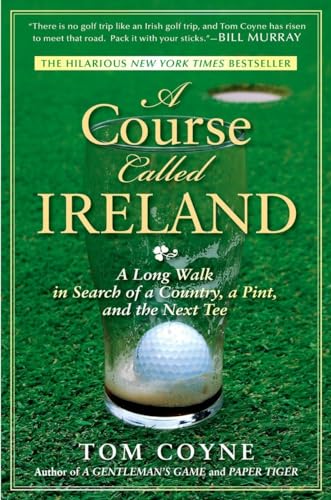
Inhaltsangabe
By turns hilarious and poetic, A Course Called Ireland is a magnificent tour of a vibrant land and paean to the world's greatest game in the tradition of Bill Bryson's A Walk in the Woods. In his thirties, married, and staring down impending fatherhood, Tom Coyne was familiar with the last refuge of the adult male: the golfing trip. Intent on designing a golf trip to end all others, Coyne looked to Ireland, the place where his father has taught him to love the game years before. As he studied a map of the island and plotted his itinerary, it dawned on Coyne that Ireland was ringed with golf holes. The country began to look like one giant round of golf, so Coyne packed up his clubs and set off to play all of it-on foot.
A Course Called Ireland is the story of a walking-averse golfer who treks his way around an entire country, spending sixteen weeks playing every seaside hole in Ireland. Along the way, he searches out his family's roots, discovers that a once-poor country has been transformed by an economic boom, and finds that the only thing tougher to escape than Irish sand traps are Irish pubs.
Die Inhaltsangabe kann sich auf eine andere Ausgabe dieses Titels beziehen.
Über die Autorin bzw. den Autor
Tom Coyne is the author of the novel A Gentleman's Game and cowriter of the screenplay for the novel's film version, which starred Dylan Baker and Gary Sinise. He is a contributor to Golf Magazine and teaches creative writing at St. Joseph's University.
Auszug. © Genehmigter Nachdruck. Alle Rechte vorbehalten.
Disclaimer: This excerpt contains adult language and may not be suitable for all readers.
I took my first golf trip to Ireland when I was nineteen years old.
Growing up outside Philadelphia as the youngest of five, I had a vague sense of my Irish roots. I knew that my great-grandparents hailed from towns in County Mayo, that they settled in Scranton, Pennsylvania, before the turn of the century, and that none of them ever went back. I wore a green kiss me, i’m irish pin on my Catholic school uniform on March 17, and I suffered through corned beef and cabbage once a year, but that was the extent to which Ireland was celebrated in our house. The only other time I remember hearing about our heritage was when my mother would accuse my father or one of my brothers (and even myself from time to time) of being a damn Irishman. I took it as a compliment, though it never quite sounded like one.
We were Americans, Catholics, golfers, Phillies fans, shoregoers, Wiffle-ballers—even as a redhead, Irish ranked low on my list of labels. The potential of my heritage never occurred to me until I graduated high school and my father took me on a golf tour of Ireland, where we spent a week discovering the Irish countryside through a bus window and I first began to wonder— what were my great-grandparents thinking? How was Lackawanna County an upgrade from County Mayo? My family came from a postcard where everyone laughed and danced and the air smelled of turf and sea. How could they have pulled up their roots out of so much soft green and gold?
My father and I spent ten days bouncing around Ireland in that bus, from golf course to hotel and hotel to golf course, and I don’t think I’ve ever enjoyed golf, or my father, or a bouncing bus, for that matter, quite so much. It was the golf trip against which all others would be measured, a few days from that time when a father first starts to look and act like a buddy. Teeing up that first ball in Ballybunion, as we looked out over an ebb and flow of dunes giving way to green strips of fairway, beach grasses spinning in the breeze, a white-tipped ocean just a three-wood away, I felt an understanding for how this strange game came to be, how a contest of knocking pebbles around a field survived through the centuries. Because those first golfers were knocking pebbles around fields like these. My first round in Ballybunion left me red-cheeked and wide-eyed, sitting straight up in my chair in the clubhouse, recounting hole after hole in a way that somehow wasn’t boring. Dad and I replayed all our shots, and then we were quiet for what felt like a week as he slid me my first pint of Guinness (at least the first one he knew about). And just like that original trip to Ireland, all subsequent pints haven’t quite lived up to the first, the one after golf with Dad, the one Mom would have so disapproved of. In his introduction to the Ballybunion links, Tom Watson wrote, “After playing Ballybunion for the first time, a man would think that the game of golf originated here.” For me, I think it kind of did.
The golf that week wasn’t perfect or great or pretty—it was something we both seemed unequipped to gauge. Golf as I’d known it was a game of explanations and excuses, strategies for future improvements. Yet that didn’t seem the language being spoken in places like Ballybunion and Tralee and Rosses Point, places that simply weren’t looking for suggestions. Any vocabulary we might have used to rate or judge or quantify a golf vacation elsewhere—those words didn’t seem to translate in Ireland. The best description seemed the simplest, the one word the Irish used for everything, and it always seemed to fit. Ireland was grand. Just grand.
Many years later, I began devising a golf trip of my own, where I would prove to my unwashed friends why golf played against the Irish Sea was the greatest and truest expression of the game. I started by printing out a map of Irish golf courses, a green island ringed with red flags, each flag denoting the next must-play links. It looked like an old man’s birthday cake, green icing crowded with red candles, and I focused in on which slice my friends and I might attempt.
It wasn’t easy. How could we skip golf holes deemed unskippable by golf pundits the world over? How many holes might we squeeze in before friends were extradited home by their wives, their children, their Mastercard? Should we play it safe with a sampling of old Irish standards, take a chance on an itinerary of best buys, or seek out the bevy of new arrivals? There was only one rule—Ballybunion—but one rule had many offshoots to consider, because you couldn’t play Ballybunion and skip Tralee, which meant you weren’t far from Lahinch, which brought you too close to Connemara to cross it off the list, and made that course in Belmullet an easy temptation, which meant Enniscrone and Rosses Point were a must. We would be close enough to Donegal that we’d have to squeeze it in, which gave us no excuse to skip Northern Ireland, or Dublin, or the whole damn thing.
As I plotted our trip, I learned that Ireland possessed some 40 percent of the true links courses in the world—for a country the size of Indiana, it seemed an absurd statistic. Loosely defined, a links is a seaside course with few, if any, trees. Wind + ocean + ball-gobbling grasses = links. The name referred to the linksland upon which the courses were laid—land that linked the beach with arable turf. Dunes, essentially, but a complicated ecosystem with properties uniquely suited to a particular style of golf. Soil rife with shell allows links courses to drain like colanders, making for firm, fast conditions that lend themselves to a more along-the-ground style of play than the air attack of modern golf. True links are covered with beach grasses of a hardiness that can only be found in such nutrient-strapped soil, and their tumultuous topography can’t be built by blueprint, only by centuries of sea-blown sand.
The golf courses we are accustomed to in America—on television or on a Saturday morning—are almost invariably parkland tracks, tree-lined layouts with tightly cropped edges, fairways defined against carefully tiered cuts of rough. Parkland golf is handsome, convenient, and often obvious, while links golf is unapologetic, unpretentious, and wonderfully unrefined—parkland is the cover girl, lovely and forgettable; linksland is the girl who doesn’t bother with makeup but still turns your head, authentic and irresistible, the one you’d travel all the way to Ireland to spend a few more hours with.
The GPS-guided game we play in benign breezes over unblemished fairways allows us to take on a course with one golf shot in our bag—high and deep—knocking the ball over bunkers and over water and thusly being rewarded. Links golf, with its sea winds and lumpy fairways rolling their way into kinked putting surfaces, is not about knocking your ball over and above a golf course, but rather playing your ball through one. It’s less like darts and more like, well, golf, and it can leave you lightheaded with options as you stand in a heaving fairway and consider your own definition of fair. For anyone with a golf imagination, playing a links is an all-out indulgence, and it makes one understand that golf isn’t about striking the perfect seven-iron or hitting x number of greens. A good day on a links reminds you that golf is about one thing, and one thing only—stuffing your ball into the hole as quickly as you damn well can.
Golf historians trace the game’s origin to ancient stick-whacks-ball pursuits in Holland, Rome, and even China, but there is no debate...
„Über diesen Titel“ kann sich auf eine andere Ausgabe dieses Titels beziehen.
Suchergebnisse für A Course Called Ireland: A Long Walk in Search of a...

Beispielbild für diese ISBN
A Course Called Ireland: A Long Walk in Search of a Country, a Pint, and the Next Tee
Anbieter: World of Books (was SecondSale), Montgomery, IL, USA
Verkäuferbewertung 5 von 5 Sternen

Paperback. Zustand: Good. Tells the story of a walking-averse golfer who treks his way around an entire country, spending sixteen weeks playing every seaside hole in Ireland. Artikel-Nr. 00102097184
Gebraucht kaufen
EUR 3,92
Versand gratis
Versand innerhalb von USA
Versand innerhalb von USA
Anzahl: Mehr als 20 verfügbar
Beispielbild für diese ISBN
A Course Called Ireland: A Long Walk in Search of a Country, a Pint, and the Next Tee
Anbieter: World of Books (was SecondSale), Montgomery, IL, USA
Verkäuferbewertung 5 von 5 Sternen
Paperback. Zustand: Fair. Tells the story of a walking-averse golfer who treks his way around an entire country, spending sixteen weeks playing every seaside hole in Ireland. Artikel-Nr. 00104010151
Gebraucht kaufen
EUR 3,92
Versand gratis
Versand innerhalb von USA
Versand innerhalb von USA
Anzahl: 2 verfügbar
Beispielbild für diese ISBN
A Course Called Ireland: A Long Walk in Search of a Country, a Pint, and the Next Tee
Verlag:
Avery (edition Reprint), 2010
ISBN 10: 1592405282
ISBN 13: 9781592405282
Gebraucht
Paperback
Anbieter: BooksRun, Philadelphia, PA, USA
Verkäuferbewertung 5 von 5 Sternen
Paperback. Zustand: Fair. Reprint. The item might be beaten up but readable. May contain markings or highlighting, as well as stains, bent corners, or any other major defect, but the text is not obscured in any way. Artikel-Nr. 1592405282-7-1
Gebraucht kaufen
EUR 4,88
Versand gratis
Versand innerhalb von USA
Versand innerhalb von USA
Anzahl: 1 verfügbar
Beispielbild für diese ISBN
A Course Called Ireland: A Long Walk in Search of a Country, a Pint, and the Next Tee
Anbieter: ThriftBooks-Reno, Reno, NV, USA
Verkäuferbewertung 5 von 5 Sternen
Paperback. Zustand: Good. No Jacket. Pages can have notes/highlighting. Spine may show signs of wear. ~ ThriftBooks: Read More, Spend Less. Artikel-Nr. G1592405282I3N00
Gebraucht kaufen
EUR 5,94
Versand gratis
Versand innerhalb von USA
Versand innerhalb von USA
Anzahl: 2 verfügbar
Beispielbild für diese ISBN
A Course Called Ireland: A Long Walk in Search of a Country, a Pint, and the Next Tee
Anbieter: ThriftBooks-Atlanta, AUSTELL, GA, USA
Verkäuferbewertung 5 von 5 Sternen
Paperback. Zustand: Good. No Jacket. Pages can have notes/highlighting. Spine may show signs of wear. ~ ThriftBooks: Read More, Spend Less. Artikel-Nr. G1592405282I3N00
Gebraucht kaufen
EUR 5,94
Versand gratis
Versand innerhalb von USA
Versand innerhalb von USA
Anzahl: 2 verfügbar
Beispielbild für diese ISBN
A Course Called Ireland: A Long Walk in Search of a Country, a Pint, and the Next Tee
Anbieter: ThriftBooks-Dallas, Dallas, TX, USA
Verkäuferbewertung 5 von 5 Sternen
Paperback. Zustand: Good. No Jacket. Pages can have notes/highlighting. Spine may show signs of wear. ~ ThriftBooks: Read More, Spend Less. Artikel-Nr. G1592405282I3N00
Gebraucht kaufen
EUR 5,94
Versand gratis
Versand innerhalb von USA
Versand innerhalb von USA
Anzahl: 2 verfügbar
Beispielbild für diese ISBN
A Course Called Ireland: A Long Walk in Search of a Country, a Pint, and the Next Tee
Anbieter: ThriftBooks-Dallas, Dallas, TX, USA
Verkäuferbewertung 5 von 5 Sternen
Paperback. Zustand: Good. No Jacket. Former library book; Pages can have notes/highlighting. Spine may show signs of wear. ~ ThriftBooks: Read More, Spend Less. Artikel-Nr. G1592405282I3N10
Gebraucht kaufen
EUR 5,94
Versand gratis
Versand innerhalb von USA
Versand innerhalb von USA
Anzahl: 1 verfügbar
Beispielbild für diese ISBN
A Course Called Ireland: A Long Walk in Search of a Country, a Pint, and the Next Tee
Anbieter: ThriftBooks-Dallas, Dallas, TX, USA
Verkäuferbewertung 5 von 5 Sternen
Paperback. Zustand: Fair. No Jacket. Readable copy. Pages may have considerable notes/highlighting. ~ ThriftBooks: Read More, Spend Less. Artikel-Nr. G1592405282I5N00
Gebraucht kaufen
EUR 5,94
Versand gratis
Versand innerhalb von USA
Versand innerhalb von USA
Anzahl: 1 verfügbar
Beispielbild für diese ISBN
A Course Called Ireland: A Long Walk in Search of a Country, a Pint, and the Next Tee
Anbieter: ThriftBooks-Phoenix, Phoenix, AZ, USA
Verkäuferbewertung 5 von 5 Sternen
Paperback. Zustand: Good. No Jacket. Pages can have notes/highlighting. Spine may show signs of wear. ~ ThriftBooks: Read More, Spend Less. Artikel-Nr. G1592405282I3N00
Gebraucht kaufen
EUR 5,94
Versand gratis
Versand innerhalb von USA
Versand innerhalb von USA
Anzahl: 2 verfügbar
Beispielbild für diese ISBN
A Course Called Ireland : A Long Walk in Search of a Country, a Pint, and the Next Tee
Verlag:
Penguin Publishing Group, 2010
ISBN 10: 1592405282
ISBN 13: 9781592405282
Gebraucht
Softcover
Anbieter: Better World Books: West, Reno, NV, USA
Verkäuferbewertung 5 von 5 Sternen
Zustand: Good. Pages intact with minimal writing/highlighting. The binding may be loose and creased. Dust jackets/supplements are not included. Stock photo provided. Product includes identifying sticker. Better World Books: Buy Books. Do Good. Artikel-Nr. 3776013-6
Gebraucht kaufen
EUR 6,16
Versand gratis
Versand innerhalb von USA
Versand innerhalb von USA
Anzahl: 1 verfügbar