
Verwandte Artikel zu A Practical Guide to Racism
Inhaltsangabe
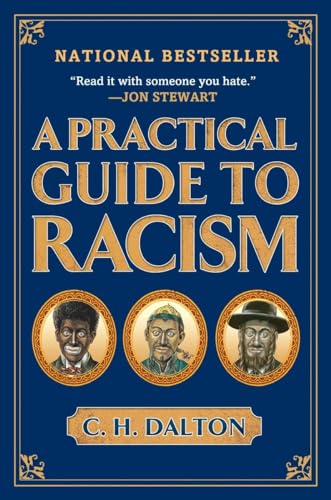
Meet C. H. Dalton, a professor of racialist studies and an expert on inferior people of all ethnicities, genders, religions, and sexual preferences. Presenting evidence that everyone should be hated, A Practical Guide to Racism contains sparkling bits of wisdom on such subjects as:
· The good life enjoyed by blacks, who shuffle through life unhindered by the white man's burdens, to become accomplished athletes, rhyme smiths, and dominoes champions
· The sad story of the industrious, intelligent Jews, whose entire reputation is sullied by their taste for the blood of Christian babies
· A close look at the bizarre, sweet-smelling race known as women, who are not very good at anything - especially ruling the free world
· A crucial manual to Arabs, a people so sensitive they are liable to blow up at any time. Literally.
Die Inhaltsangabe kann sich auf eine andere Ausgabe dieses Titels beziehen.
Über die Autorin bzw. den Autor
C. H. Dalton
Von der hinteren Coverseite
Meet C. H. Dalton, a professor of racialist studies and an expert on inferior people of all ethnicities, genders, religions, and sexual preferences. Presenting evidence that everyone should be hated, A Practical Guide to Racism contains sparkling bits of wisdom on such subjects as:
The good life enjoyed by blacks, who shuffle through life unhindered by the white man's burdens, to become accomplished athletes, rhyme smiths, and dominoes champions
-The sad story of the industrious, intelligent Jews, whose entire reputation is sullied by their taste for the blood of Christian babies
-A close look at the bizarre, sweet-smelling race known as women, who are not very good at anything - especially ruling the free world
-A crucial manual to Arabs, a people so sensitive they are liable to blow up at any time. Literally.
Auszug. © Genehmigter Nachdruck. Alle Rechte vorbehalten.
A PRACTICAL GUIDE TO RACISM
A PRACTICAL GUIDE TO RACISM
C. H. DALTON
ILLUSTRATIONS BY
Andy Friedman
Nicholas Gurewitch
Michael Kupperman
Sam Means
Tony Millionaire
R. Sikoryak
Liz Zanis
Introduction
1. Hispanics
2. Jews
3. Whites
4. Indians (and Injuns)
5. Blacks
6. Asians
7. Merpeople
8. Arabs
9. Gypsies
APPENDICES
I. Sexual Races
II. Ancient Races
III. Interracial Dating
IV. Questionable Races
V. The Good Ones
VI. Crania of the Races
VII. A Glossary of Racial Epithets
Index
A PRACTICAL GUIDE TO RACISM
INTRODUCTION
“The horse, the ass, the zebra, and the quagga are distinct species and distinct types: and so with the Jew, the Teuton, the Sclavonian, the Mongol, the Australian, the coast Negro, the Hottentot, &c.”
—Josiah Clark Nott, Types of Mankind
The human race is not actually a race. It is a species, but it is divided into several convenient races, like Black, White, Asian, and Mixed. These divisions are based on subtle biological differences, and expressed physiologically in things like skin color, eye slantiness, and leg ashiness. Racism is the dislike of another race as a whole, or of another person solely because he is a member of a certain race.
As the title implies, this book is meant to serve as a practical guide to racism, for both racists and non-racists alike. It will explore the different stereotypes associated with members of different races and ethnic groups, as well as their origin and basis in fact. Are Swedish women really able to suck the chrome off a trailer hitch? No, of course not, but the stereotype is rooted in their extraordinary talent for oral sex.
We will also look at historical examples of racism, especially here in America, and the extent to which racism has been institutionalized or officially sanctioned,1. but mostly we will be dealing with the use of stereotypes, epithets, and racial caricatures.
Like this one. This one doesn’t even make sense.
Fig. 1. “An Irish Jig”
Fig. 2. “The Irish Frankenstein”
The concept of race is controversial, since variation within the traditionally established races is often far more extreme than between any two ethnic groups, but to say that we don’t divide each other into races would be to ignore thousands of years of human history. Not to mention the fact that white people drive a car like this:
Fig. 3
While black people drive a car like this:
Fig. 4
Despite increasing globalization and intermarriage, or “miscegenation,” there are still distinct and important differences between members of the different races. Since the subtlety and scope of those differences are far too complicated to be helpful to us in everyday life, we employ certain heuristics, or “stereotypes,” to better understand and more comfortably interact with those different from ourselves. Like the Maori.
Such stereotypes are sometimes controversial, because they can oversimplify the differences between individuals. Every person is different, and it is rare for someone to fit a stereotype perfectly. Except for so-called “walking stereotypes,” like Carson from Queer Eye.2. Others don’t have any of the characteristics ascribed to their race in such stereotypes. It’s an imperfect science at best.
For example, just because the Maori are, in general, lazy, selfish, and long-winded, that does not mean that noted Maori opera singer Kiri Te Kanawa is any of those things. In fact, she is only two of them, because she is a soprano, and sopranos tend to be very succinct.
Even so, stereotypes can be very useful in our everyday social interactions and decision-making. They are actually a kind of survival instinct—a crude form of received inductive reasoning that can help us make snap judgments in situations where we don’t have all the facts.
When entering into a business deal with someone of Roma descent, for instance, I am very careful of my possessions. Knowing the stereotype that gypsies are tramps and thieves,3. I am able to better protect myself when coming into contact with them, and my increased vigilance might save me from becoming a victim. At any moment, a baby could come flying at me and, when I catch it, a young, dark-haired girl will steal my camera.
(If you find yourself confronted with this particular scam, it is better to drop the baby. Another little known stereotype is that gypsy children are unusually sturdy.)
Similarly, if I were looking for someone to lend me money, a Jewish person would be unlikely to help me, because they are traditionally parsimonious. It is best not to even ask, at the risk of being subjected to one of their patented “guilt trips” or, worse, jewed out of what money I do have.4.
That’s why words like “jewed” and “gypped” exist. Are you calling Noah Webster a racist?
I bring this up because it is important to keep in mind the difference between stereotypes and racism. Stereotypes are a useful, if flawed, mechanism for surviving in a multicultural world, but racism is saying them out loud.
Racism is about more than just making impolitic comments, though; it is about hatred. Broad stereotypes often fuel racism, but merely believing a stereotype about another race doesn’t make you a racist.5. After all, some of my best friends are members of other races. So stereotypes are kind of a sine qua non of racism—a without which not of hating people different from yourself, if you will.
Racism doesn’t need to stop at personal distaste, though. Many racists in positions of power have used their standing to oppress and even kill entire groups of people. I can’t condone that kind of violence, but it’s hard to argue with the science behind it. If eugenics and racialist phrenology have taught us nothing else, it’s that we can, through selective breeding, eliminate all those with a pronounced ideality lump on their left temple.6.
Being labeled a racist in today’s society can be extremely damaging to your reputation and your career, whether you’re a stand-up comedian, a movie star, or a radio host. And if you’re a true racist, minorities will be able to tell. They have an innate ability to sense when someone is being racist, a kind of radar for racism that I call “racism-dar,” or “ra-dar.”
Fig. 5
This book is divided into nine chapters, each devoted to a different ethnic group: Jews, Asians, Whites, Blacks, Gypsies, Indians (and Injuns), Hispanics, Arabs, and Merpeople,7. and several appendices, including a glossary of racial epithets. Anyone who’s ever thought about dating outside his own race will surely appreciate my guide to jungle fever, yellow fever, and the other various and sundry fevers.
Within each chapter we will consider not just broad ethnic stereotypes, like “South Africans are cowards,” but more specific generalities as well, like “Swazi men are meth-heads.” Lazy Guatemalans and industrious El Salvadorans are both covered in the chapter on Hispanics.
To sum up, racism is the hatred of members of another ethnic group solely because of their race, and it is often informed by negative and untrue stereotypes. It’s okay to...
„Über diesen Titel“ kann sich auf eine andere Ausgabe dieses Titels beziehen.
Suchergebnisse für A Practical Guide to Racism

Beispielbild für diese ISBN
A Practical Guide to Racism
Anbieter: World of Books (was SecondSale), Montgomery, IL, USA
Verkäuferbewertung 5 von 5 Sternen

Zustand: Good. Item in good condition. Textbooks may not include supplemental items i.e. CDs, access codes etc. Artikel-Nr. 00103019534
Gebraucht kaufen
EUR 3,96
Versand gratis
Versand innerhalb von USA
Versand innerhalb von USA
Anzahl: 2 verfügbar
Beispielbild für diese ISBN
A Practical Guide to Racism
Anbieter: World of Books (was SecondSale), Montgomery, IL, USA
Verkäuferbewertung 5 von 5 Sternen
Zustand: Very Good. Item in very good condition! Textbooks may not include supplemental items i.e. CDs, access codes etc. Artikel-Nr. 00101943197
Gebraucht kaufen
EUR 3,96
Versand gratis
Versand innerhalb von USA
Versand innerhalb von USA
Anzahl: 2 verfügbar
Beispielbild für diese ISBN
A Practical Guide to Racism
Anbieter: World of Books (was SecondSale), Montgomery, IL, USA
Verkäuferbewertung 5 von 5 Sternen
Zustand: Acceptable. Item in acceptable condition! Textbooks may not include supplemental items i.e. CDs, access codes etc. Artikel-Nr. 00094139083
Gebraucht kaufen
EUR 3,96
Versand gratis
Versand innerhalb von USA
Versand innerhalb von USA
Anzahl: 4 verfügbar
Beispielbild für diese ISBN
A Practical Guide to Racism
Verlag:
Avery (edition Reprint), 2008
ISBN 10: 1592404308
ISBN 13: 9781592404308
Gebraucht
Paperback
Anbieter: BooksRun, Philadelphia, PA, USA
Verkäuferbewertung 5 von 5 Sternen
Paperback. Zustand: Fair. Reprint. The item might be beaten up but readable. May contain markings or highlighting, as well as stains, bent corners, or any other major defect, but the text is not obscured in any way. Artikel-Nr. 1592404308-7-1
Gebraucht kaufen
EUR 4,45
Versand gratis
Versand innerhalb von USA
Versand innerhalb von USA
Anzahl: 1 verfügbar
Beispielbild für diese ISBN
A Practical Guide to Racism
Anbieter: Wonder Book, Frederick, MD, USA
Verkäuferbewertung 5 von 5 Sternen
Zustand: Very Good. Very Good condition. A copy that may have a few cosmetic defects. May also contain light spine creasing or a few markings such as an owner's name, short gifter's inscription or light stamp. Artikel-Nr. A07N-00689
Gebraucht kaufen
EUR 6,28
Versand gratis
Versand innerhalb von USA
Versand innerhalb von USA
Anzahl: 1 verfügbar
Beispielbild für diese ISBN
A Practical Guide to Racism
Anbieter: Wonder Book, Frederick, MD, USA
Verkäuferbewertung 5 von 5 Sternen
Zustand: Good. Good condition. A copy that has been read but remains intact. May contain markings such as bookplates, stamps, limited notes and highlighting, or a few light stains. Artikel-Nr. I23B-05282
Gebraucht kaufen
EUR 6,28
Versand gratis
Versand innerhalb von USA
Versand innerhalb von USA
Anzahl: 1 verfügbar
Beispielbild für diese ISBN
A Practical Guide to Racism
Anbieter: ThriftBooks-Atlanta, AUSTELL, GA, USA
Verkäuferbewertung 5 von 5 Sternen
Paperback. Zustand: Good. No Jacket. Pages can have notes/highlighting. Spine may show signs of wear. ~ ThriftBooks: Read More, Spend Less. Artikel-Nr. G1592404308I3N00
Gebraucht kaufen
EUR 6,39
Versand gratis
Versand innerhalb von USA
Versand innerhalb von USA
Anzahl: 2 verfügbar
Beispielbild für diese ISBN
A Practical Guide to Racism
Anbieter: ThriftBooks-Phoenix, Phoenix, AZ, USA
Verkäuferbewertung 5 von 5 Sternen
Paperback. Zustand: Good. No Jacket. Pages can have notes/highlighting. Spine may show signs of wear. ~ ThriftBooks: Read More, Spend Less. Artikel-Nr. G1592404308I3N00
Gebraucht kaufen
EUR 6,39
Versand gratis
Versand innerhalb von USA
Versand innerhalb von USA
Anzahl: 1 verfügbar
Beispielbild für diese ISBN
A Practical Guide to Racism
Anbieter: ThriftBooks-Dallas, Dallas, TX, USA
Verkäuferbewertung 5 von 5 Sternen
Paperback. Zustand: Good. No Jacket. Pages can have notes/highlighting. Spine may show signs of wear. ~ ThriftBooks: Read More, Spend Less. Artikel-Nr. G1592404308I3N00
Gebraucht kaufen
EUR 6,39
Versand gratis
Versand innerhalb von USA
Versand innerhalb von USA
Anzahl: 2 verfügbar
Beispielbild für diese ISBN
A Practical Guide to Racism
Anbieter: ThriftBooks-Reno, Reno, NV, USA
Verkäuferbewertung 5 von 5 Sternen
Paperback. Zustand: Good. No Jacket. Pages can have notes/highlighting. Spine may show signs of wear. ~ ThriftBooks: Read More, Spend Less. Artikel-Nr. G1592404308I3N00
Gebraucht kaufen
EUR 6,39
Versand gratis
Versand innerhalb von USA
Versand innerhalb von USA
Anzahl: 1 verfügbar