
Verwandte Artikel zu Things That Bite: Southwest Edition: A Realistic Look...
Inhaltsangabe
Be Aware, Not Afraid
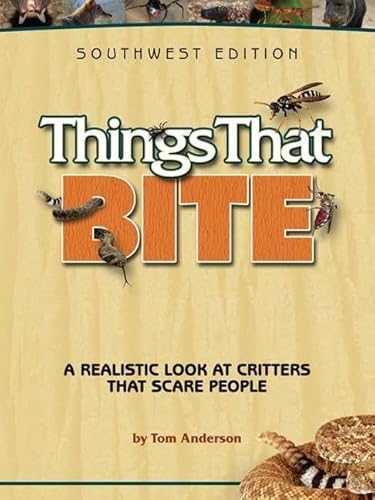
Spiders, snakes, coyotes and Gila monsters - they're out there, but there's no reason to fear them. Things That Bite takes a matter-of-fact look at more than 30 creatures found in the Southwest. Detailed information includes fascinating facts, environmental benefits of each species, discussion of why some might bite, bite prevention and myths about each creature. Be aware, not afraid.
Die Inhaltsangabe kann sich auf eine andere Ausgabe dieses Titels beziehen.
Über die Autorin bzw. den Autor
Tom Anderson is a professional naturalist, an award-winning writer and a wildlife expert. For 16 years he was director of the Lee and Rose Warner Nature Center, which is associated with the Science Museum of Minnesota and is located in Marine on St. Croix, Minnesota. In addition to his work at the nature center, Tom is a well-known writer and columnist. For nearly 15 years he wrote “Reading Sign,” an award-winning column for the Chisago County Press. He is also the author of 2 books, Learning Nature by a Country Road and Black Bear: Seasons in the Wild, both from Voyageur Press. He is a published poet and was a columnist for Midwest Fly Fishing Magazine and the Science Museum of Minnesota periodical, Encounters. Tom has been honored many times for his writing. He was 1 of 20 Minnesota artists chosen to participate in the Millennium Journal Project. In 2003 he was awarded the “Best Commentary Award” by The National Association of Interpretation’s periodical, The Legacy. In 2004 he was runner-up for the “Best Feature” category. The natural world and our intimate connection to it inspires Tom to write. He lives southwest of North Branch, but he travels often, especially in the far North. He lives with his lovely wife, Nancy Conger, in the nineteenth-century farmhouse that his Swedish great-great grandparents built.
Auszug. © Genehmigter Nachdruck. Alle Rechte vorbehalten.
Ticks
Casually ask someone, “Is that a tick on your arm?” and you will likely witness an immediate and urgent response. For such a little fellow―no bigger than one of these typed letters―the tick easily prompts even the most macho of men to take defensive action. And even after the hitchhiking tick is pointed out, there is the predictable, contagious outbreak of twitching and scratching among people nearby. Such is the power of this little creature.
About Ticks
Ticks are not insects. Like spiders, mites and scorpions, they are arachnids. Adult ticks have 8 legs, while the larvae have 6 legs. Thankfully, ticks are not a major pest in the Southwest. There are roughly 25–30 species found here with the most common being the brown dog tick. The Rocky Mountain wood tick is about 1⁄8 of an inch in length and slightly larger after it ingests a blood meal. These brown ticks turn gray when engorged. The female has a gray-colored disk behind her head, while the male’s disk is mottled brown and gray. Like the Rocky Mountain wood tick, the American dog tick is also referred to as a wood tick; it is the larger of the two, approximately ¼ inch in length. The female has a cream-colored disk behind her head, while the male lacks the disk and has 2 thin, lighter-colored stripes running down his back. This tick is the primary carrier of Rocky Mountain spotted fever. Unlike wood ticks, black-legged ticks have no white or cream-colored markings on their backs. They are smaller (about 1⁄8 inch long), dark brown to black and teardrop shaped. Females usually have an area behind their head that is orange to red in color. Black-legged ticks are the primary transmitter of Lyme disease.
Life and Times . . .
Under ideal conditions, ticks have a 2-year life cycle that includes blood-feeding stages as larvae, nymphs and adults. In the spring, tick eggs hatch and tiny larval ticks emerge. Sometimes referred to as seed ticks, they typically feed on the blood of small rodents such as mice. After developing into nymphs, they feed on small- to medium-sized mammals such as chipmunks. Adults seek out larger animals, including white-tailed deer. Because female black-legged ticks secure blood meals from deer for egg production, deer play a key role in maintaining high tick populations. In the Southwest, humans are most at risk from May to September when the tick is in the nymph stage. However, adult ticks can bite, so caution is advised from April through December.
Fascinating Facts
- Ticks have been reported to feed on at least 125 different kinds of animals including 57 bird varieties, 54 mammal species, and 14 types of lizards.
- The folds in a tick’s skin allow it to greatly expand in size. An engorged female tick might increase her weight by 200 times!
Thanks to Ticks
- Ticks are prey for many species of birds and an important part of the food chain.
Myth Busters
- MYTH: Ticks will leap out of trees onto you! Ticks are crawlers, not jumpers. Leaping insects, such as crickets or grasshoppers, have longer, larger legs. A tick’s legs are better suited for climbing up to ambush sites where they stretch out their front legs, as if signaling a touchdown. This posture is referred to as questing. Ticks will sit on grass stems or twigs for hours questing, waiting to attach to a passing host.
Why They Bite
Simply put, ticks bite only to secure a meal. They require blood meals to change from one life stage to the next. An adult female also requires a blood meal to produce her thousands of eggs.
How They Bite
An electron microscope image of a tick’s mouthparts is reminiscent of the aliens portrayed in the Star Wars movies. Creepy! The tick’s beak-like mouthparts have backward-pointing barbs that allow the tick to remain anchored for a successful bloodletting. After attaching, the tick secretes a protein-rich cementing substance that helps keep itself in place. This patch of cement, which resembles a small chunk of your skin, can often be seen when a tick is removed. As the tick feeds, it releases saliva that contains special compounds that thin the blood and suppress pain.
How Afraid Should I Be?
Tick bites can cause some discomfort, such as itching or a rash, but they are not a major threat alone. However, in the past 25 years, ticks have become more of a concern as they have been found to carry serious diseases. So let’s look at a few of the tick-borne diseases and where they are usually found. In the Southwest, 5 tick-borne illnesses have been reported: Rocky Mountain spotted fever, tick-borne relapsing fever, Lyme disease, tick paralysis and tularemia.
„Über diesen Titel“ kann sich auf eine andere Ausgabe dieses Titels beziehen.
Suchergebnisse für Things That Bite: Southwest Edition: A Realistic Look...

Beispielbild für diese ISBN
Things That Bite: Southwest Edition: A Realistic Look at Critters That Scare People
Verlag:
Adventure Publications, Incorporated, 2012
ISBN 10: 1591932793
ISBN 13: 9781591932796
Gebraucht
Paperback
Anbieter: World of Books (was SecondSale), Montgomery, IL, USA
Verkäuferbewertung 5 von 5 Sternen

Paperback. Zustand: Good. Spiders, snakes, coyotes and Gila monsters - they're out there, but there's no reason to fear them. Things That Bite takes a matter-of-fact look at more than 30 creatures found in the Southwest. Detailed information includes fascinating facts, environmental benefits of each species, discussion of why some might bite, bite prevention and myths about each creature. Be aware, not afraid. Artikel-Nr. 00096973670
Gebraucht kaufen
EUR 5,84
Versand gratis
Versand innerhalb von USA
Versand innerhalb von USA
Anzahl: 1 verfügbar
Beispielbild für diese ISBN
Things That Bite: Southwest Edition: A Realistic Look at Critters That Scare People
Verlag:
Adventure Publications, Incorporated, 2012
ISBN 10: 1591932793
ISBN 13: 9781591932796
Gebraucht
Paperback
Anbieter: World of Books (was SecondSale), Montgomery, IL, USA
Verkäuferbewertung 5 von 5 Sternen
Paperback. Zustand: Very Good. Spiders, snakes, coyotes and Gila monsters - they're out there, but there's no reason to fear them. Things That Bite takes a matter-of-fact look at more than 30 creatures found in the Southwest. Detailed information includes fascinating facts, environmental benefits of each species, discussion of why some might bite, bite prevention and myths about each creature. Be aware, not afraid. Artikel-Nr. 00099372515
Gebraucht kaufen
EUR 5,84
Versand gratis
Versand innerhalb von USA
Versand innerhalb von USA
Anzahl: 1 verfügbar
Beispielbild für diese ISBN
Things That Bite: A Realistic Look at Critters That Scare People
Anbieter: ThriftBooks-Dallas, Dallas, TX, USA
Verkäuferbewertung 5 von 5 Sternen
Paperback. Zustand: Very Good. No Jacket. Former library book; May have limited writing in cover pages. Pages are unmarked. ~ ThriftBooks: Read More, Spend Less. Artikel-Nr. G1591932793I4N10
Gebraucht kaufen
EUR 6,72
Versand gratis
Versand innerhalb von USA
Versand innerhalb von USA
Anzahl: 1 verfügbar
Beispielbild für diese ISBN
Things That Bite: A Realistic Look at Critters That Scare People
Anbieter: ThriftBooks-Atlanta, AUSTELL, GA, USA
Verkäuferbewertung 5 von 5 Sternen
Paperback. Zustand: As New. No Jacket. Pages are clean and are not marred by notes or folds of any kind. ~ ThriftBooks: Read More, Spend Less. Artikel-Nr. G1591932793I2N00
Gebraucht kaufen
EUR 6,72
Versand gratis
Versand innerhalb von USA
Versand innerhalb von USA
Anzahl: 1 verfügbar
Beispielbild für diese ISBN
Things That Bite: A Realistic Look at Critters That Scare People
Anbieter: ThriftBooks-Dallas, Dallas, TX, USA
Verkäuferbewertung 5 von 5 Sternen
Paperback. Zustand: Good. No Jacket. Pages can have notes/highlighting. Spine may show signs of wear. ~ ThriftBooks: Read More, Spend Less. Artikel-Nr. G1591932793I3N00
Gebraucht kaufen
EUR 6,72
Versand gratis
Versand innerhalb von USA
Versand innerhalb von USA
Anzahl: 1 verfügbar
Beispielbild für diese ISBN
Things That Bite: A Realistic Look at Critters That Scare People, Southwest Edition
Anbieter: Revaluation Books, Exeter, Vereinigtes Königreich
Verkäuferbewertung 5 von 5 Sternen
Paperback. Zustand: Brand New. southwest ed. edition. 160 pages. 8.00x6.00x0.50 inches. In Stock. Artikel-Nr. x-1591932793
Neu kaufen
EUR 19,46
EUR 12,00 Versand
Versand von Vereinigtes Königreich nach USA
Versand von Vereinigtes Königreich nach USA
Anzahl: 2 verfügbar
Foto des Verkäufers
Things That Bite : A Realistic Look at Critters That Scare People, Southwest Edition
Anbieter: GreatBookPricesUK, Woodford Green, Vereinigtes Königreich
Verkäuferbewertung 5 von 5 Sternen
Zustand: As New. Unread book in perfect condition. Artikel-Nr. 17797383
Gebraucht kaufen
EUR 19,82
EUR 18,00 Versand
Versand von Vereinigtes Königreich nach USA
Versand von Vereinigtes Königreich nach USA
Anzahl: Mehr als 20 verfügbar