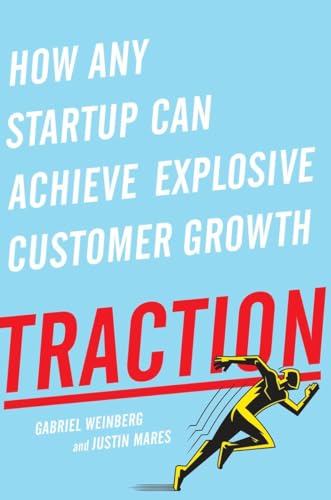
Inhaltsangabe
Most startups don’t fail because they can’t build a product.
Most startups fail because they can’t get traction.
Startup advice tends to be a lot of platitudes repackaged with new buzzwords, but Traction is something else entirely.
As Gabriel Weinberg and Justin Mares learned from their own experiences, building a successful company is hard. For every startup that grows to the point where it can go public or be profitably acquired, hundreds of others sputter and die.
Smart entrepreneurs know that the key to success isn’t the originality of your offering, the brilliance of your team, or how much money you raise. It’s how consistently you can grow and acquire new customers (or, for a free service, users). That’s called traction, and it makes everything else easier—fund-raising, hiring, press, partnerships, acquisitions. Talk is cheap, but traction is hard evidence that you’re on the right path.
Traction will teach you the nineteen channels you can use to build a customer base, and how to pick the right ones for your business. It draws on inter-views with more than forty successful founders, including Jimmy Wales (Wikipedia), Alexis Ohanian (reddit), Paul English (Kayak), and Dharmesh Shah (HubSpot). You’ll learn, for example, how to:
·Find and use offline ads and other channels your competitors probably aren’t using
·Get targeted media coverage that will help you reach more customers
·Boost the effectiveness of your email marketing campaigns by automating staggered sets of prompts and updates
·Improve your search engine rankings and advertising through online tools and research
Weinberg and Mares know that there’s no one-size-fits-all solution; every startup faces unique challenges and will benefit from a blend of these nineteen traction channels. They offer a three-step framework (called Bullseye) to figure out which ones will work best for your business. But no matter how you apply them, the lessons and examples in Traction will help you create and sustain the growth your business desperately needs.
Die Inhaltsangabe kann sich auf eine andere Ausgabe dieses Titels beziehen.
Über die Autorin bzw. den Autor
GABRIEL WEINBERG is the CEO & Founder of DuckDuckGo, the Internet privacy company and private search engine. He holds a B.S. with honors from MIT in Physics and an M.S. from the MIT Technology and Policy Program. Weinberg is also the co-author of Super Thinking.
JUSTIN MARES is the founder of two startups and the former director of revenue at Exceptional, a software company that was acquired by Rackspace. He lives in San Francisco,and on Twitter at @jwmares.
www.tractionbook.com
Auszug. © Genehmigter Nachdruck. Alle Rechte vorbehalten.
Preface: Traction Trumps Everything
In 2006 I sold for millions of dollars an Internet company that I had cofounded a few years earlier. It was a strange company for many reasons, not the least of which was that we had no employees from beginning to end. I wrote every line of code and did all the accounting and customer support.
The terms of the deal were such that my cofounder and I didn’t have to work for the acquiring company at all. We were free to move on to other things, and we did. A few months later my wife and I moved from our 865-square-foot apartment near Boston to a country house twenty-five miles outside of Philadelphia. I had just turned twenty-seven.
She went to her job and I sat at home doing nothing for the first time in my life. We knew no one for a hundred miles in any direction.
Naturally, I started tinkering on the computer again, starting about a dozen side projects simultaneously. A year and a half later, I thought I was on to something. I noticed two things that bothered me about Google: too much spam (all those sites with nothing but ads) and not enough instant answers (I kept going to Wikipedia and IMDb). I thought if I could easily pick out the spam and the answers, then I’d have a more compelling search engine.
Both problems were harder to solve than I initially thought, but I thoroughly enjoyed the work and kept at it. Everyone I talked to about my search engine project thought I was nuts. You’re doing what? Competing against Google? Why? How? Another year later, in the fall of 2008, I flipped the switch, unveiling my search engine to the public.
DuckDuckGo had a rather uneventful launch, if you can even call it a launch. I posted it to a niche tech site called Hacker News and that was the long and short of it. The post was entitled “What do you think of my new search engine?”
Like many entrepreneurs, I’m motivated by being on the cusp of something big, and I was at the point where I needed some validation. I can survive on little, but I needed something.
I got it.
Granted, the product wasn’t anything you’d want to switch to at that point, and people let me know that. It was an Internet forum, after all. However, I still felt there was genuine interest in a new search competitor. I could tell some people were growing wary of what Google was becoming. For example, those initial conversations led me to investigate search privacy and eventually become “the search engine that doesn’t track you,” years before government and corporate surveillance became a mainstream issue.
In any case, the response I received was enough motivation to keep me going. Which brings me to traction. I needed some.
Traction is the best way to improve your chances of startup success. Traction is a sign that something is working. If you charge for your product, it means customers are buying. If your product is free, it’s a growing user base.
Traction is powerful. Technical, market, and team risks are easier to address with traction. Fund-raising, hiring, press, partnerships, and acquisitions all become much easier.
In other words, traction trumps everything.
My last startup had grown using two traction channels: first, search engine optimization (ranking high in search engines for relevant terms), and later, viral marketing (where your customers bring in other customers, such as by referring friends and family through use of the product).
Viral marketing doesn’t work well in search because you can’t easily bake it into the product by putting stuff between people and their search results. So I tried search engine optimization. The terms “search engine” and “search engines” were too hard to rank for, as the high-ranking companies had been around for a decade and had tens of thousands of links pointing at them from their long histories. “New search engine” was more in my grasp.
I worked hard for many months to rank high for this phrase. The key to good search engine optimization (SEO) is getting links. As you will read later in the SEO chapter, you need a strategy to get these links in a scalable way.
Getting stories written about you in blogs and news outlets is a common SEO linking strategy. However, I hit saturation with that channel strategy pretty quickly and it didn’t get me to the top. Something more creative was required.
After much brainstorming and experimenting, I eventually hit upon a good idea. I built a karma widget that would display links to your social media profiles and how many followers you had on each service. People would embed it on their sites and at the bottom there would be a link back to DuckDuckGo that said “new search engine.”
This channel strategy worked beautifully. I was number one.
Trouble was, not a ton of people make that search—about fifty a day. So while I did get some traction and a steady stream of new users, it leveled off pretty quickly. It wasn’t enough traction to be meaningful. It didn’t move the needle.
I made two large traction mistakes here. First, I failed to have a concrete traction goal. In retrospect, to move the needle for my traction goals at the time, I needed more like five thousand new visitors a day, not fifty. Search engine optimization was not going to get me there.
Second, I was biased by my previous experience. Just because my last company got traction in this way didn’t mean it was right for every company.
These are very natural mistakes to make. In fact, most startups make them. The most common startup trajectory now goes something like the following:
Founders have an idea for a company they’re excited about. Initial excitement turns into a struggle to build a product, but they do get something out the door.
Launch!
The founders expected customers to beat a path to their door, but unfortunately that isn’t happening. Getting traction was an afterthought, but now they are focused on it. They try what they know or what they’ve heard others do: some Facebook ads, a little local PR, and maybe a smattering of blog posts.
Then they run out of money and the company dies.
Sadly, this is the norm. Even sadder, often these products are actually on to something. That is, with the right traction strategy they might have actually been able to get traction and not go out of business.
Given my previous startup success I thought I knew what I was doing. I was wrong. Luckily, I wasn’t dead wrong. I had the money to self-fund through my traction mistakes, and so they didn’t prove fatal for DuckDuckGo. Not everyone is as lucky.
Right when I realized I was making these mistakes I also realized I didn’t know the right way to go about getting traction at all. I asked around. It turns out there was no good framework for getting traction, and that’s how this book was born, way back in 2009.
Around this time I also started angel investing and more seriously advising other startups. I saw firsthand similar struggles and mistakes. I also partnered with Justin Mares, my coauthor. Justin founded two startups (one of which was acquired) and recently ran growth at Exceptional Cloud Services, which was acquired by Rackspace in 2013 for millions. He’s a growth expert in his own right.
We set out to help startups get traction no matter what business they were in: from Internet companies to local small businesses and everything in between. We drew on our personal experiences, interviewed more than forty founders, studied many more companies, and pulled out the repeatable framework they used to succeed.
That framework is Bullseye, a simple three-step process for getting traction....
„Über diesen Titel“ kann sich auf eine andere Ausgabe dieses Titels beziehen.
Weitere beliebte Ausgaben desselben Titels

Suchergebnisse für Traction: How Any Startup Can Achieve Explosive Customer...

Foto des Verkäufers
Traction: How Any Startup Can Achieve Explosive Customer Growth
Anbieter: Dream Books Co., Denver, CO, USA
Verkäuferbewertung 5 von 5 Sternen

Zustand: acceptable. This copy has clearly been enjoyedâ"expect noticeable shelf wear and some minor creases to the cover. Binding is strong, and all pages are legible. May contain previous library markings or stamps. Artikel-Nr. DBV.1591848369.A
Beispielbild für diese ISBN
Traction: How Any Startup Can Achieve Explosive Customer Growth
Anbieter: ThriftBooks-Atlanta, AUSTELL, GA, USA
Verkäuferbewertung 5 von 5 Sternen
Hardcover. Zustand: Very Good. No Jacket. Missing dust jacket; May have limited writing in cover pages. Pages are unmarked. ~ ThriftBooks: Read More, Spend Less. Artikel-Nr. G1591848369I4N01
Beispielbild für diese ISBN
Traction: How Any Startup Can Achieve Explosive Customer Growth
Anbieter: ThriftBooks-Atlanta, AUSTELL, GA, USA
Verkäuferbewertung 5 von 5 Sternen
Hardcover. Zustand: Very Good. No Jacket. May have limited writing in cover pages. Pages are unmarked. ~ ThriftBooks: Read More, Spend Less. Artikel-Nr. G1591848369I4N00
Beispielbild für diese ISBN
Traction: How Any Startup Can Achieve Explosive Customer Growth
Anbieter: ThriftBooks-Reno, Reno, NV, USA
Verkäuferbewertung 5 von 5 Sternen
Hardcover. Zustand: Good. No Jacket. Missing dust jacket; Pages can have notes/highlighting. Spine may show signs of wear. ~ ThriftBooks: Read More, Spend Less. Artikel-Nr. G1591848369I3N01
Beispielbild für diese ISBN
Traction: How Any Startup Can Achieve Explosive Customer Growth
Anbieter: ThriftBooks-Phoenix, Phoenix, AZ, USA
Verkäuferbewertung 5 von 5 Sternen
Hardcover. Zustand: Very Good. No Jacket. May have limited writing in cover pages. Pages are unmarked. ~ ThriftBooks: Read More, Spend Less. Artikel-Nr. G1591848369I4N00
Beispielbild für diese ISBN
Traction: How Any Startup Can Achieve Explosive Customer Growth
Anbieter: ThriftBooks-Reno, Reno, NV, USA
Verkäuferbewertung 5 von 5 Sternen
Hardcover. Zustand: Very Good. No Jacket. May have limited writing in cover pages. Pages are unmarked. ~ ThriftBooks: Read More, Spend Less. Artikel-Nr. G1591848369I4N00
Beispielbild für diese ISBN
Traction: How Any Startup Can Achieve Explosive Customer Growth
Anbieter: ThriftBooks-Dallas, Dallas, TX, USA
Verkäuferbewertung 5 von 5 Sternen
Hardcover. Zustand: Very Good. No Jacket. May have limited writing in cover pages. Pages are unmarked. ~ ThriftBooks: Read More, Spend Less. Artikel-Nr. G1591848369I4N00
Beispielbild für diese ISBN
Traction: How Any Startup Can Achieve Explosive Customer Growth
Anbieter: ThriftBooks-Dallas, Dallas, TX, USA
Verkäuferbewertung 5 von 5 Sternen
Hardcover. Zustand: Good. No Jacket. Missing dust jacket; Pages can have notes/highlighting. Spine may show signs of wear. ~ ThriftBooks: Read More, Spend Less. Artikel-Nr. G1591848369I3N01
Beispielbild für diese ISBN
Traction: How Any Startup Can Achieve Explosive Customer Growth
Anbieter: ThriftBooks-Reno, Reno, NV, USA
Verkäuferbewertung 5 von 5 Sternen
Hardcover. Zustand: Very Good. No Jacket. Missing dust jacket; May have limited writing in cover pages. Pages are unmarked. ~ ThriftBooks: Read More, Spend Less. Artikel-Nr. G1591848369I4N01
Beispielbild für diese ISBN
Traction: How Any Startup Can Achieve Explosive Customer Growth
Anbieter: ThriftBooks-Atlanta, AUSTELL, GA, USA
Verkäuferbewertung 5 von 5 Sternen
Hardcover. Zustand: Fair. No Jacket. Missing dust jacket; Readable copy. Pages may have considerable notes/highlighting. ~ ThriftBooks: Read More, Spend Less. Artikel-Nr. G1591848369I5N01