
Verwandte Artikel zu Humans Are Underrated: What High Achievers Know That...
Inhaltsangabe
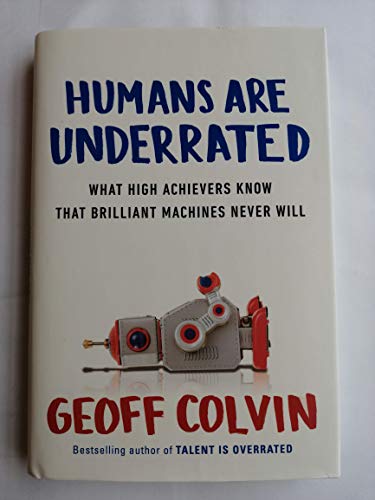
As technology races ahead, what will people do better than computers?
What hope will there be for us when computers can drive cars better than humans, predict Supreme Court decisions better than legal experts, identify faces, scurry helpfully around offices and factories, even perform some surgeries, all faster, more reliably, and less expensively than people?
It’s easy to imagine a nightmare scenario in which computers simply take over most of the tasks that people now get paid to do. While we’ll still need high-level decision makers and computer developers, those tasks won’t keep most working-age people employed or allow their living standard to rise. The unavoidable question—will millions of people lose out, unable to best the machine?—is increasingly dominating business, education, economics, and policy.
The bestselling author of Talent Is Overrated explains how the skills the economy values are changing in historic ways. The abilities that will prove most essential to our success are no longer the technical, classroom-taught left-brain skills that economic advances have demanded from workers in the past. Instead, our greatest advantage lies in what we humans are most powerfully driven to do for and with one another, arising from our deepest, most essentially human abilities—empathy, creativity, social sensitivity, storytelling, humor, building relationships, and expressing ourselves with greater power than logic can ever achieve. This is how we create durable value that is not easily replicated by technology—because we’re hardwired to want it from humans.
These high-value skills create tremendous competitive advantage—more devoted customers, stronger cultures, breakthrough ideas, and more effective teams. And while many of us regard these abilities as innate traits—“he’s a real people person,” “she’s naturally creative”—it turns out they can all be developed. They’re already being developed in a range of far-sighted organizations, such as:
• the Cleveland Clinic, which emphasizes empathy training of doctors and all employees to improve patient outcomes and lower medical costs;
• the U.S. Army, which has revolutionized its training to focus on human interaction, leading to stronger teams and greater success in real-world missions;
• Stanford Business School, which has overhauled its curriculum to teach interpersonal skills through human-to-human experiences.
As technology advances, we shouldn’t focus on beating computers at what they do—we’ll lose that contest. Instead, we must develop our most essential human abilities and teach our kids to value not just technology but also the richness of interpersonal experience. They will be the most valuable people in our world because of it. Colvin proves that to a far greater degree than most of us ever imagined, we already have what it takes to be great.
Die Inhaltsangabe kann sich auf eine andere Ausgabe dieses Titels beziehen.
Über die Autorinnen und Autoren
GEOFF COLVIN, Fortune’s senior editor at large, is one of America’s most respected journalists. He lectures widely and is the regular lead moderator for the Fortune Global Forum. He also appears daily on the CBS Radio Network, reaching seven million listeners each week. His previous book, Talent is Overrated, was a national bestseller and has been translated into a dozen languages.
GEOFF COLVIN, Fortune’s senior editor at large, is one of America’s most respected journalists. He lectures widely and is the regular lead moderator for the Fortune Global Forum. He also appears daily on the CBS Radio Network, reaching seven million listeners each week. His previous book, Talent is Overrated, was aWall Street Journal bestseller.
Auszug. © Genehmigter Nachdruck. Alle Rechte vorbehalten.
CHAPTER ONE
COMPUTERS ARE IMPROVING FASTER THAN YOU ARE
As Technology Becomes More Awesomely Able, What Will Be the High-Value Human Skills of Tomorrow?
I am standing on a stage, behind a waist-high podium with my first name on it. To my right is a woman named Vicki; she’s behind an identical podium with her name on it. Between us is a third podium with no one behind it, just the name “Watson” on the front. We are about to play Jeopardy!
This is the National Retail Federation’s mammoth annual conference at New York City’s Javits Center, and in addition to doing some onstage moderating, I have insanely agreed to compete against IBM’s Watson, the cognitive computing system, whose power the company wants to demonstrate to the 1,200 global retail leaders sitting in front of me. Watson’s celebrated defeat of Jeopardy!’s two greatest champions is almost a year old, so I’m not expecting this to go well. But I’m not prepared for what hits me.
We get to a category called “Before and After at the Movies.” Jeopardy! aficionados have seen this category many times over the years, but I have never heard of it. First clue, for $200: “Han Solo meets up with Lando Calrissian while time traveling with Marty McFly.”
Umm . . . what?
Watson has already buzzed in. “What is The Empire Strikes Back to the Future?” it responds correctly.
It picks the same category for $400: “James Bond fights the Soviets while trying to romance Ali MacGraw before she dies.” I’m still struggling with the concept, but Watson has already buzzed in. “What is From Russia with Love Story?” Right again.
By the time I figure this out, Watson is on the category’s last clue: “John Belushi & the boys set up their fraternity in the museum where crazy Vincent Price turns people into figurines.” The correct response, as Watson instantly knows, is “What is Animal House of Wax?” Watson has run the category.
My humiliation is not totally unrelieved. I do get some questions right in other categories, and Watson gets some wrong. But at the end of our one round I have been shellacked. I actually don’t remember the score, which must be how the psyche protects itself. I just know for sure that I have witnessed something profound.
Realize that Watson is not connected to the Internet. It’s a freestanding machine just like me, relying only on what it knows. It has been loaded with the entire contents of Wikipedia, for example, and much, much more. No one types the clues into Watson; it has to hear and understand the emcee’s spoken words, just as I do. In addition, Watson is intentionally slowed down by a built-in delay when buzzing in to answer a clue. We humans must use our prehistoric muscle systems to push a button that closes a circuit and sounds the buzzer. Watson could do it at light speed with an electronic signal, so the developers interposed a delay to level the playing field. Otherwise I’d never have a prayer of winning, even if we both knew the correct response. But, of course, even with the delay, I lost.
So let’s confront reality: Watson is smarter than I am. In fact, I’m surrounded by technology that’s better than I am at sophisticated tasks. Google’s autonomous car is a better driver than I am. The company has a whole fleet of vehicles that have driven hundreds of thousands of miles with only one accident while in autonomous mode, when one of the cars was rear-ended by a human driver at a stoplight. Computers are better than humans at screening documents for relevance in the discovery phase of litigation, an activity for which young lawyers used to bill at an impressive hourly rate. Computers are better at detecting some kinds of human emotion, despite our million years of evolution that was supposed to make us razor sharp at that skill.
One more thing. I competed against Watson in early 2012. Back then it was the size of a bedroom. As I write, it has shrunk to the size of three stacked pizza boxes, yet it’s also 2,400 percent faster.
More broadly, information technology is doubling in power roughly every two years. I am not—and I’ll guess that you’re not either.
A NIGHTMARE FUTURE?
The mind-bending progress of information technology makes it easier every day for us to imagine a nightmare future. Computers become so capable that they’re simply better at doing thousands of tasks that people now get paid to do. Sure, we’ll still need people to make high-level decisions and to develop even smarter computers, but we won’t need enough such workers to keep the broad mass of working-age people employed, or for their living standard to rise. And so, in the imaginary nightmare future, millions of people will lose out, unable finally to best the machine, struggling hopelessly to live the lives they thought they had earned.
In fact, as we shall see, substantial evidence suggests that technology advances really are playing a role in increasingly stubborn unemployment, slow wage growth, and the trend of college graduates taking jobs that don’t require a bachelor’s degree. If technology is actually a significant cause of those trends, then the miserable outlook becomes hard to dismiss.
But that nightmare future is not inevitable. Some people have suffered as technology has taken away their jobs, and more will do so. But we don’t need to suffer. The essential reality to grasp, larger than we may realize, is that the very nature of work is changing, and the skills that the economy values are changing. We’ve been through these historic shifts a few times before, most famously in the Industrial Revolution. Each time, those who didn’t recognize the shift, or refused to accept it, got left behind. But those who embraced it gained at least the chance to lead far better lives. That’s happening this time as well.
While we’ve seen the general phenomenon before, the way that work changes is different every time, and this time the changes are greater than ever. The skills that will prove most valuable are no longer the technical, classroom-taught, left-brain skills that economic advances have demanded from workers over the past 300 years. Those skills will remain vitally important, but important isn’t the same as valuable; they are becoming commoditized and thus a diminishing source of competitive advantage. The new high-value skills are instead part of our deepest nature, the abilities that literally define us as humans: sensing the thoughts and feelings of others, working productively in groups, building relationships, solving problems together, expressing ourselves with greater power than logic can ever achieve. These are fundamentally different types of skills than those the economy has valued most highly in the past. And unlike some previous revolutions in what the economy values, this one holds the promise of making our work lives not only rewarding financially, but also richer and more satisfying emotionally.
Step one in reaching that future is to think about it in a new way. We shouldn’t focus on beating computers at what they do. We’ll lose that contest. Nor should we even follow the inviting path of trying to divine what computers inherently cannot do—because they can do more every day.
The relentless advance of computer capability is of course merely Moore’s Law at work, as it has been for decades. Still, it’s hard for us to appreciate all the implications of this simple trend. That’s because most things in our world slow down as they get bigger and older; for evidence, just look in the...
„Über diesen Titel“ kann sich auf eine andere Ausgabe dieses Titels beziehen.
Suchergebnisse für Humans Are Underrated: What High Achievers Know That...

Beispielbild für diese ISBN
Humans Are Underrated: What High Achievers Know That Brilliant Machines Never Will
Anbieter: World of Books (was SecondSale), Montgomery, IL, USA
Verkäuferbewertung 5 von 5 Sternen

Zustand: Good. Item in good condition. Textbooks may not include supplemental items i.e. CDs, access codes etc. Artikel-Nr. 00062704494
Gebraucht kaufen
EUR 3,46
Versand gratis
Versand innerhalb von USA
Versand innerhalb von USA
Anzahl: 3 verfügbar
Beispielbild für diese ISBN
Humans Are Underrated: What High Achievers Know That Brilliant Machines Never Will
Anbieter: BooksRun, Philadelphia, PA, USA
Verkäuferbewertung 5 von 5 Sternen
Hardcover. Zustand: Very Good. With dust jacket. It's a well-cared-for item that has seen limited use. The item may show minor signs of wear. All the text is legible, with all pages included. It may have slight markings and/or highlighting. Artikel-Nr. 1591847206-11-6-29
Gebraucht kaufen
EUR 5,44
Versand gratis
Versand innerhalb von USA
Versand innerhalb von USA
Anzahl: 1 verfügbar
Beispielbild für diese ISBN
Humans Are Underrated: What High Achievers Know That Brilliant Machines Never Will
Anbieter: ThriftBooks-Reno, Reno, NV, USA
Verkäuferbewertung 5 von 5 Sternen
Hardcover. Zustand: Very Good. No Jacket. May have limited writing in cover pages. Pages are unmarked. ~ ThriftBooks: Read More, Spend Less. Artikel-Nr. G1591847206I4N00
Gebraucht kaufen
EUR 5,82
Versand gratis
Versand innerhalb von USA
Versand innerhalb von USA
Anzahl: 2 verfügbar
Beispielbild für diese ISBN
Humans Are Underrated: What High Achievers Know That Brilliant Machines Never Will
Anbieter: ThriftBooks-Phoenix, Phoenix, AZ, USA
Verkäuferbewertung 5 von 5 Sternen
Hardcover. Zustand: Very Good. No Jacket. May have limited writing in cover pages. Pages are unmarked. ~ ThriftBooks: Read More, Spend Less. Artikel-Nr. G1591847206I4N00
Gebraucht kaufen
EUR 5,82
Versand gratis
Versand innerhalb von USA
Versand innerhalb von USA
Anzahl: 2 verfügbar
Beispielbild für diese ISBN
Humans Are Underrated: What High Achievers Know That Brilliant Machines Never Will
Anbieter: ThriftBooks-Atlanta, AUSTELL, GA, USA
Verkäuferbewertung 5 von 5 Sternen
Hardcover. Zustand: Very Good. No Jacket. Former library book; May have limited writing in cover pages. Pages are unmarked. ~ ThriftBooks: Read More, Spend Less. Artikel-Nr. G1591847206I4N10
Gebraucht kaufen
EUR 5,84
Versand gratis
Versand innerhalb von USA
Versand innerhalb von USA
Anzahl: 1 verfügbar
Beispielbild für diese ISBN
Humans Are Underrated: What High Achievers Know That Brilliant Machines Never Will
Anbieter: ThriftBooks-Dallas, Dallas, TX, USA
Verkäuferbewertung 5 von 5 Sternen
Hardcover. Zustand: Very Good. No Jacket. May have limited writing in cover pages. Pages are unmarked. ~ ThriftBooks: Read More, Spend Less. Artikel-Nr. G1591847206I4N00
Gebraucht kaufen
EUR 5,84
Versand gratis
Versand innerhalb von USA
Versand innerhalb von USA
Anzahl: 3 verfügbar
Beispielbild für diese ISBN
Humans Are Underrated: What High Achievers Know That Brilliant Machines Never Will
Anbieter: ThriftBooks-Atlanta, AUSTELL, GA, USA
Verkäuferbewertung 5 von 5 Sternen
Hardcover. Zustand: Good. No Jacket. Missing dust jacket; Pages can have notes/highlighting. Spine may show signs of wear. ~ ThriftBooks: Read More, Spend Less. Artikel-Nr. G1591847206I3N01
Gebraucht kaufen
EUR 5,84
Versand gratis
Versand innerhalb von USA
Versand innerhalb von USA
Anzahl: 1 verfügbar
Beispielbild für diese ISBN
Humans Are Underrated: What High Achievers Know That Brilliant Machines Never Will
Anbieter: ThriftBooks-Atlanta, AUSTELL, GA, USA
Verkäuferbewertung 5 von 5 Sternen
Hardcover. Zustand: Very Good. No Jacket. Missing dust jacket; May have limited writing in cover pages. Pages are unmarked. ~ ThriftBooks: Read More, Spend Less. Artikel-Nr. G1591847206I4N01
Gebraucht kaufen
EUR 5,84
Versand gratis
Versand innerhalb von USA
Versand innerhalb von USA
Anzahl: 1 verfügbar
Beispielbild für diese ISBN
Humans Are Underrated: What High Achievers Know That Brilliant Machines Never Will
Anbieter: Wonder Book, Frederick, MD, USA
Verkäuferbewertung 5 von 5 Sternen
Zustand: Good. Good condition. Very Good dust jacket. A copy that has been read but remains intact. May contain markings such as bookplates, stamps, limited notes and highlighting, or a few light stains. Artikel-Nr. T12I-02763
Gebraucht kaufen
EUR 6,23
Versand gratis
Versand innerhalb von USA
Versand innerhalb von USA
Anzahl: 1 verfügbar
Beispielbild für diese ISBN
Humans Are Underrated : Proving Your Value in the Age of Brilliant Technology
Anbieter: Better World Books, Mishawaka, IN, USA
Verkäuferbewertung 5 von 5 Sternen
Zustand: Good. Pages intact with minimal writing/highlighting. The binding may be loose and creased. Dust jackets/supplements are not included. Stock photo provided. Product includes identifying sticker. Better World Books: Buy Books. Do Good. Artikel-Nr. 9312751-6
Gebraucht kaufen
EUR 6,37
Versand gratis
Versand innerhalb von USA
Versand innerhalb von USA
Anzahl: 1 verfügbar