
Verwandte Artikel zu Less Is More: How Great Companies Use Productivity
Inhaltsangabe
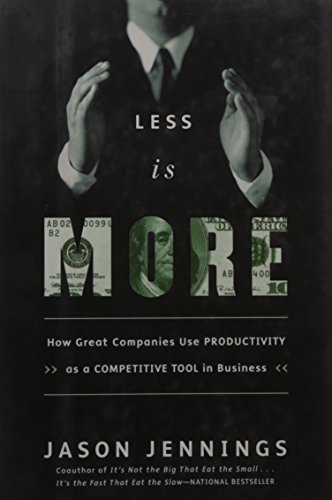
A guide for managers on how to increase productivity without adding headcount or other overhead costs offers advice on how to promote efficiency, keep track of budget dollars, and use technology and automation. 35,000 first printing.
Die Inhaltsangabe kann sich auf eine andere Ausgabe dieses Titels beziehen.
Über die Autorinnen und Autoren
Jason Jennings has spent more than twenty years teaching businesspeople how to build great organizations. He gives more than sixty keynote speeches every year and is the author of two previous business bestsellers: Less Is More and It's Not the Big That Eat the Small, It's the Fast that Eat the Slow. He lives near San Francisco.
Jason Jennings has spent more than twenty years teaching businesspeople how to build great organizations. He gives more than sixty keynote speeches every year and is the author of two previous business bestsellers:Less Is More and It's Not the Big That Eat the Small, It's the Fast that Eat the Slow. He lives near San Francisco.
Auszug. © Genehmigter Nachdruck. Alle Rechte vorbehalten.
1
A Simple BIG Objective
In the absence of a simple BIG objective to act as a unifying force, no leader or manager can hope to make a company more productive.
-Bill Zollars, CEO, Yellow Freight
Before committing even one word to paper, as I led my research team to begin the initial work of identifying a group of the world's most productive companies and figuring out how they do what they do, I'd have never guessed-not in a million years-what the theme would turn out to be for this opening chapter.
After all, the book was intended as a collection of the tactics employed by these firms to be more efficient than other businesses, proving the proposition that Less Is More. I'd imagined getting right into things with machine gun staccato . . . bang, they do this, bang, bang, they do that, bang, bang, bang!
Then a big discovery went boom and got in the way of my plans. Here it is: In productive companies, the culture is the strategy.
As I crisscrossed the United States and traveled the world, hanging out with the customers, workers, managers and leaders of companies where less is more, a single indisputable fact kept confronting me:
Unlike other companies, productive companies know the difference between tactics and strategy.
That difference is the foundation that allows them to stay focused and build remarkable companies. They have institutionalized their strategy.
There's a lot of bang, bang, bang stuff in the chapters to follow but, as a result of our exhaustive research, I'm convinced that a company will never become truly productive unless the management can learn to nail down the differences between strategy and tactics and allow the strategy to become the culture.
Strategy du Jour
If you keep your ears open on airplanes, at business meetings and in boardrooms, you'll hear the word "strategy" tossed around so frequently as to render it meaningless. It seems everyone has a strategy for this, a strategy for that, a strategy for everything from dealing with the kids to buying a new laptop to handling the boss . . . and yep, one for being more productive. And how many people do you know who have climbed the corporate ladder because management (or human resources) identified them as "strategic thinkers"? What's even more alarming is the frequency with which companies discard one "strategy" for another in the name of being flexible. Grasping at tactic after tactic, trying this and trying that and incorrectly labeling everything they attempt as a "strategy," most companies cloud the climate, confuse the troops and do the opposite of what it takes to be productive. Productive companies keep everything clear and simple-everything including strategy.
As I came to the end of my in-depth interviews with the CEOs of the companies covered in this book, I was struck by the fact that each shared this in common; the ownership of and fierce loyalty to a very simple big objective. The big objective was the strategy and it became the culture; everything else was tactics on how to achieve it.
All of these leaders vigorously prevent anyone from mucking up their drive for productivity with some strategy du jour or the latest alphabet-soup management theory.
Imagine for a moment the power of everyone in your organization-whether a ten-employee restaurant or a thirty-thousand-worker transportation company-knowing and striving to achieve a simple big objective.
While having everyone in a company share this simple BIG objective might seem to be simply common sense, as the age-old maxim goes, the most common thing about common sense . . . is how uncommon it is.
So what are these strategies-these BIG objectives-that are held so firmly by the leaders of some of the most productive businesses in the world?
NOPE! It's Not That Vision Thing Again
People who have survived the mission and vision thing give a knowing grin and agree that most of those grandiose statements are fit only to be framed on the wall of the reception area, put on the cover of the annual report and talked about with the head honcho to show you're on the team. They definitely are not ideas anybody would actually try to carry out to get the job done better. Unfortunately, lofty mission and vision statements, like all the other empty promises too many companies make, have a rich history of not being worth squat.
The real grunt work involved in building a productive company doesn't happen in the boardroom or executive offices; it's done on the shop floor, in the offices, on the factory line, on the retail sales floor and in the field. The very people who have the ability to make a business more productive have "been there, seen that, done that" with the vision thing.
The Power of a Simple BIG Objective
One company that's a poster child for productivity, Lantech, based in Louisville, Kentucky, discovered the need for a simple BIG objective the hard way. The traditional means for a company to ready their product for shipment involve putting the individual units in boxes, putting lots of little boxes together to make a big box, then wrapping these big boxes in plastic sheeting and sending them through a heated tunnel to form a weatherproof shrink-wrap. When the big boxes come out of the tunnel, they're stacked on a pallet for forklifting onto a truck or railcar.
During the U.S. energy crisis of the 1970s, Lantech founder and chairman Pat Lancaster came up with the idea of wrapping pallets of boxes tightly with strong plastic from a continuous roll. (Picture wrapping a rubber band around your fingers a number of times.) The process meant no more need for shrink-wrap heating, which translated into significant energy savings. Patenting this process and equipment designs, the company spent the 1980s making money hand over fist. Lantech was (excuse the pun) on a roll. Today it's the world leader in stretch wrappers, palletizers and conveyor systems.
That's the bright side of the story but there was a dark side, as well. By Lancaster's admission the company wasn't doing a very good job in a lot of areas. "Quality and customer service were poor, the factory was inefficient, but there was so much demand that we just kept doing things the same old way." Until one day in 1990. "After arguments all the way to the Supreme Court," he says, "we lost our patent protection and overnight everything changed. We had to admit to ourselves that we'd been selling wheelbarrows and been pretty arrogant about it. All of a sudden everybody else could sell the same wheelbarrow. It would no longer be enough to say we didn't suck worse than our competition." Pat Lancaster realized in the dark of night and in the bright light of day that the company's free ride had ended. Unless he could dramatically reduce inventories, improve product quality, deliver superior customer service and become more productive, the days of Lantech as a company were numbered.
During the next ten years, Lantech tripled sales without increasing staff, slashed the time it took to build a single machine from five weeks to eleven hours(!), and increased productivity 1 percent a month for the entire time period-all because of one man's focus.
Pat Lancaster's simple BIG objective was to become the most efficient and productive manufacturing plant on the planet and do things better than they'd ever been done.
What? A Company More Productive Than Wal-Mart? Where?
In 1982, New Zealander Stephen Tindall founded The Warehouse, a single-location discount store in Auckland. Fast-forward twenty years and you'll find this publicly traded chain of two hundred stores across New Zealand and Australia outperforming America's Wal-Mart in every metric of productivity. While Wal-Mart puts 3.3 pennies of each sales dollar to the bottom line, The Warehouse puts 6.6. And while Wal-Mart achieves a stunning 24 percent return on equity, The Warehouse smokes them with a...
„Über diesen Titel“ kann sich auf eine andere Ausgabe dieses Titels beziehen.
Suchergebnisse für Less Is More: How Great Companies Use Productivity

Beispielbild für diese ISBN
Less is More
Verlag:
Penguin Random House Australia, 2006
ISBN 10: 1591840015
ISBN 13: 9781591840015
Gebraucht
Hardcover
Anbieter: World of Books (was SecondSale), Montgomery, IL, USA
Verkäuferbewertung 5 von 5 Sternen

Hardback. Zustand: Good. Artikel-Nr. 00080338286
Gebraucht kaufen
EUR 4,27
Versand gratis
Versand innerhalb von USA
Versand innerhalb von USA
Anzahl: 6 verfügbar
Beispielbild für diese ISBN
Less is More
Verlag:
Penguin Random House Australia, 2006
ISBN 10: 1591840015
ISBN 13: 9781591840015
Gebraucht
Hardcover
Anbieter: World of Books (was SecondSale), Montgomery, IL, USA
Verkäuferbewertung 5 von 5 Sternen
Hardback. Zustand: Very Good. Artikel-Nr. 00107316098
Gebraucht kaufen
EUR 4,27
Versand gratis
Versand innerhalb von USA
Versand innerhalb von USA
Anzahl: 1 verfügbar
Beispielbild für diese ISBN
Less Is More: How Great Companies Use Productivity
Anbieter: BooksRun, Philadelphia, PA, USA
Verkäuferbewertung 5 von 5 Sternen
Hardcover. Zustand: Very Good. 1. With dust jacket. It's a well-cared-for item that has seen limited use. The item may show minor signs of wear. All the text is legible, with all pages included. It may have slight markings and/or highlighting. Artikel-Nr. 1591840015-11-18-29
Gebraucht kaufen
EUR 5,65
Versand gratis
Versand innerhalb von USA
Versand innerhalb von USA
Anzahl: 1 verfügbar
Beispielbild für diese ISBN
Less Is More: How Great Companies Use Productivity
Anbieter: BooksRun, Philadelphia, PA, USA
Verkäuferbewertung 5 von 5 Sternen
Hardcover. Zustand: Very Good. 1. It's a well-cared-for item that has seen limited use. The item may show minor signs of wear. All the text is legible, with all pages included. It may have slight markings and/or highlighting. Artikel-Nr. 1591840015-11-1
Gebraucht kaufen
EUR 5,81
Versand gratis
Versand innerhalb von USA
Versand innerhalb von USA
Anzahl: 1 verfügbar
Beispielbild für diese ISBN
Less Is More : How Great Companies Use Productivity As a Competitive Tool in Business
Verlag:
Penguin Publishing Group, 2002
ISBN 10: 1591840015
ISBN 13: 9781591840015
Gebraucht
Hardcover
Anbieter: Better World Books, Mishawaka, IN, USA
Verkäuferbewertung 5 von 5 Sternen
Zustand: Good. Former library copy. Pages intact with minimal writing/highlighting. The binding may be loose and creased. Dust jackets/supplements are not included. Includes library markings. Stock photo provided. Product includes identifying sticker. Better World Books: Buy Books. Do Good. Artikel-Nr. GRP73242945
Gebraucht kaufen
EUR 6,38
Versand gratis
Versand innerhalb von USA
Versand innerhalb von USA
Anzahl: 1 verfügbar
Beispielbild für diese ISBN
Less Is More : How Great Companies Use Productivity As a Competitive Tool in Business
Verlag:
Penguin Publishing Group, 2002
ISBN 10: 1591840015
ISBN 13: 9781591840015
Gebraucht
Hardcover
Anbieter: Better World Books: West, Reno, NV, USA
Verkäuferbewertung 5 von 5 Sternen
Zustand: Very Good. Pages intact with possible writing/highlighting. Binding strong with minor wear. Dust jackets/supplements may not be included. Stock photo provided. Product includes identifying sticker. Better World Books: Buy Books. Do Good. Artikel-Nr. GRP73176349
Gebraucht kaufen
EUR 6,38
Versand gratis
Versand innerhalb von USA
Versand innerhalb von USA
Anzahl: 1 verfügbar
Beispielbild für diese ISBN
Less Is More : How Great Companies Use Productivity As a Competitive Tool in Business
Verlag:
Penguin Publishing Group, 2002
ISBN 10: 1591840015
ISBN 13: 9781591840015
Gebraucht
Hardcover
Anbieter: Better World Books, Mishawaka, IN, USA
Verkäuferbewertung 5 von 5 Sternen
Zustand: Very Good. Former library copy. Pages intact with possible writing/highlighting. Binding strong with minor wear. Dust jackets/supplements may not be included. Includes library markings. Stock photo provided. Product includes identifying sticker. Better World Books: Buy Books. Do Good. Artikel-Nr. 11143062-6
Gebraucht kaufen
EUR 6,38
Versand gratis
Versand innerhalb von USA
Versand innerhalb von USA
Anzahl: 1 verfügbar
Beispielbild für diese ISBN
Less Is More: How Great Companies Use Productivity
Anbieter: ThriftBooks-Atlanta, AUSTELL, GA, USA
Verkäuferbewertung 5 von 5 Sternen
Hardcover. Zustand: As New. No Jacket. Pages are clean and are not marred by notes or folds of any kind. ~ ThriftBooks: Read More, Spend Less. Artikel-Nr. G1591840015I2N00
Gebraucht kaufen
EUR 6,44
Versand gratis
Versand innerhalb von USA
Versand innerhalb von USA
Anzahl: 1 verfügbar
Beispielbild für diese ISBN
Less Is More: How Great Companies Use Productivity
Anbieter: Wonder Book, Frederick, MD, USA
Verkäuferbewertung 5 von 5 Sternen
Zustand: Very Good. Very Good condition. Very Good dust jacket. A copy that may have a few cosmetic defects. May also contain light spine creasing or a few markings such as an owner's name, short gifter's inscription or light stamp. Artikel-Nr. J07O-00570
Gebraucht kaufen
EUR 6,57
Versand gratis
Versand innerhalb von USA
Versand innerhalb von USA
Anzahl: 2 verfügbar