
Verwandte Artikel zu Distracted: The Erosion of Attention and the Coming...
Inhaltsangabe
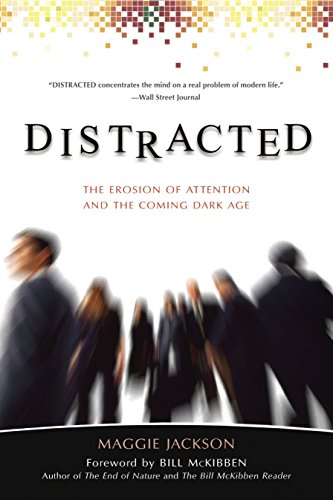
In this gripping exposé of our cyber-centric, attention-deficient life, journalist Maggie Jackson argues that we are eroding our capacity for deep attention and mindfulness — the building blocks of intimacy, wisdom, and cultural progress. The implications for a healthy society are stark.
Despite our wondrous technologies and scientific advances, we are nurturing a culture of diffusion and detachment. With our attention scattered among the beeps and pings of a push-button world, we are less and less able to pause, reflect, and deeply connect.
In her sweeping quest to unravel the nature of attention and detail its losses, Jackson introduces us to scientists, cartographers, marketers, educators, wired teens, and even roboticists. She offers us a compelling wake-up call, an adventure story, and reasons for hope.
As the author shows, neuroscience is just now decoding the workings of attention, with its three pillars of focus, awareness, and judgment, and revealing how these skills can be shaped and taught. This is exciting news for all of us living in an age of overload.
Pull over, hit the pause button, and prepare for an eye-opening journey. More than ever, we cannot afford to let distraction become the marker of our time.
Die Inhaltsangabe kann sich auf eine andere Ausgabe dieses Titels beziehen.
Über die Autorin bzw. den Autor
Maggie Jackson is an award-winning author and journalist who writes the popular "Balancing Acts" column in the Boston Globe. Her work also has appeared in the New York Times and on National Public Radio, among other national publications. Her acclaimed first book, What’s Happening to Home? Balancing Work, Life and Refuge in the Information Age, examined the loss of home as a refuge.
Auszug. © Genehmigter Nachdruck. Alle Rechte vorbehalten.
Preface to the New Edition
The pace was brisk and the dialogue frenetic. The one-liners flew thick and fast. In a small New York theater, I was watching Distracted, a play centered on a mother’s struggle to cope with her nine-year-old son’s attention deficit disorder. The year was 2009. Onstage, a mammoth wall of television monitors spewing sports, news, and sitcoms competed with the actors for the spectators’ attention. And just in front of me, two women in the audience compounded the evening’s cacophony with a running sideshow of phone-checking and chatter.
Nearly a decade ago, the world was growing ever more noisy and overloaded. We didn’t need to fire up a laptop, a BlackBerry, or its new competitor the iPhone to feel the insistent clamor of modern life. Were these glorious new riches for the heart and mind or an excess to be feared? we wondered. “This is an ADD society,” Distracted’s playwright Lisa Loomer told an interviewer, “and I don’t know whether this is a dysfunction or a difference.” It was the heyday, after all, of our yearning to live in the fast lane. Multitasking was a job description, a sure mark of success. Juggling was a mother’s main ambition, the booster rocket to having it all. The problem of distraction, we fervently hoped, was someone else’s burden, a malady for those who simply couldn’t keep up. We didn’t need to pay much attention to the costs of this way of living, or so we thought. The future was ours to splice. Distracted, the play, was billed as a comedy.
Now the curtain rarely falls on quick-cut, split-focus living. A crisis of inattention has crept onto center stage of an increasingly technological world. Skimming as a mainstay, days mired in trivia, interactions faceless and fractured, perpetually shattered focus: all these are no longer the daily diet of an elite and busy few. Toddlers stare with glazed eyes at the screen of the moment, oblivious to the real world blooming all around them. Early on, they learn that neat, easy answers come from gleaming little boxes that mesmerize their parents. In an era prizing diffusion, the young in effect are groomed to be half there, in class or at the dinner table, in the office or crossing the street. By one estimate, people check their devices an average of eighty-five times or more a day, anxiously searching for yet another dopamine-laced reward. So habituated are we to the siren song of being elsewhere that the mere presence of our own phone, silent and untouched, dramatically undermines our powers of focus. A Pandora’s box has sprung open. The struggle now seems real, and we are increasingly torn and uneasy. Americans are almost evenly divided over whether technology has had a positive overall effect on their lives. A majority of middle and high school teachers now believe that technologies do more to distract students than to help them academically. Is all this just the price to be paid for progress? Or are we, at growing cost to our very humanity, chasing a mirage?
A decade ago, the signs were all there and this book sounded a prescient warning. We have been perilously slow, however, in waking up to a crisis of our own making and even to the depths of our distraction. Avid multitaskers, for instance, are least able to juggle well and yet are most confident in their ability to do so. Or consider that beckoning phone. In laboratory studies, most of those whose focus is impaired in the presence of their devices later insist that they have not been affected at all. They are oblivious to what scientist Adrian Ward calls the “brain drain” of distrac-tion. Are we at last willing to question our hubris and take the full measure of our plight? Are we ready to face up to one of the most pressing problems of our age? Today I see our growing unease as a starting point, a potent spur toward an urgently needed reckoning. Attention is the stepping-stone to wisdom, intimacy, and creativity. It is the capacity that decides the fate of the present moment and determines the shape of the future. Without it, we are adrift. It is now time to focus on what matters and give attention its due.
As I write these words, a public outcry has erupted, condemning the behemoths of Facebook, Twitter, Google, and Apple for failing to protect our data and our politics from hackers. But perhaps most unsettling has been the discovery that the inventors whom we so revere have themselves been hacking our minds. “Their most precious asset, is our most precious asset, our attention, and they have abused it,” writes critic Franklin Foer. To public applause, Google turncoat Tristan Harris reveals the brain-hacking tricks that the “world’s smartest minds” have devised to influence people’s every online move: the slot machine–like bursts of rewards that keep us hooked to our devices, the urgency implied by notifications that constantly interrupt us, and the video autoplay that undercuts a viewer’s agency. Day by day, increasingly sophisticated technologies exploit the ceaseless yearning for validation and novelty that underlies human survival. “It’s the devil’s work,” a sales executive tells me, holding up his phone as we stand outside a funeral home waiting in line to enter a wake. He seems distressed and yet proud that he is constantly needed, or so his device tells him. Out of the corner of my eye, I see him struggle to finish a text just before we reach the casket.
Is escape then our best recourse for salvaging what one app developer calls our “cognitive liberty”? Not long ago, a detox referred to a renunciation of drugs or alcohol by abusers; now it is more often synonymous with a comic-tragic hiatus from technology that’s open to all. A grand-mother relates that her friends force their grandchildren to park their screens in baskets by the front door when they visit. Professors assign brief withdrawals to tremulous students. Joining a burgeoning market-place for digital detox retreats, hotels from Paris to Pittsburgh offer to lock up guests’ devices before ushering them to tech-free spas or suites. The off button, we believe, can keep distraction at bay, allowing for a magical restoration of all that we have lost in a time of stolen attention. It offers a Romantic hope, a page from Rousseau: if we can withdraw from our devices, we can be cleansed of the toxins of digital living and recover the gifts of an attentive mind. We once again can frolic, as Keats wrote in Ode to Psyche, in “the wreath’d trellis of a working brain.”
Yet so often we falter, eschewing or outright failing the Facebook Fast or Media Sabbath. Sixty-five percent of American adults deem periodic unplugging important for their mental health, yet less than a third of those who say this do so. In one experiment, most of one thousand college students from ten countries couldn’t last twenty-four hours without media, even for a class assignment. Some quit after just half an hour. When I interviewed University of Maryland students taking part in a pilot study for the project, many admitted to the merits of the detox. They had paid more attention to their studies and felt more productive. Yet the silence and aloneness of an unmediated day unnerved them. “I was out of my element almost,” said a junior, a journalism major from Boston. “I had no connection to anything.” In the end, the grand forces of distraction seem too relent-less, too inevitable, and surely too inviting to be tamed with a mere respite. And so we increasingly turn back to the machine for answers, hoping that the mechanized marvels that beset us can protect us as well.
“Technology...
„Über diesen Titel“ kann sich auf eine andere Ausgabe dieses Titels beziehen.
Suchergebnisse für Distracted: The Erosion of Attention and the Coming...

Beispielbild für diese ISBN
Distracted
Anbieter: World of Books (was SecondSale), Montgomery, IL, USA
Verkäuferbewertung 5 von 5 Sternen

Zustand: Good. Item in good condition. Textbooks may not include supplemental items i.e. CDs, access codes etc. Artikel-Nr. 00091221546
Gebraucht kaufen
EUR 3,96
Versand gratis
Versand innerhalb von USA
Versand innerhalb von USA
Anzahl: 3 verfügbar
Beispielbild für diese ISBN
Distracted
Verlag:
G38-Prometheus (edition 6/15/10), 2009
ISBN 10: 1591027489
ISBN 13: 9781591027485
Gebraucht
Paperback
Anbieter: BooksRun, Philadelphia, PA, USA
Verkäuferbewertung 5 von 5 Sternen
Paperback. Zustand: Very Good. 6/15/10. It's a well-cared-for item that has seen limited use. The item may show minor signs of wear. All the text is legible, with all pages included. It may have slight markings and/or highlighting. Artikel-Nr. 1591027489-11-1
Gebraucht kaufen
EUR 5,64
Versand gratis
Versand innerhalb von USA
Versand innerhalb von USA
Anzahl: 1 verfügbar
Beispielbild für diese ISBN
Distracted: The Erosion of Attention and the Coming Dark Age
Anbieter: Wonder Book, Frederick, MD, USA
Verkäuferbewertung 5 von 5 Sternen
Zustand: Very Good. Very Good condition. A copy that may have a few cosmetic defects. May also contain light spine creasing or a few markings such as an owner's name, short gifter's inscription or light stamp. Artikel-Nr. H15O-01807
Gebraucht kaufen
EUR 6,28
Versand gratis
Versand innerhalb von USA
Versand innerhalb von USA
Anzahl: 1 verfügbar
Beispielbild für diese ISBN
Distracted: The Erosion of Attention and the Coming Dark Age
Anbieter: Wonder Book, Frederick, MD, USA
Verkäuferbewertung 5 von 5 Sternen
Zustand: Good. Good condition. A copy that has been read but remains intact. May contain markings such as bookplates, stamps, limited notes and highlighting, or a few light stains. Artikel-Nr. P04C-02118
Gebraucht kaufen
EUR 6,28
Versand gratis
Versand innerhalb von USA
Versand innerhalb von USA
Anzahl: 1 verfügbar
Beispielbild für diese ISBN
Distracted : The Erosion of Attention and the Coming Dark Age
Verlag:
The Globe Pequot Publishing Group, Inc., 2009
ISBN 10: 1591027489
ISBN 13: 9781591027485
Gebraucht
Softcover
Anbieter: Better World Books, Mishawaka, IN, USA
Verkäuferbewertung 5 von 5 Sternen
Zustand: Fine. Used book that is in almost brand-new condition. May contain a remainder mark. Better World Books: Buy Books. Do Good. Artikel-Nr. 53580302-6
Gebraucht kaufen
EUR 6,42
Versand gratis
Versand innerhalb von USA
Versand innerhalb von USA
Anzahl: 1 verfügbar
Beispielbild für diese ISBN
Distracted : The Erosion of Attention and the Coming Dark Age
Verlag:
The Globe Pequot Publishing Group, Inc., 2009
ISBN 10: 1591027489
ISBN 13: 9781591027485
Gebraucht
Softcover
Anbieter: Better World Books, Mishawaka, IN, USA
Verkäuferbewertung 5 von 5 Sternen
Zustand: Very Good. Pages intact with possible writing/highlighting. Binding strong with minor wear. Dust jackets/supplements may not be included. Stock photo provided. Product includes identifying sticker. Better World Books: Buy Books. Do Good. Artikel-Nr. 9006683-6
Gebraucht kaufen
EUR 6,42
Versand gratis
Versand innerhalb von USA
Versand innerhalb von USA
Anzahl: 1 verfügbar
Beispielbild für diese ISBN
Distracted : The Erosion of Attention and the Coming Dark Age
Verlag:
The Globe Pequot Publishing Group, Inc., 2009
ISBN 10: 1591027489
ISBN 13: 9781591027485
Gebraucht
Softcover
Anbieter: Better World Books, Mishawaka, IN, USA
Verkäuferbewertung 5 von 5 Sternen
Zustand: Good. Pages intact with minimal writing/highlighting. The binding may be loose and creased. Dust jackets/supplements are not included. Stock photo provided. Product includes identifying sticker. Better World Books: Buy Books. Do Good. Artikel-Nr. 4425852-6
Gebraucht kaufen
EUR 6,42
Versand gratis
Versand innerhalb von USA
Versand innerhalb von USA
Anzahl: 1 verfügbar
Beispielbild für diese ISBN
Distracted: The Erosion of Attention and the Coming Dark Age
Anbieter: ThriftBooks-Dallas, Dallas, TX, USA
Verkäuferbewertung 5 von 5 Sternen
Paperback. Zustand: Very Good. No Jacket. May have limited writing in cover pages. Pages are unmarked. ~ ThriftBooks: Read More, Spend Less. Artikel-Nr. G1591027489I4N00
Gebraucht kaufen
EUR 7,17
Versand gratis
Versand innerhalb von USA
Versand innerhalb von USA
Anzahl: 1 verfügbar
Beispielbild für diese ISBN
Distracted: The Erosion of Attention and the Coming Dark Age
Anbieter: ThriftBooks-Reno, Reno, NV, USA
Verkäuferbewertung 5 von 5 Sternen
Paperback. Zustand: Very Good. No Jacket. May have limited writing in cover pages. Pages are unmarked. ~ ThriftBooks: Read More, Spend Less. Artikel-Nr. G1591027489I4N00
Gebraucht kaufen
EUR 7,17
Versand gratis
Versand innerhalb von USA
Versand innerhalb von USA
Anzahl: 1 verfügbar
Beispielbild für diese ISBN
Distracted: The Erosion of Attention and the Coming Dark Age
Anbieter: ThriftBooks-Atlanta, AUSTELL, GA, USA
Verkäuferbewertung 5 von 5 Sternen
Paperback. Zustand: Very Good. No Jacket. May have limited writing in cover pages. Pages are unmarked. ~ ThriftBooks: Read More, Spend Less. Artikel-Nr. G1591027489I4N00
Gebraucht kaufen
EUR 7,17
Versand gratis
Versand innerhalb von USA
Versand innerhalb von USA
Anzahl: 1 verfügbar