
Pest Control: An Assassin Bug Thriller (Assassin Bug Thrillers) - Softcover
Buch 1 von 2: Assassin Bug Thrillers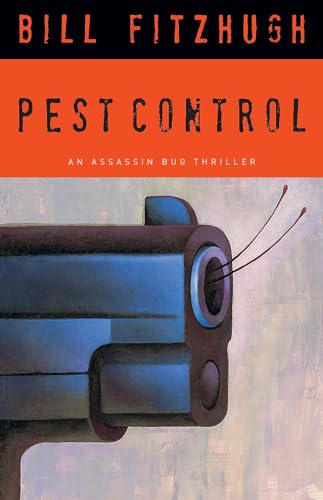
Inhaltsangabe
Bob Dillon can't get a break. A down-on-his-luck exterminator, all he wants is his own truck with a big fiberglass bug on top -- and success with his radical new, environmentally friendly pest-killing technique. So Bob decides to advertise.
Unfortunately, one of his flyers falls into the wrong hands. Marcel, a shady Frenchman, needs an assassin to handle a million-dollar hit, and he figures that Bob Dillon is his man. Through no fault -- or participation -- of his own, this unwitting pest controller from Queens has become a major player in the dangerous world of contract murder.
And now Bob's running for his life through the wormiest sections of the Big Apple -- one step ahead of a Bolivian executioner, a homicidal transvestite dwarf, meatheaded CIA agents, cabbies packing serious heat ... and the world's number-one hit man, who might just turn out to be the best friend Bob's got.
Die Inhaltsangabe kann sich auf eine andere Ausgabe dieses Titels beziehen.
Über die Autorin bzw. den Autor
Bill Fitzhugh is the award-winning author of eight satiric crime novels. The New York Times called him "a strange and deadly amalgam of screenwriter and comic novelist. His facility and wit, and his taste for the perverse, put him in a league with Carl Hiaasen and Elmore Leonard." Fitzhugh's debut novel, Pest Control, was one of Amazon's Top 50 mysteries in 1997; it has been translated into half a dozen languages, produced as a stage musical, and a German radio show. Warner Brothers owns the film rights. Since 2005, Fitzhugh has also written, produced, and hosted "Fitzhugh's All Hand Mixed Vinyl" on Sirius-XM Satellite Radio's Deep Tracks channel. He is one of only three outside hosts on Deep Tracks. The other two are Tom Petty and Bob Dylan.
Auszug. © Genehmigter Nachdruck. Alle Rechte vorbehalten.
Pest Control
An Assassin Bug ThrillerBy Bill FitzhughPoisoned Pen Press
Copyright © 2011 Bill FitzhughAll right reserved.
ISBN: 978-1-59058-550-4
Chapter One
His eyes were metallic blue jewel beetles peering out at the world from underneath a pair of furry black caterpillars. He was in good shape for thirty-five, with broad shoulders and nicely muscled arms. Topping off his six-foot frame was a swarm of dark, wavy hair and a gentle smile that lent him an affable aspect, a chewy niceness. Just looking at him you'd never guess he was a professional killer.He lived in New York City, a place where, on average, someone was hit by gunfire every eighty-eight minutes. This annoyed him greatly because it was so hard to get noticed in a place like that. And if he was going to succeed as a paid killer, he was going to need a reputation. So right now he was out to make a name for himself—a name other than the one he had.
When he was born in March of 1963, his parents—Curtis and Edna Dillon of Newark, New Jersey—were thoroughly unaware that one year earlier, Robert Allen Zimmerman of Duluth, Minnesota had released his first album under the pseudonym Bob Dylan. So, looking back, it was purely a case of bad timing when Curtis and Edna named their son Bob.
Bob Dillon.
Sure, it was spelled differently, but it sounded the same, and that was all that mattered. As a consequence Bob Dillon endured a humiliating childhood, all too frequently being forced by neighborhood bullies to sing the Dylan classic, "Rainy Day Women #12 & 35."
Bob hated doing this, not only because he couldn't sing and because he knew his off-key rendition would inevitably result in taunting and laughter, but also because he hated the song and couldn't understand why it was titled as it was since there was never any mention of women, rainy day or otherwise, much less those numbered twelve and thirty-five.
Neither could he ever understand how the song reached number two on the pop charts in 1966. To Bob it was just an endless succession of unimaginative variations on "They'll stone you when you're driving in your car ..." This carried on interminably until it reached its obtuse chorus of, "Everybody must get stoned!"
Bob always imagined his childhood wouldn't have been so bad had he been forced to sing "Like a Rolling Stone" or "Mr. Tambourine Man"—songs he actually enjoyed. Fortunately, Bob possessed a resilient and compassionate character, so he never blamed his parents for the abuse he suffered at the hands of neighborhood bullies. In fact, except for the murderous profession he eventually undertook, Bob never showed even the slightest ill effect resulting from his name.
So, yeah, Bob planned on making a name for himself alright, but right now he had a contract to fulfill.
He opened the door and found himself standing at the top of a flight of stairs leading down into darkness. He hit the light switch, illuminating his khaki jump suit and the case he carried. It was dented and scuffed, evidence of a lot of jobs. A lot of killing.
Bob crept cautiously down the creaking wooden stairs, dodging spider webs as he descended into the dank basement. He crossed to a corner of the room where he set his case on the damp concrete floor. He flipped the rusting brass latches and threw it open.
As he reached into the case he glanced at his wrist and the solid-plastic Casio timepiece: 2:00 p.m. "Right on time," he muttered to a cockroach that scurried past.
With a practiced, almost mechanical, skill Bob picked up a long, slender tube and screwed it into an exotic-looking curved wooden handle. He attached a valve gate to the apparatus then connected one end of a hose to the tube and the other end to a small compression tank. Those tasks completed, he carefully opened a valve and pumped the plunger on the tank and then flipped the valve gate, watching as the cylinder pressure gauge jumped to three hundred pounds of attention. He smiled.
"I am here to deal death," Bob mused out loud. He chuckled to himself.
Next, he pulled a two-inch hole-drilling attachment from his case and attached it to the business end of a battery-powered Black and Decker drill. Then he tested it, whrrrrrrzzzzzzz.
Satisfied with his tool, Bob knelt and bored a hole near the baseboard. He pulled a penlight from his pocket, peered into the hole and saw what he was there to kill: Periplaneta Americana, a.k.a. the American cockroach. Dozens of them.
"If I had my way," Bob said wistfully, "your deaths would be much more dignified."
This wasn't idle chatter.
Not at all.
For Bob dreamed of a day when things would be different. Bob Dillon, Brooklyn exterminator, had invented an all-natural pest-control method that wouldn't poison the environment like conventional methods. In a best-case scenario, it was a method that just might make Bob rich.
His idea revolved around members of the Reduviidae family, insects commonly known as Assassin Bugs. These murderous invertebrates occupied a specific place in the overall scheme of things. Diagrammed, it looked just like this:
KINGDOM-Animal --PHYLUM–Arthropoda ---CLASS–Insecta -----ORDER–Hemiptera -------FAMILY–Reduviidae ---------GENERA–(several) ------------SPECIES–(several)
These menacing insects hunted and killed others in their Class with gruesome efficiency, using their rigid and powerful piercing mouthparts to puncture the outer layer of their prey and pump in a paralyzing saliva. The Assassins injected their quarry with amylase and pectinase, enzymes which pre-digested and liquefied their victim's internal tissues, which the Assassins then sucked up through their rostrum like a buggy milkshake.
Bob was working with eight species of these insects. He planned to cross-breed these species in hopes of creating the consummate Assassin Bug—a robust, hybrid strain of predacious insect exhibiting the most desirable combination of hunting and killing traits. One species of Assassin with which Bob was working with was the Wheel Bug (Arilus cristatus), a voracious predator known to attack without hesitation and fearlessly suck dry insects twice its size, including even the largest species of cockroach.
The Wheel Bug was a stout grayish-black brute whose prothorax fanned upwards into a half-wheel of menacing coglike teeth along its midline, hence its common name. It's distinctive abdomen was characterized by what looked like tail-fins from a 1959 Cadillac. These dark dorsal ridges lay on its back at 45 degree angles and accentuated the bug's aura of menace.
Bob was also working with Masked Hunters (Reduvius per sonatus). These were relentless stalkers which brazenly entered human dwellings to secure meals of bed bugs, termites, and other insects. Stealthy and powerful, these rust-brown bugs had an intimidating and enlarged muscular thorax, as if augmented by doses of steroids and a weight program. Masked Hunters were known to pursue their quarry with an unforgiving single-mindedness that was both admirable and terrifying.
Bob imagined that the successful cross-breeding of these insects would result in a revolutionary new approach to pest management, not to mention a steady income. However, until he perfected his process of hybridization, Bob was forced to work for a franchised pest control outfit that flooded the environment with noxious poisons and required its employees to wear personality-robbing, soul-killing uniforms.
...
„Über diesen Titel“ kann sich auf eine andere Ausgabe dieses Titels beziehen.
Weitere beliebte Ausgaben desselben Titels

Suchergebnisse für Pest Control: An Assassin Bug Thriller (Assassin Bug...

Beispielbild für diese ISBN
Pest Control : An Assassin Bug Thriller
Verlag:
Sourcebooks, Incorporated, 2012
ISBN 10: 159058550X
ISBN 13: 9781590585504
Gebraucht
Softcover
Anbieter: Better World Books: West, Reno, NV, USA
Verkäuferbewertung 5 von 5 Sternen

Zustand: Very Good. Pages intact with possible writing/highlighting. Binding strong with minor wear. Dust jackets/supplements may not be included. Stock photo provided. Product includes identifying sticker. Better World Books: Buy Books. Do Good. Artikel-Nr. 18117853-6
Gebraucht kaufen
EUR 6,79
Versand gratis
Versand innerhalb von USA
Versand innerhalb von USA
Anzahl: 1 verfügbar
Beispielbild für diese ISBN
Pest Control: An Assassin Bug Thriller (Assassin Bug Thrillers)
Verlag:
Poisoned Pen Press, 2012
ISBN 10: 159058550X
ISBN 13: 9781590585504
Gebraucht
Softcover
Signiert
Anbieter: Wonder Book, Frederick, MD, USA
Verkäuferbewertung 5 von 5 Sternen
Zustand: Good. Signed Copy . Signed by author on title page. Artikel-Nr. SA04F-00081
Gebraucht kaufen
EUR 6,79
Versand gratis
Versand innerhalb von USA
Versand innerhalb von USA
Anzahl: 1 verfügbar
Beispielbild für diese ISBN
Pest Control : An Assassin Bug Thriller
Verlag:
Sourcebooks, Incorporated, 2012
ISBN 10: 159058550X
ISBN 13: 9781590585504
Gebraucht
Softcover
Anbieter: Better World Books, Mishawaka, IN, USA
Verkäuferbewertung 5 von 5 Sternen
Zustand: Good. Pages intact with minimal writing/highlighting. The binding may be loose and creased. Dust jackets/supplements are not included. Stock photo provided. Product includes identifying sticker. Better World Books: Buy Books. Do Good. Artikel-Nr. 9638808-6
Gebraucht kaufen
EUR 6,79
Versand gratis
Versand innerhalb von USA
Versand innerhalb von USA
Anzahl: 1 verfügbar
Beispielbild für diese ISBN
Pest Control: An Assassin Bug Thriller
Anbieter: ThriftBooks-Dallas, Dallas, TX, USA
Verkäuferbewertung 5 von 5 Sternen
Paperback. Zustand: Good. No Jacket. Pages can have notes/highlighting. Spine may show signs of wear. ~ ThriftBooks: Read More, Spend Less. Artikel-Nr. G159058550XI3N00
Gebraucht kaufen
EUR 8,92
Versand gratis
Versand innerhalb von USA
Versand innerhalb von USA
Anzahl: 1 verfügbar
Foto des Verkäufers
Pest Control: An Assassin Bug Thriller (Assassin Bug Thrillers)
Anbieter: WeBuyBooks, Rossendale, LANCS, Vereinigtes Königreich
Verkäuferbewertung 5 von 5 Sternen
Zustand: Good. Most items will be dispatched the same or the next working day. A copy that has been read but remains in clean condition. All of the pages are intact and the cover is intact and the spine may show signs of wear. The book may have minor markings which are not specifically mentioned. Artikel-Nr. rev9642900079
Gebraucht kaufen
EUR 22,35
EUR 9,70 Versand
Versand von Vereinigtes Königreich nach USA
Versand von Vereinigtes Königreich nach USA
Anzahl: 1 verfügbar