
Verwandte Artikel zu Visioneering, Revised and Updated Edition: Your Guide...
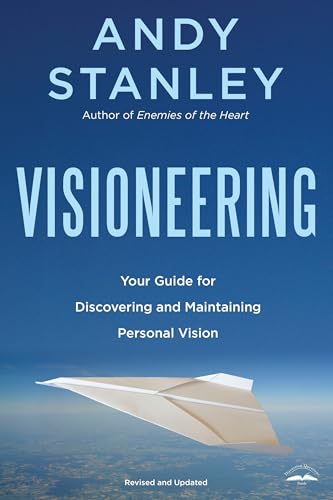
Visioneering, Revised and Updated Edition: Your Guide for Discovering and Maintaining Personal Vision - Softcover
Inhaltsangabe
Everybody ends up somewhere in life.
Wouldn’t you like to end up somewhere on purpose?
What breaks your heart?
What keeps you up at night?
What could be that should be?
Andy Stanley believes these questions are bread crumbs that lead to the discovery of personal vision. With down-to-earth practicality, Andy extracts principles from the story of Nehemiah to help you discover your purpose in life.
Visioneering includes helpful exercises and time-tested ideas for visionary decision-making, personal growth, and leadership at home and at work. Catch a glimpse of God’s incredible vision for your life, relationships, and business—and discover the passion to follow it.
Includes discussion guide for use in small groups.
Die Inhaltsangabe kann sich auf eine andere Ausgabe dieses Titels beziehen.
Über die Autorin bzw. den Autor
Communicator, author, and pastor, Andy Stanley founded Atlanta-based North Point Ministries in 1995. Today, NPM is comprised of six churches in the Atlanta area and a network of ninety churches around the globe collectively serving nearly 185,000 people weekly. As host of Your Move with Andy Stanley, with over seven million messages consumed each month through television and podcasts, and author of more than twenty books, including The New Rules for Love, Sex & Dating, Ask It, How to Be Rich, Deep & Wide, Visioneering, and Next Generation Leader, he is considered one of the most influential pastors in America. Andy and his wife, Sandra, have three grown children and live near Atlanta.
Auszug. © Genehmigter Nachdruck. Alle Rechte vorbehalten.
INTRODUCTION
Visioneering. A new word. An old concept. A familiar process. Where definitions fall short, a story often achieves clarity. So let’s begin with a story.
On December 17, 1903, at 10:35 a.m., Orville Wright secured his place in history by executing the first powered and sustained flight from level ground. For twelve gravity-defying seconds he flew 120 feet along the dunes of the Outer Banks of North Carolina.
In the field of aviation, this historic event represents a beginning. But for Orville and Wilbur Wright, it was the end of a long and tedious journey. A journey initiated by a dream common to every little boy. The desire to fly. But what most children abandon to the domain of fantasy, Orville and Wilbur Wright seized upon as potential reality. They believed they could fly. More than that, they believed they should fly.
Wilbur described the birth of their vision this way:
Our personal interest in it [aviation] dates from our childhood days. Late in the autumn of 1878, our father came into the house one evening with some object partly concealed in his hands, and before we could see what it was, he tossed it into the air.
Instead of falling to the floor, as we expected, it flew across the room till it struck the ceiling, where it fluttered awhile, and finally sank to the floor. It was a little toy, known to scientists as a “hélicoptère,” but which we, with sublime disregard for science, at once dubbed a “bat.”
It was a light frame of cork and bamboo, covered with paper, which formed two screws, driven in opposite directions by rubber bands under torsion. A toy so delicate lasted only a short time in the hands of small boys, but its memory was abiding.
This childhood experience sparked in the boys an insatiable desire to fly. The only thing they lacked was a means. So they immediately went to work removing the obstacles that stood between them and their dream. They began building their own hélicoptères. In doing so, they stumbled upon the principles of physics that would pave the way to their first successful manned flight. In short, they began to engineer their vision. They took the necessary steps to ensure that what they believed could be, would be. This process captures the essence of visioneering.
Visioneering is the course one follows to make dreams a reality. It is the process whereby ideas and convictions take on substance. As the story of the Wright brothers illustrates, visioneering is the engineering of a vision. If I were to boil it down to a formula, it would look something like this:
VISIONEERING = INSPIRATION + CONVICTION +
ACTION + DETERMINATION + COMPLETION
Destinations
Life is a journey. And as you know, every journey has a destination. In the pages that follow, we are going to spend some time discussing your destination. Not heaven and hell. Your destination in this life. Where you will end up in the various roles you play; what you will accomplish personally, professionally, domestically, and spiritually.
Everybody ends up somewhere in life. A few people end up somewhere on purpose. Those are the ones with vision. They may have other things going for them as well. But they certainly have vision. Not necessarily a vision (singular). Vision for each of the key roles they are assigned along the way.
Life is a multifaceted journey. It calls for a multifaceted vision.
Whether you are aware of it or not, you have multiple visions for your life. That is, you have a mental picture of what you want the various arenas of your life to look like down the road.
If I were to ask you to describe how you picture your life in ten years, chances are you could paint a fairly clear picture. No doubt you could outline a financial profile. You could describe what you hope to achieve relationally. You have some idea of where you want to be professionally. In other words, you would be able to look beyond what is and paint a picture of what could be—and in some cases what should be—true of your life. That’s vision.
A clear vision, along with the courage to follow through, dramatically increases your chances of coming to the end of your life, looking back with a deep abiding satisfaction, and thinking, I did it. I succeeded. I finished well. My life counted.
Without a clear vision, odds are you will come to the end of your life and wonder. Wonder what you could have done—what you should have done. And like so many, you may wonder if your life really mattered at all.
Vision gives significance to the otherwise meaningless details of our lives. And let’s face it, much of what we do doesn’t appear to matter much when evaluated apart from some larger context or purpose.
But take the minutia of this very day, drop it into the cauldron of a God-ordained vision, stir them around, and suddenly there is purpose! Meaning! Adrenaline!
It is the difference between filling bags with dirt and building a dike in order to save a town. There’s nothing glamorous or fulfilling about filling bags with dirt. But saving a city is another thing altogether. Building a dike gives meaning to the chore of filling bags with dirt. And so it is with vision.
Too many times the routines of life begin to feel like shoveling dirt. But take those same routines, those same responsibilities, and view them through the lens of vision and everything looks different. Vision brings your world into focus. Vision brings order to chaos. A clear vision enables you to see everything differently.
Specifically, vision weaves four things into the fabric of our daily experience.
1. Passion
Vision evokes emotion. There is no such thing as an emotionless vision. Think about your daydreams. The thing that makes daydreaming so enjoyable is the emotion that piggybacks on those mind’s-eye images. When we allow our thoughts to wander outside the walls of reality, our feelings are quick to follow.
A clear, focused vision actually allows us to experience ahead of time the emotions associated with our anticipated future. These emotions serve to reinforce our commitment to the vision. They provide a sneak preview of things to come. Even the most lifeless, meaningless task or routine can begin to “feel” good when it is attached to a vision. Through the avenue of vision, the feelings reserved for tomorrow are channeled back into our present reality.
When I was in high school I never dated anybody who lived on my side of town. Our church was located in the middle of Atlanta. Consequently, we drew families from all around the city. Being the preacher’s son, my primary realm of influence (and acceptance) was church. So I dated church girls.
Unfortunately, none of the girls I was interested in lived near Tucker. They lived thirty or forty miles away. So I would put up with the traffic, the gas bills, and even leaving their houses early enough to be home by curfew. Why? It was worth it!
On Friday afternoon, the thought of being across town elicited in my teenage heart emotions that were strong enough to make the headache and expense of driving across town worth it. That’s vision. I was committed to what could be (being on the other side of Atlanta) as opposed to what was (sitting at home in Tucker).
Let’s face it, you did similar things as a teenager. Thoughts of what could and should be—and the emotions...
„Über diesen Titel“ kann sich auf eine andere Ausgabe dieses Titels beziehen.
Suchergebnisse für Visioneering, Revised and Updated Edition: Your Guide...

Beispielbild für diese ISBN
Visioneering: God's Blueprint for Developing and Maintaining Vision
Anbieter: World of Books (was SecondSale), Montgomery, IL, USA
Verkäuferbewertung 5 von 5 Sternen

Paperback. Zustand: Very Good. Everybody ends up somewhere in life. Wouldn't you like to end up somewhere on purpose? What breaks your heart? What keeps you up at night? What could be that should be? Andy Stanley believes these questions are bread crumbs that lead to the discovery of personal vision. With down-to-earth practicality, Andy extracts principles from the story of Nehemiah to help you discover your purpose in life. Visioneering includes helpful exercises and time-tested ideas for visionary decision-making, personal growth, and leadership at home and at work. Catch a glimpse of God's incredible vision for your life, relationships, and business--and discover the passion to follow it. Includes discussion guide for use in small groups. Artikel-Nr. 00107790471
Gebraucht kaufen
EUR 3,72
Versand gratis
Versand innerhalb von USA
Versand innerhalb von USA
Anzahl: 18 verfügbar
Beispielbild für diese ISBN
Visioneering: God's Blueprint for Developing and Maintaining Vision
Anbieter: World of Books (was SecondSale), Montgomery, IL, USA
Verkäuferbewertung 5 von 5 Sternen
Paperback. Zustand: Fair. Everybody ends up somewhere in life. Wouldn't you like to end up somewhere on purpose? What breaks your heart? What keeps you up at night? What could be that should be? Andy Stanley believes these questions are bread crumbs that lead to the discovery of personal vision. With down-to-earth practicality, Andy extracts principles from the story of Nehemiah to help you discover your purpose in life. Visioneering includes helpful exercises and time-tested ideas for visionary decision-making, personal growth, and leadership at home and at work. Catch a glimpse of God's incredible vision for your life, relationships, and business--and discover the passion to follow it. Includes discussion guide for use in small groups. Artikel-Nr. 00107360838
Gebraucht kaufen
EUR 3,72
Versand gratis
Versand innerhalb von USA
Versand innerhalb von USA
Anzahl: 8 verfügbar
Beispielbild für diese ISBN
Visioneering: God's Blueprint for Developing and Maintaining Vision
Anbieter: World of Books (was SecondSale), Montgomery, IL, USA
Verkäuferbewertung 5 von 5 Sternen
Paperback. Zustand: Good. Everybody ends up somewhere in life. Wouldn't you like to end up somewhere on purpose? What breaks your heart? What keeps you up at night? What could be that should be? Andy Stanley believes these questions are bread crumbs that lead to the discovery of personal vision. With down-to-earth practicality, Andy extracts principles from the story of Nehemiah to help you discover your purpose in life. Visioneering includes helpful exercises and time-tested ideas for visionary decision-making, personal growth, and leadership at home and at work. Catch a glimpse of God's incredible vision for your life, relationships, and business--and discover the passion to follow it. Includes discussion guide for use in small groups. Artikel-Nr. 00091990557
Gebraucht kaufen
EUR 3,72
Versand gratis
Versand innerhalb von USA
Versand innerhalb von USA
Anzahl: Mehr als 20 verfügbar
Beispielbild für diese ISBN
Visioneering, Revised and Updated Edition: Your Guide for Discovering and Maintaining Personal Vision
Anbieter: ThriftBooks-Dallas, Dallas, TX, USA
Verkäuferbewertung 5 von 5 Sternen
Paperback. Zustand: Very Good. No Jacket. May have limited writing in cover pages. Pages are unmarked. ~ ThriftBooks: Read More, Spend Less. Artikel-Nr. G159052456XI4N00
Gebraucht kaufen
EUR 5,96
Versand gratis
Versand innerhalb von USA
Versand innerhalb von USA
Anzahl: 3 verfügbar
Beispielbild für diese ISBN
Visioneering, Revised and Updated Edition: Your Guide for Discovering and Maintaining Personal Vision
Anbieter: ThriftBooks-Atlanta, AUSTELL, GA, USA
Verkäuferbewertung 5 von 5 Sternen
Paperback. Zustand: As New. No Jacket. Pages are clean and are not marred by notes or folds of any kind. ~ ThriftBooks: Read More, Spend Less. Artikel-Nr. G159052456XI2N00
Gebraucht kaufen
EUR 5,96
Versand gratis
Versand innerhalb von USA
Versand innerhalb von USA
Anzahl: 1 verfügbar
Beispielbild für diese ISBN
Visioneering, Revised and Updated Edition: Your Guide for Discovering and Maintaining Personal Vision
Anbieter: ThriftBooks-Dallas, Dallas, TX, USA
Verkäuferbewertung 5 von 5 Sternen
Paperback. Zustand: Good. No Jacket. Pages can have notes/highlighting. Spine may show signs of wear. ~ ThriftBooks: Read More, Spend Less. Artikel-Nr. G159052456XI3N00
Gebraucht kaufen
EUR 5,96
Versand gratis
Versand innerhalb von USA
Versand innerhalb von USA
Anzahl: 1 verfügbar
Beispielbild für diese ISBN
Visioneering, Revised and Updated Edition: Your Guide for Discovering and Maintaining Personal Vision
Anbieter: ThriftBooks-Phoenix, Phoenix, AZ, USA
Verkäuferbewertung 5 von 5 Sternen
Paperback. Zustand: Very Good. No Jacket. May have limited writing in cover pages. Pages are unmarked. ~ ThriftBooks: Read More, Spend Less. Artikel-Nr. G159052456XI4N00
Gebraucht kaufen
EUR 5,96
Versand gratis
Versand innerhalb von USA
Versand innerhalb von USA
Anzahl: 2 verfügbar
Beispielbild für diese ISBN
Visioneering, Revised and Updated Edition: Your Guide for Discovering and Maintaining Personal Vision
Anbieter: ThriftBooks-Reno, Reno, NV, USA
Verkäuferbewertung 5 von 5 Sternen
Paperback. Zustand: Good. No Jacket. Pages can have notes/highlighting. Spine may show signs of wear. ~ ThriftBooks: Read More, Spend Less. Artikel-Nr. G159052456XI3N00
Gebraucht kaufen
EUR 5,96
Versand gratis
Versand innerhalb von USA
Versand innerhalb von USA
Anzahl: 1 verfügbar
Beispielbild für diese ISBN
Visioneering, Revised and Updated Edition: Your Guide for Discovering and Maintaining Personal Vision
Anbieter: ThriftBooks-Atlanta, AUSTELL, GA, USA
Verkäuferbewertung 5 von 5 Sternen
Paperback. Zustand: Very Good. No Jacket. May have limited writing in cover pages. Pages are unmarked. ~ ThriftBooks: Read More, Spend Less. Artikel-Nr. G159052456XI4N00
Gebraucht kaufen
EUR 5,96
Versand gratis
Versand innerhalb von USA
Versand innerhalb von USA
Anzahl: 3 verfügbar
Beispielbild für diese ISBN
Visioneering, Revised and Updated Edition: Your Guide for Discovering and Maintaining Personal Vision
Anbieter: ThriftBooks-Atlanta, AUSTELL, GA, USA
Verkäuferbewertung 5 von 5 Sternen
Paperback. Zustand: Good. No Jacket. Pages can have notes/highlighting. Spine may show signs of wear. ~ ThriftBooks: Read More, Spend Less. Artikel-Nr. G159052456XI3N00
Gebraucht kaufen
EUR 5,96
Versand gratis
Versand innerhalb von USA
Versand innerhalb von USA
Anzahl: 1 verfügbar