
Lion of the Sun: Warrior of Rome: Book 3 (Warrior of Rome, 3, Band 3) - Hardcover
Buch 3 von 6: Warrior of Rome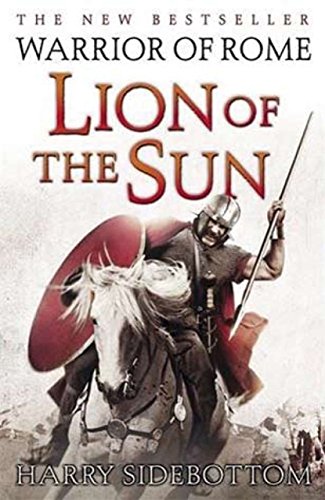
Inhaltsangabe
The shame of the vanquished beats down mercilessly, as the frail old emperor prostrates himself before Shapur, King of Kings. Ballista looks on helplessly, but vows under his breath to avenge those who have brought the empire to the brink of destruction with their treachery. But first, he must decide what price he will pay for his own freedom. Only the fearless and only those whom the gods will spare from hell can now save the empire from a catastrophic ending. Ballista, the Warrior of Rome, faces his greatest challenge yet.
Die Inhaltsangabe kann sich auf eine andere Ausgabe dieses Titels beziehen.
Über die Autorinnen und Autoren
Harry Sidebottom is best known for the Warrior of Rome series of novels, published by Overlook. He teaches classical history at Oxford University, where he is a Fellow of St. Benets Hall and a Lecturer at Lincoln College. Visit HarrySidebottom.co.uk
Harry Sidebottom is best known for the Warrior of Rome series of novels, published by Overlook. He teaches classical history at Oxford University, where he is a Fellow of St. Benets Hall and a Lecturer at Lincoln College. Visit HarrySidebottom.co.uk
Auszug. © Genehmigter Nachdruck. Alle Rechte vorbehalten.
By the same author
WARRIOR OF ROME—BOOK ONE
Fire in the East
WARRIOR OF ROME—BOOK TWO
King of Kings
Copyright
To Lisa, with all my love
Gone is the trust to be placed in oaths; I cannot understand if the gods you
swore by then no longer rule, or if men live by new standards of what is right?
Euripides, Medea, 490–94
Prologue
Mesopotamia, North of the City of Carrhae, Spring AD260
The emperor blinked as he stepped out into the bright sunshine. He seemed to wince as the court official called out his full title in Latin. ‘Imperator Caesar Publius Licinius Valerianus Augustus, Pius Felix, Pater Patriae, Germanicus Maximus, Invictus, Restitutor Orbis’. At a sign, a horse was led forward. Its bridle shone with silver and gold, and its trappings were imperial purple. Needing no prompting, the elderly emperor walked to where the horse waited. As so many times before in the last few days, he got down on one knee, then the other. With a momentary pause, which might be excused in someone his age, he got down on all fours, his elbows in the dust. What seemed an age passed. The horse shifted and exhaled through its lips, the noise loud in the quiet camp. The sun was hot on the emperor’s back.
The sound of another man walking towards the horse broke the near-silence. Out of the corner of his eye, the emperor could see two purple boots. Deliberately, the left one was raised and placed on his neck. As many times before, its owner let some of his weight come down through the boot before he spoke.
‘This is the truth, not what the Romans depict in their sculptures and paintings,’ he declared, then swung himself into the saddle, his weight hard upon his imperial mounting block. ‘I am the Mazda-worshipping divine Shapur, King of Kings of Aryans and non-Aryans, of the race of the gods, son of the Mazda-worshipping divine Ardashir, King of Kings of the Aryans, of the race of the gods, grandson of the King Papak, of the house of Sasan; I am the lord of the Aryan nation. You mighty, look on my works and tremble.’
Ballista, the Roman general from beyond the borders in the far north, lay full length in the dust and watched. His reluctant proskynesis, or posture of adoration, was enforced by guards and the threat of a beating or worse and echoed by the rest of the Roman high command. Successianus the Praetorian Prefect, Cledonius the ab Admissionibus, Camillus the commander of Legio VI Gallicana – everyone of importance who had been with the field army – they were all there. The world had been turned upside down, the whole cosmos was shaken. For the first time, a Roman emperor had been captured by the barbarians. Ballista could feel the outrage and horror of his commilitiones as they were forced to witness the humiliation of Valerian – the pious, lucky, invincible emperor of the Romans, the restorer of the world – on his knees and dressed as a slave.
Four days earlier, Valerian had been captured. He had been betrayed by the companion he most trusted, the Comes Sacrarum Largitionum Macrianus the Lame. The Count of the Sacred Largess had arranged everything. His younger son, Quietus, had led the aged emperor and his army into a trap and then abandoned them.
Ballista, belly to the ground, furious in his abasement, thought of the repulsive youth Quietus, by now safely back in the Roman city of Samosata, and he repeated to himself a vow he had made twice before: One day, maybe not soon, but one day, I will kill you.
Shapur caracoled his mount, its hooves plunging and stamping dangerously close to the elderly man on the ground. Then the Sassanid King of Kings paced his horse along the line of his own courtiers, noblemen and priests and rode away, laughing.
Slowly, heavily, Valerian began to get to his feet. The butts of spears, freely wielded, encouraged the Comites Augusti to do the same.
As he hauled himself up, Ballista looked at the Sassanid courtiers. There, prominent among the priests, was the Persian youth whom Ballista had known as Bagoas when the boy had been his slave. How the wheel of fortune turns. Was the youth smiling at him behind that black beard?
The sight of Bagoas turned Ballista’s thoughts to his familia. Had his ex-slaves Calgacus, Maximus and Demetrius made it to safety? Were they now also safe in Samosata? Or were they already on the road to Antioch? Antioch, where Ballista’s two young sons and wife waited, all unaware. The pain of thinking of them was almost unbearable. Ballista spoke in his heart to the high god of his northern youth: Allfather, Death-blinder, Deep Hood, Fulfiller of Desire, Woden-born as I am, hear my prayer: I will give whatever is necessary, do whatever it takes, but let me return to them – return to them whatever the cost.
PART ONE
Captivus
(The East, Spring–Summer AD260)
‘What is it like to lose one’s native land? Is it a grievous loss?’
Euripides, Phoenissae, 387–8
I
Maximus lay motionless watching the Persians. They were in front of and below him, towards the middle of the small upland meadow where three paths came together. They were not above forty paces away. He could see them clearly: in the pale moonlight, men and horses were solid, dark-grey silhouettes. There were twenty-one Sassanid cavalrymen. Maximus had counted them several times.
The Sassanids were confident. They had dismounted and were talking quietly. They were unavoidably in the way. Maximus raised his eyes to check the position of the sickle-shaped, three-night-old moon. There was not much of the night left. With northern Mesopotamia overrun with Persian patrols, Maximus and the others had to be safe behind the walls of Zeugma by dawn. There was no time to retrace their steps or to cast about for another path which ran east–west through the high country. If the Persians did not move on within half an hour, the Romans would have to try and fight their way through. It did not promise well. They were outnumbered three to one. Demetrius had never been much of a one in a fight, and old Calgacus was wounded....
„Über diesen Titel“ kann sich auf eine andere Ausgabe dieses Titels beziehen.
Weitere beliebte Ausgaben desselben Titels

Suchergebnisse für Lion of the Sun: Warrior of Rome: Book 3 (Warrior of...

Beispielbild für diese ISBN
Lion of the Sun: Warrior of Rome: Book 3
Anbieter: ThriftBooks-Atlanta, AUSTELL, GA, USA
Verkäuferbewertung 5 von 5 Sternen

Hardcover. Zustand: Very Good. No Jacket. May have limited writing in cover pages. Pages are unmarked. ~ ThriftBooks: Read More, Spend Less. Artikel-Nr. G1590203518I4N00
Gebraucht kaufen
EUR 8,38
Versand gratis
Versand innerhalb von USA
Versand innerhalb von USA
Anzahl: 1 verfügbar
Beispielbild für diese ISBN
Lion of the Sun: Warrior of Rome: Book 3
Anbieter: ThriftBooks-Dallas, Dallas, TX, USA
Verkäuferbewertung 5 von 5 Sternen
Hardcover. Zustand: Fair. No Jacket. Former library book; Readable copy. Pages may have considerable notes/highlighting. ~ ThriftBooks: Read More, Spend Less. Artikel-Nr. G1590203518I5N10
Gebraucht kaufen
EUR 8,38
Versand gratis
Versand innerhalb von USA
Versand innerhalb von USA
Anzahl: 1 verfügbar
Beispielbild für diese ISBN
Lion of the Sun: Warrior of Rome: Book 3
Anbieter: ThriftBooks-Atlanta, AUSTELL, GA, USA
Verkäuferbewertung 5 von 5 Sternen
Hardcover. Zustand: Very Good. No Jacket. Former library book; May have limited writing in cover pages. Pages are unmarked. ~ ThriftBooks: Read More, Spend Less. Artikel-Nr. G1590203518I4N10
Gebraucht kaufen
EUR 8,38
Versand gratis
Versand innerhalb von USA
Versand innerhalb von USA
Anzahl: 1 verfügbar
Beispielbild für diese ISBN
Lion of the Sun : Warrior of Rome: Book 3
Anbieter: Better World Books, Mishawaka, IN, USA
Verkäuferbewertung 5 von 5 Sternen
Zustand: Very Good. Former library copy. Pages intact with possible writing/highlighting. Binding strong with minor wear. Dust jackets/supplements may not be included. Includes library markings. Stock photo provided. Product includes identifying sticker. Better World Books: Buy Books. Do Good. Artikel-Nr. 6495198-6
Gebraucht kaufen
EUR 8,42
Versand gratis
Versand innerhalb von USA
Versand innerhalb von USA
Anzahl: 1 verfügbar
Foto des Verkäufers
Lion of the Sun
Verlag:
Overlook Press, 2011
ISBN 10: 1590203518
ISBN 13: 9781590203514
Gebraucht
Hardcover
Erstausgabe
Anbieter: High Street Books, New Mills, Vereinigtes Königreich
Verkäuferbewertung 5 von 5 Sternen
Hardcover. Zustand: Good. Zustand des Schutzumschlags: Good. First Edition. First printing, shelf wear to the dust jacket, page edges tanned. Shipped from the UK in recyclable card packaging. Artikel-Nr. pb31a-1223-0033
Gebraucht kaufen
EUR 16,96
EUR 23,52 Versand
Versand von Vereinigtes Königreich nach USA
Versand von Vereinigtes Königreich nach USA
Anzahl: 1 verfügbar