
Verwandte Artikel zu Perfect 10: The University of Georgia Gymdogs and the...
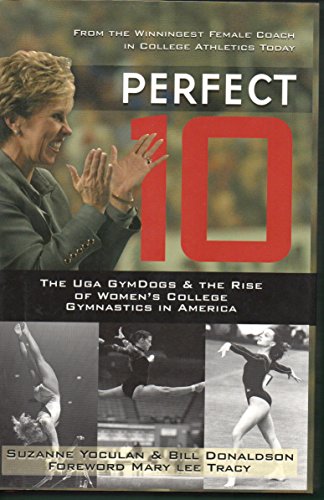
Perfect 10: The University of Georgia Gymdogs and the Rise of Women's College Gymnastics in America - Hardcover
Inhaltsangabe
The story of the winningest women's college coach in history
Die Inhaltsangabe kann sich auf eine andere Ausgabe dieses Titels beziehen.
Von der hinteren Coverseite
Suzanne Yoculan is the winningest coach in the history of American women'ssports and Perfect 10 is the first book on women's college gymnastics, thefastest- growing college sport in terms of popularity.The book chronicles the rise of women's college gymnastics from the time ofthe first NCAA Championships in 1982 to the present. Centered on Yoculan andthe GymDogs, Perfect 10 presents details of this coach's formula forsuccess-extending performance longevity, helping gymnasts with eatingdisorders, team chemistry, gender equity, and promotional savvy. This savvy,combined with Yoculan's dynamic coaching techniques, responsible for raisingthe attendance at a GymDogs' meet from 200 in 1983, when she became headcoach, to 10,000 today-virtually unparalleled at any other college.
The GymDogs are the only women's college gymnastics team to go undefeatedthrough an entire season and they've done it four times. Under Yoculan'sdirection, Georgia gymnasts have earned 267 All-America honors, and Georgiagymnasts have won 29 NCAA individual championships. The GymDogs have placedin the nation's top 3 teams in 18 of the last 20 years.
Yoculan has been at the forefront of every important movement in women'scollege gymnastics-she showed the world that college gymnasts were not "overthe hill" at 18 and could improve every season, she showed other coaches howto successfully battle the problem of anorexia in female gymnasts, sheintroduced Olympic-level skills to a college sport suffering frommediocrity, she initiated the establishment of the first renewable seasonticket program in the nation for a women's college team, and she developedboth a winner's and a fan's code of conduct for college gymnastics meets.Winner of 7 NCAA Championships and 15 SEC Championships, Yoculan has foughthard for Title IX-promoting the rights of women in sport, both players andcoaches alike, and fighting against chauvinism within collegeadministrations-opening the door for women coaches to question the fairnessof their compensation packages.
Perfect 10 is a triple story of success, that of Suzanne Yoculan, theGymDogs, and women's college gymnastics.
Suzanne Yoculan is Head Coach of the University of Georgia GymDogs. For thepast 23 years, she has led the team to unparalled success in women's collegegymnastics. She is a 4-Time NCAA Coach of the Year and a 6-Time SEC Coach ofthe Year.
Bill Donaldson is a former director of scientific research for over 40years at the E.I. DuPont Company and the U.S. Environmental ProtectionAgency. He is now a freelance writer covering environmental issues andwomen's college gymnastics.
Mary Lee Tracy is the owner and head coach of Cincinnati Gymnastics Academy,a USA Olympic Coach and a USA Gymnastics Coach of the Year.
Aus dem Klappentext
Suzanne Yoculan is the winningest coach in the history of American women'ssports and Perfect 10 is the first book on women's college gymnastics, thefastest- growing college sport in terms of popularity.The book chronicles the rise of women's college gymnastics from the time ofthe first NCAA Championships in 1982 to the present. Centered on Yoculan andthe GymDogs, Perfect 10 presents details of this coach's formula forsuccess-extending performance longevity, helping gymnasts with eatingdisorders, team chemistry, gender equity, and promotional savvy. This savvy,combined with Yoculan's dynamic coaching techniques, responsible for raisingthe attendance at a GymDogs' meet from 200 in 1983, when she became headcoach, to 10,000 today-virtually unparalleled at any other college.
The GymDogs are the only women's college gymnastics team to go undefeatedthrough an entire season and they've done it four times. Under Yoculan'sdirection, Georgia gymnasts have earned 267 All-America honors, and Georgiagymnasts have won 29 NCAA individual championships. The GymDogs have placedin the nation's top 3 teams in 18 of the last 20 years.
Yoculan has been at the forefront of every important movement in women'scollege gymnastics-she showed the world that college gymnasts were not "overthe hill" at 18 and could improve every season, she showed other coaches howto successfully battle the problem of anorexia in female gymnasts, sheintroduced Olympic-level skills to a college sport suffering frommediocrity, she initiated the establishment of the first renewable seasonticket program in the nation for a women's college team, and she developedboth a winner's and a fan's code of conduct for college gymnastics meets.Winner of 7 NCAA Championships and 15 SEC Championships, Yoculan has foughthard for Title IX-promoting the rights of women in sport, both players andcoaches alike, and fighting against chauvinism within collegeadministrations-opening the door for women coaches to question the fairnessof their compensation packages.
Perfect 10 is a triple story of success, that of Suzanne Yoculan, theGymDogs, and women's college gymnastics.
Suzanne Yoculan is Head Coach of the University of Georgia GymDogs. For thepast 23 years, she has led the team to unparalled success in women's collegegymnastics. She is a 4-Time NCAA Coach of the Year and a 6-Time SEC Coach ofthe Year.
Bill Donaldson is a former director of scientific research for over 40years at the E.I. DuPont Company and the U.S. Environmental ProtectionAgency. He is now a freelance writer covering environmental issues andwomen's college gymnastics.
Mary Lee Tracy is the owner and head coach of Cincinnati Gymnastics Academy,a USA Olympic Coach and a USA Gymnastics Coach of the Year.
Auszug. © Genehmigter Nachdruck. Alle Rechte vorbehalten.
GENDER EQUALITY
In 2001, Brian Schrader came from the University of Iowa swimmingprogram to become an assistant coach with Georgia'sthree-time-national-championship women's swimming team. He saidpublicly that Georgia was the perfect place for him: "It is one of thefew schools in the country where all the sports get an incredibleamount of support."
"All the sports," of course, includes women's sports. And theUniversity of Georgia, indeed, has a remarkable record in women'sathletics. Georgia won the sec women's all-sports trophy six timesbetween the year of its inception, 1984, and 1994, when the conferencedecided to combine men's and women's sports for the trophy, as is donefor the Sears Cup. It is awarded to the school whose overall athleticprogram ranks highest in the nation, based largely on the nationalrankings of its teams. Since 1987, uga has won thirteen nationalchampionships in four women's sports. Without question, Liz Murphey,who was Georgia's first coordinator for women's athletics, deserves amajor share of the credit. But Liz will insist that Athletic DirectorVince Dooleyand the coaches she hired deserve the credit.
As significant as the contributions of Murphey, Dooley, and thecoaches are, the strongest force behind the emergence of women'sintercollegiate sports at the University of Georgia was the enactmentof Title IX of the Educational Amendments of 1972 to the Civil RightsAct. Title IX bans sex discrimination within schools in academics andathletics. In short, it calls for equality of financial assistance(athletic scholarships), awarding of scholarships in proportion to thenumbers of males and females in the total student enrollment, andproviding equivalent benefits in other areas of collegeathletics-coaching, equipment, travel, medical, and training support.Georgia hasn't always been a leader in women's sports. In the 1970suga was slow-and that's being generous-to react to Title IX. It tooksix years after the enactment of Title IX for the university to awardthe first athletic scholarship to a female in 1978. At the time therewas a ratio of about 150 male scholarships to the lone femalescholarship. In 2000, the numbers were 141.2 for males to 108 forfemales. These numbers demonstrate that women have made substantialprogress in the number of scholarships and in other areas, but it wasnot without prodding from the courts. And it was in an environmentthat was, and still is to some extent, one of the most chauvinistic ofany profession-a college athletic department. Liz provides backgroundon the women's sports situation before Title IX and during the earlyyears after enactment:
„Über diesen Titel“ kann sich auf eine andere Ausgabe dieses Titels beziehen.
Suchergebnisse für Perfect 10: The University of Georgia Gymdogs and the...

Beispielbild für diese ISBN
Perfect 10: The UGA GymDogs & the Rise of Women's College Gymnastics in America
Anbieter: World of Books (was SecondSale), Montgomery, IL, USA
Verkäuferbewertung 5 von 5 Sternen

Zustand: Very Good. Item in very good condition! Textbooks may not include supplemental items i.e. CDs, access codes etc. Artikel-Nr. 00110225942
Gebraucht kaufen
EUR 5,50
Versand gratis
Versand innerhalb von USA
Versand innerhalb von USA
Anzahl: 1 verfügbar
Beispielbild für diese ISBN
Perfect 10: The UGA GymDogs & the Rise of Women's College Gymnastics in America
Anbieter: ThriftBooks-Dallas, Dallas, TX, USA
Verkäuferbewertung 5 von 5 Sternen
Hardcover. Zustand: Fair. No Jacket. Readable copy. Pages may have considerable notes/highlighting. ~ ThriftBooks: Read More, Spend Less. Artikel-Nr. G1588181111I5N00
Gebraucht kaufen
EUR 6,09
Versand gratis
Versand innerhalb von USA
Versand innerhalb von USA
Anzahl: 1 verfügbar
Beispielbild für diese ISBN
Perfect 10: The UGA GymDogs & the Rise of Women's College Gymnastics in America
Anbieter: ThriftBooks-Atlanta, AUSTELL, GA, USA
Verkäuferbewertung 5 von 5 Sternen
Hardcover. Zustand: Very Good. No Jacket. May have limited writing in cover pages. Pages are unmarked. ~ ThriftBooks: Read More, Spend Less. Artikel-Nr. G1588181111I4N00
Gebraucht kaufen
EUR 6,09
Versand gratis
Versand innerhalb von USA
Versand innerhalb von USA
Anzahl: 1 verfügbar
Beispielbild für diese ISBN
Perfect 10: The University of Georgia Gymdogs and the Rise of Women's College Gymnastics in America
Anbieter: Studibuch, Stuttgart, Deutschland
Verkäuferbewertung 5 von 5 Sternen
hardcover. Zustand: Sehr gut. 254 Seiten; 9781588181114.2 Gewicht in Gramm: 1. Artikel-Nr. 1048776
Gebraucht kaufen
EUR 7,86
EUR 62,30 Versand
Versand von Deutschland nach USA
Versand von Deutschland nach USA
Anzahl: 1 verfügbar