
Verwandte Artikel zu The Definitive Guide to Cancer, 3rd Edition: An Integrative...
The Definitive Guide to Cancer, 3rd Edition: An Integrative Approach to Prevention, Treatment, and Healing - Softcover
Buch 1 von 3: Alternative Medicine Guides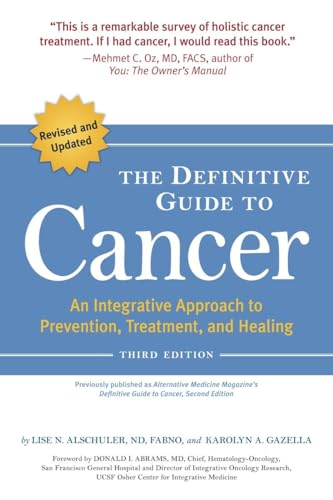
Inhaltsangabe
This comprehensive guide delivers informed hope along with effective tools for reclaiming your vitality in the midst of cancer treatment, healing, and recovery.
When you or a loved one is faced with a cancer diagnosis, the need for accurate and trusted medical information becomes urgent. Naturopathic physician Lise N. Alschuler and medical journalist Karolyn A. Gazella present an overview of what cancer is, its causes and preventative strategies, an in-depth approach to integrative treatment options, descriptions of key body functions, and discussions of more than twenty specific cancers. The Definitive Guide to Cancer, now in its third edition, encourages you to take an integrative approach that embraces both alternative and conventional therapies across the spectrum of cancer prevention, treatment, and healing.
Die Inhaltsangabe kann sich auf eine andere Ausgabe dieses Titels beziehen.
Über die Autorin bzw. den Autor
LISE N. ALSCHULER, ND, FABNO, is a naturopathic physician with widely recognized expertise as a speaker, author, and practitioner of integrative medicine.
KAROLYN A. GAZELLA is an accomplished author, health writer, and publisher of the Natural Medicine Journal.
Auszug. © Genehmigter Nachdruck. Alle Rechte vorbehalten.
The Cancer Experience
Cancer results from the uncontrolled growth of abnormal cells. As these cells continue to divide, they form into cancerous tumors. With destructive precision, a cancerous tumor redirects blood flow to itself as it leaches off its healthy cellular neighbors. Cancer cells can invade other tissues within the body and produce additional tumors. The frenzied development of a cancerous tumor can overwhelm the organ or tissue where it is located. Left unchecked, many cancers can eventually destroy enough tissue that the body loses its ability to sustain life.
This monstrous demolition can be mirrored emotionally in the person with cancer. The physical chaos and damage is only a part of the story. Cancer brings with it thundering amounts of anger, anxiety, or fear, which can render someone less able to cope emotionally. Even for the most stoic of souls, three simple words--“you have cancer”-- can create a simmering internal panic. This panic can be both reflected and magnified in loved ones. A cancer diagnosis goes well beyond the patient, and takes its toll on loving family and friends as well. Sometimes it can be even more difficult being a caregiver or support person and watching a loved one struggle.
Although a cancer diagnosis can bring on a fear of dying, cancer is not a death sentence. That may be difficult to believe if you are in the throes of a recent diagnosis or struggling with treatment. However, not all people diagnosed with cancer physically succumb to the disease. And even among those who do die from cancer-related causes, there are some who experience tremendous wellness and healing in the process. Cancer offers an opportunity for deep reflection and introspection, no matter what the outcome of the disease. It helps us consider the whole of life rather than the sum of its material parts.
Coping with cancer requires us to first embrace it. After it shakes us to our very core, we concede the emotional storm it has created. During a conversation with mind-body-spirit pioneer Rachel Naomi Remen, MD, who has worked with thousands of cancer patients, she explained that ignoring fear can prevent us from healing. She recommends that people with cancer invite it in. “Although it is expressed in a very constricting way, fear is the will to live. What’s under the fear is a desire for life, and we need to somehow get to that. That means going through the fear, not denying it.” Discovering our inner strength enables us to face the unknowns associated with a cancer diagnosis. Over the years, Dr. Remen has found that “the experience [of having cancer] can be transformative.”
For both patients and their loving supporters, this will be a highly individualized and personal process. There is no right way to cope with cancer. Whether you are the one with the diagnosis or a loved one is, you will want to patiently take one step at a time.
The first step is to understand what cancer is.
Cancer Defined
Technically, cancer is not one disease. It is a complex illness with more than 200 variations. A cancer malignancy is characterized as a locally invasive and destructive growth pattern caused by the development of genetically altered cells. The cancer is typically designated based on the organ it originates in. There are five major types of cancer:
• Carcinomas, the most common type of cancerous growth, are solid tumors that may affect almost any organ or part of the body. They can spread to other parts of the body via the lymphatic fluid or the bloodstream. Carcinomas may occur in the skin, mouth, nose, throat, lungs, genitourinary and gastrointestinal tracts, and glands, such as the breasts or thyroid.
• Leukemias form in the blood and bone marrow and are not solid tumors. The abnormal white blood cells associated with leukemias replace healthy white blood cells and circulate throughout the bloodstream.
• Myelomas are tumors that originate in bone marrow plasma cells, the antibody-producing white blood cells. Myelomas were formerly considered rare, but their incidence is increasing.
• Lymphomas are cancers found in the glands and nodes of the lymphatic system. Lymph nodes are the body’s filtering system, helping to remove toxins and impurities. These small, round masses of tissue are concentrated in the neck, groin, armpits, spleen, center of the chest, and around the intestines. Lymphomas are solid tumors usually made up of abnormal white blood cells. Hodgkin’s and non-Hodgkin’s lymphoma are the most common forms of lymphatic cancer in the United States.
• Sarcomas are the rarest of the five types. Sarcomas are solid tumors that arise from connective tissue, such as bone and muscle. Sarcomas can also form in the surrounding connective tissues of major organs, including the bladder, kidneys, liver, lungs, and spleen.
The process of developing cancer is known as carcinogenesis, which literally means “the birth of cancer.” The cancer process begins with damage to a cell. Specifically, one or more genes in cellular DNA (deoxyribonucleic acid) become damaged, which is referred to as genetic mutation. This is significant because DNA is the critical information-carrying part of the cell. When the DNA is repeatedly damaged, the cell loses its ability to repair the damage, begins to behave abnormally, and divides uncontrollably. Scientists have confirmed that genetic mutations activate the process of carcinogenesis. This becomes important when considering ways to prevent cellular damage to ward off cancer, something we’ll discuss in subsequent chapters.
As damaged or malignant cells divide, more mutations occur, a process known as promotion. Malignant cells eventually become numerous enough to join together to form a solid tumor, or they simply circulate throughout the body, wreaking havoc on other healthy cellular systems. Most anticancer therapies attempt to halt the growth of cancerous cells. Radiation therapy and some chemotherapy agents damage DNA so much that the malignant cells can no longer divide; instead, they undergo a process either of cellular rupture and destruction or of apoptosis, which may be thought of as cellular suicide. Other chemotherapy agents interrupt the process of cell division, effectively halting cellular replication and eventually sending the cell down the path of apoptosis.
How Does Cancer Grow?
Rapidly growing cancer cells are not only hearty, they are demanding. Their appetite for nutrients, oxygen, and blood far exceeds that of healthy cells. At the same time, they can also survive under a variety of internal conditions. According to a recent issue of Cancer Research, Japanese researchers discovered that, despite their voracious needs, cancer cells also have an amazing ability to tolerate extreme conditions, including a low supply of nutrients and oxygen. They discovered that cancer cells have the ability to modify their energy metabolism to sustain growth while simultaneously minimizing their need for nutrients and energy. Cancer cells can also develop resistance to specific chemotherapy drugs. It is this adaptability and resilience that makes cancer such a daunting and dangerous opponent.
Like a biochemical vampire, the cancer cell’s nectar of choice is blood. The human body is fertile ground for these bloodthirsty cells. As long as the cancer cell has access to blood, it is less likely to die. In fact, cancer cells go to great lengths to ensure they have a sufficient blood supply. The body’s process for developing blood vessels is known as angiogenesis. Cancer cells hijack this mechanism by sending signals to existing blood vessels, redirecting their growth and creating their own blood supply. Finding ways to shut down the blood...
„Über diesen Titel“ kann sich auf eine andere Ausgabe dieses Titels beziehen.
Suchergebnisse für The Definitive Guide to Cancer, 3rd Edition: An Integrative...

Beispielbild für diese ISBN
The Definitive Guide to Cancer
Verlag:
Clarkson Potter/Ten Speed, 2010
ISBN 10: 1587613581
ISBN 13: 9781587613586
Gebraucht
Softcover
Anbieter: World of Books (was SecondSale), Montgomery, IL, USA
Verkäuferbewertung 5 von 5 Sternen

Zustand: Good. Item in good condition and has highlighting/writing on text. Used texts may not contain supplemental items such as CDs, info-trac etc. Artikel-Nr. 00101147961
Gebraucht kaufen
EUR 3,96
Versand gratis
Versand innerhalb von USA
Versand innerhalb von USA
Anzahl: 1 verfügbar
Beispielbild für diese ISBN
The Definitive Guide to Cancer, 3rd Edition: An Integrative Approach to Prevention, Treatment, and Healing
Verlag:
Clarkson Potter/Ten Speed (edition Revised), 2010
ISBN 10: 1587613581
ISBN 13: 9781587613586
Gebraucht
Paperback
Anbieter: BooksRun, Philadelphia, PA, USA
Verkäuferbewertung 5 von 5 Sternen
Paperback. Zustand: Fair. Revised. The item might be beaten up but readable. May contain markings or highlighting, as well as stains, bent corners, or any other major defect, but the text is not obscured in any way. Artikel-Nr. 1587613581-7-1
Gebraucht kaufen
EUR 5,70
Versand gratis
Versand innerhalb von USA
Versand innerhalb von USA
Anzahl: 1 verfügbar
Beispielbild für diese ISBN
The Definitive Guide to Cancer: An Integrative Approach to Prevention, Treatment, and Healing
Anbieter: ThriftBooks-Dallas, Dallas, TX, USA
Verkäuferbewertung 5 von 5 Sternen
Paperback. Zustand: Good. No Jacket. Pages can have notes/highlighting. Spine may show signs of wear. ~ ThriftBooks: Read More, Spend Less. Artikel-Nr. G1587613581I3N00
Gebraucht kaufen
EUR 5,84
Versand gratis
Versand innerhalb von USA
Versand innerhalb von USA
Anzahl: 1 verfügbar
Beispielbild für diese ISBN
The Definitive Guide to Cancer, 3rd Edition : An Integrative Approach to Prevention, Treatment, and Healing
Anbieter: Better World Books, Mishawaka, IN, USA
Verkäuferbewertung 5 von 5 Sternen
Zustand: Good. 3rd Edition. Pages intact with minimal writing/highlighting. The binding may be loose and creased. Dust jackets/supplements are not included. Stock photo provided. Product includes identifying sticker. Better World Books: Buy Books. Do Good. Artikel-Nr. 5452128-6
Gebraucht kaufen
EUR 6,20
Versand gratis
Versand innerhalb von USA
Versand innerhalb von USA
Anzahl: 1 verfügbar
Beispielbild für diese ISBN
The Definitive Guide to Cancer, 3rd Edition : An Integrative Approach to Prevention, Treatment, and Healing
Anbieter: Better World Books: West, Reno, NV, USA
Verkäuferbewertung 5 von 5 Sternen
Zustand: Very Good. 3rd Edition. Pages intact with possible writing/highlighting. Binding strong with minor wear. Dust jackets/supplements may not be included. Stock photo provided. Product includes identifying sticker. Better World Books: Buy Books. Do Good. Artikel-Nr. 8706416-6
Gebraucht kaufen
EUR 6,20
Versand gratis
Versand innerhalb von USA
Versand innerhalb von USA
Anzahl: 1 verfügbar
Beispielbild für diese ISBN
The Definitive Guide to Cancer, 3rd Edition : An Integrative Approach to Prevention, Treatment, and Healing
Anbieter: Better World Books, Mishawaka, IN, USA
Verkäuferbewertung 5 von 5 Sternen
Zustand: Very Good. 3rd Edition. Pages intact with possible writing/highlighting. Binding strong with minor wear. Dust jackets/supplements may not be included. Stock photo provided. Product includes identifying sticker. Better World Books: Buy Books. Do Good. Artikel-Nr. 8706416-6
Gebraucht kaufen
EUR 6,20
Versand gratis
Versand innerhalb von USA
Versand innerhalb von USA
Anzahl: 1 verfügbar
Beispielbild für diese ISBN
The Definitive Guide to Cancer, 3rd Edition : An Integrative Approach to Prevention, Treatment, and Healing
Anbieter: Better World Books: West, Reno, NV, USA
Verkäuferbewertung 5 von 5 Sternen
Zustand: Good. 3rd Edition. Pages intact with minimal writing/highlighting. The binding may be loose and creased. Dust jackets/supplements are not included. Stock photo provided. Product includes identifying sticker. Better World Books: Buy Books. Do Good. Artikel-Nr. 5452128-6
Gebraucht kaufen
EUR 6,20
Versand gratis
Versand innerhalb von USA
Versand innerhalb von USA
Anzahl: 3 verfügbar
Beispielbild für diese ISBN
The Definitive Guide to Cancer, 3rd Edition : An Integrative Approach to Prevention, Treatment, and Healing
Anbieter: Better World Books, Mishawaka, IN, USA
Verkäuferbewertung 5 von 5 Sternen
Zustand: Very Good. 3rd Edition. Former library copy. Pages intact with possible writing/highlighting. Binding strong with minor wear. Dust jackets/supplements may not be included. Includes library markings. Stock photo provided. Product includes identifying sticker. Better World Books: Buy Books. Do Good. Artikel-Nr. 4219338-6
Gebraucht kaufen
EUR 6,20
Versand gratis
Versand innerhalb von USA
Versand innerhalb von USA
Anzahl: 2 verfügbar
Beispielbild für diese ISBN
The Definitive Guide to Cancer, 3rd Edition: An Integrative Approach to Prevention, Treatment, and Healing
Verlag:
Clarkson Potter/Ten Speed, 2010
ISBN 10: 1587613581
ISBN 13: 9781587613586
Gebraucht
Paperback
Anbieter: WorldofBooks, Goring-By-Sea, WS, Vereinigtes Königreich
Verkäuferbewertung 5 von 5 Sternen
Paperback. Zustand: Very Good. The book has been read, but is in excellent condition. Pages are intact and not marred by notes or highlighting. The spine remains undamaged. Artikel-Nr. GOR004821005
Gebraucht kaufen
EUR 2,90
EUR 6,52 Versand
Versand von Vereinigtes Königreich nach USA
Versand von Vereinigtes Königreich nach USA
Anzahl: 3 verfügbar
Foto des Verkäufers
The Definitive Guide to Cancer, 3rd Edition: An Integrative Approach to Prevention, Treatment, and Healing
Verlag:
Clarkson Potter/Ten Speed, 2010
ISBN 10: 1587613581
ISBN 13: 9781587613586
Gebraucht
paperback
Anbieter: WeBuyBooks, Rossendale, LANCS, Vereinigtes Königreich
Verkäuferbewertung 5 von 5 Sternen
paperback. Zustand: Like New. Most items will be dispatched the same or the next working day. An apparently unread copy in perfect condition. Dust cover is intact with no nicks or tears. Spine has no signs of creasing. Pages are clean and not marred by notes or folds of any kind. Artikel-Nr. rev7724685399
Gebraucht kaufen
EUR 3,32
EUR 10,31 Versand
Versand von Vereinigtes Königreich nach USA
Versand von Vereinigtes Königreich nach USA
Anzahl: 1 verfügbar