
Verwandte Artikel zu Hidden Drivers of Success: Leveraging Employee Insights...
Inhaltsangabe
A framework for HR managers and business leaders to identify and extract crucial information to lead their enterprise, business unit, or department to success, this book demonstrates how various measures—with a particular emphasis on surveys—can be reinvented to serve today’s strategic and operational needs. This reference lays out why real-time actionable information is critical to every organization today and why employees are one of the best sources of that information. With examples of how the best firms have learned to harness the most important facts and to let go of extraneous data that bogs down and distracts decision-makers, this record’s ultimate goal is to expand thinking around how to use the richness of the available information for the strategic benefit of the organization. In short, this is a book about managing organizational value—how to define it, how to measure it, and how to grow it.
Die Inhaltsangabe kann sich auf eine andere Ausgabe dieses Titels beziehen.
Über die Autorin bzw. den Autor
William A. Schiemann, PhD is the CEO of Metrus Group in Somerville, New Jersey, which created the People Equity talent optimization framework. He is also the author of several books, including The ACE Advantage: How Smart Companies Unleash Talent for Optimal Performance and Reinventing Talent Management: How to Maximize Performance in the New Marketplace. Jerry H. Seibert is the principal and vice president of Diagnostic Services of Metrus Group. He has 25 years of experience working with organizations to measure and improve customer, employee, and other stakeholder perceptions. Brian S. Morgan, PhD is the director of the Organization Assessment Services at Metrus Group, Inc. He has more than 30 years of experience in organization diagnostics, with particular specialization in employee survey and follow-up action planning. They all live in Somerville, New Jersey.
Auszug. © Genehmigter Nachdruck. Alle Rechte vorbehalten.
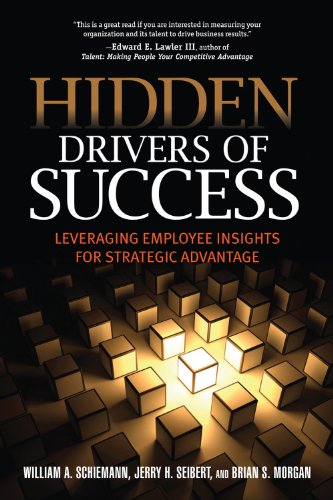
Hidden Drivers of Success
Leveraging Employeee Insights for Strategic Advantage
By William Schiemann, Jerry H. Seibert, Brian S. MorganSociety For Human Resource Management
Copyright © 2013 Metrus Group, Inc.
All rights reserved.
ISBN: 978-1-58644-333-7All rights reserved.
Contents
Dedications,
Preface,
Acknowledgments,
SECTION I: UNLEASHING THE POWER OF INFORMATION,
Chapter 1 The Information Gap,
Chapter 2 What Do You Really Know About Your Organization?,
SECTION II: FROM THE OUTSIDE IN,
Chapter 3 Supplier Value Assessment,
SECTION III: FROM THE INSIDE OUT — USING PEOPLE EQUITY AND STRATEGIC INFORMATION TO MAKE BETTER DECISIONS,
Chapter 4 Optimizing Talent,
Chapter 5 Strategic Employee Surveys: Planning and Design,
Chapter 6 Strategic Employee Surveys: Turning Data into Insight,
Chapter 7 Strategic Employee Surveys: Turning Insight into Business Results,
SECTION IV: USING SURVEY INTELLIGENCE TO MAKE KEY TALENT DECISIONS,
Chapter 8 Leveraging Information to Optimize Employer Brand, Hiring, and Onboarding.....,
Chapter 9 Using Information Tools to Retain and Recover Talent,
Chapter 10 Leadership Development and Succession,
SECTION V: MANAGING AND MEASURING VALUES,
Chapter 11 Measuring and Living Organizational Values,
Chapter 12 Ethics,
Chapter 13 Diversity and Inclusion,
Chapter 14 Innovation,
SECTION VI: MANAGING ENVIRONMENTAL CONSTITUENTS,
Chapter 15 Using Information to Optimize Labor Relations and Union Outcomes,
Chapter 16 Using Measurement to Support ustainability,
SECTION VII: PREPARING FOR THE FUTURE — NOW!,
Chapter 17 Do You Have A Strategic Intelligence System?,
Chapter 18 The Employee Intelligence System,
Chapter 19 Mass-Customizing Your Workforce: Using Measurement to Optimize Your Talent,
SECTION VIII: A CALL TO ACTION,
Chapter 20 Building Your Strategic Intelligence System,
Endnotes,
Index,
About the Authors,
Additional SHRM-Published Books,
CHAPTER 1
The Information Gap
"It was the best of times, it was the worst of times ... it was the spring of hope, it was the winter of despair ..."
— Charles Dickens, A Tale of Two Cities
A Tale of Two Rentals
A few years ago, one of our authors (Schiemann) lost his wallet en route to a small Midwestern airport late one evening. As he headed from the terminal to the rental car agency, he had a queasy feeling, knowing he would have to explain his loss of identity to the service representative. But as a road warrior for many years, he had duplicate photo identification and another credit card tucked away in his suitcase, and besides, he was an "elite" renter.
He approached Cindi and Kim, the reps for the rental car agency, as they packed up for the night, knowing they had just one last reservation to deal with. Then came the dreaded question from Kim, "May I see your license please?" When our intrepid traveler pulled out his emergency backup, which incidentally had recently expired, she proffered the dreaded smirk and said, "You can't expect to rent a car here with an expired license."
After explaining the situation, the elite status, and the fact that he had rented about 25 times from the company that year, the deer-in-the-headlights look appeared as she slowly repeated, "Sir, you can't expect to rent a car here with an expired license."
At this stage, the road warrior moved on to Plan B, offering a few easy solutions. "How about looking me up in the computer?" After all, he had just rented one of their cars a few days ago. No dice. Apparently the computer system — or at least the operator — did not work that way.
Now our traveler was in Code Red — with no wallet and no cash, a taxi was not an option. On a last-ditch long shot, he asked to speak to the supervisor. The two quickly exchanged nervous glances, "No, we can't call her at home."
Our desperate traveler, on a tip from an airport manager, then tried a run at another rental car cube. Alex and Anthony gave him a different reception. After the traveler revealed his plight, these two superheroes went into action. They immediately logged in to their computer and identified his prior rental from many months earlier and then woke their manager at home to obtain special permission. Even when his emergency credit card came up "expired," they agreed to speak with the traveler's wife, by phone, who dictated another credit card number. By now, it was nearly 11:30 p.m. All the other cubicles were deserted, but Alex and Anthony had him driving out of the airport, despite all the setbacks.
What caused these two different experiences? Why did one team seem more interested in going home, whereas the other was inspired to extraordinary discretionary effort? If you were the CEO of the first company, how would you feel knowing your team risked the loss of a 30-year, loyal customer, especially when your competitor next door got the job done? Would you have wondered how many of your other employees are truly aligned with your values, brand, and strategy? Or were they indeed aligned with a culture that values no risk taking and has policies intended to avoid individual variation?
We experience these paradoxical service situations every day. And the impact of outcomes such as this are multiplied daily as customers tweet and post on Facebook. We start with this anecdote because it is fundamental to the story of success and failure in the new marketplace. It also raises the role of measurement, especially as it relates to human capital and other intangibles. Departing customers and their wallet share are measures that may indicate how good our strategy is and how well it has been implemented. Sadly, by the time these measures are noticed, analyzed, and reported, it is often late in the game. Reclaiming lost loyalties takes many years. Earlier indicators gathered through the eyes of employees or other sources are needed to identify gaps and to serve as early warning predictors of future customer or operational problems.
The rental car example is more than a story of great vs. poor service. It captures many of the key differentiators between successful and unsuccessful businesses today. Cindi and Kim may not have been highly engaged, or the capabilities simply were not there: training may have been inadequate, policies inflexible, and computer systems antiquated. Or possibly the company would have wanted them to bend the rules, but they did not understand or were not aligned with the values.
This book discusses a variety of ways in which measurement can be used more strategically and more decisively to gain competitive advantage — or for not-for-profits or government agencies, it is about reaching goals or achieving objectives more effectively and with less waste and frustration.
CEOs tell us they are urgently searching for answers to several core questions:
• Do we have a winning business strategy, and is it working?
• What do our customers think, want, or need?
• Are we effectively managing our risks?
• Do we have the right talent, and are we utilizing it well to execute the business strategy, to meet customer expectations, and to anticipate future customer needs or desires?
We have found that if we focus on these strategic questions first and deploy the right measurement systems to capture these core issues, other tactical decisions and measures will...
„Über diesen Titel“ kann sich auf eine andere Ausgabe dieses Titels beziehen.
Suchergebnisse für Hidden Drivers of Success: Leveraging Employee Insights...

Beispielbild für diese ISBN
Hidden Drivers of Success: Leveraging Employee Insights for Strategic Advantage
Verlag:
Society For Human Resource Management, 2013
ISBN 10: 158644333X
ISBN 13: 9781586443337
Gebraucht
Softcover
Anbieter: World of Books (was SecondSale), Montgomery, IL, USA
Verkäuferbewertung 5 von 5 Sternen

Zustand: Good. Item in good condition. Textbooks may not include supplemental items i.e. CDs, access codes etc. Artikel-Nr. 00104516947
Gebraucht kaufen
EUR 4,46
Versand gratis
Versand innerhalb von USA
Versand innerhalb von USA
Anzahl: 1 verfügbar
Beispielbild für diese ISBN
Hidden Drivers of Success: Leveraging Employee Insights for Strategic Advantage
Verlag:
Society For Human Resource Management, 2013
ISBN 10: 158644333X
ISBN 13: 9781586443337
Gebraucht
Softcover
Anbieter: World of Books (was SecondSale), Montgomery, IL, USA
Verkäuferbewertung 5 von 5 Sternen
Zustand: Very Good. Item in very good condition! Textbooks may not include supplemental items i.e. CDs, access codes etc. Artikel-Nr. 00097750718
Gebraucht kaufen
EUR 4,46
Versand gratis
Versand innerhalb von USA
Versand innerhalb von USA
Anzahl: 1 verfügbar
Beispielbild für diese ISBN
Hidden Drivers of Success: Leveraging Employee Insights for Strategic Advantage
Verlag:
Society for Human Resource Management, 2013
ISBN 10: 158644333X
ISBN 13: 9781586443337
Gebraucht
Paperback
Anbieter: ThriftBooks-Dallas, Dallas, TX, USA
Verkäuferbewertung 5 von 5 Sternen
Paperback. Zustand: Good. No Jacket. Pages can have notes/highlighting. Spine may show signs of wear. ~ ThriftBooks: Read More, Spend Less. Artikel-Nr. G158644333XI3N00
Gebraucht kaufen
EUR 10,11
Versand gratis
Versand innerhalb von USA
Versand innerhalb von USA
Anzahl: 1 verfügbar
Beispielbild für diese ISBN
Hidden Drivers of Success: Leveraging Employee Insights for Strategic Advantage
Verlag:
Society for Human Resource Management, 2013
ISBN 10: 158644333X
ISBN 13: 9781586443337
Gebraucht
Paperback
Anbieter: ThriftBooks-Atlanta, AUSTELL, GA, USA
Verkäuferbewertung 5 von 5 Sternen
Paperback. Zustand: As New. No Jacket. Pages are clean and are not marred by notes or folds of any kind. ~ ThriftBooks: Read More, Spend Less. Artikel-Nr. G158644333XI2N00
Gebraucht kaufen
EUR 10,11
Versand gratis
Versand innerhalb von USA
Versand innerhalb von USA
Anzahl: 1 verfügbar
Beispielbild für diese ISBN
Schiemann, W: Hidden Drivers of Success
Verlag:
Society For Human Resource Management, 2013
ISBN 10: 158644333X
ISBN 13: 9781586443337
Gebraucht
Softcover
Anbieter: medimops, Berlin, Deutschland
Verkäuferbewertung 5 von 5 Sternen
Zustand: good. Befriedigend/Good: Durchschnittlich erhaltenes Buch bzw. Schutzumschlag mit Gebrauchsspuren, aber vollständigen Seiten. / Describes the average WORN book or dust jacket that has all the pages present. Artikel-Nr. M0158644333X-G
Gebraucht kaufen
EUR 19,18
EUR 10,00 Versand
Versand von Deutschland nach USA
Versand von Deutschland nach USA
Anzahl: 1 verfügbar
Beispielbild für diese ISBN
Hidden Drivers of Success: Leveraging Employee Insights for Strategic Advantage
Anbieter: Revaluation Books, Exeter, Vereinigtes Königreich
Verkäuferbewertung 5 von 5 Sternen
Paperback. Zustand: Brand New. 276 pages. 9.00x6.00x0.75 inches. In Stock. Artikel-Nr. 158644333X
Neu kaufen
EUR 49,72
EUR 11,68 Versand
Versand von Vereinigtes Königreich nach USA
Versand von Vereinigtes Königreich nach USA
Anzahl: 1 verfügbar