
Verwandte Artikel zu Legends: A Novel of Dissimulation
Inhaltsangabe
Now a TNT series starring Sean Bean
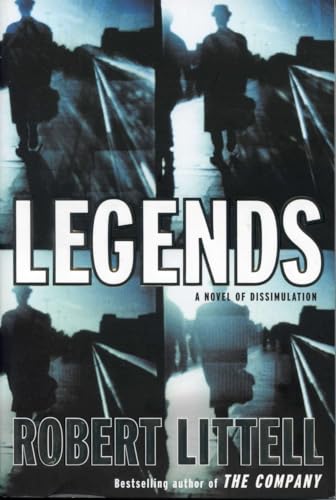
Robert Littell is the undisputed master of American spy fiction, hailed for his profound grasp of the world of international espionage. His previous novel, The Company, an international bestseller, was praised as "one of the best spy novels ever written" (Chicago Tribune). For his new novel, Legends, Littell focuses on the life of one great agent caught in a "wilderness of mirrors" where both remembering and forgetting his past are deadly options.
Martin Odum is a CIA field agent turned private detective, struggling his way through a labyrinth of past identities - "legends" in CIA parlance. Is he really Martin Odum? Or is he Dante Pippen, an IRA explosives maven? Or Lincoln Dittmann, Civil War expert? These men like different foods, speak different languages, have different skills. Is he suffering from multiple personality disorder, brainwashing, or simply exhaustion? Can Odum trust the CIA psychiatrist? Or Stella Kastner, a young Russian woman who engages him to find her brother-in-law so he can give her sister a divorce.
As Odum redeploys his dormant tradecraft skills to solve Stella's case, he travels the globe battling mortal danger and psychological disorientation. Part Three Faces of Eve, part The Spy Who Came in From the Cold, and always pure Robert Littell, Legends—from unforgettable opening to astonishing ending—again proves Littell's unparalleled prowess as a seductive storyteller.
Die Inhaltsangabe kann sich auf eine andere Ausgabe dieses Titels beziehen.
Über die Autorin bzw. den Autor
Robert Littell is the author of more than a dozen other highly acclaimed novels, many about the Cold War and the Soviet Union, including his masterwork, the New York Times bestseller The Company, and the Los Angeles Times Book Award winner for Best Mystery/Thriller, Legends. An American born in Brooklyn, Littell now lives in France.
Auszug. © Genehmigter Nachdruck. Alle Rechte vorbehalten.
1993: THE CONDEMNED MAN CATCHES A GLIMPSE OF THE ELEPHANTTHEY HAD FINALLY GOTTEN AROUND TO PAVING THE SEVEN kilometers of dirt spur connecting the village of Prigorodnaia to the four-lane Moscow-Petersburg highway. The local priest, surfacing from a week-long binge, lit beeswax tapers to Innocent of Irkutsk, the saint who in the 1720s had repaired the road to China and was now about to bring civilization to Prigorodnaia in the form of a ribbon of macadam with a freshly painted white stripe down the middle.
The peasants, who had a shrewder idea of how Mother Russia functioned, thought it more likely that this evidence of progress, if that was the correct name for it, was somehow related to the purchase, several months earlier, of the late and little lamented Lavrenti Pavlovich Beria's sprawling wooden dacha by a man identified only as the Oligarkh. Next to nothing was known about him. He came and went at odd hours in a glistening black Mercedes S-600 sedan, his shock of silver hair and dark glasses a fleeting apparition behind its tinted windows. A local woman hired to do laundry was said to have seen him angrily flick cigar ashes from the crow's-nest rising like a turret from the dacha before turning back to issue instructions to someone. The woman, who was terrified of the dacha's newfangled electric washing machine and scrubbed the laundry in a shallow reach of the river, had been too far away to make out more than a few words— "Buried, that's what I want, but alive . . ."—but they and the ' Oligarkh's feral tone had dispatched a chill down her spine that made her shudder every time she recounted the story.
Two peasants cutting firewood on the other side of the river had caught a glimpse of the Oligarkh from a distance, struggling on aluminum crutches along the path behind his dacha that led to the dilapidated paper factory disgorging dirty white smoke from its giant stacks fourteen hours a day, six days a week, and beyond that to the village cemetery and the small Orthodox church with the faded paint peeling away from its onion domes. A pair of Borzois rollicked in the dirt ahead of the Oligarkh as he thrust one hip forward and dragged the leg after it, then repeated the movement with the other hip. Three men in Ralph Lauren jeans and telnyashki, the distinctive striped shirts that paratroopers often continued to wear after they quit the army, trailed after him, shotguns cradled in the crooks of their arms. The peasants had been sorely tempted to try for a closer look at the stubby, hunch-shouldered newcomer to their village, but abandoned the idea when one of them reminded the other what the Metropolitan come from Moscow to celebrate Orthodox Christmas two Januaries earlier had proclaimed from the ambo:
If you are stupid enough to dine with the devil, for Christ's sake use a long spoon.
The road crew, along with giant tank-treaded graders and steamrollers and trucks brimming with asphalt and crushed stone, had turned up during the night while the aurora borealis was still flickering like soundless cannon fire in the north; it didn't take much imagination to suppose a great war was being fought beyond the horizon. Casting elongated shadows in the ghostly gleam of headlights, the men pulled on tar-stiff overalls and knee-high rubber boots and set to work. By first light, with forty meters of paved road behind them, the aurora and the stars had vanished, but two planets were visible in the moonless sky: one, Mars, directly overhead, the other, Jupiter, still dancing in the west above the low haze saturated with the amber glow of Moscow. When the lead crew reached the circular crater that had been gouged in the dirt spur the day before by a steam shovel, the foreman blew on a whistle. The machines ground to a halt. "Why are we stopping?" one of the drivers, leaning out the cab of his steamroller, shouted impatiently through the face mask he'd improvised to filter out the sulfurous stench from the paper factory. The men, who were paid by the meter and not the hour, were anxious to keep moving forward.
"At any moment we are expecting Jesus to return to earth as a Russian czar," the foreman called back lazily. "We don't want to miss it when he comes across the river." He lit a thick Turkish cigarette from the embers of an old one and strolled down to the edge of the river that ran parallel to the road for several kilometers. It was called the Lesnia, which was the name of the dense woods it meandered through as it skirted Prigorodnaia. At 6:12 a cold sun edged above the trees and began to burn off the mustard-thick September haze that clung to the river, which was in flood, creating a margin of shallow marshes on either side; long blades of grass could be seen undulating in the current.
The fisherman's dinghy that materialized out of the haze couldn't make it as far as the shore and the three occupants were obliged to climb out and wade the rest of the way. The two men wearing paratrooper shirts pulled off their boots and socks and rolled their jeans up to their knees. The third occupant didn't have to. He was stark naked. A crown of thorns, with blood trickling where the skin had been torn, sat on his head. A large safety pin attached to a fragment of cardboard had been passed through the flesh between his shoulder blades; on the cardboard was printed: "The spy Kafkor." The prisoner, his wrists and elbows bound behind him with a length of electrical wire, had several weeks growth of matted beard on his face, and purple bruises and what looked like cigarette burns over his emaciated body. Stepping cautiously through the slime until he reached solid ground, looking disoriented, he regarded his image in the shallow water of the river while the paratroopers dried their feet with an old shirt, then pulled on their socks and boots and rolled down their pants.
The spy Kafkor didn't appear to recognize the figure gaping at him from the surface of the river.
By now the two dozen crewmen, mesmerized by the arrival of the three figures, had abandoned all interest in road work. Drivers swung out of their cabs, the men with rakes or shovels stood around shifting their weight from one foot to the other in discomfort. No one doubted that something dreadful was about to happen to the naked Christ, who was being prodded up the incline by the paratroopers. Nor did they doubt that they were meant to witness it and spread the story. Such things happened all the time in Russia these days.
Back on the stretch of freshly paved road, the team's ironmonger wiped his sweaty palms on his thick leather apron, then retrieved a lunch box from the bullock-cart piled with welding gear and scrambled up the slope to get a better view of the proceedings. The ironmonger, who was short and husky and wearing tinted steel-rimmed eyeglasses, flicked open the lid of the lunch box and reached into it to activate the hidden camera set up to shoot through a puncture in the bottom of a thermos. Casually balancing the thermos on his knees, he began to rotate the cap and snap photographs.
Below, the prisoner, suddenly aware that every member of the road crew was gazing at him, seemed more distressed by his nakedness than his plight—until he caught sight of the crater. It was roughly the size of a large tractor tire. Thick planks were stacked on the ground next to it. He froze in his tracks and the paratroopers had to grasp him by the upper arms and drag him the last few meters. The prisoner sank to his knees at the lip of the crater and looked back at the workers, his eyes hollow with terror, his mouth open and gulping air with rattling gasps through a parched throat. He saw things he recognized but his brain, befuddled with chemicals released by fear, couldn't locate the words to describe them: the twin stacks spewing plumes of dirty white smoke, the abandoned...
„Über diesen Titel“ kann sich auf eine andere Ausgabe dieses Titels beziehen.
Suchergebnisse für Legends: A Novel of Dissimulation

Beispielbild für diese ISBN
Legends: A Novel of Dissimulation
Anbieter: World of Books (was SecondSale), Montgomery, IL, USA
Verkäuferbewertung 5 von 5 Sternen

Zustand: Good. Item in good condition. Textbooks may not include supplemental items i.e. CDs, access codes etc. Artikel-Nr. 00102753097
Gebraucht kaufen
EUR 3,90
Versand gratis
Versand innerhalb von USA
Versand innerhalb von USA
Anzahl: 1 verfügbar
Beispielbild für diese ISBN
Legends: A Novel of Dissimulation
Verlag:
The Overlook Press (edition First Edition), 2005
ISBN 10: 1585676969
ISBN 13: 9781585676965
Gebraucht
Hardcover
Erstausgabe
Anbieter: BooksRun, Philadelphia, PA, USA
Verkäuferbewertung 5 von 5 Sternen
Hardcover. Zustand: Fair. First Edition. With dust jacket. The item might be beaten up but readable. May contain markings or highlighting, as well as stains, bent corners, or any other major defect, but the text is not obscured in any way. Artikel-Nr. 1585676969-7-1-29
Gebraucht kaufen
EUR 5,24
Versand gratis
Versand innerhalb von USA
Versand innerhalb von USA
Anzahl: 2 verfügbar
Beispielbild für diese ISBN
Legends: A Novel of Dissimulation
Anbieter: Wonder Book, Frederick, MD, USA
Verkäuferbewertung 5 von 5 Sternen
Zustand: Good. Good condition. Like New dust jacket. A copy that has been read but remains intact. May contain markings such as bookplates, stamps, limited notes and highlighting, or a few light stains. Artikel-Nr. P05D-00179
Gebraucht kaufen
EUR 6,19
Versand gratis
Versand innerhalb von USA
Versand innerhalb von USA
Anzahl: 1 verfügbar
Beispielbild für diese ISBN
Legends: A Novel of Dissimulation
Anbieter: Wonder Book, Frederick, MD, USA
Verkäuferbewertung 5 von 5 Sternen
Zustand: Very Good. Very Good condition. Very Good dust jacket. A copy that may have a few cosmetic defects. May also contain light spine creasing or a few markings such as an owner's name, short gifter's inscription or light stamp. Artikel-Nr. P10A-03365
Gebraucht kaufen
EUR 6,19
Versand gratis
Versand innerhalb von USA
Versand innerhalb von USA
Anzahl: 1 verfügbar
Beispielbild für diese ISBN
Legends : A Novel of Dissimulation
Verlag:
Abrams, Inc., 2005
ISBN 10: 1585676969
ISBN 13: 9781585676965
Gebraucht
Hardcover
Erstausgabe
Anbieter: Better World Books: West, Reno, NV, USA
Verkäuferbewertung 5 von 5 Sternen
Zustand: Very Good. First Edition. Pages intact with possible writing/highlighting. Binding strong with minor wear. Dust jackets/supplements may not be included. Stock photo provided. Product includes identifying sticker. Better World Books: Buy Books. Do Good. Artikel-Nr. 5998460-6
Gebraucht kaufen
EUR 6,67
Versand gratis
Versand innerhalb von USA
Versand innerhalb von USA
Anzahl: 1 verfügbar
Beispielbild für diese ISBN
Legends : A Novel of Dissimulation
Verlag:
Abrams, Inc., 2005
ISBN 10: 1585676969
ISBN 13: 9781585676965
Gebraucht
Hardcover
Erstausgabe
Anbieter: Better World Books, Mishawaka, IN, USA
Verkäuferbewertung 5 von 5 Sternen
Zustand: Good. First Edition. Pages intact with minimal writing/highlighting. The binding may be loose and creased. Dust jackets/supplements are not included. Stock photo provided. Product includes identifying sticker. Better World Books: Buy Books. Do Good. Artikel-Nr. 3767703-6
Gebraucht kaufen
EUR 6,67
Versand gratis
Versand innerhalb von USA
Versand innerhalb von USA
Anzahl: 2 verfügbar
Beispielbild für diese ISBN
Legends: A Novel of Dissimulation
Anbieter: ThriftBooks-Reno, Reno, NV, USA
Verkäuferbewertung 5 von 5 Sternen
Hardcover. Zustand: Very Good. No Jacket. May have limited writing in cover pages. Pages are unmarked. ~ ThriftBooks: Read More, Spend Less. Artikel-Nr. G1585676969I4N00
Gebraucht kaufen
EUR 6,70
Versand gratis
Versand innerhalb von USA
Versand innerhalb von USA
Anzahl: 1 verfügbar
Beispielbild für diese ISBN
Legends: A Novel of Dissimulation
Anbieter: ThriftBooks-Atlanta, AUSTELL, GA, USA
Verkäuferbewertung 5 von 5 Sternen
Hardcover. Zustand: Very Good. No Jacket. May have limited writing in cover pages. Pages are unmarked. ~ ThriftBooks: Read More, Spend Less. Artikel-Nr. G1585676969I4N00
Gebraucht kaufen
EUR 6,72
Versand gratis
Versand innerhalb von USA
Versand innerhalb von USA
Anzahl: 1 verfügbar
Beispielbild für diese ISBN
Legends: A Novel of Dissimulation
Anbieter: ThriftBooks-Dallas, Dallas, TX, USA
Verkäuferbewertung 5 von 5 Sternen
Hardcover. Zustand: Very Good. No Jacket. May have limited writing in cover pages. Pages are unmarked. ~ ThriftBooks: Read More, Spend Less. Artikel-Nr. G1585676969I4N00
Gebraucht kaufen
EUR 6,72
Versand gratis
Versand innerhalb von USA
Versand innerhalb von USA
Anzahl: 1 verfügbar
Foto des Verkäufers
Legends: A Novel of Dissimulation
Anbieter: Dream Books Co., Denver, CO, USA
Verkäuferbewertung 5 von 5 Sternen
Zustand: good. Gently used with minimal wear on the corners and cover. A few pages may contain light highlighting or writing, but the text remains fully legible. Dust jacket may be missing, and supplemental materials like CDs or codes may not be included. May be ex-library with library markings. Ships promptly! Artikel-Nr. DBV.1585676969.G
Gebraucht kaufen
EUR 7,24
Versand gratis
Versand innerhalb von USA
Versand innerhalb von USA
Anzahl: 1 verfügbar