
Verwandte Artikel zu IBM Business Analytics and Cloud Computing: Best Practices...
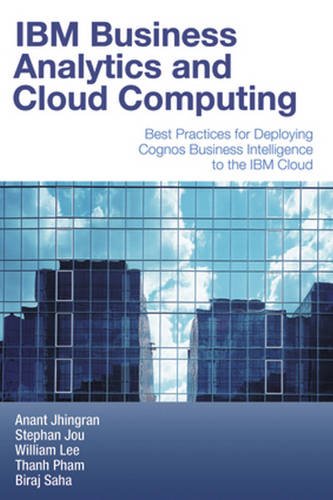
IBM Business Analytics and Cloud Computing: Best Practices for Deploying Cognos Business Intelligence to the IBM Cloud - Softcover
Inhaltsangabe
Business intelligence and analytics software enable businesses to analyze performance data in order to make better decisions through the use of cloud computing&;an Internet-based model for convenient, on-demand network access to a shared pool of configurable computing resources. This book is a practitioner&;s guide for successful evaluation and design for implementation of Cognos Business Intelligence cloud solution, for either Cognos 8 BI or Cognos Business Intelligence Version 10. With pragmatic and practical information about the best practices and guidelines, as well as specific software and configuration steps, this guide for solutions and IT architects includes detailed screen shots, code samples, and input instructions.
Die Inhaltsangabe kann sich auf eine andere Ausgabe dieses Titels beziehen.
Über die Autorin bzw. den Autor
Anant Jhingran is an IBM fellow and vice president and chief technical officer for IBM&;s Information Management division. He lives in San Francisco. Stephan Jou is a technical architect, research staff member, and senior technical staff member in IBM&;s Business Analytics division in the Technology and Innovation group. William Lee is a senior software consulting engineer at IBM through the Cognos acquisition. Thanh Pham is a solution architect in the IBM Information Management Advanced Technology group, focusing on helping customers build applications using the IBM Mashup Center product and IBM cloud computing. Biraj Saha is an advisory software developer at IBM Cognos, specializing in metadata and algorithm design and development for Cognos modeling tools. They all live in Ottawa, Ontario.
Auszug. © Genehmigter Nachdruck. Alle Rechte vorbehalten.
IBM Business Analytics and Cloud Computing
Best Practices for Deploying Cognos Business Intelligence to the IBM Cloud
By Anant Jhingran, Stephan Jou, William Lee, Thanh Pham, Biraj SahaMC Press
Copyright © 2010 IBM Corporation
All rights reserved.
ISBN: 978-1-58347-363-4All rights reserved.
Contents
Title Page,
Copyright Page,
Acknowledgments,
About the Authors,
Introduction,
1 - Cloud Computing and Analytics,
2 - Getting Started,
3 - Installation and Configuration,
4 - Security Best Practices,
5 - Handling Cloud Topologies,
6 - Performance and Scalability Best Practices,
7 - High Availability Best Practices,
CHAPTER 1
Cloud Computing and Analytics
At the time of writing, a Google search on the phrase "cloud computing definition" returned more than 3.5 million results. There appear to be as many definitions of cloud computing as there are people excited about it! Some of these definitions are very good. For example, the U.S. National Institute of Standards and Technology (NIST) provides a concise but comprehensive effort at http://csrc.nist.gov/groups/SNS/cloud-computing
This book will not repeat such efforts at defining cloud computing. Instead, we intend this book to be a practical companion to leveraging cloud computing in your IBM Cognos analytics solution. As such, it focuses on the main characteristics of cloud computing with respect to their tangible advantages for you, the cloud practitioner.
On-Demand Infrastructure
On cloud computing platforms, the required IT infrastructure for your applications is provided to you, based on what you actually require. Nearly all clouds now provide compute cycles, networking, storage space, and memory capacity, all on an on-demand basis. Because you can simply release unused resources back into the pool, you do not have to worry about over-purchasing more hardware than you actually need.
In a pure and simple comparison with traditional data centers, this arrangement provides immediate and obvious cost advantages. Underutilization of purchased hardware is a genuine problem. It's what made virtualization such an attractive IT strategy in the early 2000s: replace the physical hardware with virtual hardware so you can allocate virtual machines when you need them and deallocate them when you're done. This strategy is particularly cost-effective for analytical applications that are tied to seasonal behavior, such as a sales application that is used only during the end of a quarter.
Small wonder that the major cloud platforms, including those from Amazon and IBM, are, at their lowest level, Web interfaces wrapped around virtual machines (VMs), storage, and networking. Being able to create and configure VMs through a simple browser interface or through Representational State Transfer (REST) calls is one simple way to think about and approach cloud computing.
This pay-as-you-go, utility-based cost model is, in some ways, the most innovative aspect of cloud computing. You trade away the requirement for up-front capital expenditures (capex) to purchase hardware and software, and instead favor ongoing operational expenditures (opex) based on what you actually use.
This book takes you through the process of leveraging such an infrastructure to create a fully working IBM Cognos Business Intelligence (BI) virtual instance running in the cloud. This instance is then saved as an image, consuming no resources or cost, until you are ready and have a need for a Cognos deployment.
While the steps in this book are based on the IBM Smart Business Development and Test Cloud, they are also applicable with little modification to other cloud infrastructures, such as Amazon's. And of course, the best practices we describe here have general applicability and relevance, no matter how you ultimately deploy your Cognos application.
On-Demand Higher Services
Moving above the so-called Infrastructure-as-a-Service (IaaS) layer to the higher so-called Platform-as-a-Service (PaaS) and Software-as-a-Service (SaaS) layers is where cloud starts to differentiate itself from simple virtualization. The PaaS and SaaS cloud layers bring higher-level services to the table, and things get much more interesting. Rather than thinking in terms of machines, networking, bandwidth, and storage space, imagine services related to the provisioning of complex topologies with defined quality-of-service constraints, analytical and reporting services, and Hadoop-style big-calculation jobs.
While nascent, there is a tremendous amount of growth in the cloud computing ecosystem around these higher-level cloud services. For example, both Amazon and Yahoo! offer platforms that can execute Hadoop applications in their cloud infrastructures.
There is a good and practical reason why higher-level services are interesting: they are more cost-efficient. For example, running a Hadoop job using Amazon's Elastic MapReduce, which leverages Amazon's Elastic Compute (EC2) and Simple Storage Service (S3) under the covers, costs less than directly using EC2 or S3 yourself. That's because not only do you avoid having to install and configure the software, but Amazon can optimize and manage the entire infrastructural stack much more efficiently.
The end result is that as we move up the cloud stack and focus more on higher-level services that provide targeted solutions and workloads, we are able to build more for less.
Resource Pooling and Rapid Elasticity
The distressing amount of hardware underutilization in traditional data centers that we noted previously remains the main reason why virtualization and cloud has been on the IT agenda for the past few years and will continue to be in the years to come. Being able to more closely match capacity and cost with demand is the cost justification we all need.
This ability to pool and share resources to match demand clearly requires rapid elasticity. The amount of storage available (and being paid for) should always be slightly ahead of the growth of your database. Any new virtual machines required to handle added load should be recruited and connected to the system in minutes or hours, not days or weeks.
This book provides techniques and best practices to scale up or down a Cognos BI system, dynamically recruiting additional virtual machines and connecting them or disconnecting them as required.
Flexible Deployment Models
When most people first hear of cloud computing, they think of the public cloud — an IT infrastructure that is delivered externally. While a public cloud is appropriate for many scenarios, there are many other cases in which data cannot leave the enterprise boundaries. Fortunately, in addition to public clouds, you can deploy your solution to private clouds, where the cloud infrastructure is erected within the enterprise firewalls and managed by the enterprise IT department itself, or even to hybrid clouds, which are a combination of public and private clouds, with systems on both sides and a secure connection between them.
No single model will work in all cases. Data security and sensitivity, bandwidth and latency, and even legal and regulatory requirements all need to factor into the deployment and topology of this solution. Fortunately, cloud computing offers a flexible allocation of resources and the ability to loosely couple systems together with standard Internet protocols, letting you design the right solution for the requirements on hand.
This book provides some...
„Über diesen Titel“ kann sich auf eine andere Ausgabe dieses Titels beziehen.
Suchergebnisse für IBM Business Analytics and Cloud Computing: Best Practices...

Beispielbild für diese ISBN
IBM Business Analytics and Cloud Computing: Best Practices for Deploying Cognos Business Intelligence to the IBM Cloud
Anbieter: ThriftBooks-Atlanta, AUSTELL, GA, USA
Verkäuferbewertung 5 von 5 Sternen

Paperback. Zustand: As New. No Jacket. Pages are clean and are not marred by notes or folds of any kind. ~ ThriftBooks: Read More, Spend Less. Artikel-Nr. G1583473637I2N00
Gebraucht kaufen
EUR 12,09
Versand gratis
Versand innerhalb von USA
Versand innerhalb von USA
Anzahl: 1 verfügbar
Beispielbild für diese ISBN
IBM Business Analytics and Cloud Computing: Best Practices for Deploying Cognos Business Intelligence to the IBM Cloud
Anbieter: Revaluation Books, Exeter, Vereinigtes Königreich
Verkäuferbewertung 5 von 5 Sternen
Paperback. Zustand: Brand New. 1st edition. 128 pages. 9.00x6.00x0.25 inches. In Stock. Artikel-Nr. 1583473637
Neu kaufen
EUR 26,92
EUR 11,69 Versand
Versand von Vereinigtes Königreich nach USA
Versand von Vereinigtes Königreich nach USA
Anzahl: 1 verfügbar