
Verwandte Artikel zu Business Intelligence Strategy: A Practical Guide for...
Inhaltsangabe
Geared toward IT management and business executives seeking to excel in business intelligence initiatives, this practical guide explores creating business alignment strategies that help prioritize business requirements, build organizational and cultural strategies, increase IT efficiency, and promote user adoption. Business intelligence, together with business analytics and performance management, eliminates information overload by organizing the massive amounts of information available in the modern enterprise. Addressing the challenges of business intelligence operations, this resource supports the goal of better business decision making and identifying unrealized opportunities. Each chapter includes a checklist of recommended approaches and a strategy overview template.
Die Inhaltsangabe kann sich auf eine andere Ausgabe dieses Titels beziehen.
Über die Autorinnen und Autoren
John Boyer leads the business intelligence advisory team at the Nielsen Company. He lives in Chicago. Bill Frank has more than 25 years of experience in decision support and business intelligence and is a certified Project Management Professional (PMP). He lives in New Brunswick, New Jersey. Brian Green is manager of business intelligence and performance management at Blue Cross Blue Shield of Tennessee. He lives in Chattanooga, Tennessee. Tracy Harris is senior manager in business intelligence excellence at IBM and is responsible for chairing the BI Excellence Advisory board and managing the BI Excellence Program and Champion initiative at IBM. She lives in Ottawa, Ontario. Kay Van De Vanter is the enterprise BI architect and business intelligence competency center lead at the Boeing Company. She lives in Seattle.
John Boyer leads the business intelligence advisory team at the Nielsen Company. He lives in Chicago. Bill Frank has more than 25 years of experience in decision support and business intelligence and is a certified Project Management Professional (PMP). He lives in New Brunswick, New Jersey. Brian Green is manager of business intelligence and performance management at Blue Cross Blue Shield of Tennessee. He lives in Chattanooga, Tennessee. Tracy Harris is senior manager in business intelligence excellence at IBM and is responsible for chairing the BI Excellence Advisory board and managing the BI Excellence Program and Champion initiative at IBM. She lives in Ottawa, Ontario. Kay Van De Vanter is the enterprise BI architect and business intelligence competency center lead at the Boeing Company. She lives in Seattle.
Auszug. © Genehmigter Nachdruck. Alle Rechte vorbehalten.
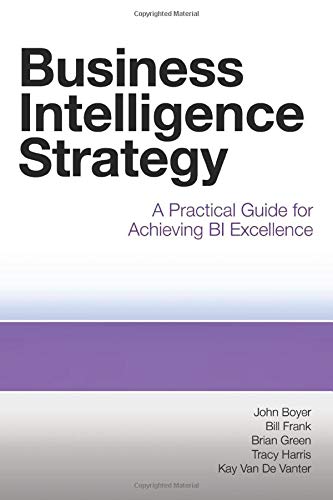
Business Intelligence Strategy
A Practical Guide for Achieving BI Excellence
By John Boyer, Bill Frank, Brian Green, Tracy Harris, Kay Van De VanterMC Press Online, LLC
Copyright © 2010 IBM Corporation
All rights reserved.
ISBN: 978-1-58347-362-7All rights reserved.
Contents
About the Authors,
Preface,
Introduction,
Chapter 1: Defining Your Business Alignment Strategy,
Chapter 2: Organizational and Behavioral Strategy,
Chapter 3: Technology Strategy,
Summary,
Notes,
CHAPTER 1
Defining Your Business Alignment Strategy
What strategic approach do top-performing, breakaway organizations share? According to the IBM Institute for Business Value study Breaking Away with Business Analytics and Optimization, it is the use of business intelligence and analytics. Using BI, analytics, and performance management eliminates information overload by making sense of the massive amount of information that is now available in the enterprise. In order to become a breakaway organization, companies need to establish both a vision about the strategic use of information and a plan to implement this vision.
We know that most organizations have an understanding of one or more of the basic elements of corporate business strategy. They typically define, at least on an annual basis, their top corporate objectives and business unit strategies. They analyze their markets, determine their direction, and create a plan to ensure that resources are available and stakeholders informed. However, it is apparent that most organizations do not sufficiently link these plans to daily operations or manage execution effectively. And while it is recognized that BI technologies can be an enabler to successful execution, many do not have a business alignment strategy that allows them to plan their strategies via data-driven metrics and BI or to map these corporate objectives in order to effectively monitor results to ensure objectives are achieved. This area is often either overlooked completely or implemented on an ad hoc basis versus as part of the basic success of the business strategy.
In fact, according to a study conducted by IBM in September2010, only 22 percent of organizations are successfully linking strategy to execution with BI and performance management. And we know that when companies fail in strategy execution, company results can suffer.
On the flip side, however, this means that roughly one in five companies is successful in its strategy execution. Such organizations can reap the benefits of overall performance improvements, gaining competitive advantage, finding new opportunities, and creating business impact that is aligned with their goals. They have enabled visibility into the information that matters and improved decision-making capabilities. With the ability to understand, anticipate, and shape outcomes through innovative technologies, these organizations can help to increase efficiencies and effectiveness throughout the key areas of the organization.
Our task in this chapter is to explore considerations and identify steps in developing an effective business alignment strategy for a strategic business intelligence initiative. It should map to corporate business strategy to enable successful execution, a critical first step in the strategic BI initiative. This includes the following:
1. Assessing Your Current Situation — Understanding the corporate strategy and identifying how your organization is currently managing its business strategy and monitoring and measuring outcomes
2. Developing Effective Strategies for Linking the Business Strategy to BI Initiatives — Examining strategies that are used today and determining how your organization can develop an effective business alignment strategy that improves outcomes and results
3. Involving Key Stakeholders and Priority Business Areas — Understanding how to determine, prioritize, and involve key stakeholders who can influence the business and execution strategies
4. Implementing Sound Solutions — Learning how proven practices can transform the effectiveness of the organization
An Introduction to Strategic Management Approaches
So how can strategy be managed to achieve the desired outcomes? Many different strategic management approaches may be in use within the organization.
Organizations use various methods today, and others have been used in the past. As examples, some of the highly common ones include, but are not limited to:
• Balanced Scorecard (BSC) — A strategic planning and management system that aligns business activities to the strategy of the organization. BSC offers the following:
[much greater than] Stresses the communication of the strategy — both internally and externally — and monitors the progress of the organization against strategic goals
[much greater than] Adds strategic non-financial performance measurements to the financial metrics to provide a more balanced view of organizational behavior
[much greater than] Applies metrics to the decision-making areas of finance, customer, internal process, and innovation BSC became popular in the 1990s and is used today by entrepreneurial firms as well as some government departments.
• Six Sigma (6S) — A very rigorous system of management tactics that seeks to improve the quality of process outputs by identifying and removing the causes of defects (errors) and minimizing variability in manufacturing and business processes. 6S does the following:
* Uses a set of quality management methods, including statistical methods
* Creates a special infrastructure of people within the organization (Black Belts, Green Belts, and so on) who are experts in these methods
* Follows a defined sequence of steps and has quantified targets; these targets can be financial (cost reduction or profit increase) or whatever is critical to the customer of that process (e.g., cycle time, safety, delivery)
Six Sigma was originally developed by Motorola in 1981 and was used first in manufacturing. Its roots are based heavily on Japanese quality improvement initiatives in the automotive industry. It focuses on quantifiable bottom-line results that are tied to strategy.
• Total Quality Management (TQM) — A management concept that is often associated with developing, deploying, and maintaining organizational systems required for various business processes. TQM achieves these goals:
* Reduces the errors produced during the manufacturing or service process
* Increases customer satisfaction
* Streamlines supply-chain management
* Modernizes equipment and ensures workers have the highest level of training
TQM is closely associated with Six Sigma and differs mainly in its approach. W. Edwards Deming is considered the founder of this management model, which preceded Six Sigma.
All of these are solid approaches to managing strategy, and chances are good that management decision-makers use more than one of these, in addition to other management tactics, to control and direct the organization. However, whichever one is used, some common themes arise from these approaches:
• Goals — The definition and selection of strategic objectives and/or goals
• Measurements — The consolidation of measurement information relevant to an organization's progress against these objectives and goals
•...
„Über diesen Titel“ kann sich auf eine andere Ausgabe dieses Titels beziehen.
Suchergebnisse für Business Intelligence Strategy: A Practical Guide for...

Beispielbild für diese ISBN
Business Intelligence Strategy : A Practical Guide for Achieving BI Excellence
Verlag:
MC Press Online, LLC, 2010
ISBN 10: 1583473629
ISBN 13: 9781583473627
Gebraucht
Softcover
Erstausgabe
Anbieter: Better World Books, Mishawaka, IN, USA
Verkäuferbewertung 5 von 5 Sternen

Zustand: Good. 1st Edition. Pages intact with minimal writing/highlighting. The binding may be loose and creased. Dust jackets/supplements are not included. Stock photo provided. Product includes identifying sticker. Better World Books: Buy Books. Do Good. Artikel-Nr. 9509717-6
Gebraucht kaufen
EUR 9,09
Versand gratis
Versand innerhalb von USA
Versand innerhalb von USA
Anzahl: 2 verfügbar
Foto des Verkäufers
Business Intelligence Strategy: A Practical Guide for Achieving BI Excellence
Anbieter: WeBuyBooks, Rossendale, LANCS, Vereinigtes Königreich
Verkäuferbewertung 5 von 5 Sternen
paperback. Zustand: Good. Most items will be dispatched the same or the next working day. A copy that has been read but remains in clean condition. All of the pages are intact and the cover is intact and the spine may show signs of wear. The book may have minor markings which are not specifically mentioned. Artikel-Nr. rev2931420088
Gebraucht kaufen
EUR 4,12
EUR 6,04 Versand
Versand von Vereinigtes Königreich nach USA
Versand von Vereinigtes Königreich nach USA
Anzahl: 1 verfügbar
Beispielbild für diese ISBN
Business Intelligence Strategy: A Practical Guide for Achieving BI Excellence
Anbieter: WorldofBooks, Goring-By-Sea, WS, Vereinigtes Königreich
Verkäuferbewertung 5 von 5 Sternen
Paperback. Zustand: Very Good. The book has been read, but is in excellent condition. Pages are intact and not marred by notes or highlighting. The spine remains undamaged. Artikel-Nr. GOR005584728
Gebraucht kaufen
EUR 3,68
EUR 6,55 Versand
Versand von Vereinigtes Königreich nach USA
Versand von Vereinigtes Königreich nach USA
Anzahl: 1 verfügbar
Beispielbild für diese ISBN
Business Intelligence Strategy : A Practical Guide for Achieving BI Excellence
Verlag:
MC Press Online, LLC, 2010
ISBN 10: 1583473629
ISBN 13: 9781583473627
Gebraucht
Softcover
Erstausgabe
Anbieter: Better World Books Ltd, Dunfermline, Vereinigtes Königreich
Verkäuferbewertung 5 von 5 Sternen
Zustand: Good. 1st Edition. Former library copy. Pages intact with minimal writing/highlighting. The binding may be loose and creased. Dust jackets/supplements are not included. Includes library markings. Stock photo provided. Product includes identifying sticker. Better World Books: Buy Books. Do Good. Artikel-Nr. GRP89064984
Gebraucht kaufen
EUR 7,11
EUR 5,85 Versand
Versand von Vereinigtes Königreich nach USA
Versand von Vereinigtes Königreich nach USA
Anzahl: 1 verfügbar
Beispielbild für diese ISBN
Business Intelligence Strategy : A Practical Guide for Achieving BI Excellence
Verlag:
MC Press Online, LLC, 2010
ISBN 10: 1583473629
ISBN 13: 9781583473627
Gebraucht
Softcover
Erstausgabe
Anbieter: Better World Books Ltd, Dunfermline, Vereinigtes Königreich
Verkäuferbewertung 5 von 5 Sternen
Zustand: Very Good. 1st Edition. Former library copy. Pages intact with possible writing/highlighting. Binding strong with minor wear. Dust jackets/supplements may not be included. Includes library markings. Stock photo provided. Product includes identifying sticker. Better World Books: Buy Books. Do Good. Artikel-Nr. 15368200-20
Gebraucht kaufen
EUR 7,11
EUR 5,85 Versand
Versand von Vereinigtes Königreich nach USA
Versand von Vereinigtes Königreich nach USA
Anzahl: 1 verfügbar
Beispielbild für diese ISBN
Business Intelligence Strategy: A Practical Guide for Achieving BI Excellence
Anbieter: Sell Books, Elland, YORKS, Vereinigtes Königreich
Verkäuferbewertung 5 von 5 Sternen
paperback. Zustand: Good. Our good condition books are generally good for reading but not for gifting or collecting. They could have imperfections such as creasing, fanning, inscriptions, margin notes, yellowing, staining on edge or cover or pages, bumps, scuffs, etc etc (sometimes multiple of these). It's a wide category that encompasses anything that isn't almost-new down to anything that is slightly better than poor. We would NOT recommend gifting Good books - these should be considered reading copies. Our books are dispatched from a Yorkshire former cotton mill. We list via barcode/ISBN so please note that the images are stock images and may not be the exact copy you receive, furthermore the details about edition and year might not be accurate as many publishers reuse the same ISBN for multiple editions and as we simply scan a barcode or enter an ISBN we do not check the validity of the edition data when listing. If you're looking for an exact edition please don't order (at least not without checking with us first, although we don't always have time to check). We aim to dispatch prompty, the service used will depend on order value and book size. We can ship to most countries, see our shipping policies. Payment is via Abe only. Artikel-Nr. L-BFA00791-RAG-20240412-G
Gebraucht kaufen
EUR 3,65
EUR 14,20 Versand
Versand von Vereinigtes Königreich nach USA
Versand von Vereinigtes Königreich nach USA
Anzahl: 1 verfügbar
Beispielbild für diese ISBN
Business Intelligence Strategy: A Practical Guide for Achieving Bi Excellence
Anbieter: Revaluation Books, Exeter, Vereinigtes Königreich
Verkäuferbewertung 5 von 5 Sternen
Paperback. Zustand: Brand New. 1st edition. 136 pages. 8.80x5.90x0.40 inches. In Stock. Artikel-Nr. __1583473629
Neu kaufen
EUR 16,80
EUR 11,69 Versand
Versand von Vereinigtes Königreich nach USA
Versand von Vereinigtes Königreich nach USA
Anzahl: 1 verfügbar
Beispielbild für diese ISBN
Business Intelligence Strategy: A Practical Guide for Achieving BI Excellence
Anbieter: Kennys Bookstore, Olney, MD, USA
Verkäuferbewertung 5 von 5 Sternen
Zustand: New. Num Pages: 115 pages, black & white illustrations, figures. BIC Classification: UY. Category: (G) General (US: Trade). Dimension: 155 x 230 x 31. Weight in Grams: 202. . 2010. 1st Edition. Paperback. . . . . Books ship from the US and Ireland. Artikel-Nr. V9781583473627
Neu kaufen
EUR 27,34
EUR 9,09 Versand
Versand innerhalb von USA
Versand innerhalb von USA
Anzahl: 13 verfügbar
Foto des Verkäufers
Business Intelligence Strategy: A Practical Guide for Achieving BI Excellence
Anbieter: moluna, Greven, Deutschland
Verkäuferbewertung 5 von 5 Sternen
Kartoniert / Broschiert. Zustand: New. Über den AutorJohn Boyer leads the business intelligence advisory team at the Nielsen Company. He lives in Chicago. Bill Frank has more than 25 years of experience in decision support and business intelligence and is a certified Pro. Artikel-Nr. 596342774
Neu kaufen
EUR 25,81
EUR 48,99 Versand
Versand von Deutschland nach USA
Versand von Deutschland nach USA
Anzahl: Mehr als 20 verfügbar