
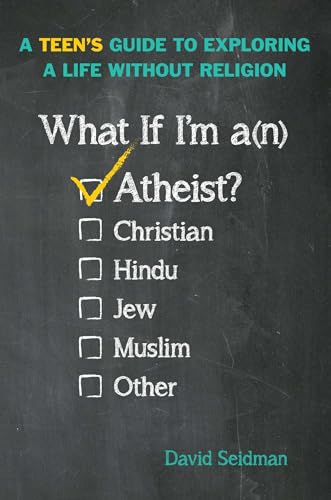
Verwandte Artikel zu What If I'm an Atheist?: A Teen's Guide to...
Inhaltsangabe
Can you have guidance without God? This thoughtful, one-of-a-kind guide offers answers to all of your questions about atheism and nonbelief.
Have you ever wondered what religion and belief means for your life? Maybe you believe in nothing at all. Does that mean you’re an atheist? What does atheism even mean? Regardless of the religious background you grew up with, it’s natural to question what you believe…or what you don’t. Establishing your views about religion and spirituality is part of becoming an individual, but outside pressures can make it tough to know what is right for you.
What If I’m an Athiest? offers a thoughtful exploration of how atheism or the absence of religion can impact your life. From discussing the practical significance of holidays to offering conversation starters and tips, this guide is an invaluable resource about religion, spirituality, and the lack thereof.
This compassionate, nonjudgmental guide includes peer interviews featuring both religious and atheist teens and provides a safe space to find answers to the questions you may not want ask out loud, so you can decide what you believe—or don’t—for yourself.
Die Inhaltsangabe kann sich auf eine andere Ausgabe dieses Titels beziehen.
Über die Autorin bzw. den Autor
David Seidman is a Los Angeles–area journalist, editor, and author who often writes nonfiction for teens. He comes to the topic of atheism with empathy for teenagers and for people in the religious minority, but he’s nobody’s advocate. He has written on topics as diverse as a US president, civil rights, teens in Iran, and holiday lights displays.
Auszug. © Genehmigter Nachdruck. Alle Rechte vorbehalten.
What If I’m an Atheist?
1
Who Are Atheists (and Agnostics and Other Unbelievers)?
The term that best describes me now is secular humanist.
CHARLES SCHULZ, CREATOR OF PEANUTS1
Atheists may not be who you think they are.
To begin with, atheist is a pretty narrow term. It doesn’t include the whole spread of people who don’t worship a god. Agnostics, freethinkers, humanists, rationalists, objectivists—there are lots of names.
What’s an Atheist?
The most common name for an unbeliever—and a controversial name it is—is atheist. An atheist doesn’t believe that God exists. Thus, God didn’t create the universe, write the Bible, or care what you did on your date last Saturday.
Some people who believe in God can find atheism and atheists a threat.
In a 2007 poll of more than a thousand Americans, more than half of them wouldn’t elect an atheist president even if he or she were qualified for the job.2 A 2010 poll added that more than half of all Americans would be uncomfortable with an atheist on the Supreme Court.3
In 2010 Pope Benedict XVI associated godlessness with the Nazis. “Britain and her leaders stood against a Nazi tyranny that wished to eradicate God from society,” he announced on a visit to England. “As we reflect on the sobering lessons of the atheist extremism of the twentieth century, let us never forget how the exclusion of God, religion, and virtue from public life leads ultimately to a truncated vision of man.”4
The Boy Scouts don’t let atheists become scouts or scoutmasters.5 In a number of Islamic countries, atheists face discrimination up to and including execution.6 A poll by the University of Minnesota found atheists to be “America’s most distrusted minority,” less trustworthy than Muslims, immigrants, or gay people. “Atheists are also the minority group most Americans are least willing to allow their children to marry.”7
So yes, atheism can be dangerous—to atheists as well as to theists. (Theist, by the way, means “believer in God.”)
Atheists come in a lot of varieties, but they often break down into two categories: negative atheists (also known as weak atheists or soft atheists) and positive atheists (also called strong atheists or hard atheists). These are pretty new terms, and exactly what they mean is still being nailed down, but here are a couple of examples.
• Negative/weak/soft atheists say that there is no proof that any god exists. Positive/strong/hard atheists say that there is proof that no god exists.
• Negative/weak/soft atheists tolerate religion and believers. Positive/strong/hard atheists, according to journalist Gary Wolf, “condemn not just belief in God but respect for belief in God.” In their view, Wolf has said, “Religion is not only wrong, it’s evil.”8
There are millions of atheists, as you’ll learn later in this chapter. They’re all over the world. And a lot of them are teenagers.
The Ones Who Don’t Know
The second-most-famous segment of unbelievers is agnostics. “An agnostic is a doubter,” said Clarence Darrow, possibly the most famous trial lawyer of the past hundred years—and an agnostic. “The word is generally applied to those who doubt the verity of accepted religious creeds.”9
Agnostic literally means “without knowing,” and it’s the viewpoint for people who aren’t certain what’s out there. Agnostics range from people who have no opinion at all to people who are pretty sure of their views but don’t want to shut other possibilities out. “I like being agnostic,” said an ex-Baptist on the site Teenage Writers who called herself CassieCasey. “I think it gives me the freedom to be a little bit more open-minded about other religions.”10
“As an agnostic, I may not be religious, but I am still spiritual,” said Gaarden (a screen name), a seventeen-year-old agnostic from Arizona. He started out Christian (“baptized when I was ten, without really knowing anything about Christianity”) but switched to atheism until “I really began to fear the possibility of empty nothingness and oblivion after death.” To find answers, he read up on different religions. He ended up respecting them but questioning their views on salvation and morality; he realized, “I am an agnostic at heart.”11
So Many Different Flavors
If you’ve got a version of unbelief, you can probably find a name for it.
Freethinker sounds quaint, and it should. It’s one of the oldest names for an unbeliever, dating to 1692.12 “ ‘Free thought’ means coming to your own conclusion about religion and without the influences of religious dogma or doctrine,” according to Blair Scott, who was a director of the unbelievers group American Atheists at the time of this comment.13
Rationalists trust logic and reason. Science-fiction writer Isaac Asimov said that he’d rather call himself a rationalist than an atheist because “ ‘Atheist,’ meaning ‘no God,’ is negative and defeatist. It says what you don’t believe and puts you in an eternal position of defense. ‘Rationalism,’ on the other hand, states what you DO believe: That is, that which can be understood in the light of reason.”14
Humanists focus on people rather than on God. Instead of taking guidance from a spirit in the sky, they emphasize humanity’s “ability and responsibility to lead ethical lives of personal fulfillment that aspire to the greater good of humanity.”15 So says the American Humanist Association—but theirs isn’t the only definition. Some people apply humanism to any attitude that cares about people, which means that it’s possible to be a religious humanist. In fact, a tradition of Christian humanism dates back to the Renaissance.
Some nonreligious humanists call themselves secular humanists, a term that’s suffered attacks from some Christian conservatives. “Most of today’s evils can be traced to secular humanism,” say evangelical ministers Tim LaHaye and David Noebel in their book Mind Siege. “Secular humanism . . . is driven by a flaming hatred for Jesus Christ that seeks to eradicate the Christian worldview.”16
Objectivists follow the philosophy of Russian American novelist Ayn Rand, who promoted selfishness and wrote, “I raise this god over the earth . . . . This god, this one word:...
„Über diesen Titel“ kann sich auf eine andere Ausgabe dieses Titels beziehen.
Suchergebnisse für What If I'm an Atheist?: A Teen's Guide to...

Beispielbild für diese ISBN
What If I'm an Atheist?: A Teen's Guide to Exploring a Life Without Religion
Anbieter: World of Books (was SecondSale), Montgomery, IL, USA
Verkäuferbewertung 5 von 5 Sternen

Zustand: Good. Good condition ex-library book with usual library markings and stickers. Artikel-Nr. 00082842967
Gebraucht kaufen
EUR 4,04
Versand gratis
Versand innerhalb von USA
Versand innerhalb von USA
Anzahl: 1 verfügbar
Beispielbild für diese ISBN
What If I'm an Atheist?: A Teen's Guide to Exploring a Life Without Religion
Anbieter: BooksRun, Philadelphia, PA, USA
Verkäuferbewertung 5 von 5 Sternen
Hardcover. Zustand: Very Good. With dust jacket. It's a well-cared-for item that has seen limited use. The item may show minor signs of wear. All the text is legible, with all pages included. It may have slight markings and/or highlighting. Artikel-Nr. 1582704074-11-1-29
Gebraucht kaufen
EUR 5,32
Versand gratis
Versand innerhalb von USA
Versand innerhalb von USA
Anzahl: 1 verfügbar
Beispielbild für diese ISBN
What If I'm an Atheist? : A Teen's Guide to Exploring a Life Without Religion
Anbieter: Better World Books, Mishawaka, IN, USA
Verkäuferbewertung 5 von 5 Sternen
Zustand: Good. Former library copy. Pages intact with minimal writing/highlighting. The binding may be loose and creased. Dust jackets/supplements are not included. Includes library markings. Stock photo provided. Product includes identifying sticker. Better World Books: Buy Books. Do Good. Artikel-Nr. 5680723-6
Gebraucht kaufen
EUR 6,56
Versand gratis
Versand innerhalb von USA
Versand innerhalb von USA
Anzahl: 2 verfügbar
Beispielbild für diese ISBN
What If I'm an Atheist?: A Teen's Guide to Exploring a Life Without Religion
Anbieter: ThriftBooks-Dallas, Dallas, TX, USA
Verkäuferbewertung 5 von 5 Sternen
Hardcover. Zustand: Very Good. No Jacket. Former library book; May have limited writing in cover pages. Pages are unmarked. ~ ThriftBooks: Read More, Spend Less. Artikel-Nr. G1582704074I4N10
Gebraucht kaufen
EUR 7,32
Versand gratis
Versand innerhalb von USA
Versand innerhalb von USA
Anzahl: 1 verfügbar
Beispielbild für diese ISBN
What If I'm an Atheist?: A Teen's Guide to Exploring a Life Without Religion
Anbieter: ThriftBooks-Atlanta, AUSTELL, GA, USA
Verkäuferbewertung 5 von 5 Sternen
Hardcover. Zustand: Very Good. No Jacket. Former library book; May have limited writing in cover pages. Pages are unmarked. ~ ThriftBooks: Read More, Spend Less. Artikel-Nr. G1582704074I4N10
Gebraucht kaufen
EUR 7,32
Versand gratis
Versand innerhalb von USA
Versand innerhalb von USA
Anzahl: 1 verfügbar