
Verwandte Artikel zu Threads of Time: Recollections
Inhaltsangabe
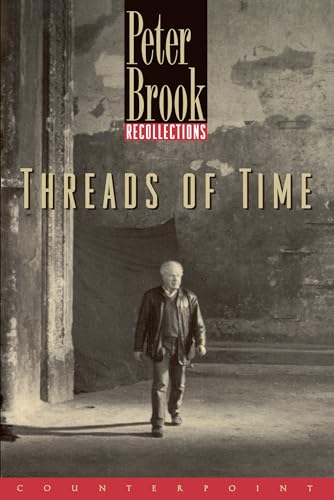
Director Peter Brook reveals the myriad sources driving his lifelong passion for finding the most expressive way to tell a story. Over the years we watch his metamorphosis from traditionalist to radical innovator, witnessing his expanding field of vision and sense of dramatic possibility.
For fifty years, Peter Brook's opera, stage, and film productions have held audiences spellbound. His visionary directing has created some of the most influential productions in contemporary theater. Now at the pinnacle of his career, Brook has given us his memoir, a luminous, inspiring work in which he reflects on his artistic fortunes, his idols and teachers, his philosophical path and personal journey. In this autobiography, the man The New York Times has called "the English-speaking world's most eminent director" and The London Times has named "theater's living legend" reveals the myriad sources behind his lifelong passion to find the most expressive way of telling a story. Whether in India's epic "Mahabharata" or a stage adaptation of Oliver Sak's The Man Who Mistook His Wife for a Hat, South Africa's "Woza Albert" or "The Cherry Orchard," Brook's unique blend of practicality and vision creates unforgettable experiences for audiences worldwide.Die Inhaltsangabe kann sich auf eine andere Ausgabe dieses Titels beziehen.
Über die Autorin bzw. den Autor
Peter Brook received his M.A. at Oxford, where he founded the Oxford University Film Society. A former codirector of the Royal Shakespeare Company, he currently heads the International Centre of Theatre Research, which he founded in Paris in 1971. He has directed more than fifty productions, and his films include the original Lord of the Flies. He lives with his wife Natasha Parry in Paris.
Von der hinteren Coverseite
For fifty years, Peter Brook's opera, stage, and film productions have held audiences spellbound. His visionary directing has created some of the most influential productions in contemporary theater. Now at the pinnacle of his career, Brook has given us his memoir, a luminous, inspiring work in which he reflects on his artistic fortunes, his idols and teachers, his philosophical path and personal journey. In this autobiography, the man The New York Times has called "the English-speaking world's most eminent director" and The London Times has named "theater's living legend" reveals the myriad sources behind his lifelong passion to find the most expressive way of telling a story. Whether in India's epic Mahabharata or a stage adaptation of Oliver Sask's The Man Who Mistook His Wife for a Hat, South Africa's Woza Albert or The Cherry Orchard, Brook's unique blend of practicality and vision creates unforgettable experiences for audiences worldwide.
Auszug. © Genehmigter Nachdruck. Alle Rechte vorbehalten.
Threads of Time
RecollectionsBy Peter BrookCounterpoint Press
Copyright © 1999 Peter BrookAll right reserved.
ISBN: 9781582430188
Chapter One
I could have called this book False Memories. Not because I wantconsciously to tell a lie but because the act of writing proves that there isno deep freeze in the brain where memories are stored intact. On the contrary,the brain seems to hold a reservoir of fragmentary signals that have neithercolor, sound, nor taste, waiting for the power of imagination to bring them tolife. In a way, this is a blessing.
At this moment, somewhere in Scandinavia, a man with a prodigious capacityfor total recall is also recording his life. I am told that as he puts downevery detail that his memory provides, it is taking him a year to write ayear, and as he started late he can never catch up. His predicament makes itclear that autobiography has another aim. It is to peer into a bewilderingconfusion of indiscriminate, incomplete impressions, never quite this, neverquite that, in an attempt to see whether, with hindsight, a pattern canemerge.
As I write, I do not feel a compulsion to tell the whole truth. It isimpossible, however hard one tries, to penetrate into the obscure areas ofone's own hidden motivations. Indeed, there are taboos, hang-ups, and areas ofobscurity behind this story that I am not exploring, and I certainly do notfeel that personal relationships, indiscretions, indulgences, excesses, namesof close friends, private angers, family adventures, or debts ofgratitude--which alone could fill a ledger--can have a place here, any morethan the well-known splendors and miseries of first nights. I have no respectat all for the school of biography that believes if every social, historical,and psychological detail is added together, a true portrait of a life appears.Rather, I side with Hamlet when he calls for a flute and cries out against theattempt to sound the mystery of a human being, as though one could know allits holes and stops. What I am trying to weave together as best I can are thethreads that have helped to develop my own practical understanding, in thehope that somewhere they may contribute usefully to someone else's experience.
The nurse tries to be kind to the five-year-old boy, who is puzzled at findinghimself in a hospital bed in the middle of the night. "Do you like oranges?"she asks. "No," I answer stubbornly. Irritated that her customary trick hasfailed, she loses her patience. "You're going to have them anyway," shesnaps, and I'm wheeled to the operating theater. "Here, smell these oranges,"she says, as a mask is clamped over my nostrils. Immediately, there is aroaring and a bitter smell, a wild plunging and a surging swing upward. I tryto hold on, but I lose; noise and fear merge into pure horror, then oblivion.It was a first disillusion, and it taught me how hard it is to let go.
Years go by. I am dressed for war. It's a disguise; this anonymous figurecan't be me. But there's a war on and a student at Oxford has to pay for hisprivileges once a week by training to be an officer, because an undergraduateis officer material. Since childhood, the thought of war has terrified me, butbecause it seemed to take place far outside normal time, I always believedthat if it came, I could escape by hiding under my bed for the duration. NowI see that I can't get out of it so easily and, all excuses and evasionshaving failed, I'm on parade, in heavy boots and a scratchy tunic.
Today is our first experience of the Obstacle Course. When the whistleblows, we set off, the sergeants shouting encouragement and all theenthusiasts charging forward, with leaps at the ropes, vaulting over thebarriers, eagerly scaling the scaffolding. I come last, from school days aprofessional shirker, ignoring the sergeant's jeers, dragging myselflaboriously over the mock-up walls and instead of jumping, sliding down untilI hang by one hand, before dropping cautiously to the ground. By the time itcomes to crossing the river on a log, the others have long since reached theother bank and are vanishing with joyful shouts into the distance. Thesergeant waits for me. "Come on, sir!" he roars. The tone is insulting, but Iam a budding officer, so the "sir" is mandatory.
I put my great boot on the log and grab a branch from an overhanging tree.Now both feet are on the log. "Come on, sir!" I advance. "Let go of thebranch!" I do so. Two more steps, I reach up to steady myself and catch holdof a leaf. The leaf gives me courage, I walk forward, my balance is good, Ican manage. The log stretches ahead of me across the water, the sergeantbeckons encouragingly. Another step. The hand holding the leaf is even with myshoulder; another step and it's behind me. I'm balanced, confident, but myarm's fully extended. I can't take another step unless I let go of the leaf,and I can't let go. "Let go of the leaf!" the sergeant bellows. "Damn it, letgo of that bloody leaf!" I resist. He roars. I call on all my willpower toforce my fingers to let go, but they refuse. With my arm way behind me, I tryto go forward. The leaf still gives me confidence, my arm is stretched to itsfull limit, it pulls me one way, my feet go the other. For a moment, I leanlike the Tower of Pisa, then at long last I let go of the leaf and fallsplashing into the stream below.
Again and again I return to this picture: the log and the leaf have becomepart of my private mythology; in a way they contain the essential conflictthat I have tried all my life to resolve--when to cling to a conviction, andwhen to see through it and let go.
When I was a child, I had an idol. It wasn't a protective deity, it was a filmprojector. For a long while, I was never allowed to touch it, as only myfather and my brother could understand its intricacies. Then the time camewhen I was considered old enough to attach and thread the little reels ofnine-and-a-half-millimeter Pathe film, to set up a tiny cardboard screen withinthe proscenium of my toy theater and to watch with ever-repeated fascinationthe scratched gray images. Despite my love for the pictures it produced, theprojector itself was a dour and charmless machine. There was, however, a shopI would pass every day on my way back from school, and in the window stood acheap toy projector, made of red and gold tin. I coveted it. Again and again,my father and my brother would explain to me that this object of my desireswas nothing compared with the serious grown-up instrument we had at home, butI refused to be convinced; the lure of the trashy redness was stronger thanany persuasion they could offer. Then my father would ask me, "What would youprefer, a shining golden penny or a dirty gray sixpence? I was tormented bythe question, I could feel it had a catch to it, but I would always settle forthe gleaming penny.
One afternoon, I was taken to Bumpus, a bookshop in Oxford Street, to see aperformance for children on a nineteenth-century toy theater. This was myfirst theatrical experience, and to this day it remains not only the mostvivid but also the most real. Everything was made of cardboard: on thecardboard proscenium, Victorian notables leaned stiffly forward in theirpainted boxes; under the footlights in the orchestra pit a conductor, baton inhand, was suspended for eternity preparing to attack the first note. Nothingmoved; then all of a sudden the red and yellow picture of a tasseled curtainslid upward and The Miller and His Men was under way. I saw a lakemade of parallel rows of blue cardboard with...
„Über diesen Titel“ kann sich auf eine andere Ausgabe dieses Titels beziehen.
Suchergebnisse für Threads of Time: Recollections

Beispielbild für diese ISBN
Threads of Time: Recollections
Anbieter: World of Books (was SecondSale), Montgomery, IL, USA
Verkäuferbewertung 5 von 5 Sternen

Zustand: Acceptable. Item in acceptable condition! Textbooks may not include supplemental items i.e. CDs, access codes etc. Artikel-Nr. 00103729918
Gebraucht kaufen
EUR 5,93
Versand gratis
Versand innerhalb von USA
Versand innerhalb von USA
Anzahl: 1 verfügbar
Beispielbild für diese ISBN
Threads of Time: Recollections
Anbieter: ThriftBooks-Atlanta, AUSTELL, GA, USA
Verkäuferbewertung 5 von 5 Sternen
Paperback. Zustand: Very Good. No Jacket. May have limited writing in cover pages. Pages are unmarked. ~ ThriftBooks: Read More, Spend Less. Artikel-Nr. G1582430187I4N00
Gebraucht kaufen
EUR 5,94
Versand gratis
Versand innerhalb von USA
Versand innerhalb von USA
Anzahl: 1 verfügbar
Beispielbild für diese ISBN
Threads of Time : Recollections
Verlag:
Counterpoint Press, 1999
ISBN 10: 1582430187
ISBN 13: 9781582430188
Gebraucht
Softcover
Erstausgabe
Anbieter: Better World Books, Mishawaka, IN, USA
Verkäuferbewertung 5 von 5 Sternen
Zustand: Very Good. 1st Edition. Pages intact with possible writing/highlighting. Binding strong with minor wear. Dust jackets/supplements may not be included. Stock photo provided. Product includes identifying sticker. Better World Books: Buy Books. Do Good. Artikel-Nr. 10526000-6
Gebraucht kaufen
EUR 6,55
Versand gratis
Versand innerhalb von USA
Versand innerhalb von USA
Anzahl: 1 verfügbar
Beispielbild für diese ISBN
Threads of Time : Recollections
Verlag:
Counterpoint Press, 1999
ISBN 10: 1582430187
ISBN 13: 9781582430188
Gebraucht
Softcover
Erstausgabe
Anbieter: Better World Books: West, Reno, NV, USA
Verkäuferbewertung 5 von 5 Sternen
Zustand: Good. 1st Edition. Pages intact with minimal writing/highlighting. The binding may be loose and creased. Dust jackets/supplements are not included. Stock photo provided. Product includes identifying sticker. Better World Books: Buy Books. Do Good. Artikel-Nr. 4550357-75
Gebraucht kaufen
EUR 6,55
Versand gratis
Versand innerhalb von USA
Versand innerhalb von USA
Anzahl: 1 verfügbar
Beispielbild für diese ISBN
Threads of Time : Recollections
Verlag:
Counterpoint Press, 1999
ISBN 10: 1582430187
ISBN 13: 9781582430188
Gebraucht
Softcover
Erstausgabe
Anbieter: Better World Books: West, Reno, NV, USA
Verkäuferbewertung 5 von 5 Sternen
Zustand: Very Good. 1st Edition. Former library copy. Pages intact with possible writing/highlighting. Binding strong with minor wear. Dust jackets/supplements may not be included. Includes library markings. Stock photo provided. Product includes identifying sticker. Better World Books: Buy Books. Do Good. Artikel-Nr. 38608278-20
Gebraucht kaufen
EUR 6,55
Versand gratis
Versand innerhalb von USA
Versand innerhalb von USA
Anzahl: 1 verfügbar
Beispielbild für diese ISBN
Threads of Time: Recollections
Anbieter: Phatpocket Limited, Waltham Abbey, HERTS, Vereinigtes Königreich
Verkäuferbewertung 5 von 5 Sternen
Zustand: Good. Your purchase helps support Sri Lankan Children's Charity 'The Rainbow Centre'. Shows some signs of wear but in good overall condition. Our donations to The Rainbow Centre have helped provide an education and a safe haven to hundreds of children who live in appalling conditions. Artikel-Nr. Z1-B-026-02608
Gebraucht kaufen
EUR 1,22
EUR 12,62 Versand
Versand von Vereinigtes Königreich nach USA
Versand von Vereinigtes Königreich nach USA
Anzahl: 1 verfügbar
Foto des Verkäufers
Threads of Time: Recollections
Anbieter: WeBuyBooks, Rossendale, LANCS, Vereinigtes Königreich
Verkäuferbewertung 5 von 5 Sternen
paperback. Zustand: Good. Most items will be dispatched the same or the next working day. A copy that has been read but remains in clean condition. All of the pages are intact and the cover is intact and the spine may show signs of wear. The book may have minor markings which are not specifically mentioned. Artikel-Nr. rev8746271656
Gebraucht kaufen
EUR 2,66
EUR 11,92 Versand
Versand von Vereinigtes Königreich nach USA
Versand von Vereinigtes Königreich nach USA
Anzahl: 1 verfügbar
Beispielbild für diese ISBN
Threads of Time: Recollections
Anbieter: Hollywood Canteen Inc., Toronto, ON, Kanada
Verkäuferbewertung 5 von 5 Sternen
Paperback. Zustand: Good. 2025 maydec/light surface wear/remainder mark. Artikel-Nr. 211212024
Gebraucht kaufen
EUR 13,75
EUR 5,78 Versand
Versand von Kanada nach USA
Versand von Kanada nach USA
Anzahl: 1 verfügbar
Beispielbild für diese ISBN
Threads of Time: Recollections
Anbieter: medimops, Berlin, Deutschland
Verkäuferbewertung 5 von 5 Sternen
Zustand: good. Befriedigend/Good: Durchschnittlich erhaltenes Buch bzw. Schutzumschlag mit Gebrauchsspuren, aber vollständigen Seiten. / Describes the average WORN book or dust jacket that has all the pages present. Artikel-Nr. M01582430187-G
Gebraucht kaufen
EUR 10,59
EUR 10,00 Versand
Versand von Deutschland nach USA
Versand von Deutschland nach USA
Anzahl: 2 verfügbar
Beispielbild für diese ISBN
Threads of Time: Recollections
Anbieter: Revaluation Books, Exeter, Vereinigtes Königreich
Verkäuferbewertung 5 von 5 Sternen
Paperback. Zustand: Brand New. 1st edition. 212 pages. 9.50x6.00x0.50 inches. In Stock. Artikel-Nr. x-1582430187
Neu kaufen
EUR 20,61
EUR 11,86 Versand
Versand von Vereinigtes Königreich nach USA
Versand von Vereinigtes Königreich nach USA
Anzahl: 2 verfügbar