
Verwandte Artikel zu Fishing (Golden Guide from St. Martin's Press)
Inhaltsangabe
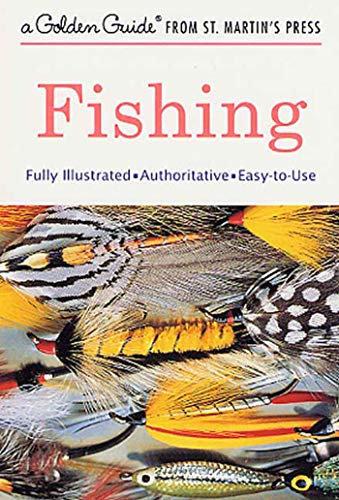
Fishing presents a basic guide for the novice and a handy reference for the experienced angler, it's packed with useful information and helpful tips on when, where, and how to fish most successfully.
This compact guide to both salt-and fresh-water fishing will help you to:
-Select baits and tackle
-Hook and land a fish
Die Inhaltsangabe kann sich auf eine andere Ausgabe dieses Titels beziehen.
Über die Autorinnen und Autoren
George S. Fichter contributed to nature guides from Golden Guides and St. Martin's Press.
Phil Francis contributed to nature guides from Golden Guides and St. Martin's Press.
Tom Dolan contributed to nature guides from Golden Guides and St. Martin's Press.
Ken Martin contributed to nature guides from Golden Guides and St. Martin's Press.
Harry McKnaught contributed to nature guides from Golden Guides and St. Martin's Press.
Auszug. © Genehmigter Nachdruck. Alle Rechte vorbehalten.
Fishing
A Guide to Fresh- and Salt-Water
By George S. Fichter, Phil Francis, Herbert S. Zim, Tom Dolan, Ken Martin, Harry McnaughtSt. Martin's Press
Copyright © 1987 St. Martin's Press
All rights reserved.
ISBN: 978-1-58238-141-1All rights reserved.
Contents
Sport Fishing,
Its past and present,
Fishes,
External anatomy and senses,
Sport Fish,
Salt-water fishes,
Fresh-water fishes,
Natural Baits,
Fresh water,
Saltwater,
Artificial Baits,
Spoons, spinners, plugs, flies,
Tackle And Its Use,
Reels, rods, lines,
Spinning,
Fly fishing,
Bait casting, spin casting,
Surf casting,
Salt-water tackle,
Leaders,
Hooks,
Other methods,
Accessory tackle,
Knots,
Terminal rigs,
When, Where, And How To Fish,
Fishing methods,
Streams,
Ponds, shallow and deep lakes,
Piers, bridges,
Bays, lagoons,
Surf fishing,
Rocky shores and jetties,
Party boats,
Charter boats,
Hooking, landing,
Care of catch, cleaning,
Trophies, records,
Navigation charts,
Fish conservation,
Boats,
Other Sources Of Information,
Index,
CHAPTER 1
SPORT FISHING
Sport fishing — catching fish for fun — began in ancient times. Man fished first for food, of course, then made a sport of it. Primitive man used a gorge, forerunner of today's fishhook. It consisted of a piece of bone, wood, or shell sharpened at both ends. A line was tied to its center, and the gorge was hidden in a bait. When a fish swallowed the morsel, the line was pulled tight, lodging the gorge crosswise in the fish's gullet.
Barbed hooks are mentioned in the Bible, and the Red Hackle, an artificial fly first described by the Romans, is still used to this day. By 1496, when Dame Juliana Berners, a Benedictine nun, published "The Treatyse of Fysshynge wyth an Angle" in The Book of St. Albans, fishing had definitely become a sport.
Then came Izaak Walton, patron saint of modern fishing, whose classic book, The Compleat Angler, first appeared in 1653. A truly contemplative angler, Izaak Walton enjoyed a day by the stream as much as the catch. His descriptions of the art of fishing are still inspiring.
Approximately 30 million fishing licenses are sold annually in the United States, and an estimated 30 million additional anglers fish where licenses are not required, as in most salt-water fishing areas. Every year anglers take some 500 million pounds of fish from fresh waters and about 700 million pounds from salt. Roughly 25 billion dollars are spent annually on this popular sport. In the United States, there are some 100,000 lakes and more than a million miles of streams and rivers for the freshwater fisherman and more than 90,000 miles of coastline on which the salt-water fisherman can try his luck. Most important is the immeasurable pleasure enjoyed by each of these millions of fishermen.
CHAPTER 2FISHES
Fishes are a varied group of some 40,000 species, most of which have skeletons of bone. The few hundred species of sharks, rays, and lampreys have skeletons of cartilage. Most bony fishes are covered with overlapping scales over which there is a thin skin that secretes a coating of slime. This aids the fish in slipping through the water and protects it from parasites. A fish's age can be determined by counting the rings on its scales. The typical fish has two sets of paired fins (pectoral and pelvic) and three unpaired fins (dorsal, anal, and caudal). It swims mainly by wagging its body from side to side and uses its fins for steering. A fish breathes by alternately opening its mouth to let in water, then shutting its mouth and forcing the water back over its gills and out the gill openings. As the water passes over the gill filaments, dissolved oxygen is exchanged for carbon dioxide.
A fish's shape is a clue to where it lives, how it feeds and the sort of fight it puts up when hooked. Fish of the open sea generally have a spindle-shaped body. They depend on speed to escape enemies and to catch food. They fight hard. Many kinds leap from the water as they try to get rid of the hook. Marlins, tunas and mackerels are among these fast, streamlined fish.
At the opposite extreme are flat or chunky bottom-dwellers. Usually slow swimmers, they do not jump when hooked, but may pull hard as they bore deeper into the water. Some will saw the line in two on pilings or rocks.
Many fish that live in quiet waters between the surface and the bottom have a compressed body — flattened from side to side. Members of the sunfish family in fresh water or pompanos, among others, in salt water are of this type.
Many fishes are protected from enemies by sharp spines or spiny fins, some of which are poisonous. A puffer can inflate its body until it is too large for a predator to swallow. Groupers and flounders are among the fish that can change their color or pattern so that they blend with their surroundings.
SENSES
Fish detect danger and find their food by their senses of sight, hearing, smell, and taste. Generally, fish with a well-developed sense of sight are predators; they eat smaller fish or other live, active animals. Their sense of smell is not as well developed as it is in bottom feeders, many of which are scavengers.
SIGHT
A fish's eyes are at the sides of its head; hence it can see behind as well as in front. Experiments have demonstrated that many fish can detect even slight variations in form and that they can see colors ranging over the spectrum from red to violet. Fresh-water bass, for example, often show strong preference for lures that are red or yellow. A fish can focus on near objects and can detect even slight movements in distant objects. Distance vision is limited by the short range light travels in water. Fish that live at moderate depths or those that feed in dim evening or morning light may have large eyes. Fish that find their food mainly by its odor, as do catfish and eels, have small eyes. Fish that feed mainly by sight readily take artificial lures.
Light rays bend in passing from water to air; hence fish's exact location varies with observer's viewing angle.
A fish looks from the water through a circular window, which varies in size with the clarity of the water and the fish's depth.
HEARING
Vibrations travel more rapidly and also greater distances in water than in air. Lures that gurgle, pop, or rattle attract a fish's attention; they can be "heard" without being seen and are effective at night or in murky water where silent lures pass unnoticed. Fish do not hear fishermen talking because these sound waves are in the air, but banging on a boat sets up vibrations in the water that may frighten fish away. A fish picks up vibrations through the ear bones in its skull; it has no external ear openings. Its lateral line, with pores opening to the outside, detects low-frequency vibrations, such as footsteps on the bank, and changes in pressure or current direction.
SMELL AND TASTE are closely related, but smell is effective at a distance, while an object must be contacted to be tasted. A fish's nostrils are blind sacs lined with a tissue that is sensitive to odors. At spawning time, salmon find their way from the sea to their parental stream by the odor of its water. They can be guided to a new spawning area by an odor path of the old stream. Odors given off by alarmed or injured minnows...
„Über diesen Titel“ kann sich auf eine andere Ausgabe dieses Titels beziehen.
Suchergebnisse für Fishing (Golden Guide from St. Martin's Press)

Beispielbild für diese ISBN
Fishing Golden Guide from St M
Verlag:
Golden Guides from St. Martin's Press, 2001
ISBN 10: 1582381410
ISBN 13: 9781582381411
Gebraucht
Softcover
Anbieter: World of Books (was SecondSale), Montgomery, IL, USA
Verkäuferbewertung 5 von 5 Sternen

Zustand: Acceptable. McKnaught, Harry; Martin, Ken; Dolan, Tom (illustrator). Item in acceptable condition! Textbooks may not include supplemental items i.e. CDs, access codes etc. Artikel-Nr. 00109396287
Gebraucht kaufen
EUR 4,23
Versand gratis
Versand innerhalb von USA
Versand innerhalb von USA
Anzahl: 1 verfügbar
Beispielbild für diese ISBN
Fishing Golden Guide from St M
Verlag:
Golden Guides from St. Martin's Press, 2001
ISBN 10: 1582381410
ISBN 13: 9781582381411
Gebraucht
Softcover
Anbieter: World of Books (was SecondSale), Montgomery, IL, USA
Verkäuferbewertung 5 von 5 Sternen
Zustand: Good. McKnaught, Harry; Martin, Ken; Dolan, Tom (illustrator). Item in good condition. Textbooks may not include supplemental items i.e. CDs, access codes etc. Artikel-Nr. 00096912455
Gebraucht kaufen
EUR 4,23
Versand gratis
Versand innerhalb von USA
Versand innerhalb von USA
Anzahl: 8 verfügbar
Beispielbild für diese ISBN
Fishing: A Guide to Fresh and Salt-Water Fishing
ISBN 10: 1582381410
ISBN 13: 9781582381411
Gebraucht
Paperback
Erstausgabe
Anbieter: BooksRun, Philadelphia, PA, USA
Verkäuferbewertung 5 von 5 Sternen
Paperback. Zustand: Fair. Dolan, Tom; Martin, Ken; McKnaught, Harry (illustrator). First Edition. The item might be beaten up but readable. May contain markings or highlighting, as well as stains, bent corners, or any other major defect, but the text is not obscured in any way. Artikel-Nr. 1582381410-7-1-13
Gebraucht kaufen
EUR 4,24
Versand gratis
Versand innerhalb von USA
Versand innerhalb von USA
Anzahl: 1 verfügbar
Beispielbild für diese ISBN
Fishing
Verlag:
Golden Guides from St. Martin's Press, 2001
ISBN 10: 1582381410
ISBN 13: 9781582381411
Gebraucht
Paperback
Anbieter: ThriftBooks-Reno, Reno, NV, USA
Verkäuferbewertung 5 von 5 Sternen
Paperback. Zustand: Very Good. No Jacket. Dolan, Tom; Martin, Ken; McKnaught, Harry (illustrator). May have limited writing in cover pages. Pages are unmarked. ~ ThriftBooks: Read More, Spend Less. Artikel-Nr. G1582381410I4N00
Gebraucht kaufen
EUR 6,17
Versand gratis
Versand innerhalb von USA
Versand innerhalb von USA
Anzahl: 1 verfügbar
Beispielbild für diese ISBN
Fishing
Verlag:
Golden Guides from St. Martin's Press, 2001
ISBN 10: 1582381410
ISBN 13: 9781582381411
Gebraucht
Paperback
Anbieter: ThriftBooks-Reno, Reno, NV, USA
Verkäuferbewertung 5 von 5 Sternen
Paperback. Zustand: Good. No Jacket. Dolan, Tom; Martin, Ken; McKnaught, Harry (illustrator). Pages can have notes/highlighting. Spine may show signs of wear. ~ ThriftBooks: Read More, Spend Less. Artikel-Nr. G1582381410I3N00
Gebraucht kaufen
EUR 6,17
Versand gratis
Versand innerhalb von USA
Versand innerhalb von USA
Anzahl: 1 verfügbar
Beispielbild für diese ISBN
Fishing
Verlag:
Golden Guides from St. Martin's Press, 2001
ISBN 10: 1582381410
ISBN 13: 9781582381411
Gebraucht
Paperback
Anbieter: ThriftBooks-Reno, Reno, NV, USA
Verkäuferbewertung 5 von 5 Sternen
Paperback. Zustand: Fair. No Jacket. Dolan, Tom; Martin, Ken; McKnaught, Harry (illustrator). Readable copy. Pages may have considerable notes/highlighting. ~ ThriftBooks: Read More, Spend Less. Artikel-Nr. G1582381410I5N00
Gebraucht kaufen
EUR 6,17
Versand gratis
Versand innerhalb von USA
Versand innerhalb von USA
Anzahl: 1 verfügbar
Beispielbild für diese ISBN
Fishing
Verlag:
Golden Guides from St. Martin's Press, 2001
ISBN 10: 1582381410
ISBN 13: 9781582381411
Gebraucht
Paperback
Anbieter: ThriftBooks-Phoenix, Phoenix, AZ, USA
Verkäuferbewertung 5 von 5 Sternen
Paperback. Zustand: Good. No Jacket. Dolan, Tom; Martin, Ken; McKnaught, Harry (illustrator). Pages can have notes/highlighting. Spine may show signs of wear. ~ ThriftBooks: Read More, Spend Less. Artikel-Nr. G1582381410I3N00
Gebraucht kaufen
EUR 6,17
Versand gratis
Versand innerhalb von USA
Versand innerhalb von USA
Anzahl: 1 verfügbar
Beispielbild für diese ISBN
Fishing
Verlag:
Golden Guides from St. Martin's Press, 2001
ISBN 10: 1582381410
ISBN 13: 9781582381411
Gebraucht
Paperback
Anbieter: ThriftBooks-Dallas, Dallas, TX, USA
Verkäuferbewertung 5 von 5 Sternen
Paperback. Zustand: Very Good. No Jacket. Dolan, Tom; Martin, Ken; McKnaught, Harry (illustrator). May have limited writing in cover pages. Pages are unmarked. ~ ThriftBooks: Read More, Spend Less. Artikel-Nr. G1582381410I4N00
Gebraucht kaufen
EUR 6,18
Versand gratis
Versand innerhalb von USA
Versand innerhalb von USA
Anzahl: 1 verfügbar
Beispielbild für diese ISBN
Fishing
Verlag:
Golden Guides from St. Martin's Press, 2001
ISBN 10: 1582381410
ISBN 13: 9781582381411
Gebraucht
Paperback
Anbieter: ThriftBooks-Atlanta, AUSTELL, GA, USA
Verkäuferbewertung 5 von 5 Sternen
Paperback. Zustand: Good. No Jacket. Dolan, Tom; Martin, Ken; McKnaught, Harry (illustrator). Pages can have notes/highlighting. Spine may show signs of wear. ~ ThriftBooks: Read More, Spend Less. Artikel-Nr. G1582381410I3N00
Gebraucht kaufen
EUR 6,18
Versand gratis
Versand innerhalb von USA
Versand innerhalb von USA
Anzahl: 1 verfügbar
Beispielbild für diese ISBN
Fishing
Verlag:
Golden Guides from St. Martin's Press, 2001
ISBN 10: 1582381410
ISBN 13: 9781582381411
Gebraucht
Paperback
Anbieter: ThriftBooks-Atlanta, AUSTELL, GA, USA
Verkäuferbewertung 5 von 5 Sternen
Paperback. Zustand: Fair. No Jacket. Dolan, Tom; Martin, Ken; McKnaught, Harry (illustrator). Readable copy. Pages may have considerable notes/highlighting. ~ ThriftBooks: Read More, Spend Less. Artikel-Nr. G1582381410I5N00
Gebraucht kaufen
EUR 6,18
Versand gratis
Versand innerhalb von USA
Versand innerhalb von USA
Anzahl: 1 verfügbar