
Verwandte Artikel zu Pond Life: A Guide to Common Plants and Animals of...
Pond Life: A Guide to Common Plants and Animals of North American Ponds and Lakes (Golden Guide) - Softcover
Inhaltsangabe
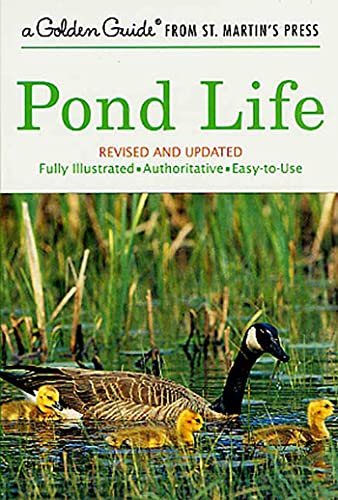
This guide describes and illustrates, in full color, the plants and animals that live in or near ponds, lakes, streams, and wetlands. It includes surface-dwelling creatures as well as those of open water, the bottom, and the shore and tells how various animals and plants live together in a community.
Plus suggestions for:
Where and when to look
Observing and collecting specimens
Making exciting discoveries
Die Inhaltsangabe kann sich auf eine andere Ausgabe dieses Titels beziehen.
Über die Autorin bzw. den Autor
Golden Guides first appeared in 1949 and quickly established themselves as authorities on subjects from Natural History to Science. Relaunched in 2000, Golden Guides from St. Martin's Press feature modern, new covers as part of a multi-year, million-dollar program to revise, update, and expand the complete line of guides for a new generation of students.
Auszug. © Genehmigter Nachdruck. Alle Rechte vorbehalten.
Pond Life
A Guide to Common Plants and Animals of North American Ponds and Lakes
By George K. Reid, Herbert S. Zim, George S. Fichter, Sally D. Kaicher, Tom DolanSt. Martin's Press
Copyright © 2001 St. Martin's Press
All rights reserved.
ISBN: 978-1-58238-130-5All rights reserved.
Contents
Ponds and Lakes,
Characteristics of Water,
Habitats,
Food Webs,
Community Changes,
Observing and Collecting,
Plants,
Animals,
More Information,
Index,
CHAPTER 1
PONDS AND LAKES
In spring and summer, activity is ceaseless in a pond or small lake. Water striders skate over the surface. Dragonfly nymphs, which will soon change into swift, darting adults, climb the stems of cattails. Close to shore a crayfish grabs and eats a worm — and moments later a bass devours the crayfish. A turtle plops off a log and begins to browse on plants. Countless small shrimplike copepods strain their microscopic plant food from the water and then become food for small fishes that, in turn, are eaten by large fishes or by wading birds. As the water cools in autumn, animals become less active. In winter, the pond or lake is rather quiet, and in the North, only a few animals still stir under the ice.
To understand the teeming life in a pond, one must know what conditions are necessary to support it. This study of inland waters — ponds, lakes, and streams — is called limnology. It is a division of the broader science of ecology, which deals with the ways plants and animals live together in particular environments. Limnology is concerned with all the interrelated factors that influence the inland-water environment. Thus it treats not only biology but also chemistry, geography, weather, climate, and other similar factors or conditions. Only a few of the many thousands of plants and animals that live in or near ponds, lakes, and streams are described and illustrated in this book. As your interest in "pond probing" grows you can consult the books listed on page 155 for more detailed information.
A POND is commonly described by limnologists as a quiet body of water so shallow that rooted plants grow completely across it. Its water temperature is fairly uniform from top to bottom and tends to change with the air temperature. There is little wave action, and the bottom is usually covered with mud. Typically, plants grow all along the shore. The amount of dissolved oxygen may vary greatly in a 24-hour period.
A lake is usually larger than a pond. The water is too deep for plants to grow except around the shore. The temperature of the water is relatively stable from day to day, but in northern lakes, temperature "layering" occurs in summer. The amount of dissolved oxygen during a 24-hour period remains about the same. Because of the broad expanse of water exposed to the wind, shores on the down-wind side are commonly wave-washed, barren strands of sand or rocks.
What people know as a pond or a lake locally, however, differs from one region to another. In some places, for example, the pond illustrated here would be called a marsh. Many of the broad lakes in Florida are shallow, and though they lack plants in the middle, their water temperature and amount of dissolved oxygen follow the pattern of ponds.
SEVERAL DIFFERENT KINDS of bodies of water are called ponds. The basins of some ponds are potholes in glacial debris and are filled by seepage and runoff water from the surrounding land. Others are cutoffs from old stream channels. Some are temporary, others permanent. Despite their differences in origin and age, all are much alike in size, depth, and similar features. A few of the more common and distinctive kinds of ponds are shown here.
CYPRESS PONDS are common in the central and lower Mississippi Basin and along the coastal plain of the southeastern U.S. Their water is often brownish, and many are dry during parts of the year. Along the shore, willows and bay trees are mixed with cypresses, which often grow out into the water.
BOG PONDS are found in moist temperate regions over most of N.A. Their water is usually highly acidic and is often muddy. Cedars dominate the high ground, and alders grow profusely on the shore. Thick beds of sphagnum extend outward from shore. Floating-leaf plants may cover the surface.
MEADOW-STREAM PONDS develop where a stream widens and the speed of its current drops sharply. Pondweeds, stoneworts, cattails, and others with emergent leaves grow in the shallows. Water lilies, water shield, and others send floating leaves to the surface. Above.
MOUNTAIN PONDS are often formed by glaciers. In some, the bottom is pure rock; in others, deep, soft mud. Many are ice-free only briefly and dry up in summer. Sedges grow along margins. Despite the short summer season, many kinds of animals live in these icy waters.
FARM PONDS are built as a part of good farming practices. They also provide fishing and boating. A farm pond should be at least 3 feet deep at the shoreline to prevent plant growth and have a spillway to control water level. It should fill from seepage, not from a stream that will soon fill the basin with silt.
CHAPTER 2CHARACTERISTICS OF WATER
Water will dissolve more substances than will any other liquid, and for this reason it is called "the universal solvent." Oxygen, carbon dioxide, and nitrogen are absorbed from the atmosphere. Oxygen is also contributed as a by-product of photosynthesis (here), and carbon dioxide is released by both plants and animals in respiration (here). Phosphates, chlorides, and similar mineral salts are dissolved in run-off and seepage water.
WATER MOLECULES are strongly attracted to one another through their two hydrogen atoms. At the surface this attraction produces a tight film over the water. A number of organisms live both on the upper and on the lower sides of this surface film.
DENSITY OF WATER is greatest at 4°C (39.2°F). It becomes less as water warms and, more important, as it cools to freezing at 0°C. Then it changes to ice which floats as its density is only 0.917. Ice is also a poor conductor and thus reduces heat loss from below. Only very shallow ponds ever freeze solid.
HEAT-HOLDING CAPACITY of water is great. It absorbs and releases heat much more slowly than does air. For this reason plants and animals of most ponds and lakes are not usually subjected to suddenly varied temperatures. Though the air temperature may change rapidly and greatly, the water temperature of a deep lake changes slowly. In a shallow pond or lake, the water temperature varies with the air temperature, as above.
TRANSPARENCY OF WATER permits enough light to penetrate for plants to carry on photosynthesis. The depth to which light can penetrate decreases as water becomes more turbid or contains more suspended materials. Few plants grow in muddy ponds because the silt absorbs light.
OXYGEN AND CARBON DIOXIDE are passed back and forth between plants and animals and their environment. The proportion of these gases in the atmosphere is generally constant: oxygen, 21 percent; carbon dioxide, .03 percent. In pond, lake, and stream waters they usually vary greatly, even from night to day.
Oxygen, which is necessary for the survival of nearly all plants and animals, is quite soluble in water, but the amount dissolved in fresh water is much lower than in the atmosphere. Oxygen from the air is absorbed slowly, but the process is...
„Über diesen Titel“ kann sich auf eine andere Ausgabe dieses Titels beziehen.
Suchergebnisse für Pond Life: A Guide to Common Plants and Animals of...

Beispielbild für diese ISBN
Pond Life: Revised and Updated (A Golden Guide from St. Martin's Press)
Verlag:
Golden Guides from St. Martin's Press (edition Revised), 2001
ISBN 10: 1582381305
ISBN 13: 9781582381305
Gebraucht
Paperback
Anbieter: BooksRun, Philadelphia, PA, USA
Verkäuferbewertung 5 von 5 Sternen

Paperback. Zustand: Very Good. Kaicher, Sally D.; Dolan, Tom (illustrator). Revised. It's a well-cared-for item that has seen limited use. The item may show minor signs of wear. All the text is legible, with all pages included. It may have slight markings and/or highlighting. Artikel-Nr. 1582381305-11-1
Gebraucht kaufen
EUR 4,57
Versand gratis
Versand innerhalb von USA
Versand innerhalb von USA
Anzahl: 1 verfügbar
Beispielbild für diese ISBN
Pond Life: Revised and Updated
Verlag:
Golden Guides from St. Martin's Press, 2001
ISBN 10: 1582381305
ISBN 13: 9781582381305
Gebraucht
Paperback
Anbieter: ThriftBooks-Dallas, Dallas, TX, USA
Verkäuferbewertung 5 von 5 Sternen
Paperback. Zustand: Very Good. No Jacket. Kaicher, Sally D.; Dolan, Tom (illustrator). May have limited writing in cover pages. Pages are unmarked. ~ ThriftBooks: Read More, Spend Less. Artikel-Nr. G1582381305I4N00
Gebraucht kaufen
EUR 5,95
Versand gratis
Versand innerhalb von USA
Versand innerhalb von USA
Anzahl: 1 verfügbar
Beispielbild für diese ISBN
Pond Life: Revised and Updated
Verlag:
Golden Guides from St. Martin's Press, 2001
ISBN 10: 1582381305
ISBN 13: 9781582381305
Gebraucht
Paperback
Anbieter: ThriftBooks-Phoenix, Phoenix, AZ, USA
Verkäuferbewertung 5 von 5 Sternen
Paperback. Zustand: Fair. No Jacket. Kaicher, Sally D.; Dolan, Tom (illustrator). Readable copy. Pages may have considerable notes/highlighting. ~ ThriftBooks: Read More, Spend Less. Artikel-Nr. G1582381305I5N00
Gebraucht kaufen
EUR 5,95
Versand gratis
Versand innerhalb von USA
Versand innerhalb von USA
Anzahl: 1 verfügbar
Beispielbild für diese ISBN
Pond Life: Revised and Updated
Verlag:
Golden Guides from St. Martin's Press, 2001
ISBN 10: 1582381305
ISBN 13: 9781582381305
Gebraucht
Paperback
Anbieter: ThriftBooks-Reno, Reno, NV, USA
Verkäuferbewertung 5 von 5 Sternen
Paperback. Zustand: Fair. No Jacket. Kaicher, Sally D.; Dolan, Tom (illustrator). Readable copy. Pages may have considerable notes/highlighting. ~ ThriftBooks: Read More, Spend Less. Artikel-Nr. G1582381305I5N00
Gebraucht kaufen
EUR 5,95
Versand gratis
Versand innerhalb von USA
Versand innerhalb von USA
Anzahl: 2 verfügbar
Beispielbild für diese ISBN
Pond Life: Revised and Updated
Verlag:
Golden Guides from St. Martin's Press, 2001
ISBN 10: 1582381305
ISBN 13: 9781582381305
Gebraucht
Paperback
Anbieter: ThriftBooks-Phoenix, Phoenix, AZ, USA
Verkäuferbewertung 5 von 5 Sternen
Paperback. Zustand: Very Good. No Jacket. Kaicher, Sally D.; Dolan, Tom (illustrator). May have limited writing in cover pages. Pages are unmarked. ~ ThriftBooks: Read More, Spend Less. Artikel-Nr. G1582381305I4N00
Gebraucht kaufen
EUR 5,95
Versand gratis
Versand innerhalb von USA
Versand innerhalb von USA
Anzahl: 1 verfügbar
Beispielbild für diese ISBN
Pond Life: Revised and Updated
Verlag:
Golden Guides from St. Martin's Press, 2001
ISBN 10: 1582381305
ISBN 13: 9781582381305
Gebraucht
Paperback
Anbieter: ThriftBooks-Dallas, Dallas, TX, USA
Verkäuferbewertung 5 von 5 Sternen
Paperback. Zustand: Good. No Jacket. Kaicher, Sally D.; Dolan, Tom (illustrator). Pages can have notes/highlighting. Spine may show signs of wear. ~ ThriftBooks: Read More, Spend Less. Artikel-Nr. G1582381305I3N00
Gebraucht kaufen
EUR 5,95
Versand gratis
Versand innerhalb von USA
Versand innerhalb von USA
Anzahl: 1 verfügbar
Beispielbild für diese ISBN
Pond Life: Revised and Updated
Verlag:
Golden Guides from St. Martin's Press, 2001
ISBN 10: 1582381305
ISBN 13: 9781582381305
Gebraucht
Paperback
Anbieter: ThriftBooks-Atlanta, AUSTELL, GA, USA
Verkäuferbewertung 5 von 5 Sternen
Paperback. Zustand: Fair. No Jacket. Kaicher, Sally D.; Dolan, Tom (illustrator). Readable copy. Pages may have considerable notes/highlighting. ~ ThriftBooks: Read More, Spend Less. Artikel-Nr. G1582381305I5N00
Gebraucht kaufen
EUR 5,95
Versand gratis
Versand innerhalb von USA
Versand innerhalb von USA
Anzahl: 2 verfügbar
Beispielbild für diese ISBN
Pond Life: Revised and Updated
Verlag:
Golden Guides from St. Martin's Press, 2001
ISBN 10: 1582381305
ISBN 13: 9781582381305
Gebraucht
Paperback
Anbieter: ThriftBooks-Phoenix, Phoenix, AZ, USA
Verkäuferbewertung 5 von 5 Sternen
Paperback. Zustand: Good. No Jacket. Kaicher, Sally D.; Dolan, Tom (illustrator). Pages can have notes/highlighting. Spine may show signs of wear. ~ ThriftBooks: Read More, Spend Less. Artikel-Nr. G1582381305I3N00
Gebraucht kaufen
EUR 5,95
Versand gratis
Versand innerhalb von USA
Versand innerhalb von USA
Anzahl: 1 verfügbar
Beispielbild für diese ISBN
Pond Life: Revised and Updated
Verlag:
Golden Guides from St. Martin's Press, 2001
ISBN 10: 1582381305
ISBN 13: 9781582381305
Gebraucht
Paperback
Anbieter: ThriftBooks-Dallas, Dallas, TX, USA
Verkäuferbewertung 5 von 5 Sternen
Paperback. Zustand: Fair. No Jacket. Kaicher, Sally D.; Dolan, Tom (illustrator). Readable copy. Pages may have considerable notes/highlighting. ~ ThriftBooks: Read More, Spend Less. Artikel-Nr. G1582381305I5N00
Gebraucht kaufen
EUR 5,95
Versand gratis
Versand innerhalb von USA
Versand innerhalb von USA
Anzahl: 2 verfügbar
Beispielbild für diese ISBN
Pond Life: Revised and Updated
Verlag:
Golden Guides from St. Martin's Press, 2001
ISBN 10: 1582381305
ISBN 13: 9781582381305
Gebraucht
Paperback
Anbieter: World of Books (was SecondSale), Montgomery, IL, USA
Verkäuferbewertung 5 von 5 Sternen
Paperback. Zustand: Very Good. Kaicher, Sally D.; Dolan, Tom (illustrator). This guide describes and illustrates, in full color, the plants and animals that live in or near ponds, lakes, streams, and wetlands. It includes surface-dwelling creatures as well as those of open water, the bottom, and the shore and tells how various animals and plants live together in a community. Plus suggestions for: Where and when to look Observing and collecting specimens Making exciting discoveries. Artikel-Nr. CIN1582381305VG
Gebraucht kaufen
EUR 7,32
Versand gratis
Versand innerhalb von USA
Versand innerhalb von USA
Anzahl: 1 verfügbar