
Verwandte Artikel zu ADHD: What Every Parent Needs to Know
Inhaltsangabe
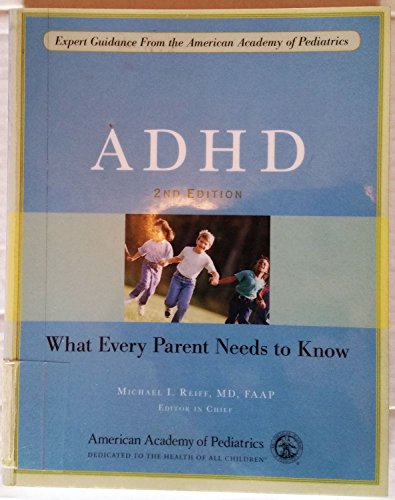
Based on the American Academy of Pediatrics' current clinical practice guidelines for attention deficit/hyperactivity disorder (ADHD), this updated guide offers parents balanced, reassuring, and authoritative information on this challenging and often misunderstood condition. Written in clear, accessible language, the new edition features the latest information on ADHD medications and offers expanded sections on preschoolers and adolescents. A new chapter on advocacy, updates on special education services and laws, and the role of the medical home are also included. Among the common questions examined are How is ADHD diagnosed? What are today's best treatment options? and Will my child outgrow ADHD? The reference also addresses what schools can do to support children with the condition and offers ADHD management strategies that balance the roles of behavior therapy, medications, and parenting techniques.
Die Inhaltsangabe kann sich auf eine andere Ausgabe dieses Titels beziehen.
Über die Autorin bzw. den Autor
Michael I. Reiff, MD, FAAP, is an associate professor of pediatrics and family medicine at the University of Minnesota, where he is the director of the Autism Spectrum and Neurodevelopmental Disorders Clinic. He has written and spoken nationally and internationally on ADHD and autism spectrum disorders and served on the Executive Committee of the AAP Section on Developmental and Behavioral Pediatrics. He is presently the editor of Developmental and Behavioral News, the AAP Section on Developmental and Behavioral Pediatrics newsletter, and a member of the AAP ADHD Guidelines Committee.
Auszug. © Genehmigter Nachdruck. Alle Rechte vorbehalten.
ADHD
What Every Parent Needs to Know
By Michael I. Reiff, Anthony Alex LeTourneauAmerican Academy of Pediatrics
Copyright © 2011 American Academy of Pediatrics
All rights reserved.
ISBN: 978-1-58110-451-6All rights reserved.
Contents
Please Note,
Foreword,
Note on Gender,
Introduction,
Chapter 1: What Is ADHD?,
Chapter 2: Does My Child Have ADHD? Evaluation and Diagnosis,
Chapter 3: What Should We Do?: Treatment Options,
Chapter 4: The Role of Medications,
Chapter 5: Managing ADHD at Home,
Chapter 6: Behavior Therapy: Parenting Techniques That Work,
Chapter 7: Your Child at School,
Chapter 8: Advocating for Your Child and Others By E. Clarke Ross, DPA, on behalf of CHADD; Paula F. Goldberg and Julie Holmquist, on behalf of PACER,
Chapter 9: When It Is Not Just ADHD: Identifying Coexisting Conditions,
Chapter 10: Complementary and Alternative Treatments for ADHD,
Chapter 11: ADHD in Adolescence,
Chapter 12: A Look at Your Child's Future,
Afterword,
Resources,
Appendix: Vanderbilt Assessment Scales,
Index,
CHAPTER 1
What Is ADHD?
Andrew Scott had always been an active child. From the time he learned to walk his parents noticed he was "into everything." Andrew's preschool teachers frequently commented on how active he was, and his kindergarten teacher observed that he was "quite a handful." First grade passed without any major problems, though his level of activity seemed to overwhelm some of the other children during playtime. In third grade, however, Andrew began to fall behind in math and reading. His teacher said he was too restless. During class he bothered the children around him. He seemed unable to focus on a learning activity for longer than a few minutes. On the playground he was "over-physical" with his peers, invading their space and then overreacting when they pushed him away.
Around the middle of the year, Andrew's teacher met with his parents. She told them that she believed Andrew's problems paying attention, his high activity level, and troubles with schoolwork might indicate the presence of attention-deficit/hyperactivity disorder (ADHD). She explained that ADHD often goes undetected until children enter school and academics and social relationships begin to be affected.
Despite the teacher's positive attitude, Andrew's parents were stunned by her recommendation that their son be evaluated for ADHD. They had always been challenged by their active child, but they had never considered his behavior out of the ordinary for a healthy young boy. As Andrew's father often pointed out, Andrew was "just like me when I was in school" — eager, excited, and always on the go. While both parents agreed that Andrew could use some extra help with his social skills and reading, they did not see how these behaviors could be thought of as a medical condition. "I think his teacher just can't handle him in class," Andrew's mother told her husband later when they were back at home. "She has a discipline problem and she calls it ADHD. I think it's the school that should be evaluated."
The Keller family was experiencing similar confusion. Their 12-year-old daughter, Emma, was also having problems. However, she was on the quiet and somewhat anxious side. Since early childhood, she had been a "dreamer" whose thoughts tended to drift easily. She often forgot things she had recently learned or been told, and spent much of her time alone. In recent years, her "randomness" and lack of organization had begun to seriously affect her school performance, social life, and family relationships. She was having trouble completing tasks and was messy and careless about her schoolwork. Her parents noted that she was often forgetful and at times it seemed as if her mind was elsewhere and that she was not listening. Still, Emma's parents felt that her behavior was typical of many girls her age and was nothing that a little maturation and help with organization could not cure. Was it really necessary, they asked Emma's pediatrician, to consider this a medical issue or to start an evaluation for ADHD as he had suggested?
As different as Andrew's and Emma's situations seem to be, both are typical for children with ADHD. Attention-deficit/hyperactivity disorder limits children's ability to filter out irrelevant input, focus, organize, prioritize, delay gratification, think before they act, or perform other so-called executive functions that most of us perform automatically. In children such as Andrew, with "hyperactive-impulsive" elements to his ADHD, the disorder presents itself as an inability to control impulses or regulate activity levels, even when the child knows how he is expected to behave. In those with "inattentive-type" ADHD, including Emma, an inability to filter information means that someone walking by the classroom can claim as much attention as the teacher's lecture, and that a date with a friend can be forgotten in a flood of unregulated input.
Because these behaviors — short attention span, forgetfulness, inability to sit still, unusually high activity level, and a tendency to act before thinking — are also common in children with and without ADHD, many families are surprised when their child is referred for an evaluation. Adding to their confusion is the fact that all of these behaviors occur in children and adolescents throughout their development, although those with ADHD exhibit more extreme and immature forms of these behaviors. These behaviors interfere in significant ways with their day-today functioning, and they do not outgrow them at the same pace that other children do. Because other disorders, such as learning disabilities, oppositional defiant disorder, and anxiety or depression, can resemble ADHD (and, in fact, often accompany it), it can be difficult to tell whether a child has another condition, ADHD, or both. Finally, the fact that ADHD is diagnosed through careful observations of inattentive, hyperactive, and impulsive behaviors across the major settings of a child's life — rather than the types of laboratory procedures used to diagnose such disorders as diabetes — leads some adults and the popular press to question whether ADHD exists at all.
Yet a large body of convincing evidence suggests that ADHD is a biological, brain-based condition. The scientific research on ADHD is more thorough and compelling than for most behavioral and mental health disorders, and even many medical conditions. Even so, among many parents it remains controversial and misunderstood. In 1998 the National Institutes of Health, responding to public concern and debate about ADHD diagnosis and treatment, assembled a group of experts for a consensus conference on ADHD. These experts published their conclusions stating that ADHD is indeed a medical disorder.
According to recent estimates, ADHD is among the most prevalent chronic childhood disorders, occurring in 6% to 9% of school-aged children (second only to asthma). The Centers for Disease Control and Prevention has reported that about 4.5 million children (ages 3–17) in the United States have ADHD, and the condition currently accounts for as many as 30% to 50% of child referrals to mental health services. Many people believe that the prevalence of ADHD has increased significantly in recent decades, perhaps due to environmental factors, but there is no convincing evidence that this is the case. The number of children who have ADHD has likely remained roughly stable, but the number of children diagnosed with the condition has...
„Über diesen Titel“ kann sich auf eine andere Ausgabe dieses Titels beziehen.
Suchergebnisse für ADHD: What Every Parent Needs to Know

Beispielbild für diese ISBN
ADHD What Every Parent Needs t
Verlag:
American Academy of Pediatrics, 2011
ISBN 10: 1581104510
ISBN 13: 9781581104516
Gebraucht
Softcover
Anbieter: World of Books (was SecondSale), Montgomery, IL, USA
Verkäuferbewertung 5 von 5 Sternen

Zustand: Good. Item in good condition. Textbooks may not include supplemental items i.e. CDs, access codes etc. Artikel-Nr. 00095419403
Gebraucht kaufen
EUR 4,92
Versand gratis
Versand innerhalb von USA
Versand innerhalb von USA
Anzahl: 8 verfügbar
Beispielbild für diese ISBN
ADHD: What Every Parent Needs to Know
Verlag:
American Academy of Pediatrics, 2011
ISBN 10: 1581104510
ISBN 13: 9781581104516
Gebraucht
Paperback
Anbieter: ThriftBooks-Dallas, Dallas, TX, USA
Verkäuferbewertung 5 von 5 Sternen
Paperback. Zustand: As New. No Jacket. Pages are clean and are not marred by notes or folds of any kind. ~ ThriftBooks: Read More, Spend Less. Artikel-Nr. G1581104510I2N00
Gebraucht kaufen
EUR 5,83
Versand gratis
Versand innerhalb von USA
Versand innerhalb von USA
Anzahl: 1 verfügbar
Beispielbild für diese ISBN
ADHD: What Every Parent Needs to Know
Verlag:
American Academy of Pediatrics, 2011
ISBN 10: 1581104510
ISBN 13: 9781581104516
Gebraucht
Paperback
Anbieter: ThriftBooks-Dallas, Dallas, TX, USA
Verkäuferbewertung 5 von 5 Sternen
Paperback. Zustand: Very Good. No Jacket. May have limited writing in cover pages. Pages are unmarked. ~ ThriftBooks: Read More, Spend Less. Artikel-Nr. G1581104510I4N00
Gebraucht kaufen
EUR 5,83
Versand gratis
Versand innerhalb von USA
Versand innerhalb von USA
Anzahl: 1 verfügbar
Beispielbild für diese ISBN
ADHD: What Every Parent Needs to Know
Verlag:
American Academy of Pediatrics, 2011
ISBN 10: 1581104510
ISBN 13: 9781581104516
Gebraucht
Paperback
Anbieter: ThriftBooks-Atlanta, AUSTELL, GA, USA
Verkäuferbewertung 5 von 5 Sternen
Paperback. Zustand: Very Good. No Jacket. May have limited writing in cover pages. Pages are unmarked. ~ ThriftBooks: Read More, Spend Less. Artikel-Nr. G1581104510I4N00
Gebraucht kaufen
EUR 5,83
Versand gratis
Versand innerhalb von USA
Versand innerhalb von USA
Anzahl: 1 verfügbar
Beispielbild für diese ISBN
ADHD : What Every Parent Needs to Know
Verlag:
American Academy of Pediatrics, 2011
ISBN 10: 1581104510
ISBN 13: 9781581104516
Gebraucht
Softcover
Anbieter: Better World Books, Mishawaka, IN, USA
Verkäuferbewertung 5 von 5 Sternen
Zustand: Good. Second Edition, Second edition. Former library copy. Pages intact with minimal writing/highlighting. The binding may be loose and creased. Dust jackets/supplements are not included. Includes library markings. Stock photo provided. Product includes identifying sticker. Better World Books: Buy Books. Do Good. Artikel-Nr. 7880594-6
Gebraucht kaufen
EUR 6,21
Versand gratis
Versand innerhalb von USA
Versand innerhalb von USA
Anzahl: 2 verfügbar
Beispielbild für diese ISBN
ADHD: What Every Parent Needs to Know
Verlag:
American Academy of Pediatrics, 2011
ISBN 10: 1581104510
ISBN 13: 9781581104516
Gebraucht
Softcover
Anbieter: Wonder Book, Frederick, MD, USA
Verkäuferbewertung 5 von 5 Sternen
Zustand: Good. Good condition. A copy that has been read but remains intact. May contain markings such as bookplates, stamps, limited notes and highlighting, or a few light stains. Artikel-Nr. Q04M-01870
Gebraucht kaufen
EUR 6,28
Versand gratis
Versand innerhalb von USA
Versand innerhalb von USA
Anzahl: 1 verfügbar
Beispielbild für diese ISBN
ADHD: What Every Parent Needs to Know
Verlag:
American Academy of Pediatrics, 2011
ISBN 10: 1581104510
ISBN 13: 9781581104516
Gebraucht
Softcover
Anbieter: Wonder Book, Frederick, MD, USA
Verkäuferbewertung 5 von 5 Sternen
Zustand: Very Good. Very Good condition. 2nd edition. A copy that may have a few cosmetic defects. May also contain light spine creasing or a few markings such as an owner's name, short gifter's inscription or light stamp. Artikel-Nr. F10B-02752
Gebraucht kaufen
EUR 6,28
Versand gratis
Versand innerhalb von USA
Versand innerhalb von USA
Anzahl: 2 verfügbar
Beispielbild für diese ISBN
ADHD: What Every Parent Needs to Know
Verlag:
American Academy of Pediatrics (edition Second), 2011
ISBN 10: 1581104510
ISBN 13: 9781581104516
Gebraucht
Paperback
Anbieter: BooksRun, Philadelphia, PA, USA
Verkäuferbewertung 5 von 5 Sternen
Paperback. Zustand: Very Good. Second. It's a well-cared-for item that has seen limited use. The item may show minor signs of wear. All the text is legible, with all pages included. It may have slight markings and/or highlighting. Artikel-Nr. 1581104510-11-1
Gebraucht kaufen
EUR 9,34
Versand gratis
Versand innerhalb von USA
Versand innerhalb von USA
Anzahl: 1 verfügbar
Beispielbild für diese ISBN
ADHD: What Every Parent Needs to Know
Verlag:
American Academy of Pediatrics, 2011
ISBN 10: 1581104510
ISBN 13: 9781581104516
Gebraucht
Paperback
Anbieter: WorldofBooks, Goring-By-Sea, WS, Vereinigtes Königreich
Verkäuferbewertung 5 von 5 Sternen
Paperback. Zustand: Very Good. The book has been read, but is in excellent condition. Pages are intact and not marred by notes or highlighting. The spine remains undamaged. Artikel-Nr. GOR006062436
Gebraucht kaufen
EUR 3,36
EUR 6,53 Versand
Versand von Vereinigtes Königreich nach USA
Versand von Vereinigtes Königreich nach USA
Anzahl: 2 verfügbar