
Verwandte Artikel zu Tabletop Gardens: Create 40 Intimate Gardens for the...
Inhaltsangabe
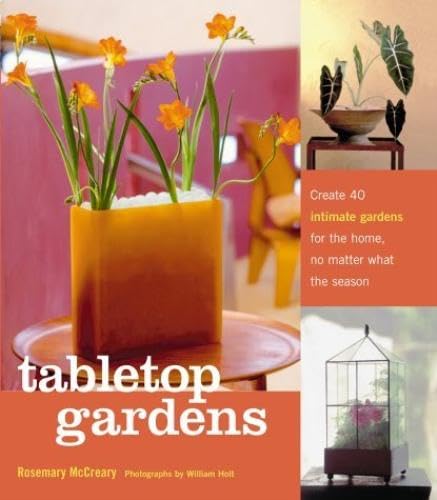
Indoor plants bring living warmth to any interior décor. Arrange them in beautiful containers, root them creatively in varied textural beds, and enjoy the stunning results. Author Rosemary McCreary has designed 40 dazzling tabletop gardens to inspire the indoor green thumb year-round — gardens that enhance the home with more drama than potted houseplants and greater durability than cut flowers.
McCreary’s innovative designs include stylish gardens under glass; floating plants whose roots, visible in clear water, are part of the allure; and miniature landscapes that grow in every type of beautiful tray, container, and basket imaginable. Among the projects are a collection of succulents springing out of a colorful gravel bed; a basket of savory Mediterranean herbs to perk up winter meals; cascading ivy, trained to frame a north-facing window; and a charming miniature tea rose in a jar.
To ensure success, each project includes step-by-step design and planting instructions, a complete checklist of required materials, ongoing care advice, and full-color photography of materials and the completed garden. Exotic orchids, soft grasses, easy-to-grow herbs, and colorful bulbs are among the dozens of popular plants McCreary encourages gardeners to work with in her designs.
For every dedicated gardener who has spent dull winter months longing for the scent of dirt, tabletop gardens are the answer. Their elegance and vitality connect the housebound grower to summer’s cycles of growth.
McCreary’s innovative designs include stylish gardens under glass; floating plants whose roots, visible in clear water, are part of the allure; and miniature landscapes that grow in every type of beautiful tray, container, and basket imaginable. Among the projects are a collection of succulents springing out of a colorful gravel bed; a basket of savory Mediterranean herbs to perk up winter meals; cascading ivy, trained to frame a north-facing window; and a charming miniature tea rose in a jar.
To ensure success, each project includes step-by-step design and planting instructions, a complete checklist of required materials, ongoing care advice, and full-color photography of materials and the completed garden. Exotic orchids, soft grasses, easy-to-grow herbs, and colorful bulbs are among the dozens of popular plants McCreary encourages gardeners to work with in her designs.
For every dedicated gardener who has spent dull winter months longing for the scent of dirt, tabletop gardens are the answer. Their elegance and vitality connect the housebound grower to summer’s cycles of growth.
Die Inhaltsangabe kann sich auf eine andere Ausgabe dieses Titels beziehen.
Von der hinteren Coverseite
Bring the beauty and allure of living plants indoors with 40 miniature gardens, designed to lend warmth and interest to a variety of surfaces. Through exquisite photography, a dazzling array of creative ideas, step-by-step instructions, and all the practical advice you need, you'll discover how simple it is to enhance your home and satisify your winter gardening urges at the same time.
Tabletop Gardens shows you how to integrate a project with your decor, choose plants and flowers that will thrive indoors, work with space limitations, manipulate light, and select creative containers. You'll learn all the basics that ensure success—watering, fertilizing, pruning, repotting, and propagating.
Innovative designs include plants and styling for all tastes, from delicate gardens under glass to Zenlike stone mosaics. Exotic orchids, soft grasses, easy-to-grow herbs, and colorful bulbs are among the plants that take center stage. And adding personality to every project are the containers—from clear glass jars to indoor fountains, shallow ceramic trays to wicker and wire baskets. Vitality and elegance—yours throughout the year.
Tabletop Gardens shows you how to integrate a project with your decor, choose plants and flowers that will thrive indoors, work with space limitations, manipulate light, and select creative containers. You'll learn all the basics that ensure success—watering, fertilizing, pruning, repotting, and propagating.
Innovative designs include plants and styling for all tastes, from delicate gardens under glass to Zenlike stone mosaics. Exotic orchids, soft grasses, easy-to-grow herbs, and colorful bulbs are among the plants that take center stage. And adding personality to every project are the containers—from clear glass jars to indoor fountains, shallow ceramic trays to wicker and wire baskets. Vitality and elegance—yours throughout the year.
Auszug. © Genehmigter Nachdruck. Alle Rechte vorbehalten.
Chapter 2 - Tray & Dish Gardens
Gardening often begins as an idea inspired by the shape of a leaf, the color of foliage, or the promise of an exquisite blossom. Indoor gardening is no different, though sometimes a striking container ignites a desire to dabble in that age-old blend of art and science. Although indoor gardening prohibits laying out elaborate design schemes in borders and parterres, tray and dish gardens provide a setting for simple yet impressive patterns. Small-scale interior landscapes challenge our creativity and yield exciting plant combinations that are often impossible outdoors. These gardens express a unique blend of earthiness and style while remaining easy to assemble and maintain. They feature small, shallow-rooted plants that give a garden a low profile - perfect for a tabletop.
GARDEN MOSAIC
This is a garden bed in miniature, where a checkerboard mosaic of creeping mint and river stones connects you to the natural world all the while you're indoors. Like any constantly growing garden, this one calls to an appreciative eye to watch it grow, a green thumb to snip back stray stems, and a nose to enjoy the spicy fragrance of freshly cut leaves.
Polished stones impart a clean, uncluttered look to this dish garden, reflecting a sense of tidiness and order. A minimalist approach restricts the foliage to a simple creeping mint ground cover, but the result becomes an artistic, un-demanding element in a room's decor.
Because geometry is the essential element in this design, place your garden mosaic where it will harmonize with its surroundings. It is best suited to a room with pared-down accessories, where the sharp, artful contrasts within its sleek, sparse form will stand out. Although there's nothing fussy about the minimal color, texture, and intricacy here, you'll have fun collecting and putting together the component materials that suit your gardening and decorating style.
What You'll Need
Thickly growing creeping Corsican mint (Mentha requienii)
Sharp knife
Scissors or garden shears
Soilless potting mix
Distilled water
Small trowel or large spoon
Low rectangular container, 2-3 inches deep
Slow-release fertilizer
Polished river stones, thin and flat
Ongoing Care
Water only when top half of soil under stones feels dry to the touch, and then only with distilled water. Hard water leaves a residue; chemically treated water harms plants. Trim fast-growing plants every week or two; trim slow-growing species every other month, or as needed.
Begin by making a scale drawing of the mosaic you want to create. Then select a color palette for the container and stones so your garden will blend with other accessories in the room. Ideally, your container should have drainage holes and rest on a tray so that the plants never sit in water. Garden shops, pet stores, and landscape suppliers carry a wide variety of stones in dark hues, earth tones, and bright pastels.
Using a sharp knife, cut large blocks of mint into 2- to 3-inch plugs. Switch to scissors or garden shears to trim away matted roots and finish edges squarely.
Moisten potting mix with distilled water. Using a trowel, fill container with potting mix to within 1/2 inch of the top and apply a half dose of slow-release fertilizer.
Set in plugs of mint and gently firm potting mix around roots. Lay stones neatly among plugs, covering soil completely. When plant vigor declines, after a year or more, empty and clean the container, then rebuild the garden with new plants. Don't be afraid to improvise as you build your garden. Instead of stones, try using delicate seashells from a coastal stroll or a pocketful of pebbles collected on a summer's day. You aren't limited, either, by plant choices. Alternatives range from fast-growing baby's tears (Soleirolia soleirolii), to more moderately paced woolly or elfin thyme (Thymus pseudolanuginosus or T. serpyllum 'Elfin') and Scotch or Irish moss (Sagina subulata), to a slow-growing mini mondo grass (Ophiopogon japonicus) such as 'Kyoto Dwarf'.
Cut and Trim
Plugs 2 to 3 inches square work best and are easiest to cut, though you may want to create a pattern of diamonds, circles, or other shapes. Depending on the size and configuration of your mosaic, purchase plants in 6-packs, 4-inch pots, or flats.
CREATIVE MULCH CHOICES
Mulch in any garden slows evaporation from the soil and reduces the frequency of watering. But in a garden mosaic, its role is as decorative as it is practical. The mulch you choose establishes the overriding mood of a dish garden, whether it's formal and precise in neutral colors with smooth, level textures or less meticulously drawn with coarser textures and arresting colors.
Clockwise from lower left: Sharp sand, polished river stones, opaque beach glass, textured terra-cotta balls, and aquarium gravel are all good choices. Buy materials for decorative mulches at a garden center, a florist, or an aquarium shop. Clean and rinse beach glass repeatedly to remove salt residue.
SUCCULENT COLLECTION AND DESERT GARDEN
What could be better than a garden that takes care of itself? For today's busy gardener, a collection of succulents and cacti keeps the garden growing indoors despite periods of neglect. These water-conserving plants flourish with very little attention and manage to stay on schedule, producing eye-popping blooms. Some species send up a stalk of dangling bells; others sport a wreath of lively, daisylike flowers around their crowns. With just a bit of encouragement from regular care, most types slowly spread into attractive clumps, generating offspring around the base to join in the show.
Succulents, such as the ones at left, have evolved around the globe with this easygoing style. In their native habitats, many species survive for long periods by relying on water stored in moisture-laden stems, leaves, and roots. When water is available, they stock up for dry days ahead.
Of the thousands of cacti and succulents, many become tree size, while others remain minuscule. Select those that won't grow out of bounds and will complement the container of your choice. Stemless globes, rosettes, mat-forming clumps, and short columnar forms are best suited to indoor gardens. Grow them singly in shallow pots and group the containers, or craft a community in a broad, flat dish.
What You'll Need
Compatible group of mixed cacti or succulents
Shallow container, 2-4 inches deep
Trowel
Cactus soil mix
Horticultural sand (optional)
Gravel mulch (optional)
Distilled water or rainwater
Balanced fertilizer
Spray bottle
Ongoing Care
Allow soil mix to dry completely before watering, then give it a good soaking and allow water to drain. For pots with no drainage holes, water only until the soil is moist throughout. Standing water will cause plants to rot. Fertilize lightly in summer or succulents will lose their form and become lanky.
Tabletops are ideal places to feature unusual plants, and succulents especially are best viewed from above. Crassula, Sedum, Sempervivum, and Echeveria species and their numerous hybrids offer seemingly limitless varieties from which to choose. Although you won't want to touch cactus spines, you'll appreciate the diversity of their forms when you see them at eye level.
Easy care and long life are hallmarks of succulents and cacti - if their basic requirements are met. Make sure that species planted in the same container have similar growth habits and cultural needs. Your composition will be most appealing when you balance rigid and spiky forms with leafy and globular shapes.
If you opt for spiny cacti, handle them with care! Wrap plants with folded newspaper or use kitchen tongs when potting and moving them. Cactus soil mix provides needed porosity, but be alert to brand variations. Mix in gritty horticultural...
„Über diesen Titel“ kann sich auf eine andere Ausgabe dieses Titels beziehen.
Suchergebnisse für Tabletop Gardens: Create 40 Intimate Gardens for the...

Beispielbild für diese ISBN
Tabletop Gardens: Create 40 Intimate Gardens for the Home, No Matter What the Season
Anbieter: ThriftBooks-Atlanta, AUSTELL, GA, USA
Verkäuferbewertung 5 von 5 Sternen

Hardcover. Zustand: Good. No Jacket. Former library book; Pages can have notes/highlighting. Spine may show signs of wear. ~ ThriftBooks: Read More, Spend Less. Artikel-Nr. G1580174663I3N10
Gebraucht kaufen
EUR 6,26
Versand gratis
Versand innerhalb von USA
Versand innerhalb von USA
Anzahl: 1 verfügbar
Beispielbild für diese ISBN
Tabletop Gardens: Create 40 Intimate Gardens for the Home, No Matter What the Season
Anbieter: World of Books (was SecondSale), Montgomery, IL, USA
Verkäuferbewertung 5 von 5 Sternen
Hardback. Zustand: Good. An imaginative approach to gardening that constructs miniature indoor gardens in simple containers, combining the permanence of houseplants with the stylized beauty of flower arrangements. This book offers 40 garden ideas to enjoy all year round. Artikel-Nr. 00071896689
Gebraucht kaufen
EUR 6,40
Versand gratis
Versand innerhalb von USA
Versand innerhalb von USA
Anzahl: 1 verfügbar
Beispielbild für diese ISBN
Tabletop Gardens : Create 40 Intimate Gardens for the Home, No Matter What the Season
Anbieter: Better World Books, Mishawaka, IN, USA
Verkäuferbewertung 5 von 5 Sternen
Zustand: Very Good. Former library copy. Pages intact with possible writing/highlighting. Binding strong with minor wear. Dust jackets/supplements may not be included. Includes library markings. Stock photo provided. Product includes identifying sticker. Better World Books: Buy Books. Do Good. Artikel-Nr. GRP64744356
Gebraucht kaufen
EUR 6,66
Versand gratis
Versand innerhalb von USA
Versand innerhalb von USA
Anzahl: 1 verfügbar
Beispielbild für diese ISBN
Tabletop Gardens : Create 40 Intimate Gardens for the Home, No Matter What the Season
Anbieter: Better World Books, Mishawaka, IN, USA
Verkäuferbewertung 5 von 5 Sternen
Zustand: Very Good. Pages intact with possible writing/highlighting. Binding strong with minor wear. Dust jackets/supplements may not be included. Stock photo provided. Product includes identifying sticker. Better World Books: Buy Books. Do Good. Artikel-Nr. 10629909-75
Gebraucht kaufen
EUR 6,66
Versand gratis
Versand innerhalb von USA
Versand innerhalb von USA
Anzahl: 1 verfügbar
Beispielbild für diese ISBN
Tabletop Gardens: Create 40 intimate gardens for the home, no matter what the season
Anbieter: Wonder Book, Frederick, MD, USA
Verkäuferbewertung 5 von 5 Sternen
Zustand: As New. Like New condition. Very Good dust jacket. A near perfect copy that may have very minor cosmetic defects. Artikel-Nr. I12K-01319
Gebraucht kaufen
EUR 6,89
Versand gratis
Versand innerhalb von USA
Versand innerhalb von USA
Anzahl: 1 verfügbar
Beispielbild für diese ISBN
Tabletop Gardens: Create 40 intimate gardens for the home, no matter what the season
Anbieter: Wonder Book, Frederick, MD, USA
Verkäuferbewertung 5 von 5 Sternen
Zustand: Very Good. Very Good condition. Very Good dust jacket. A copy that may have a few cosmetic defects. May also contain light spine creasing or a few markings such as an owner's name, short gifter's inscription or light stamp. Artikel-Nr. W03E-03545
Gebraucht kaufen
EUR 6,89
Versand gratis
Versand innerhalb von USA
Versand innerhalb von USA
Anzahl: 1 verfügbar
Beispielbild für diese ISBN
Tabletop Gardens
Anbieter: Anybook.com, Lincoln, Vereinigtes Königreich
Verkäuferbewertung 5 von 5 Sternen
Zustand: Good. This is an ex-library book and may have the usual library/used-book markings inside.This book has hardback covers. Clean from markings In good all round condition. Dust jacket in poor condition. Please note the Image in this listing is a stock photo and may not match the covers of the actual item,1100grams, ISBN:9781580174664. Artikel-Nr. 9702450
Gebraucht kaufen
EUR 13,64
EUR 15,48 Versand
Versand von Vereinigtes Königreich nach USA
Versand von Vereinigtes Königreich nach USA
Anzahl: 1 verfügbar