
Verwandte Artikel zu Raptor!: A Kid's Guide to Birds of Prey
Inhaltsangabe
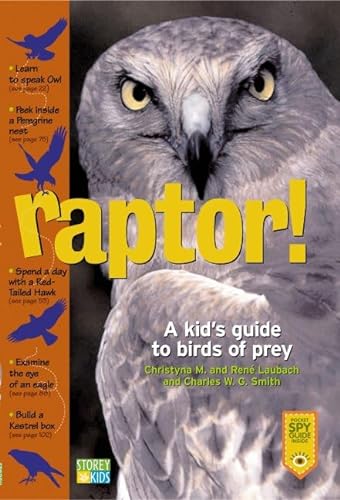
Explore life at the top of the food chain with this exciting look into the world of raptors. This fun activity book immerses children in vulture culture, hawk talk, and owl prowls as they learn about the behavior and hunting strategies of these fascinating birds. A removable “pocket spy guide” will help kids identify raptors in the wild, while breed profiles, flight silhouettes, range maps, and real-life stories will satisfy even the most voracious raptor enthusiast.
Die Inhaltsangabe kann sich auf eine andere Ausgabe dieses Titels beziehen.
Über die Autorin bzw. den Autor
Christyna M. Laubach is a high school science teacher in western Massachusetts. She is the co-author of Raptor!
Rene Laubach has served as Director of the Massachusetts Audubon Society's Berkshire Wildlife Sanctuaries since 1985. He is the co-author of Raptor! and lives in western Massachusetts.
A former horticulturalist for White Flower Farm, Charles W.G. Smith has also been an instructor of vocational agriculture. He has written about gardening and environmental issues for more than a decade. He is the author of The Beginner's Guide to Edible Herbs, The Weather-Resilient Garden, and Raptor!
Auszug. © Genehmigter Nachdruck. Alle Rechte vorbehalten.
Chapter 1 - Raptors in Focus
A raptor is a carnivorous bird that feeds chiefly on meat taken by hunting or on carrion (dead animals), using its powerful talons to kill and carry its prey. The word raptor comes from the Latin word rapere, meaning to seize and sweep away. (Other words from the same root are "rapt," "enraptured," and "rapid.")
Although raptors are often called birds of prey, many other birds also hunt prey. Flycatchers nab flying insects; robins yank out worms. Flickers prey upon ants; pelicans scoop up fish. Raptors, though, are unique among birds because of their special survival tools.
What Makes a True Raptor?
All raptors come with three features as standard equipment: powerful vision, sharp talons to grasp and kill prey, and a hooked beak to kill prey and tear it apart.
Many raptors have additional tools for catching their prey. Some, such as eagles, have great strength. Others, like owls, have very sensitive hearing, while still others, like falcons, are among the fastest flyers on the planet. Each raptor species has its own set of skills and tools that allow it to succeed where it lives.
Claws and Effects
A raptor's talons are very different from a songbird's claws. A sparrow's little claws are meant to scratch the dirt and cling to a branch. The large, powerful, curved, sharp talons of an eagle are designed to kill, to grip, and to carry heavy prey.
Unique Beaks
Each type of bird has evolved with a beak that helps it do special jobs. Osprey beaks have a hook to help them grip the fish that Ospreys eat. A Prairie Falcon has a notch in its beak, called a falcon tooth, which slips neatly between the neck bones of its prey. The bird kills its prey by breaking its neck. The Snail Kite's slender beak ends in a long hook, perfect for pulling snails out of their shells.
Tail Winds
The tails of birds are used for many things, from attracting a mate to balancing on a perch. But raptor tails are especially good for steering in flight. The tail is composed of a group of feathers arranged in a fan.
Spread wide, the tail makes a larger sail area, which helps the bird soar better. If the tail is folded the bird can glide with speed. Turning the tail feathers steers the bird left or right. Some raptors that have fairly long, strong tails, like Sharp-shinned or Cooper's Hawks, can perform amazing tricks: loop-de-loops, rolls, and steep, blindingly fast dives. Often, two birds will perform a duet in the sky.
The World's Sharpest Eyes
A raptor's eyes do just about everything better than ours do. Different species have different types of eyes, depending on whether they are active during the day (diurnal), like hawks, or at night (nocturnal), like most owls.
Day-Watching Eyes
Diurnal raptors need to see their prey clearly and in sharp detail from far away. In these birds both the cornea and the lens bulge more than in the eyes of other birds. This bulge allows them to focus better and to see more sharply.
The cornea and lens focus the image onto the retina at the back of the eye. The retina contains light-sensitive cells called cones. The more cones on the retina, the clearer the image appears. Diurnal raptors have huge numbers of cones, which produces color and clarity -- much sharper than those of a human eye. In fact, a hawk's eyes are ten times more powerful than a human's.
Night-Watching Eyes
Nocturnal raptors (owls) need to see clearly in very dim light. Their eyes are tube-shaped and very large, to pull in as much light as possible. While the eyes of diurnal raptors have lots of cones, owls' eyes have lots of cells called rods. Rods allow nocturnal raptors to see well in very low light. In what we see as darkness, owls can see perfectly, but they are color-blind.
A Bird's Eye View
Most birds' eyes are set on the sides of their heads so that they can see more of their surroundings. This is called monocular vision, and it gives the bird a better ability to sense motion, such as the movement of a predator creeping up on it. Predators such as raptors, on the other hand, have their eyes set close together, on the front of their heads. The resulting binocular vision allows both eyes to focus on an object at the same time, creating depth perception, the ability to see in three dimensions (3-D). Depth perception lets the raptor see exactly where the prey is. When the raptor attacks, the talons hit their mark.
Flight
Raptors can fly in four ways: gliding, flapping, soaring, and hovering. Other birds can fly in one, two, or even three of these ways, but many raptors are experts in all four.
Gliding
This simplest form of flight was probably used by the earliest birds millions of years ago. A bird in a glide looks like an airplane coming in for a landing. The wings are tucked in slightly for speed, and the tail is closed, giving the bird a more streamlined shape, which helps it go faster. Raptors glide as they "stoop," or swoop down on prey. This gives them great body control to help them aim their talons accurately.
Flapping
When a bird flaps its wings in flight, the wings provide two different things at the same time: lift to keep the bird up and forward motion to keep it going.
Hovering
You may have seen a raptor hanging in one spot, its wings outstretched and motionless, like a kite in a breeze. Not surprisingly, this is called kiting, and the experts at it are called kites. Other raptors that kite include Red-tailed Hawks, Ferruginous Hawks, and Rough-legged Hawks.
In the other form of hovering, the bird's body is nearly vertical, suspended in the air, while its wings beat rapidly. Hummingbirds are the obvious champs here, but American Kestrels can often be seen hovering in this way over a clearing before dropping onto the prey below.
Soaring
Soaring means the bird is rising without flapping. To soar, a bird spreads its wings wide and fans its tail, creating a larger surface, or sail area, to catch the rising air or wind. True soaring uses about 1/20 the energy of flapping flight.
Raptors use rising columns of warm, upward-moving air, called thermals, and winds that bounce upward off mountain ridges, called updrafts (see page 8), to carry them skyward and forward.
Back to the Dinosaurs
Many scientists believe that the birds of today evolved from dinosaurs that lived millions of years ago.
What kind of dinosaurs produced today's birds? No one is really sure. Scientists look for similarities between certain dinosaur fossils and today's birds. A group of dinosaurs called coelurosaurs, including the aggressive Velociraptor, has amazing similarities to modern birds and may be their long-sought ancestors. There is even evidence that some coelurosaurs had feathers, which makes the link between them and raptors even more likely.
Who's for Lunch?
Most animals, whether they are mice, songbirds, or grasshoppers, spend their lives always on alert for danger. That's how life is for most creatures. Their goal is to stay alive long enough to make sure their offspring -- and therefore their species -- will survive.
Balancing Act
Every habitat, or living area of a certain species, has a limit on the number of animals of each species it can support. A habitat always has more animals of a prey species than it has predators. This makes sense -- if there were more predators than prey, there would soon be nothing for predators to eat. Prey species stay healthy because predators usually remove animals that are slow, weak, or not very alert, leaving the strongest to breed and continue the species.
One example of nature's balancing act is the relationship between Snowy Owls and their main prey, lemmings. Snowy Owls live on the Arctic tundra. Lemmings are small, furry rodents that also live on the tundra and...
„Über diesen Titel“ kann sich auf eine andere Ausgabe dieses Titels beziehen.
Suchergebnisse für Raptor!: A Kid's Guide to Birds of Prey

Beispielbild für diese ISBN
Raptor!: A Kid's Guide to Bird
Anbieter: World of Books (was SecondSale), Montgomery, IL, USA
Verkäuferbewertung 5 von 5 Sternen

Zustand: Good. Item in good condition. Textbooks may not include supplemental items i.e. CDs, access codes etc. Artikel-Nr. 00060803581
Gebraucht kaufen
EUR 3,49
Versand gratis
Versand innerhalb von USA
Versand innerhalb von USA
Anzahl: 18 verfügbar
Beispielbild für diese ISBN
Raptor!: A Kid's Guide to Bird
Anbieter: World of Books (was SecondSale), Montgomery, IL, USA
Verkäuferbewertung 5 von 5 Sternen
Zustand: Acceptable. Item in acceptable condition! Textbooks may not include supplemental items i.e. CDs, access codes etc. Artikel-Nr. 00104466848
Gebraucht kaufen
EUR 3,49
Versand gratis
Versand innerhalb von USA
Versand innerhalb von USA
Anzahl: 1 verfügbar
Beispielbild für diese ISBN
Raptor!: A Kid's Guide to Bird
Anbieter: World of Books (was SecondSale), Montgomery, IL, USA
Verkäuferbewertung 5 von 5 Sternen
Zustand: Very Good. Item in very good condition! Textbooks may not include supplemental items i.e. CDs, access codes etc. Artikel-Nr. 00109438324
Gebraucht kaufen
EUR 3,49
Versand gratis
Versand innerhalb von USA
Versand innerhalb von USA
Anzahl: 2 verfügbar
Foto des Verkäufers
Raptor! A Kid's Guide to Birds of Prey
Anbieter: Dream Books Co., Denver, CO, USA
Verkäuferbewertung 5 von 5 Sternen
Zustand: acceptable. This copy has clearly been enjoyedâ"expect noticeable shelf wear and some minor creases to the cover. Binding is strong, and all pages are legible. May contain previous library markings or stamps. Artikel-Nr. DBV.1580174450.A
Gebraucht kaufen
EUR 4,21
Versand gratis
Versand innerhalb von USA
Versand innerhalb von USA
Anzahl: 1 verfügbar
Foto des Verkäufers
Raptor! A Kid's Guide to Birds of Prey
Anbieter: Dream Books Co., Denver, CO, USA
Verkäuferbewertung 5 von 5 Sternen
Zustand: good. Gently used with minimal wear on the corners and cover. A few pages may contain light highlighting or writing, but the text remains fully legible. Dust jacket may be missing, and supplemental materials like CDs or codes may not be included. May be ex-library with library markings. Ships promptly! Artikel-Nr. DBV.1580174450.G
Gebraucht kaufen
EUR 4,47
Versand gratis
Versand innerhalb von USA
Versand innerhalb von USA
Anzahl: 1 verfügbar
Beispielbild für diese ISBN
Raptor! A Kid's Guide to Birds of Prey
Verlag:
Storey Publishing, LLC (edition First Edition), 2002
ISBN 10: 1580174450
ISBN 13: 9781580174459
Gebraucht
Paperback
Erstausgabe
Anbieter: BooksRun, Philadelphia, PA, USA
Verkäuferbewertung 5 von 5 Sternen
Paperback. Zustand: Very Good. First Edition. It's a well-cared-for item that has seen limited use. The item may show minor signs of wear. All the text is legible, with all pages included. It may have slight markings and/or highlighting. Artikel-Nr. 1580174450-11-1
Gebraucht kaufen
EUR 4,72
Versand gratis
Versand innerhalb von USA
Versand innerhalb von USA
Anzahl: 1 verfügbar
Beispielbild für diese ISBN
Raptor! : A Kid's Guide to Birds of Prey
Anbieter: Better World Books, Mishawaka, IN, USA
Verkäuferbewertung 5 von 5 Sternen
Zustand: Good. Former library copy. Pages intact with minimal writing/highlighting. The binding may be loose and creased. Dust jackets/supplements are not included. Includes library markings. Stock photo provided. Product includes identifying sticker. Better World Books: Buy Books. Do Good. Artikel-Nr. GRP94469425
Gebraucht kaufen
EUR 5,97
Versand gratis
Versand innerhalb von USA
Versand innerhalb von USA
Anzahl: 4 verfügbar
Beispielbild für diese ISBN
Raptor!: A Kid's Guide to Birds of Prey
Anbieter: ThriftBooks-Atlanta, AUSTELL, GA, USA
Verkäuferbewertung 5 von 5 Sternen
Paperback. Zustand: Very Good. No Jacket. Former library book; May have limited writing in cover pages. Pages are unmarked. ~ ThriftBooks: Read More, Spend Less. Artikel-Nr. G1580174450I4N10
Gebraucht kaufen
EUR 6,11
Versand gratis
Versand innerhalb von USA
Versand innerhalb von USA
Anzahl: 1 verfügbar
Beispielbild für diese ISBN
Raptor!: A Kid's Guide to Birds of Prey
Anbieter: ThriftBooks-Atlanta, AUSTELL, GA, USA
Verkäuferbewertung 5 von 5 Sternen
Paperback. Zustand: Fair. No Jacket. Former library book; Readable copy. Pages may have considerable notes/highlighting. ~ ThriftBooks: Read More, Spend Less. Artikel-Nr. G1580174450I5N10
Gebraucht kaufen
EUR 6,11
Versand gratis
Versand innerhalb von USA
Versand innerhalb von USA
Anzahl: 1 verfügbar
Beispielbild für diese ISBN
Raptor!: A Kid's Guide to Birds of Prey
Anbieter: ThriftBooks-Phoenix, Phoenix, AZ, USA
Verkäuferbewertung 5 von 5 Sternen
Paperback. Zustand: Very Good. No Jacket. Former library book; May have limited writing in cover pages. Pages are unmarked. ~ ThriftBooks: Read More, Spend Less. Artikel-Nr. G1580174450I4N10
Gebraucht kaufen
EUR 6,19
Versand gratis
Versand innerhalb von USA
Versand innerhalb von USA
Anzahl: 1 verfügbar