
Verwandte Artikel zu Alt Fiber: 25+ Projects for Knitting Green With Bamboo,...
Inhaltsangabe
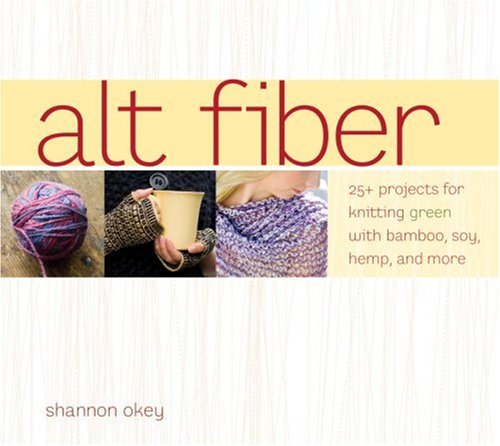
Like any modern, responsible citizen or fervent DIYer, you’ve probably been using salvaged materials for years. But did you know that the fastest growing trend in knitting and crochet takes reduce-reuse-recycle to a whole new level? In Alt Fiber, popular craft author, teacher, and blogger Shannon Okey presents more than twenty-five patterns for jackets, skirts, sweaters, wraps, socks, bags, and more using nonallergenic plant fibers. And these aren’t just any fibers . . . from the seaweed-derived Seacell yarn, which transmits vitamins and nutrients to your skin when you wear it, to soy-based yarns made from tofu manufacturing waste, alternative fibers are good for the environment, easy to care for, and more available than ever.
Since these fibers don’t work up or drape like wool or cotton yarns, Shannon channels her enthusiasm and expertise into teaching crafters of all skill levels about the properties of alt fibers, how to incorporate them into existing patterns, and even how to hand-dye them. And with contemporary designs contributed by Knit Brit’s Andi Smith, Acme Knitting Company’s Jillian Moreno, Julie Armstrong Holetz, Sivia Harding, Laura Chau, Kate Jackson, Keri Williams, and other up-and-coming designers, Alt Fiber is a must-have addition to overstuffed stash bags everywhere. Whether you make a pine wrap, a bamboo coat, a kenaf bag, or a corn T-shirt, knitting green has never been so easy.
Die Inhaltsangabe kann sich auf eine andere Ausgabe dieses Titels beziehen.
Über die Autorin bzw. den Autor
\Shannon Okey is the spokesperson for South West Trading Company’s “Go Green” campaign and the author or co-author of more than ten books. She has appeared on HGTV’s Crafters Coast to Coast, the DIY Network’s Uncommon Threads and Knitty Gritty, and several other shows. She writes a column for knit.1 magazine, is a frequent contributor to CRAFT and Yarn Market News, and teaches craft classes all over the country. She co-owns a studio workshop/store called Stitch Cleveland (www.stitchcleveland.com) and created Stitch Cooperative, a designer-owned pattern distribution network. Shannon lives in Cleveland, Ohio, with her boyfriend, Tamas Jakab, and three furry beasts. Connect with Shannon online at www.knitgrrl.com.
THE AUTHOR SCOOP
Who would you cast as yourself in a movie of your life?
My mother says it’s already been done: Reese Witherspoon in “Election.” I thought she (my mother, not Witherspoon) was going to asphyxiate herself laughing when she called to tell me I was “in” a movie.
Are you “six degrees of separation” away from anyone famous?
I’ve beaten a certain award-winning, NYT-bestselling novelist at Trivial Pursuit.
What is your favorite sandwich?
Wheat bread, Stonewall Kitchens onion & garlic jam, sharp cheddar, walnuts and roast beef, pressed in the panini maker. Oh my.
What’s the farthest you’ve ever traveled?
Czestochowa, Poland, to see the Black Madonna icon.
How long does it take you to write a book?
I once wrote 10,000 words of a draft book manuscript from scratch in under 12 hours. I type fast!
Auszug. © Genehmigter Nachdruck. Alle Rechte vorbehalten.
introduction:
knitting green with plant fibers
Unusual plant-based yarns, or what I call alt fibers, are an interesting and addictive addition to the knitter’s arsenal. Why “alt” fibers? It’s short for “alternative” and a play on the terminology used in early online Usenet newsgroup names. In many ways, these newsgroups were the predecessors to today’s wide array of topic-specific blogs and websites, so if you enjoy reading knitblogs today, you have Usenet to thank!
Taking the reference a little bit further, while a knitting newsgroup might feature moderators who expect some decorum from online residents, the alt.knitting newsgroup would tend to be more “wild West” in its approach, lacking a fixed set of rules or guidelines. By extension, this book and its contents also want to break--or at least bend--all the rules when it comes to using extraordinary plant fibers in knitting and crochet.
Cotton is usually the first and only plant fiber knitters try, but there are so many new fibers to play with that trying cotton alone is like going to an all-you-can-eat buffet and only eating carrot sticks from the salad table. Let’s take a look at a sampling of the fibers you’ll encounter in this book.
Soy is transformed into a sensuously soft yarn that is virtually indistinguishable from its silkworm-generated counterpart and improves upon real silk in ease of care. But soy isn’t the only plant used for both food and fiber--so is corn! Wood pulp is reborn as cellulose-based lyocell (brand name Tencel), a durable and soft fiber frequently incorporated into higher-end fabrics. Pineapple fiber yarn resembles linen: while it’s hard wearing, after many washes, it becomes as soft as silk yet retains its durability. Ramie, kenaf, flax, hemp--even yarn made from nettles!--it’s a fiber wonderland out there.
An added advantage is that many of these fibers are more environmentally friendly than cotton. Growing cotton has its downside--a constant need for water that has created unfortunate environmental consequences around the world. In Kazakhstan, the Aral Sea has lost more than six miles of surface area along with its lively fishing industry to large-scale industrial farms that diverted the rivers feeding the sea to irrigate endless cotton fields. Today, most cotton is grown in China and the former Soviet Union. By contrast, soy and corn are two of the largest American crops, and North American manufacturers are experimenting with bamboo and other fast-growing fiber crops that don’t require nearly as many agricultural inputs, such as chemical fertilizers and irrigation. Because I believe in making the choice to use fibers from eco-friendly sources wherever possible, the cotton used in this book is all organically grown.
Plant fiber yarns are also allergy friendly. Even if you’re not allergic to wool or other animal fibers, chances are you know someone who is or perhaps you know someone with multiple chemical sensitivities. This book features several sections about natural dyes and naturally colored fibers that may inspire you to use them for these hard-to-knit-for friends.
There’s a small learning curve with alt fibers, but once you’ve mastered a few basics, you’ll be on your way to knitting projects that are allergy friendly, impressive, and socially responsible.
my history with alt fibers . . . or a seed is planted
I first encountered alt fibers a number of years ago when Jonelle Raffino, the founder of South West Trading Company, produced a booklet for spinners complete with fiber samples. I ordered some soy fiber from her online and quite literally fell in love with it. At the time, the only alt fiber yarns I could find locally were linen and some terribly scratchy hemp that seemed better suited for tying up packages than for knitting.
Jonelle’s soy fiber (trade name SoySilk) was a revelation--it was not only softer than the other plant yarns I’d tried, but it was also shiny and beautiful. I’d struggled to find something cool I could knit for my best friend, Pamela, a vegan, using fibers she would appreciate and enjoy. The eventual project, a soy ÒpurlsÓ hat that looked more like the gleaming oyster-born kind than anything grown in the ground, was unlike anything I’d ever knitted before. Fortunately, I’d recently learned to spin, so I could make my own yarn from Jonelle’s fiber without worrying about what was commercially available as yarn. Over time, I hunted down more fibers and yarns--bamboo, organic cotton, linen that didn’t cut your hand like twine--and my alt fibers class was born.
This class, which I’ve taught everywhere from yarn shops to arboretums, drove me to research other fibers that fit the out-of-the-ordinary-plants-used-for-knitting description. Other knitters were taking notice, too. Long before the mainstream knitting magazines featured soy and bamboo as anything other than an oddity, Amy R. Singer, the founder of Knitty.com and author of No Sheep for You: Knit Happy with Cotton, Silk, Linen, Hemp, Bamboo and Other Delights (Interweave Press, 2007) published an article by Julie Theaker called “Plant Freak” in a 2004 issue of Knitty. Amy herself is highly allergic to animal fibers of all kinds (I’ve seen what happens when she accidentally picks up a skein of alpaca!), so it seemed only natural that her magazine would feature plant fiber yarns alongside the more common wool and wool blends from its very inception. I’m certain that Knitty fans and other online knitters helped spread these fibers’ popularity through their willingness to experiment and try new yarns.
As more and more alt fiber yarns came on the market, the question I was most frequently asked was, “What can you do with them?” My short and sarcastic answer was and is, “Just about everything.” I realized, however, that these yarns have properties both good and bad that puzzle even the most experienced knitters. Are they warm like wool? Well, they can be if you knit them a certain way! How can I compensate for their lack of stretch? Plan carefully and use the right stitch patterns! How do I care for the finished garments? Most alt fiber yarns are machine washable and can even be dried in the dryer! In fact, some of these yarns look better the more they’re washed. Try saying that about wool! This book is in many ways a response to all the questions I’ve gotten and a chance to showcase what these yarns can do.
about this book
Not only do I want to introduce you to these fibers and inspire you to use them in your own projects, but I also want to explain where they come from, the environmental concerns, how to dye and alter them to suit your needs, and many other subjects you won’t see tackled in the typical pattern book. You’ll notice that the “Resource Guide” at the back of the book is considerably larger and more detailed than most. I want you to be able to find the materials you need now for the patterns but also the information you might want in future if you become as fond of these fibers as I am. And don’t worry: the world wool market won’t go out of business if we knit a few soy fiber hats!
yarn qualities
If you are accustomed to knitting with wool or wool blends, adjusting your knitting style to alt fiber yarns might take a little time and experimentation. For one thing, they are not nearly as elastic as wool yarns, and depending on how the yarn is constructed, you may encounter some unexpected behavior. Alt fiber sock yarns are one example: to make up for the lack of elasticity, most plant yarns meant for socks have elastic, Lycra, or...
„Über diesen Titel“ kann sich auf eine andere Ausgabe dieses Titels beziehen.
Suchergebnisse für Alt Fiber: 25+ Projects for Knitting Green With Bamboo,...

Beispielbild für diese ISBN
Alt Fiber: 25 Projects for Knitting Green with Bamboo, Soy, Hemp, and More
Anbieter: Wonder Book, Frederick, MD, USA
Verkäuferbewertung 5 von 5 Sternen

Zustand: Very Good. Very Good condition. A copy that may have a few cosmetic defects. May also contain light spine creasing or a few markings such as an owner's name, short gifter's inscription or light stamp. Artikel-Nr. V10A-04534
Gebraucht kaufen
EUR 6,28
Versand gratis
Versand innerhalb von USA
Versand innerhalb von USA
Anzahl: 1 verfügbar
Beispielbild für diese ISBN
Alt Fiber : 25 Projects for Knitting Green with Bamboo, Soy, Hemp and More
Anbieter: Better World Books: West, Reno, NV, USA
Verkäuferbewertung 5 von 5 Sternen
Zustand: Good. Pages intact with minimal writing/highlighting. The binding may be loose and creased. Dust jackets/supplements are not included. Stock photo provided. Product includes identifying sticker. Better World Books: Buy Books. Do Good. Artikel-Nr. 9792357-75
Gebraucht kaufen
EUR 6,85
Versand gratis
Versand innerhalb von USA
Versand innerhalb von USA
Anzahl: 1 verfügbar
Beispielbild für diese ISBN
Alt Fiber : 25 Projects for Knitting Green with Bamboo, Soy, Hemp and More
Anbieter: Better World Books, Mishawaka, IN, USA
Verkäuferbewertung 5 von 5 Sternen
Zustand: Good. Former library copy. Pages intact with minimal writing/highlighting. The binding may be loose and creased. Dust jackets/supplements are not included. Includes library markings. Stock photo provided. Product includes identifying sticker. Better World Books: Buy Books. Do Good. Artikel-Nr. 1472425-75
Gebraucht kaufen
EUR 6,85
Versand gratis
Versand innerhalb von USA
Versand innerhalb von USA
Anzahl: 2 verfügbar
Beispielbild für diese ISBN
Alt Fiber: 25 Projects for Knitting Green with Bamboo, Soy, Hemp, and More
Anbieter: ThriftBooks-Atlanta, AUSTELL, GA, USA
Verkäuferbewertung 5 von 5 Sternen
Paperback. Zustand: Good. No Jacket. Pages can have notes/highlighting. Spine may show signs of wear. ~ ThriftBooks: Read More, Spend Less. Artikel-Nr. G1580089151I3N00
Gebraucht kaufen
EUR 7,61
Versand gratis
Versand innerhalb von USA
Versand innerhalb von USA
Anzahl: 1 verfügbar
Beispielbild für diese ISBN
Alt Fiber: 25 Projects for Knitting Green with Bamboo, Soy, Hemp, and More
Anbieter: ThriftBooks-Atlanta, AUSTELL, GA, USA
Verkäuferbewertung 5 von 5 Sternen
Paperback. Zustand: Very Good. No Jacket. May have limited writing in cover pages. Pages are unmarked. ~ ThriftBooks: Read More, Spend Less. Artikel-Nr. G1580089151I4N00
Gebraucht kaufen
EUR 7,61
Versand gratis
Versand innerhalb von USA
Versand innerhalb von USA
Anzahl: 1 verfügbar