
Verwandte Artikel zu Taking Back Islam: American Muslims Reclaim Their Faith
Inhaltsangabe
A panel of thirty-five experts, writers, and religious leaders--including Muhammad Ali and Karen Armstrong--take a close-up look at the future of Islam, the historical realities that have shaped it, the paradoxes and schisms within it, the conflict between fundamentalism and progressives, and its beliefs and practices, in an informative panel discussion. 40,000 first printing.Sandy Duncan.
Die Inhaltsangabe kann sich auf eine andere Ausgabe dieses Titels beziehen.
Über die Autorin bzw. den Autor
Michael Wolfe is the author of books of poetry, fiction, travel, and history. His most recent works are a pair of books from Grove Press on the pilgrimage to Mecca: The Hadj, a first-person travel account and One Thousand Roads to Mecca, an anthology of 10 centuries of travelers writing about the Muslim pilgrimage. In 1997, Wolfe hosted a televised account of the Hadj from Mecca for Nightline on ABC. He is currently at work on a four-hour television documentary on the life and times of the Prophet Muhammad. He lives in California.
Von der hinteren Coverseite
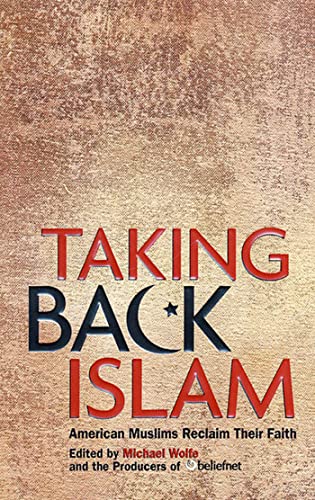
Taking Back Islam: American Muslims Reclaim Their Faith
"September 11 forced a reckoning of sorts, and it has led us to be more self-reliant. When any religion is new to a place, as Islam is new to America, the tendency to take one's cues from the Motherland is strong, wherever that Motherland is perceived to be. And then there comes a moment to grow up. For many American Muslims, that moment arrived in the weeks following September 11.
"This is a book by forward-looking Muslims-- in love with Islam, proud of Islam, and confident enough in its strength to believe that it can stand up to honest introspection. 'Speak the truth,' Muhammad said, 'even if it hurts you.' A sometimes painful struggle, nothing less than a faith in search of its soul, informs this book."--Michael Wolfe
Is it possible that the seeds of Islamic renewal are being sown in the West? Are there ways that American Muslims, combining a commitment to democratic pluralism with their faith, have the opportunity to energize Islam globally? What does this Islam look like?
In Taking Back Islam, notable figures such as Karen Armstrong, Hakeem Olajuwon, Ingrid Mattson, Kabir Helminski, and Arsalan Tariq Iftikhar take on the big questions, such as Islam's views on violence, women, democracy, and other faiths. It gathers the voices of Muslims who are faithfully practicing a brand of Islam in defiance of extremists within the faith and critics outside of it. Here are the voices of the future of Islam.
People of all faiths, and those of none, must hear these voices and understand them in order to truly comprehend the state of the world today.
Aus dem Klappentext
In the months after September 11, American Muslims heard the familiar sounds of Islam being defined by others. On television, from the Capitol, from the pulpit, in the classroom, and, worst of all, on videotapes from Osama bin Laden's cave, commentators, politicians, scholars, and wealthy terrorists were busily telling Muslims the "real meaning" of Islam.
Western Muslims knew something had to be done or Islam might be tarnished, even corrupted. In the past year, they have gathered informally to discuss the past, the present, and how things ought to be. Over time, they began to conceive, then voice, then, finally, put to paper ideas about how they might define Islam in this century. In the year since September 11, American Muslims began to do something extraordinary. They began to reclaim the core values of Islam.
Taking Back Islam is a bold collection of voices in the vanguard of the faith, voices of men and women who remain devout and utterly convinced of Islam's power to help create a just, ordered, and beautiful world but who are also unafraid to be critical of those who would distort Islam for violent or political ends. Many of these writers are American Muslims who benefit from a commitment to democratic pluralism as well as a commitment to Islam.
"I believe in Allah and America," writes Arsalan Tariq Iftikhar. "The Qur'an has a radical message of tolerance," says Kabir Helminski. "American Muslims have a special obligation," according to Ingrid Mattson. "Many Muslims suspect that Islam's 'traditional lands' have less to teach us than they claim," writes Michael Wolfe.
The unique nature and strength of these voices, fueled by a strong desire to tap the best traditions within Islam, offer hope for rescuing a faith that has been injured from within by extremists and demonized from without by Western culture.
Auszug. © Genehmigter Nachdruck. Alle Rechte vorbehalten.
AMERICAN MUSLIMS' SPECIAL OBLIGATION
AN AMERICAN MUSLIM LEADER ASKS: WHO HAS THE GREATEST RESPONSIBILITY TO STOP VIOLENCE COMMITTED BY MUSLIMS IN THE NAME OF ISLAM?
By Ingrid Mattson
September 11 exacerbated a double-bind American Muslims have been feeling for some time. So often, it seems, we have to apologize for reprehensible actions committed by Muslims in the name of Islam. We tell other Americans, "People who do these things (oppression of women, persecution of religious minorities, terrorism) have distorted the 'true' Islam."
And so often we have to tell other Muslims throughout the world that America is not as bad as it appears. We say, "These policies (support for oppressive governments, enforcement of sanctions responsible for the deaths of almost one million Iraqi children, vetoing any criticism of Israel at the United Nations) contradict the 'true' values of America."
But frankly, American Muslims have generally been more critical of injustices committed by the American government than of injustices committed by Muslims. This has to change.
For several years prior to September 11, I spoke publicly in Muslim forums against the injustice of the Taliban. My criticism of this self-styled Muslim regime was not always well-received. Some Muslims felt that public criticism of the Taliban harmed Muslim solidarity. Others questioned my motives, suggesting that I was more interested in serving a feminist agenda than an Islamic one. My answer to the apologists has always been: Who has the greatest duty to stop the oppression of Muslims committed by other Muslims in the name of Islam? The answer, obviously, is Muslims.
I had not previously spoken about suicide attacks committed by Muslims in the name of Islam. I did not avoid the subject; it simply did not cross my mind as a priority among the many issues I felt needed to be addressed. This was a gross oversight. I should have asked myself, "Who has the greatest duty to stop violence committed by Muslims against innocent non- Muslims in the name of Islam?" The answer, obviously, is Muslims.
American Muslims, in particular, have a great responsibility to speak out. The freedom, stability, and strong moral foundation of the United States are great blessings for all Americans, particularly for Muslims.
Moreover, we do not have cultural restrictions that Muslims in some other countries have. In America, Muslim women have found the support and freedom to reclaim their proper place in the life of their religious community. And Muslims have pushed and been allowed to democratize their governing bodies. Important decisions relating to theological and legal matters are increasingly made in mosques and Islamic organizations by elected boards or the collective membership.
But God has not blessed us with these things because we are better than the billions of humans who do not live in America. We do not deserve good health, stable families, safety, and freedom more than the millions of Muslims and non-Muslims throughout the world who are suffering from disease, poverty, and oppression. Muslims who live in America are being tested by God to see if we will be satisfied with a self-contained, self- serving Muslim community that resembles an Islamic town in the Epcot global village, or if we will use the many opportunities available to us to change the world for the better--beginning with an honest critical evaluation of our own flaws.
Because we have freedom and wealth, we have a special obligation to help those Muslims who do not--by speaking out against the abuses of Muslim "leaders" in other countries.
So let me state it clearly: I, as an American Muslim leader, denounce not only suicide bombers and the Taliban, but those leaders of other Muslim states who thwart democracy, repress women, use the Qur'an to justify un- Islamic behavior, and encourage violence. Alas, these views are not only the province of a small group of terrorists or dictators. Too many rank-and- file Muslims, in their isolation and pessimism, have come to hold these self-destructive views as well.
The problem is that other Muslims may not listen to us, no matter how loud our voices. American Muslim leaders will be heard only if they are recognized as authentic interpreters of Islam among the global community. This will be very difficult to achieve because our legitimacy in the Muslim world is intimately linked with American foreign policy. An understanding of some important developments in Islamic history and theology will clarify this apparently odd dependence.
ISLAM IS WITHOUT CENTRAL LEADERSHIP
According to Islamic doctrine, after the death of the Prophet Muhammad, no Muslim has the right to claim infallibility in interpreting the faith. There is no ordination, no clergy, no unquestioned authority. This does not mean that all opinions are equal, nor that everyone has the ability to interpret religious and legal doctrine. Solid scholarship and a deep understanding of the tradition are essential. But not all scholars are considered authoritative. Most Muslims will accept the opinions only of scholars who demonstrate that they are truly concerned about the welfare of ordinary people. People simply will not listen to scholars who seem to be mostly interested in serving the interests of the government.
Throughout Muslim history, religious leaders who advocated aggression against the state were usually marginalized. After all, most Muslims did not want to be led into revolution--they simply wanted their lives to be better. The most successful religious leaders were those who, in addition to serving the spiritual needs of the community, acted as intermediaries between the people and state. There have been times, however, when hostile forces attacked or occupied Muslim lands--the Mongol invasions, the Crusades, European colonialism, and the Soviet invasion of Afghanistan. At those times, people needed revolutionary leaders; those who were unable to unite the people against aggression were irrelevant.
The question we need to ask is, At this point in history, what do Muslims need to hear from their leaders? What voices will they listen to?
It often seems that American Muslims are asked to choose between uncritical support for rebels acting in the name of Islam or uncritical support for any actions taken by the American government. Muslim extremists have divided the world into two camps: those who oppose the oppression of the Muslim people and those who aid in that oppression. President Bush has divided the world into two camps: those who support terrorism and those who fight terrorism.
Where does this leave American Muslim leaders who oppose the oppression of the Muslim people but who also want to fight terrorism? In the increasingly strident rhetoric of war, we may be considered traitors by both sides.
Nevertheless, we must continue to speak. We have to speak against oppressive interpretations of Islam and against emotional, superficial, and violent apocalyptic depictions of a world divided. And in our desire to show ourselves to be patriotic Americans, we cannot suppress our criticisms of the United States when we have them. We have to do this, not only because it is the right thing to do, but also because if we do not, the Muslim world will remain deaf to our arguments that peaceful change is possible and that revolt and ensuing lawlessness almost always cause the greatest harm to the people.
It is in the best interest of the United States that we be permitted to continue to speak. In many parts of the world, those who speak out against corruption and unfair government policies are jailed, tortured, and killed. In such circumstances, very few people--only those who are willing to risk losing their property, their families, their security, and their lives-- will continue to speak out. Only the...
„Über diesen Titel“ kann sich auf eine andere Ausgabe dieses Titels beziehen.
Suchergebnisse für Taking Back Islam: American Muslims Reclaim Their Faith

Beispielbild für diese ISBN
Taking Back Islam: American Muslims Reclaim Their Faith
Anbieter: ThriftBooks-Dallas, Dallas, TX, USA
Verkäuferbewertung 5 von 5 Sternen

Hardcover. Zustand: Very Good. No Jacket. May have limited writing in cover pages. Pages are unmarked. ~ ThriftBooks: Read More, Spend Less. Artikel-Nr. G1579546552I4N00
Gebraucht kaufen
EUR 6,39
Versand gratis
Versand innerhalb von USA
Versand innerhalb von USA
Anzahl: 1 verfügbar
Beispielbild für diese ISBN
Taking Back Islam: American Muslims Reclaim Their Faith
Anbieter: ThriftBooks-Dallas, Dallas, TX, USA
Verkäuferbewertung 5 von 5 Sternen
Hardcover. Zustand: Good. No Jacket. Pages can have notes/highlighting. Spine may show signs of wear. ~ ThriftBooks: Read More, Spend Less. Artikel-Nr. G1579546552I3N00
Gebraucht kaufen
EUR 6,39
Versand gratis
Versand innerhalb von USA
Versand innerhalb von USA
Anzahl: 1 verfügbar
Beispielbild für diese ISBN
Taking Back Islam: American Muslims Reclaim Their Faith
Anbieter: Wonder Book, Frederick, MD, USA
Verkäuferbewertung 5 von 5 Sternen
Zustand: Good. Good condition. Good dust jacket. A copy that has been read but remains intact. May contain markings such as bookplates, stamps, limited notes and highlighting, or a few light stains. Bundled media such as CDs, DVDs, floppy disks or access codes may not be included. Artikel-Nr. Q01F-00300
Gebraucht kaufen
EUR 6,42
Versand gratis
Versand innerhalb von USA
Versand innerhalb von USA
Anzahl: 1 verfügbar
Beispielbild für diese ISBN
Taking Back Islam: American Muslims Reclaim Their Faith
Anbieter: Wonder Book, Frederick, MD, USA
Verkäuferbewertung 5 von 5 Sternen
Zustand: Very Good. Very Good condition. Very Good dust jacket. A copy that may have a few cosmetic defects. May also contain light spine creasing or a few markings such as an owner's name, short gifter's inscription or light stamp. Artikel-Nr. H11A-01865
Gebraucht kaufen
EUR 6,42
Versand gratis
Versand innerhalb von USA
Versand innerhalb von USA
Anzahl: 1 verfügbar
Beispielbild für diese ISBN
Taking Back Islam : American Muslims Reclaim their Faith
Verlag:
Potter/Ten Speed/Harmony/Rodale, 2002
ISBN 10: 1579546552
ISBN 13: 9781579546557
Gebraucht
Hardcover
Anbieter: Better World Books: West, Reno, NV, USA
Verkäuferbewertung 5 von 5 Sternen
Zustand: Good. 0th Edition. Pages intact with minimal writing/highlighting. The binding may be loose and creased. Dust jackets/supplements are not included. Stock photo provided. Product includes identifying sticker. Better World Books: Buy Books. Do Good. Artikel-Nr. 52488190-75
Gebraucht kaufen
EUR 6,74
Versand gratis
Versand innerhalb von USA
Versand innerhalb von USA
Anzahl: 1 verfügbar
Beispielbild für diese ISBN
Taking Back Islam : American Muslims Reclaim their Faith
Verlag:
Potter/Ten Speed/Harmony/Rodale, 2002
ISBN 10: 1579546552
ISBN 13: 9781579546557
Gebraucht
Hardcover
Anbieter: Better World Books, Mishawaka, IN, USA
Verkäuferbewertung 5 von 5 Sternen
Zustand: Good. 0th Edition. Former library copy. Pages intact with minimal writing/highlighting. The binding may be loose and creased. Dust jackets/supplements are not included. Includes library markings. Stock photo provided. Product includes identifying sticker. Better World Books: Buy Books. Do Good. Artikel-Nr. 1471017-75
Gebraucht kaufen
EUR 6,74
Versand gratis
Versand innerhalb von USA
Versand innerhalb von USA
Anzahl: 1 verfügbar
Foto des Verkäufers
Taking Back Islam: American Muslims Reclaim Their Faith
Verlag:
Rodale Books, 2002
ISBN 10: 1579546552
ISBN 13: 9781579546557
Gebraucht
Hardcover
Erstausgabe
Anbieter: Southampton Books, Sag Harbor, NY, USA
Verkäuferbewertung 5 von 5 Sternen
Hardcover. Zustand: Like New. Zustand des Schutzumschlags: Like New. First Edition. First Edition, First Printing. Not price-clipped ($21.95 price intact). Published by Rodale, 2002. Octavo. Hardcover. Book is like new. Dust jacket is like new. 100% positive feedback. 30 day money back guarantee. NEXT DAY SHIPPING! Excellent customer service. Please email with any questions or if you would like a photo. All books packed carefully and ship with free delivery confirmation/tracking. All books come with free bookmarks. Ships from Sag Harbor, New York. Artikel-Nr. 193419
Gebraucht kaufen
EUR 22,96
EUR 4,45 Versand
Versand innerhalb von USA
Versand innerhalb von USA
Anzahl: 1 verfügbar