
Verwandte Artikel zu 365 More Simple Science Experiments with Everyday Materials
Inhaltsangabe
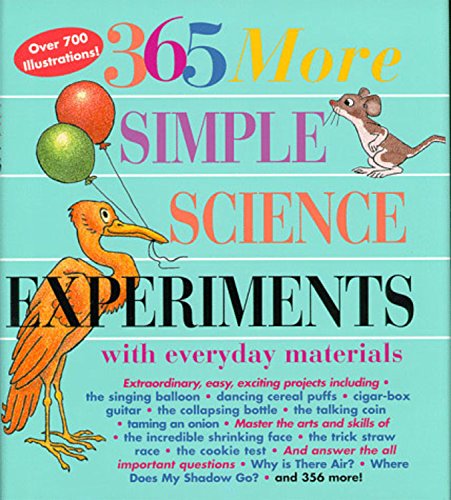
Illustrated by Frances Zweifel This companion to the popular 365 Simple Science Experiments fills a whole new year with fun, easy and educational hands-on experiments. Kids will learn basic scientific concepts, covering everything from nature, physics, time, chemistry and space. The fundamentals of science are brought to life in an informative and colorful text that children ages seven and up can easily follow by themselves. Simple, clear and safe instructions explain the experiments all of which use everyday materials found in most homes. Projects range from mastering helicopter flight with a pencil and piece of cardboard to building bird-nests, preserving spider webs and constructing a "cigar box" guitar (to understand sound waves). More than 700 lively illustrations give visual aids to help set up the experiments.
Die Inhaltsangabe kann sich auf eine andere Ausgabe dieses Titels beziehen.
Über die Autorin bzw. den Autor
n/a
E. Richard Churchill,Louis V. Loeschnig, and Muriel Mandell are authors of books in the No-Sweat Science series, published by Sterling Publishers. They each have written several other science-related books for children and young adults.
Von der hinteren Coverseite
Make a foundation from a can and learn about water pressure. Float a glass in water and learn the principle of displacement (discovered by Greek mathematicians Archimedes). Heat an egg in hot water and actually see evidence of the molecules escaping through the shell. Drop marbles into a glass of water and prove that two forms of matter cannot occupy the same space at the same time. Use a straw to demonstrate air pressure. Make a parachute to understand a law of physics. Amaze your friends by sticking pins in an inflated balloon without popping it, and then conduct an experiment to show them why 1 plus 1 does not equal 2.
In 365 more Simple Science Experiments, you'll know exactly what to do, what happens and why. So whether it's understanding gravity, becoming a kitchen alchemist, designing a rocket, or telling time by the sun, the moon, or the stars, you'll see that being a scientist doesn't just make the world a better place - it's also great fun. Following are just a few of the fascinating experiments you'll find inside:
- Launch your own astronauts
- Catching sound
- Musical nails
- Pendulum sand painting
- Maple snow sugar
- Milking a potato
- How to make vinegar
- Poached egg physics
- Crazy cave icicles
- The amazing humm-o-comb
- Find the center of gravity
- A gyroscope in your pocket
Auszug. © Genehmigter Nachdruck. Alle Rechte vorbehalten.
1 + 1 Does Not Always = 2
You might be a good math student, but you will have to be a good physics student to figure out this experiment.
You will need:
- large-size glass jar
- masking tape
- pen
- cup of sugar
- measuring cup
- paper towel
- drinking straw
- warm water
What to do: Place a strip of masking tape down the outside of the jar. Pour one cup of warm water into the jar and mark the level that it reaches on the tape. Then, add a second cup of warm water and, again mark the water level on the tape. Empty all of the water out of the jar and dry the inside of it with a paper towel. Now, pour one cup of warm water into the jar. Follow that with one cup of sugar. Stir this solution well with the straw and then check the liquid level on the masking-tape measuring strip.
What happens: The liquid level of one cup of water plus one cup of sugar does not reach the two-cup mark of the tape.
Why: If you caught the clue word, solution, when you were instructed to stir the sugar and water together, you probably know the answer. The substances in a solution fit neatly together, like puzzle parts. Instead of taking up their own space, the grains of sugar simply fill in the empty spaces around the water molecules to make something entirely new, a solution called sugar water...but less of it than you thought you would have when you added the sugar and water measurements.
The Talking Coin
You may have heard somebody say that money talks, but until you do this experiment you have probably never actually seen it speak.
You will need:
- plastic 2-liter bottle
- quarter
- cup of water
- freezer
- kitchen timer or watch
What to do: Put the quarter in the cup of water and place the empty bottle in the freezer for five minutes. When the time is up, remove the bottle from the freezer and, immediately, cover the mouth of the bottle with the wet coin. (It is important to completely cover the bottle's mouth with the coin.)
What happens: The quarter becomes a tongue for the bottle and begins to chatter to you.
Why: When the bottle was put into the freezer, the air molecules inside of it cooled and moved closer together. Since the air in the bottle then took up less space, it left room for extra air to flow in - so it did.
When the bottle was removed from the freezer, however, the air molecules inside of it began to warm up and spread out again. It's a great example of, "There was enough room for everyone to sit comfortably in the car until we all put on coats and it was crowded." Suddenly there was no room for the extra air molecules.
It is that "extra air" that is being pushed out of the bottle as the air warms that makes the coin move up and down as if it were talking.
"Boil, Boil Magical Water"
Would you believe you can boil water without using a stove? Here's the key to this old, well-kept secret.
You will need:
- clear drinking glass (a
„Über diesen Titel“ kann sich auf eine andere Ausgabe dieses Titels beziehen.
Suchergebnisse für 365 More Simple Science Experiments with Everyday Materials

Beispielbild für diese ISBN
365 More Simple Science Experi
Anbieter: World of Books (was SecondSale), Montgomery, IL, USA
Verkäuferbewertung 5 von 5 Sternen

Zustand: Good. Item in good condition. Textbooks may not include supplemental items i.e. CDs, access codes etc. Artikel-Nr. 00102320710
Gebraucht kaufen
EUR 4,55
Versand gratis
Versand innerhalb von USA
Versand innerhalb von USA
Anzahl: 5 verfügbar
Beispielbild für diese ISBN
365 More Simple Science Experi
Anbieter: World of Books (was SecondSale), Montgomery, IL, USA
Verkäuferbewertung 5 von 5 Sternen
Zustand: Very Good. Item in very good condition! Textbooks may not include supplemental items i.e. CDs, access codes etc. Artikel-Nr. 00102017519
Gebraucht kaufen
EUR 4,55
Versand gratis
Versand innerhalb von USA
Versand innerhalb von USA
Anzahl: 2 verfügbar
Beispielbild für diese ISBN
365 More Simple Science Experiments with Everyday Materials
Anbieter: ThriftBooks-Dallas, Dallas, TX, USA
Verkäuferbewertung 5 von 5 Sternen
Hardcover. Zustand: As New. No Jacket. Pages are clean and are not marred by notes or folds of any kind. ~ ThriftBooks: Read More, Spend Less. Artikel-Nr. G1579120350I2N00
Gebraucht kaufen
EUR 5,96
Versand gratis
Versand innerhalb von USA
Versand innerhalb von USA
Anzahl: 1 verfügbar
Beispielbild für diese ISBN
365 More Simple Science Experiments with Everyday Materials
Anbieter: ThriftBooks-Phoenix, Phoenix, AZ, USA
Verkäuferbewertung 5 von 5 Sternen
Hardcover. Zustand: As New. No Jacket. Pages are clean and are not marred by notes or folds of any kind. ~ ThriftBooks: Read More, Spend Less. Artikel-Nr. G1579120350I2N00
Gebraucht kaufen
EUR 5,96
Versand gratis
Versand innerhalb von USA
Versand innerhalb von USA
Anzahl: 1 verfügbar
Beispielbild für diese ISBN
365 More Simple Science Experiments with Everyday Materials
Anbieter: ThriftBooks-Atlanta, AUSTELL, GA, USA
Verkäuferbewertung 5 von 5 Sternen
Hardcover. Zustand: As New. No Jacket. Pages are clean and are not marred by notes or folds of any kind. ~ ThriftBooks: Read More, Spend Less. Artikel-Nr. G1579120350I2N00
Gebraucht kaufen
EUR 5,96
Versand gratis
Versand innerhalb von USA
Versand innerhalb von USA
Anzahl: 1 verfügbar
Beispielbild für diese ISBN
365 More Simple Science Experiments with Everyday Materials
Verlag:
Workman Publishing Company, Incorporated, 1998
ISBN 10: 1579120350
ISBN 13: 9781579120351
Gebraucht
Hardcover
Anbieter: Better World Books, Mishawaka, IN, USA
Verkäuferbewertung 5 von 5 Sternen
Zustand: Good. Pages intact with minimal writing/highlighting. The binding may be loose and creased. Dust jackets/supplements are not included. Stock photo provided. Product includes identifying sticker. Better World Books: Buy Books. Do Good. Artikel-Nr. 5210026-20
Gebraucht kaufen
EUR 6,50
Versand gratis
Versand innerhalb von USA
Versand innerhalb von USA
Anzahl: 1 verfügbar
Beispielbild für diese ISBN
365 More Simple Science Experiments with Everyday Materials
Verlag:
Workman Publishing Company, Incorporated, 1998
ISBN 10: 1579120350
ISBN 13: 9781579120351
Gebraucht
Hardcover
Anbieter: Better World Books, Mishawaka, IN, USA
Verkäuferbewertung 5 von 5 Sternen
Zustand: Good. Former library copy. Pages intact with minimal writing/highlighting. The binding may be loose and creased. Dust jackets/supplements are not included. Includes library markings. Stock photo provided. Product includes identifying sticker. Better World Books: Buy Books. Do Good. Artikel-Nr. GRP91841573
Gebraucht kaufen
EUR 6,50
Versand gratis
Versand innerhalb von USA
Versand innerhalb von USA
Anzahl: 1 verfügbar
Beispielbild für diese ISBN
365 More Simple Science Experiments with Everyday Materials
Verlag:
Workman Kids (edition ), 1998
ISBN 10: 1579120350
ISBN 13: 9781579120351
Gebraucht
Hardcover
Anbieter: BooksRun, Philadelphia, PA, USA
Verkäuferbewertung 5 von 5 Sternen
Hardcover. Zustand: Fair. With dust jacket. The item might be beaten up but readable. May contain markings or highlighting, as well as stains, bent corners, or any other major defect, but the text is not obscured in any way. Artikel-Nr. 1579120350-7-1-13_29
Gebraucht kaufen
EUR 6,55
Versand gratis
Versand innerhalb von USA
Versand innerhalb von USA
Anzahl: 1 verfügbar
Beispielbild für diese ISBN
365 More Simple Science Experiments with Everyday Materials
Anbieter: Wonder Book, Frederick, MD, USA
Verkäuferbewertung 5 von 5 Sternen
Zustand: As New. Like New condition. Like New dust jacket. A near perfect copy that may have very minor cosmetic defects. Artikel-Nr. S17N-00991
Gebraucht kaufen
EUR 6,62
Versand gratis
Versand innerhalb von USA
Versand innerhalb von USA
Anzahl: 1 verfügbar
Beispielbild für diese ISBN
365 More Simple Science Experiments with Everyday Materials
Anbieter: Wonder Book, Frederick, MD, USA
Verkäuferbewertung 5 von 5 Sternen
Zustand: Very Good. Very Good condition. Very Good dust jacket. A copy that may have a few cosmetic defects. May also contain light spine creasing or a few markings such as an owner's name, short gifter's inscription or light stamp. Artikel-Nr. K05A-03472
Gebraucht kaufen
EUR 6,62
Versand gratis
Versand innerhalb von USA
Versand innerhalb von USA
Anzahl: 2 verfügbar