
Verwandte Artikel zu Sun of gOd: Consciousness and Self-Organizing Force...
Inhaltsangabe
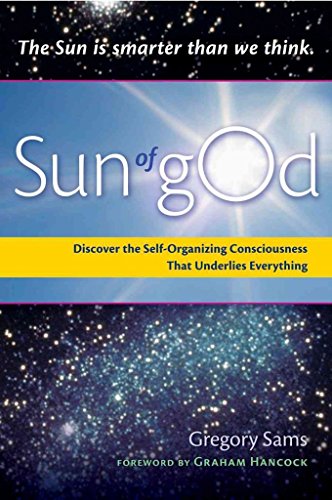
In Sun of gOd, cultural pioneer and philosopher Gregory Sams takes a fresh look at our solar benefactor. As Sams sees it cultures throughout the ancient world were right to recognize the Sun as a living, conscious being. The implications of a conscious provider in the sky are startling, though often obvious and in harmony with science, logic and common sense.
Sun of gOd explores exciting new ground, adding a crucial piece to the jigsawpuzzle picture we have of the cosmos. In the light of a conscious Sun, Sams looks at our hardwired tendency for religion, notions of god and divinity, our place in the firmament, star formation, intelligent light, electromagnetism, feedback, chaos theory, free will, the four elements, and the nearuniversal selforganization of systems from the bottom up.
"Could it really be that the universe waited 13.7 billion years until we came along to manifest the phenomenon of consciousness and made ours the only type of vessel able to experience it?" Sams thinks not. Citing David Bohm's discovery that even on the subatomic level of electrons there appears to be intention and choice, Sams goes on to suggest that creative intelligence may be a bot¬tomup system in which "everything, from a molecule of water to a neuron in our brain to the Sun itself, is a part of the bottom that is subtly steering a greater whole." From this perspective, he smoothly joins the microcosm to the macrocosm, revealing a Universe incorporating both intelligence and design, with no need for an Intelligent Designer.
Die Inhaltsangabe kann sich auf eine andere Ausgabe dieses Titels beziehen.
Über die Autorin bzw. den Autor
Gregory Sams has been changing the culture from the age of 19, when he cofounded SEED, the UK's first natural and organic restaurant in 1960's London. It led to Ceres Grain store, where customers could buy these foods to cook at home. Within a few years he had created the nation's first natural and organic food enterprises, including Whole Earth Foods. He was founder publisher of Harmony Magazine, to which John Lennon dedicated an eightframe cartoon, and copublished Seed, the Journal of Organic Living. In 1982 he created and christened the original VegeBurger, initiating the market for vegetarian food. In 1990 he founded Strange Attractions, the world's only shop ever dedicated to new science "chaos theory." His interest in that science planted the seeds of this book in Gregory's mind. Visit Sams at gregorysams.com. He lives in London.
Graham Hancock is the author of the international bestsellers The Sign and The Seal, Fingerprints of the Gods, and Heaven's Mirror. His books have sold more than five million copies.
Graham Hancock is the author of the international bestsellers The Sign and The Seal, Fingerprints of the Gods, and Heaven's Mirror. His books have sold more than five million copies.
Von der hinteren Coverseite
In Sun of gOd, cultural pioneer and bootstrap philosopher Gregory Sams takes a fresh look at our solar benefactor. As Sams sees it, the Sun is a living, conscious being, fully aware of itself and its place in the universe. Simply put, the Sun of gOd communicates with other conscious beings on all levels with an intelligence that dwarfs our own. Sun of gOd explores exciting new ground, adding a crucial piece to the jigsaw-puzzle picture we have of our cosmos. Sams considers God, gods, notions of divinity, our place in the firmament, the intelligence of light, feedback, free will, electro-magnetism, crystals, fractals, macrobiotics, the four elements, and the self-organizing force that seems to crop up everywhere, perhaps powering everything.
Auszug. © Genehmigter Nachdruck. Alle Rechte vorbehalten.
Son of God
Consciousness and the Self-Organizing Force that Underlies Everything
By Gregory SamsRed Wheel/Weiser, LLC
Copyright © 2009 Gregory Sams
All rights reserved.
ISBN: 978-1-57863-454-5All rights reserved.
Contents
| Foreword by Graham Hancock | |
| Preface: Recalling the forgotten now the box is open | |
| From nothing to now maybe we just got lucky | |
| What is this? we'd not be here without it | |
| One, many or both? a question of divinities | |
| How great, how knowing? less than we are told, more than we believe | |
| Our place in the firmament Galileo tried to point it out | |
| Religion is it hard-wired into being human? | |
| Organized religion maybe one of them has got it right | |
| Animism: first faith perhaps our instincts make more sense | |
| Sun of gOd our local life transmitter | |
| Say hello ... back getting in touch | |
| The solar system our closest family in the cosmos | |
| Stars is there content to the twinkle? | |
| Galaxies our brains are not unlike them | |
| Universe the "all" in "all is One" | |
| In the light of intelligence on the intelligence in light | |
| Chaos, the invisible architect controlling it is not the way to order | |
| Inanimate intelligence might stuff be smarter than we think? | |
| The four elements they shape the cosmos | |
| Free will: no human preserve even a grain of sand might have it | |
| Feedback it makes the world go 'round | |
| The biggest question we'll never answer this | |
| From the bottom up creation as a built-in feature | |
| Overview wrapping it up | |
| Afterwords | |
| Smart evolution and the roots of this book | |
| The little things of life small rules the world | |
| Water inanimate, active and alive | |
| Fire and flame consuming force, transforming gift | |
| Transmute to live the food of life | |
| Beauty and the beholder do flowers know it? | |
| Que sera, sera what to do with a house guest like us? | |
| Special people us amazing newcomers | |
| Acknowledgements | |
| Notes |
CHAPTER 1
From nothing to now
maybe we just got lucky
"Science without religion is lame, religion without science is blind."
—ALBERT EINSTEIN, 1941
Once before a time there was nothing—so the story goes. No bugs, no planets, nostars—neither clouds of cosmic dust nor space for them to be within. Nothing fortime to clock. And then came space, and with it substance, materializing as asoup of subatomic particles during the first moments of a newborn Universe.Endlessly recombined and rearranged, those original particles continue to makeup all that's physical—from comets to custard pies, from our Sun to a swallowand the air in which it flies.
The scientific establishment takes pride in its efforts to explain Universe,from the Big Bang until recently, as a combination of chance events untouched byany intelligence or consciousness—until, of course, we human beings arrived uponthe scene. The outlandish explanations of creation offered by organizedreligions serve to convince many that science must have the better answers. Butthe sometimes stranger theories of cosmologists explaining how dumb particlesaccidentally bumbled into becoming stars and fleshy organisms make many cling tothe irrational ideas of organized religion, if only for tradition's sake. Whilethe concept of a divine planner plotting planetary orbits and designing the DNAof each new species does not bear rational exploration, could the extraordinaryroute from then to now have been random process, devoid of any intent orconsciousness?
That there was a beginning to the Universe is one point upon which science andreligion do agree. Outside the religious arena, this singular moment came to beknown as the Big Bang—a unique, naturally occurring random event, albeit one ofliterally cosmic proportions. Much of the Universe that we know is empty spacebut before the Big Bang there was not even that. This theoretical startingpoint, set at 13.7 billion years ago, brought forth massive amounts ofsubatomic particles into a newly formed space. These individual particles soonassembled themselves into simple atoms of hydrogen and helium—the firstrecognizable matter in Universe.
Universe's original atoms, instead of dispersing like ink in a glass of water,grouped together into giant clouds of thin gas dotted about the newly formedcosmos. And if our Universe were seen as a being that was 100 years old, itwould have been within its first few years that these clouds of simple atomsbegan condensing into many denser balls of gas. Within a relative one to twohours the pressure in these balls became so intense that contained and steadynuclear reactions kicked off within the hearts of the newborn stars.Illumination came to the cosmos.
In our local galaxy, the Milky Way, we have a hundred billion or more stars.Four and a half billion years ago one of them, our own Sun, was born. Soonafterwards it collected nine balls of concentrated matter around it and, bychance, the third ball away had a hot center, a high water content and a thinatmosphere of gases surrounding it—gases that would be deadly to most life formswe know. Earth spent its first half billion or so years just chilling out andsettling down to a quieter existence.
Before its first billion years passed, Earth had settled down enough for organiclife to appear, as bacteria became its first living occupants. This incrediblyversatile and persistent life form may have arisen upon Earth spontaneously. Butit is so difficult to explain how bacteria could have evolved in the availabletime that it is easier for some cosmologists to adopt the panspermia principleand believe that the first bacteria came in on a comet, or by other means fromouter space. Panspermia does not suggest how and where such a finely-craftedliving device as the bacterium could have developed accidentally, just that itwas probably somewhere else. However it came to be, this highly adaptable lifeforce soon colonized the surface of planet Earth, as its waters and land massbecame host to a growing array of increasingly complex microbial life forms.
The thin layer of soil that forms a patchy covering over the continents controlsour own existence and that of every other animal of the land. Without the soil,land plants as we know could not grow, and without plants no animal couldsurvive.
—RACHEL CARSON, SILENT SPRING, 1963
For about 3 billion years, single-celled microbes were all there was. These tinyorganisms mutated and adapted as they nibbled away at the rocks and otherinorganic matter of Earth, creating a living soil. Bacterial activity slowlyaltered the mixture of gases in the atmosphere and the organic content of theoceans, allowing more complex life forms to arise upon Earth. These more complexlife forms, whether worms or human beings, provide a warm home for more...
„Über diesen Titel“ kann sich auf eine andere Ausgabe dieses Titels beziehen.
Suchergebnisse für Sun of gOd: Consciousness and Self-Organizing Force...

Beispielbild für diese ISBN
Sun of God: Discover the Self-Organizing Consciousness That Underlies Everything
Anbieter: World of Books (was SecondSale), Montgomery, IL, USA
Verkäuferbewertung 5 von 5 Sternen

Paperback. Zustand: Fair. In Sun of gOd, cultural pioneer and philosopher Gregory Sams takes a fresh look at our solar benefactor. As Sams sees it cultures throughout the ancient world were right to recognize the Sun as a living, conscious being. The implications of a conscious provider in the sky are startling, though often obvious and in harmony with science, logic and common sense. Sun of gOd explores exciting new ground, adding a crucial piece to the jigsawpuzzle picture we have of the cosmos. In the light of a conscious Sun, Sams looks at our hardwired tendency for religion, notions of god and divinity, our place in the firmament, star formation, intelligent light, electromagnetism, feedback, chaos theory, free will, the four elements, and the nearuniversal selforganization of systems from the bottom up. "Could it really be that the universe waited 13.7 billion years until we came along to manifest the phenomenon of consciousness and made ours the only type of vessel able to experience it?" Sams thinks not. Citing David Bohm's discovery that even on the subatomic level of electrons there appears to be intention and choice, Sams goes on to suggest that creative intelligence may be a bot¬tomup system in which "everything, from a molecule of water to a neuron in our brain to the Sun itself, is a part of the bottom that is subtly steering a greater whole." From this perspective, he smoothly joins the microcosm to the macrocosm, revealing a Universe incorporating both intelligence and design, with no need for an Intelligent Designer. Artikel-Nr. 00094223564
Gebraucht kaufen
EUR 6,30
Versand gratis
Versand innerhalb von USA
Versand innerhalb von USA
Anzahl: 1 verfügbar
Beispielbild für diese ISBN
Sun of gOd: Discover the Self-Organizing Consciousness that Underlies Everything
Verlag:
Weiser Books (edition Illustrated), 2009
ISBN 10: 1578634547
ISBN 13: 9781578634545
Gebraucht
Paperback
Anbieter: BooksRun, Philadelphia, PA, USA
Verkäuferbewertung 5 von 5 Sternen
Paperback. Zustand: Very Good. Illustrated. It's a well-cared-for item that has seen limited use. The item may show minor signs of wear. All the text is legible, with all pages included. It may have slight markings and/or highlighting. Artikel-Nr. 1578634547-11-1
Gebraucht kaufen
EUR 7,40
Versand gratis
Versand innerhalb von USA
Versand innerhalb von USA
Anzahl: 1 verfügbar
Beispielbild für diese ISBN
Sun of God: Consciousness and the Self-Organizing Force That Underlies Everything
Anbieter: ThriftBooks-Atlanta, AUSTELL, GA, USA
Verkäuferbewertung 5 von 5 Sternen
Paperback. Zustand: Good. No Jacket. Pages can have notes/highlighting. Spine may show signs of wear. ~ ThriftBooks: Read More, Spend Less. Artikel-Nr. G1578634547I3N00
Gebraucht kaufen
EUR 8,15
Versand gratis
Versand innerhalb von USA
Versand innerhalb von USA
Anzahl: 1 verfügbar
Beispielbild für diese ISBN
Sun of God: Consciousness and the Self-Organizing Force That Underlies Everything
Anbieter: ThriftBooks-Dallas, Dallas, TX, USA
Verkäuferbewertung 5 von 5 Sternen
Paperback. Zustand: Good. No Jacket. Former library book; Pages can have notes/highlighting. Spine may show signs of wear. ~ ThriftBooks: Read More, Spend Less. Artikel-Nr. G1578634547I3N10
Gebraucht kaufen
EUR 8,15
Versand gratis
Versand innerhalb von USA
Versand innerhalb von USA
Anzahl: 1 verfügbar
Beispielbild für diese ISBN
Sun of God : Discover the Self-Organizing Consciousness That Underlies Everything
Anbieter: Better World Books: West, Reno, NV, USA
Verkäuferbewertung 5 von 5 Sternen
Zustand: Good. Former library copy. Pages intact with minimal writing/highlighting. The binding may be loose and creased. Dust jackets/supplements are not included. Includes library markings. Stock photo provided. Product includes identifying sticker. Better World Books: Buy Books. Do Good. Artikel-Nr. 4549964-6
Gebraucht kaufen
EUR 10,10
Versand gratis
Versand innerhalb von USA
Versand innerhalb von USA
Anzahl: 1 verfügbar
Beispielbild für diese ISBN
Sun of gOd: Discover the Self-Organizing Consciousness that Underlies Everything
Anbieter: WorldofBooks, Goring-By-Sea, WS, Vereinigtes Königreich
Verkäuferbewertung 5 von 5 Sternen
Paperback. Zustand: Very Good. The book has been read, but is in excellent condition. Pages are intact and not marred by notes or highlighting. The spine remains undamaged. Artikel-Nr. GOR001873627
Gebraucht kaufen
EUR 6,63
EUR 6,68 Versand
Versand von Vereinigtes Königreich nach USA
Versand von Vereinigtes Königreich nach USA
Anzahl: 7 verfügbar
Beispielbild für diese ISBN
Sun Of God: Discover the Self-Organizing Consciousness That Underlies Everything
Anbieter: WorldofBooks, Goring-By-Sea, WS, Vereinigtes Königreich
Verkäuferbewertung 5 von 5 Sternen
Paperback. Zustand: Good. The book has been read but remains in clean condition. All pages are intact and the cover is intact. Some minor wear to the spine. Artikel-Nr. GOR004155176
Gebraucht kaufen
EUR 6,63
EUR 6,68 Versand
Versand von Vereinigtes Königreich nach USA
Versand von Vereinigtes Königreich nach USA
Anzahl: 1 verfügbar
Beispielbild für diese ISBN
Sun of God : Discover the Self-Organizing Consciousness That Underlies Everything
Anbieter: Better World Books Ltd, Dunfermline, Vereinigtes Königreich
Verkäuferbewertung 5 von 5 Sternen
Zustand: Very Good. Former library copy. Pages intact with possible writing/highlighting. Binding strong with minor wear. Dust jackets/supplements may not be included. Includes library markings. Stock photo provided. Product includes identifying sticker. Better World Books: Buy Books. Do Good. Artikel-Nr. 15555904-20
Gebraucht kaufen
EUR 10,03
EUR 5,96 Versand
Versand von Vereinigtes Königreich nach USA
Versand von Vereinigtes Königreich nach USA
Anzahl: 1 verfügbar
Beispielbild für diese ISBN
The Sun is Smarter Than We Think
Anbieter: Hamelyn, Madrid, M, Spanien
Verkäuferbewertung 5 von 5 Sternen
Zustand: Very Good. : En este libro, Gregory Sams presenta la idea de que el Sol es un ser vivo y consciente, plenamente consciente de sí mismo y de su lugar en el universo. Según Sams, el Sol se comunica con otros seres conscientes en todos los niveles con una inteligencia que empequeñece la nuestra. El libro explora esta perspectiva y su impacto en nuestra comprensión del mundo. EAN: 9781578634545 Tipo: Libros Categoría: Filosofía Título: The Sun is Smarter Than We Think Autor: Gregory Sams Editorial: Red Wheel/Weiser, LLC Idioma: eng Páginas: 256. Artikel-Nr. Happ-2026-09-29-f2610cf8
Gebraucht kaufen
EUR 11,13
EUR 8,99 Versand
Versand von Spanien nach USA
Versand von Spanien nach USA
Anzahl: 1 verfügbar
Beispielbild für diese ISBN
Sun of God
Anbieter: PBShop.store UK, Fairford, GLOS, Vereinigtes Königreich
Verkäuferbewertung 5 von 5 Sternen
PAP. Zustand: New. New Book. Shipped from UK. Established seller since 2000. Artikel-Nr. GB-9781578634545
Neu kaufen
EUR 21,59
EUR 4,96 Versand
Versand von Vereinigtes Königreich nach USA
Versand von Vereinigtes Königreich nach USA
Anzahl: 2 verfügbar