
Verwandte Artikel zu Psychic Dreamwalking: Explorations at the Edge of Self
Inhaltsangabe
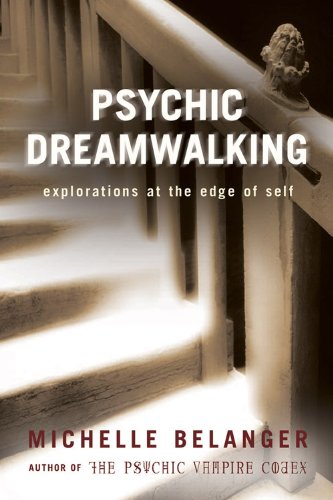
No single book ever before has brought together the history, theory and practice of dreamwalking--entering into another's dreamspace--even though you may be physically at a great distance. Michelle Belanger, the author of Psychic Vampire Codex, takes readers on an adventure into the subconscious world of dreams, territory that no amount of psychology or research has fully charted. This absorbing account, beginning with the author's own first experience of dreamwalking in a school bus as a child, both explains the phenomenon and teaches the techniques of dreamwalking. Learn to set up a dream space and a dream gate. Harness your dreaming mind to visit distant family members, pass vital messages to friends, even start secret trysts with your lover! Nobody knows exactly what happens when we dream, but practicing dreamwalking can and will open a whole new world in which the connections between ourselves and our spirit selves and others, as well as the meaning of dreams and the relationship of dreaming to other energy work and magick become clear.
Die Inhaltsangabe kann sich auf eine andere Ausgabe dieses Titels beziehen.
Über die Autorin bzw. den Autor
Michelle Belanger discovered her psychic abilities at an early age, and her affinity with psychic vampirism while in high school. She has been deeply and centrally involved in the vampire community since the early 1990s, working with many vampire luminaries as a vital part of House Kheperu. She edited and published the Gothic literary magazine Shadowdance. Belanger is a member of the Goth band URN, which performs widely in the Midwest. Belanger lives in Brunswick, Ohio.
Auszug. © Genehmigter Nachdruck. Alle Rechte vorbehalten.
PSYCHIC DREAMWALKING
explorations at the edge of self
By MICHELLE BELANGERRed Wheel/Weiser, LLC
Copyright © 2006 Michelle Belanger
All rights reserved.
ISBN: 978-1-57863-386-9All rights reserved.
Contents
| INTRODUCTION | |
| A LITTLE GIRL'S DREAM | |
| CHAPTER ONE THE STUFF OF DREAMS | |
| CHAPTER TWO EXPLORATIONS AT THE EDGE OF SELF | |
| CHAPTER THREE THE SHIFTING BOUNDARIES OF DREAM | |
| CHAPTER FOUR PREPARING THE WAY | |
| CHAPTER FIVE OPENING THE GATES OF DREAM | |
| CHAPTER SIX RIDING THE TWILIGHT | |
| CHAPTER SEVEN REMEMBERING YOUR DREAMS | |
| CHAPTER EIGHT LUCID DREAMS | |
| CHAPTER NINE INVADING THE DREAMSPACE | |
| CHAPTER TEN SEX IN THE DREAMSPACE | |
| CHAPTER ELEVEN LINES OF FLESH AND SPIRIT | |
| APPENDIX I * A BRIEF HISTORY OF DREAMS | |
| APPENDIX II * DREAM STORMS | |
| APPENDIX III * SPELLS FOR DREAMING | |
| BIBLIOGRAPHY |
CHAPTER 1
THE STUFF OF DREAMS
Dreamwalking is the art of sending forth a part of the self in order to makecontact with others through the medium of dreams. Anyone can learn how todreamwalk, and, as we explore the concept throughout this book, you will findthat most people probably already do. The trick, as with everything related toour internal, psychic worlds, is to bring this inborn talent into the realm ofconscious control.
It's nearly impossible to find written material on dreamwalking. I maintain alibrary of several thousand books, and yet I do not own a single book on thesubject. This is not for lack of trying; books on this topic simply do notexist. A survey of the Internet, moreover, is both flattering and frustrating:aside from references to Robert Jordan's Wheel of Time series, just about everyentry on dreamwalking led me back to my own work in the Codex. And yet,dreamwalking is not a technique that I invented. It existed before this book,and it existed before I ever described it in The Psychic Vampire Codex.
The lack of available information on dreamwalking exists in part because thereis no consistent nomenclature for the technique. There are accounts ofdreamwalking mixed in with experiments in astral projection, dream telepathy,and lucid dreaming, but they are rarely identified as such. Other experiences,such as deathbed visitations and even some instances of psychic attack, could beclassified as dreamwalking. Once again, however, these are rarely placed in acategory that is separate and distinct. Many occultists from the nineteenthcentury onward have written volumes on astral projection and out-of-bodyexperience, but if they address the intersection of these techniques withdreamwalking at all, it is only in passing. Of everything that has come down tous from the occult explosion of the nineteenth century, only one writer tackledthe idea of dreamwalking head-on. His name was Hugh Calloway. He is betterremembered by his pen name of Oliver Fox.
A WALK IN THE PARK
Hugh Calloway was a science and engineering student when he first began hisstudies of dreaming and the occult. Writing under the pen name Oliver Fox, hepublished a number of articles in the Occult Review and other esoteric journalsaround the beginning of the twentieth century. One afternoon, in the early1900s, Calloway proposed a curious experiment to two of his friends. Hesuggested that they attempt to arrange a meeting later that night—in theirdreams. For their meeting place, he chose Southampton Commons, a park that waswell-known to all three of them. The other two young men, recorded as Slade andElkington, agreed to make the attempt. So began one of the few recordedintentional adventures in the history of dreamwalking.
That night, Calloway dreamed of meeting with Elkington at the park. The twostayed around and chatted for some time, waiting for their third companion.Slade, however, never made an appearance. As they lingered in the dream-aspectof Southampton Commons, both Calloway and Elkington commented on Slade'sabsence. After a while, they grew tired of waiting, and left.
Calloway felt the experiment had been a success, and recorded his experiencesfor future readers. He contacted Elkington, and learned that his friend not onlyremembered dreaming of the Commons, he also recalled greeting Callowayremembered the distinct absence of Slade and how they both had commented on thisin the dream.
Slade, for his part, felt the experiment had been a failure. When Callowaycontacted him, he asserted that he had not dreamed at all that night. As far asElkington and Calloway were concerned, this explained his absence at the park.As tantalizing as this little dream rendezvous was, Calloway writes that he wasnever able to reproduce it.
The young man remembered as Oliver Fox remains one of the few occultists toexperiment with dreamwalking alongside his betterknown work on astralprojection. Most other occultists of his era preferred to explore the distantreaches of the astral plane, returning to tell vivid tales of their visits tothe Akashic Records and the hallowed halls of the Ascended Masters. In manyways, it is easier to convince readers of extended forays into the astral realmthan it is to convince them that one can travel to equally "real" places throughdreams.
But this is the fundamental premise of dreamwalking: on some level, thedreamspace is real. It is not real in the sense that the physical world it real,but it is certainly as real as the astral planes described by writers likeMadame Blavatsky and Dion Fortune. Like the astral planes, the dreamspace is asubjective reality. As much as it is a place we can go to, it is also a placethat we shape with out hopes, desires, and fears. Not all dreams lead to thisdreamspace, but the very act of dreaming opens up a gate that one can harness inorder to enter this other realm of being. Because everyone dreams, even if theydon't remember it, all of humanity can pass through the Gates of Dream and enterinto the dreamspace. Skilled dreamwalkers do this intentionally, harnessing thistwilight realm of shared imagery to communicate over long distances, reachingout to friends and family members in order to share an interaction that feels asreal and immediate as anything carried out face-to-face in the waking world.
THE GOLDEN FLEECE
In the ancient world, it was believed that the realm of dreams connected themortal world to the realm of the gods. Because of this, dreams were seen as theprimary method by which the gods communicated with mortal men. In accordancewith this belief, the kings of ancient Sumeria would ascend to the tops of theirziggurats and await a sacred dream that revealed the divine will. Some of theearliest known records of this kind of divine dreaming are clay cylinders thattell the story of King Gudea, ruler of Lagash, who sought the god Nin- Girsu indreams. The Sumerian cylinders date to about 2200 B.C.E.
In Sumeria, contact with the gods through dreams was a privilege reserved forkings. By the time of the ancient Greeks, however, it was accepted that anyonecould communicate with gods or daimons through the dreamspace. In a practicecalled "dream incubation," people would travel from all over to famous shrinesand temples, seeking answers through dreams. These ancient dream-seekers wouldsleep in special...
„Über diesen Titel“ kann sich auf eine andere Ausgabe dieses Titels beziehen.
Suchergebnisse für Psychic Dreamwalking: Explorations at the Edge of Self

Beispielbild für diese ISBN
Psychic Dreamwalking: Explorations at the Edge of Self
Anbieter: ThriftBooks-Atlanta, AUSTELL, GA, USA
Verkäuferbewertung 5 von 5 Sternen

Paperback. Zustand: Fair. No Jacket. Readable copy. Pages may have considerable notes/highlighting. ~ ThriftBooks: Read More, Spend Less. Artikel-Nr. G1578633869I5N00
Gebraucht kaufen
EUR 8,77
Versand gratis
Versand innerhalb von USA
Versand innerhalb von USA
Anzahl: 1 verfügbar
Beispielbild für diese ISBN
Psychic Dreamwalking: Explorations at the Edge of Self
Anbieter: ThriftBooks-Atlanta, AUSTELL, GA, USA
Verkäuferbewertung 5 von 5 Sternen
Paperback. Zustand: Good. No Jacket. Pages can have notes/highlighting. Spine may show signs of wear. ~ ThriftBooks: Read More, Spend Less. Artikel-Nr. G1578633869I3N00
Gebraucht kaufen
EUR 8,77
Versand gratis
Versand innerhalb von USA
Versand innerhalb von USA
Anzahl: 1 verfügbar
Beispielbild für diese ISBN
Psychic Dreamwalking: Explorations at the Edge of Self
Anbieter: World of Books (was SecondSale), Montgomery, IL, USA
Verkäuferbewertung 5 von 5 Sternen
Zustand: Acceptable. Item in acceptable condition! Textbooks may not include supplemental items i.e. CDs, access codes etc. Artikel-Nr. 00103561148
Gebraucht kaufen
EUR 8,78
Versand gratis
Versand innerhalb von USA
Versand innerhalb von USA
Anzahl: 2 verfügbar
Beispielbild für diese ISBN
Psychic Dreamwalking: Explorations at the Edge of Self
Anbieter: ThriftBooks-Dallas, Dallas, TX, USA
Verkäuferbewertung 5 von 5 Sternen
Paperback. Zustand: Fair. No Jacket. Readable copy. Pages may have considerable notes/highlighting. ~ ThriftBooks: Read More, Spend Less. Artikel-Nr. G1578633869I5N00
Gebraucht kaufen
EUR 8,79
Versand gratis
Versand innerhalb von USA
Versand innerhalb von USA
Anzahl: 1 verfügbar
Beispielbild für diese ISBN
Psychic Dreamwalking: Explorations at the Edge of Self
Anbieter: Revaluation Books, Exeter, Vereinigtes Königreich
Verkäuferbewertung 5 von 5 Sternen
Paperback. Zustand: Brand New. 205 pages. 9.00x6.00x1.00 inches. In Stock. Artikel-Nr. 1578633869
Neu kaufen
EUR 64,35
EUR 11,64 Versand
Versand von Vereinigtes Königreich nach USA
Versand von Vereinigtes Königreich nach USA
Anzahl: 1 verfügbar