
Verwandte Artikel zu Beginning Mindfulness: Learning the Way of Awareness
Inhaltsangabe
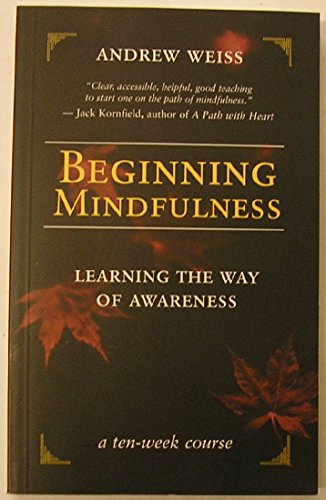
A Simple Manual That Really Works
Knowing that most people do not stop their lives to engage in spiritual practice, Buddhist teacher Andrew Weiss has always taught the direct application of practice to daily life. While also teaching sitting and walking meditation, he emphasizes mindfulness — the practice of seeing every action as an opportunity to awaken meditative inquiry. Over the years, Andrew has honed his teachings into an effective ten-week course with progressive steps and home-play assignments.
Beginning Mindfulness is intended for anyone practicing in daily life without the luxury of long meditation retreats. Weiss skillfully blends the traditions of his teachers into an easy and humorous program of learning the Buddhist art of mindfulness.
Die Inhaltsangabe kann sich auf eine andere Ausgabe dieses Titels beziehen.
Über die Autorin bzw. den Autor
Meditation teacher Andrew JiYu Weiss is ordained in both Thich Nhat Hanh’s Order of Interbeing and the White Plum Lineage of the Japanese Soto Zen tradition. Andrew is founder of the Clock Tower Sangha in Maynard, Massachusetts.
Auszug. © Genehmigter Nachdruck. Alle Rechte vorbehalten.
Beginning Mindfulness
Learning the Way of Awareness
By Andrew WeissNew World Library
Copyright © 2004 Andrew Weiss
All rights reserved.
ISBN: 978-1-57731-441-7All rights reserved.
Contents
Acknowledgments,
Introduction,
How to Use This Book,
PART ONE Beginning Mindfulness,
First Week: Getting Started,
Second Week: Going Deeper,
Third Week: Increasing Awareness,
Fourth Week: Who Am I?,
PART TWO The Four Foundations of Mindfulness,
Fifth Week: Mindfulness in the Body,
Sixth Week: Mindfulness in Feelings,
Seventh Week: Mindfulness in Thinking,
Eighth Week: Mindfulness in Objects of Mind,
PART THREE Widening the Heart,
Ninth Week: Practicing Loving-Kindness,
Tenth Week: Practicing Compassion,
PART FOUR Going On,
How to Continue,
Transforming Suffering,
The Five Mindfulness Trainings,
The Importance of Community,
True Voice,
Afterword,
Permissions Acknowledgments,
Recommended Reading,
Index,
About the Author,
CHAPTER 1
FIRST WEEK
Getting Started
The first step in starting a mindfulness practice is to establish the basic elements. These include mindfulness of breathing, sitting meditation, and daily-life mindfulness. In this chapter, you will learn how to use your breathing to establish mindfulness and increase your awareness. You will also learn the basics of sitting meditation and get suggestions for creating your own daily-life mindfulness practice. In each subsequent chapter in this section, you will build on the practices you learn here and add new ones, so by the fourth week you will have the essentials of mindfulness practice in place.
Mindfulness practice comes in two varieties: formal and informal. The formal practice is what we would normally call "meditation," for which we set aside a specific time to sit silently with mindful awareness of our breathing, or to walk slowly and silently with mindful awareness of our breath and our walking. The informal practice involves mindfulness of our daily-life activities, and is just as much "meditation" as the formal practices are. Because the heart of mindfulness practice is the enactment of mindfulness in everything in our lives, both the formal and informal practices of mindfulness are equally important. Each supports the other. Without formal practice, it is difficult to develop a deep understanding of our minds and our true nature as living beings. Formal practice gives us a controlled, simplified environment where we can encounter ourselves and the world in the present moment. Informal practice puts mindfulness into every act and increases our concentration and awareness. Without informal practice, we would develop split personalities, with one deeper level of awareness when we are doing sitting or walking meditation and another less open level of awareness at other times.
Daily Formal Practice
Doing some formal mindfulness practice every day is important. It strengthens our concentration and gives us the opportunity to do nothing and to be present in the moment. Be is the operative word here: be and not do. We all have plenty of "do-ing" in our lives, and not enough "be-ing." We need both. Not only do we encounter ourselves and the world differently when we are be-ing rather than do-ing, we also learn quickly that the secret to living well is to "be" in the center of our "do-ing." Or to put it another way, we learn that the secret to an awakened life is to be completely, deeply still, expansive and present in the heart of whatever we are doing. We stop, come to rest. Only when we can rest from our mind's constant running can we be present to this moment.
The first formal meditation practice you will learn is sitting meditation.
Sitting Meditation
Meditation teacher Arnie Kotler likes to say that sitting meditation accomplishes two things: It allows us to get to know ourselves, and it improves our concentration. Getting to know ourselves means looking deeply into our own nature and the nature of everything around us, and cultivating our willingness to allow our preconceptions about ourselves and our lives, and about everything else, to fall away. As we get to know better the true nature of our minds, we start to understand that thoughts are thoughts and feelings are feelings, and to become less invested in the drama that our thoughts and feelings can so easily create. We begin to live more gracefully.
Mindfulness meditation is not about being in a trance, or about escaping from reality. It is about waking up. We spend most of our lives caught up in the conceptual knowledge we have acquired, and in our concepts of who we are, or what our lives mean, or what a tree is or what a boulder is, and so on and on. This layer of concept sits between us and the reality of the present moment. To touch the present moment, we must allow this layer of concept to drop away. To allow this layer to drop away, we first have to be able to stop. We have to stop both body and mind. Only when our minds stop racing, only when we allow ourselves to be in one place, can we truly be present in the here and now. This is the first step we take in mindfulness meditation: We use mindfulness of breathing as a way to help us stop and truly be here. As we continue to practice mindfulness meditation, our capacity to stop and be present increases. Out of this we naturally develop deeper concentration and the capacity to look deeply into ourselves or into whatever we encounter.
This process of looking deeply is not analytical. It is spontaneous and unstudied. We don't have to figure anything out or make anything happen. All we need do is to sit, be aware of our breathing, and allow our concentration and mindfulness to penetrate whatever comes along.
In sitting meditation we begin by focusing our attention on our breathing. If we can truly be present with our in-breath and out-breath, we have stopped ourselves in the present moment, allowed our concept about what breathing is to fall away, and begun to touch the true nature of breathing. If we stay concentrated on our breathing, we will notice that our breathing changes, that no two breaths are exactly the same, and that other things, like thoughts and feelings, arise and ask for our attention. In this way we come to know ourselves, our feelings, and our minds directly, in a way that sits outside conceptual knowledge.
Posture
To do sitting meditation well, you need a good and stable posture. If you sit in a chair, sit with your back straight so that your legs are at a 90-degree angle (or as close to one as you can put them) and with your feet flat on the floor. If you are sitting on a cushion, sit with your legs crossed or in a half- lotus position (or if you are really flexible, in a full-lotus) and with your back straight. It is helpful to have the cushion tilt your buttocks forward slightly to stabilize the base of your spine. Please do not lean against the back of a chair or against a wall, because if you do, you are likely to go to sleep.
Your arms should be near, but not touching, your sides. Make sure you are not pressing against your chest; this will inhibit your breathing. Your chin should be slightly tucked in. Your hands can be in any comfortable posture.
You can close your eyes during sitting meditation, or if you wish, you can keep them slightly open, with your gaze adjusted to about a 45-degree angle and directed at the floor in front of you. If you keep your eyes open, here are two...
„Über diesen Titel“ kann sich auf eine andere Ausgabe dieses Titels beziehen.
Suchergebnisse für Beginning Mindfulness: Learning the Way of Awareness

Beispielbild für diese ISBN
Beginning Mindfulness: Learning the Way of Awareness
Anbieter: World of Books (was SecondSale), Montgomery, IL, USA
Verkäuferbewertung 5 von 5 Sternen

Paperback. Zustand: Fair. A Simple Manual That Really Works Knowing that most people do not stop their lives to engage in spiritual practice, Buddhist teacher Andrew Weiss has always taught the direct application of practice to daily life. While also teaching sitting and walking meditation, he emphasizes mindfulness -- the practice of seeing every action as an opportunity to awaken meditative inquiry. Over the years, Andrew has honed his teachings into an effective ten-week course with progressive steps and home-play assignments. Beginning Mindfulness is intended for anyone practicing in daily life without the luxury of long meditation retreats. Weiss skillfully blends the traditions of his teachers into an easy and humorous program of learning the Buddhist art of mindfulness. Artikel-Nr. 00101317914
Gebraucht kaufen
EUR 4,22
Versand gratis
Versand innerhalb von USA
Versand innerhalb von USA
Anzahl: 3 verfügbar
Beispielbild für diese ISBN
Beginning Mindfulness: Learning the Way of Awareness
Anbieter: World of Books (was SecondSale), Montgomery, IL, USA
Verkäuferbewertung 5 von 5 Sternen
Paperback. Zustand: Good. A Simple Manual That Really Works Knowing that most people do not stop their lives to engage in spiritual practice, Buddhist teacher Andrew Weiss has always taught the direct application of practice to daily life. While also teaching sitting and walking meditation, he emphasizes mindfulness -- the practice of seeing every action as an opportunity to awaken meditative inquiry. Over the years, Andrew has honed his teachings into an effective ten-week course with progressive steps and home-play assignments. Beginning Mindfulness is intended for anyone practicing in daily life without the luxury of long meditation retreats. Weiss skillfully blends the traditions of his teachers into an easy and humorous program of learning the Buddhist art of mindfulness. Artikel-Nr. 00096403311
Gebraucht kaufen
EUR 4,22
Versand gratis
Versand innerhalb von USA
Versand innerhalb von USA
Anzahl: 6 verfügbar
Beispielbild für diese ISBN
Beginning Mindfulness: Learning the Way of Awareness
Anbieter: World of Books (was SecondSale), Montgomery, IL, USA
Verkäuferbewertung 5 von 5 Sternen
Paperback. Zustand: Very Good. A Simple Manual That Really Works Knowing that most people do not stop their lives to engage in spiritual practice, Buddhist teacher Andrew Weiss has always taught the direct application of practice to daily life. While also teaching sitting and walking meditation, he emphasizes mindfulness -- the practice of seeing every action as an opportunity to awaken meditative inquiry. Over the years, Andrew has honed his teachings into an effective ten-week course with progressive steps and home-play assignments. Beginning Mindfulness is intended for anyone practicing in daily life without the luxury of long meditation retreats. Weiss skillfully blends the traditions of his teachers into an easy and humorous program of learning the Buddhist art of mindfulness. Artikel-Nr. 00098370320
Gebraucht kaufen
EUR 4,22
Versand gratis
Versand innerhalb von USA
Versand innerhalb von USA
Anzahl: 4 verfügbar
Beispielbild für diese ISBN
Beginning Mindfulness: Learning the Way of Awareness
Verlag:
New World Library (edition ), 2004
ISBN 10: 1577314417
ISBN 13: 9781577314417
Gebraucht
Paperback
Anbieter: BooksRun, Philadelphia, PA, USA
Verkäuferbewertung 5 von 5 Sternen
Paperback. Zustand: Fair. The item might be beaten up but readable. May contain markings or highlighting, as well as stains, bent corners, or any other major defect, but the text is not obscured in any way. Artikel-Nr. 1577314417-7-1
Gebraucht kaufen
EUR 4,40
Versand gratis
Versand innerhalb von USA
Versand innerhalb von USA
Anzahl: 1 verfügbar
Beispielbild für diese ISBN
Beginning Mindfulness: Learning the Way of Awareness
Verlag:
New World Library (edition ), 2004
ISBN 10: 1577314417
ISBN 13: 9781577314417
Gebraucht
Paperback
Anbieter: BooksRun, Philadelphia, PA, USA
Verkäuferbewertung 5 von 5 Sternen
Paperback. Zustand: Very Good. It's a well-cared-for item that has seen limited use. The item may show minor signs of wear. All the text is legible, with all pages included. It may have slight markings and/or highlighting. Artikel-Nr. 1577314417-11-1
Gebraucht kaufen
EUR 4,60
Versand gratis
Versand innerhalb von USA
Versand innerhalb von USA
Anzahl: 1 verfügbar
Beispielbild für diese ISBN
Beginning Mindfulness: Learning the Way of Awareness: A Ten Week Course
Anbieter: ThriftBooks-Dallas, Dallas, TX, USA
Verkäuferbewertung 5 von 5 Sternen
Paperback. Zustand: Very Good. No Jacket. May have limited writing in cover pages. Pages are unmarked. ~ ThriftBooks: Read More, Spend Less. Artikel-Nr. G1577314417I4N00
Gebraucht kaufen
EUR 5,98
Versand gratis
Versand innerhalb von USA
Versand innerhalb von USA
Anzahl: 1 verfügbar
Beispielbild für diese ISBN
Beginning Mindfulness: Learning the Way of Awareness: A Ten Week Course
Anbieter: ThriftBooks-Atlanta, AUSTELL, GA, USA
Verkäuferbewertung 5 von 5 Sternen
Paperback. Zustand: Very Good. No Jacket. May have limited writing in cover pages. Pages are unmarked. ~ ThriftBooks: Read More, Spend Less. Artikel-Nr. G1577314417I4N00
Gebraucht kaufen
EUR 5,98
Versand gratis
Versand innerhalb von USA
Versand innerhalb von USA
Anzahl: 1 verfügbar
Beispielbild für diese ISBN
Beginning Mindfulness: Learning the Way of Awareness: A Ten Week Course
Anbieter: ThriftBooks-Phoenix, Phoenix, AZ, USA
Verkäuferbewertung 5 von 5 Sternen
Paperback. Zustand: Very Good. No Jacket. May have limited writing in cover pages. Pages are unmarked. ~ ThriftBooks: Read More, Spend Less. Artikel-Nr. G1577314417I4N00
Gebraucht kaufen
EUR 5,98
Versand gratis
Versand innerhalb von USA
Versand innerhalb von USA
Anzahl: 1 verfügbar
Beispielbild für diese ISBN
Beginning Mindfulness: Learning the Way of Awareness: A Ten Week Course
Anbieter: ThriftBooks-Reno, Reno, NV, USA
Verkäuferbewertung 5 von 5 Sternen
Paperback. Zustand: Very Good. No Jacket. May have limited writing in cover pages. Pages are unmarked. ~ ThriftBooks: Read More, Spend Less. Artikel-Nr. G1577314417I4N00
Gebraucht kaufen
EUR 5,98
Versand gratis
Versand innerhalb von USA
Versand innerhalb von USA
Anzahl: 1 verfügbar
Beispielbild für diese ISBN
Beginning Mindfulness : Learning the Way of Awareness
Anbieter: Better World Books, Mishawaka, IN, USA
Verkäuferbewertung 5 von 5 Sternen
Zustand: Good. Pages intact with minimal writing/highlighting. The binding may be loose and creased. Dust jackets/supplements are not included. Stock photo provided. Product includes identifying sticker. Better World Books: Buy Books. Do Good. Artikel-Nr. 4992475-6
Gebraucht kaufen
EUR 6,20
Versand gratis
Versand innerhalb von USA
Versand innerhalb von USA
Anzahl: 1 verfügbar