
Verwandte Artikel zu Learning Their Language: Intuitive Communication with...
Inhaltsangabe
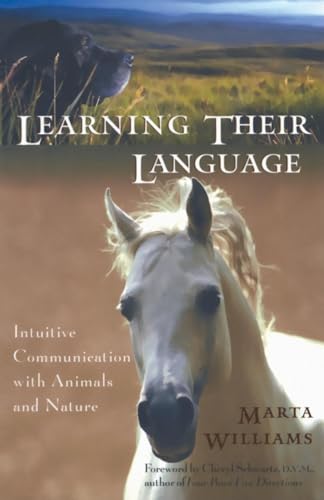
Forget about whispering to horses, our author knows their language and talks to them. Almost everyone has had a moment when they felt a connection to an animal, almost as if they were communicating. According to animal communicator and author Marta Williams, they probably were. Over the past 13 years, Marta has worked with clients (people and the animals in their lives) to resolve behavior and training problems, find lost animals, assist animals that are ill or dying, and help animals get along with each other. Her human clients have contacted her from all parts of the globe, and her animal clients have included horses, dogs, and cats. In the course of her work, she has come to believe that anyone can learn to communicate with animals and with nature, and this inviting book teaches readers how they can use techniques and exercises to tune in and learn this language.
Die Inhaltsangabe kann sich auf eine andere Ausgabe dieses Titels beziehen.
Auszug. © Genehmigter Nachdruck. Alle Rechte vorbehalten.
Learning Their Language
Intuitive Communication with Animals and Nature
By Marta WilliamsNew World Library
Copyright © 2003 Marta Williams
All rights reserved.
ISBN: 978-1-57731-243-7All rights reserved.
Contents
Acknowledgments,
Foreword by Cheryl Schwartz, D.V.M.,
Author's Note to Text,
Introduction: All Our Relations,
Part One The World of Intuitive Communication,
1. How I Learned to Communicate Intuitively,
2. Intuition: The Hidden Ability,
3. Using Your Intuition to Communicate Nonverbally,
4. Accuracy and Verification,
Part Two Getting Started,
5. A New Way of Talking,
6. Basic Techniques for Receiving Information Intuitively,
7. The Critic Within,
Part Three Advanced Techniques,
8. Better Reception,
9. Practice, Practice,
Part Four Practical Applications,
10. Talking with Your Own Animals,
11. Past, Present, and Future,
12. In Sickness and in Health,
13. Lost Animals,
Part Five Communicating with Nature,
14. The World's Wildlife,
15. Plants and the Landscape,
16. Collaborating with the Earth,
Answer Key,
Chapter Notes,
Suggested Reading,
Resources,
Index,
About the Author,
CHAPTER 1
How I Learned to Communicate Intuitively
I did not grow up consciously able to talk intuitively with animals. I learned how to do this by studying and practicing, just as you can. I don't believe that I have any more innate talent for it than you do. For more than a decade, I've taught classes in intuitive communication, and I have yet to meet someone who was incapable of learning. The only difference between me and a beginning student, is the amount of time I've spent practicing and researching.
I have, however, been concerned about animals and nature for as long as I can remember, which led to my pursuit of an undergraduate degree in resource conservation at the University of California, Berkeley. While in college, I developed a severe back problem. It was so bad that I had to take a break from school. Rather than getting back surgery, I sought out noninvasive alternative therapies, which put me in touch with a different crowd than I was meeting in my university classes. Had I not been exposed to alternative forms of healing — bodyworkers, psychic healers, and the like — I might not have been so accepting of the idea of intuitive communication when I encountered it later on.
At one of the healing workshops I attended, something happened that changed my life: I learned about the work of J. Allen Boone. One of the people at the workshop suggested that I read Boone's book, Kinship with All Life. When I went looking for the book, I found that it was out of print. I finally located a dusty original hardbound copy in the stacks of a public library. The inside back cover indicated that it had last been checked out in 1954. Boone's books have since been reprinted and are available in most bookstores, but back then few people seemed to know of him.
Reading this book changed my whole perspective on what was real and possible. In his book, Boone told how he came to know a famous Hollywood German shepherd dog named Strongheart. Boone had been asked to take care of the dog for several months. During that time, he realized that Strongheart was far more intelligent than he was, and furthermore that Strongheart understood everything Boone said, felt, or thought. With this insight, Boone set out to hear responses back from Strongheart so that they could converse — and he succeeded. The book is elegant and convincing, but no one would ever be able to figure out Boone's technique from his book. Even so, he persuaded me that intuitive communication was real. Up until that point I knew it only as an intriguing daydream and the subject of some of my favorite science fiction novels.
One thing I found compelling about Boone was that he voiced an ethic and a philosophy that I was not seeing reflected anywhere in society. Boone talked about the equality of all living beings and advised that all life, regardless of its form, would respond favorably to our genuine interest and respect. To Boone, there were no communication boundaries between one life form and another; the silent language he discovered with Strongheart had the power to unite us all.
After I finished my studies at Berkeley, I worked as a director of wildlife rehabilitation clinics for about five years. Even though this was important work, and it was fantastic to interact with wild animals every day, I worried about the problems facing the animals and the earth, and wanted to help in a more significant way. Hoping that I could have a greater impact as a professional scientist, I earned an M.S. degree in biology at San Francisco State University. I conducted my thesis research at the U.S. Fish and Wildlife Kesterson Reservoir in central California, studying the harmful effects of chemical residues from agricultural runoff on birds' reproductive systems. Many birds in the Kesterson refuge were born disfigured, and none of the juveniles survived to adulthood.
After graduate school, I went to work in the field of environmental regulation and restoration, conducting audits, hazardous-waste site clean-ups, and habitat restoration projects. This work was worthwhile too, but I still felt like I wasn't doing enough, or wasn't doing the right thing. My work as an environmental scientist seemed to be too little, too late. In my free time, I was an environmental activist (and still am), but even that felt inadequate.
In the late 1980s, I decided to go on a vision quest. I had been reading and hearing a lot about impending changes to the earth's climate and ecology, caused by human activity. The Hopi prophecies for our time suggested that if people could experience a shift in consciousness and reconnect with animals, nature, and spirit, much of the predicted destruction could be avoided. I started thinking about how such a connection could be encouraged in the modern world. I decided to go on the vision quest to ask to be shown the best way for me to help this change come about.
During the trip to the vision quest site in the White Mountains in California, the trip leaders told me about a woman in my region who offered classes in animal communication. I became very intrigued by the idea that I could actually study and learn how to do this. Throughout my time in the desert, I could not stop thinking about it. I had the feeling I was being led to do this.
As soon as I returned from the vision quest, I signed up for classes and started reading everything I could find on the subject of animal communication. I soon realized that this pursuit was not going to be that easy. In fact, I had a hard time learning to do animal communication, mainly because I believed that I was making things up, and therefore I felt like a failure.
It didn't help that whenever I told people outside of the animal communication classes what I was doing, their reactions were negative and guarded. At that time, in the late 1980s, most people regarded intuitive communication with animals as unintelligent nonsense. As a scientist, I was accustomed to being taken seriously, not ridiculed. In addition to regaining the actual skill of intuitive communication, I had to learn how to deal with the taboos associated with this field and to remain confident in the face of doubt and disbelief from those around me. I now see that process as having been immensely valuable; I had to learn to trust my own truth in...
„Über diesen Titel“ kann sich auf eine andere Ausgabe dieses Titels beziehen.
Suchergebnisse für Learning Their Language: Intuitive Communication with...

Beispielbild für diese ISBN
Learning Their Language: Intui
Anbieter: World of Books (was SecondSale), Montgomery, IL, USA
Verkäuferbewertung 5 von 5 Sternen

Zustand: Acceptable. Item in acceptable condition! Textbooks may not include supplemental items i.e. CDs, access codes etc. Artikel-Nr. 00106453660
Gebraucht kaufen
EUR 4,99
Versand gratis
Versand innerhalb von USA
Versand innerhalb von USA
Anzahl: 2 verfügbar
Beispielbild für diese ISBN
Learning Their Language: Intuitive Communication with Animals and Nature
Anbieter: World of Books (was SecondSale), Montgomery, IL, USA
Verkäuferbewertung 5 von 5 Sternen
Paperback. Zustand: Good. Forget about whispering to horses, our author knows their language and talks to them. Almost everyone has had a moment when they felt a connection to an animal, almost as if they were communicating. According to animal communicator and author Marta Williams, they probably were. Over the past 13 years, Marta has worked with clients (people and the animals in their lives) to resolve behavior and training problems, find lost animals, assist animals that are ill or dying, and help animals get along with each other. Her human clients have contacted her from all parts of the globe, and her animal clients have included horses, dogs, and cats. In the course of her work, she has come to believe that anyone can learn to communicate with animals and with nature, and this inviting book teaches readers how they can use techniques and exercises to tune in and learn this language. Artikel-Nr. 00090758382
Gebraucht kaufen
EUR 4,99
Versand gratis
Versand innerhalb von USA
Versand innerhalb von USA
Anzahl: 7 verfügbar
Beispielbild für diese ISBN
Learning Their Language: Intuitive Communication with Animals and Nature
Verlag:
New World Library (edition 7th Printing), 2003
ISBN 10: 1577312430
ISBN 13: 9781577312437
Gebraucht
Paperback
Anbieter: BooksRun, Philadelphia, PA, USA
Verkäuferbewertung 5 von 5 Sternen
Paperback. Zustand: Very Good. 7th Printing. It's a well-cared-for item that has seen limited use. The item may show minor signs of wear. All the text is legible, with all pages included. It may have slight markings and/or highlighting. Artikel-Nr. 1577312430-11-6
Gebraucht kaufen
EUR 5,00
Versand gratis
Versand innerhalb von USA
Versand innerhalb von USA
Anzahl: 1 verfügbar
Beispielbild für diese ISBN
Learning Their Language: Intuitive Communication with Animals and Nature
Anbieter: ThriftBooks-Reno, Reno, NV, USA
Verkäuferbewertung 5 von 5 Sternen
Paperback. Zustand: Good. No Jacket. Pages can have notes/highlighting. Spine may show signs of wear. ~ ThriftBooks: Read More, Spend Less. Artikel-Nr. G1577312430I3N00
Gebraucht kaufen
EUR 6,00
Versand gratis
Versand innerhalb von USA
Versand innerhalb von USA
Anzahl: 1 verfügbar
Beispielbild für diese ISBN
Learning Their Language: Intuitive Communication with Animals and Nature
Anbieter: ThriftBooks-Phoenix, Phoenix, AZ, USA
Verkäuferbewertung 5 von 5 Sternen
Paperback. Zustand: Good. No Jacket. Pages can have notes/highlighting. Spine may show signs of wear. ~ ThriftBooks: Read More, Spend Less. Artikel-Nr. G1577312430I3N00
Gebraucht kaufen
EUR 6,00
Versand gratis
Versand innerhalb von USA
Versand innerhalb von USA
Anzahl: 1 verfügbar
Beispielbild für diese ISBN
Learning Their Language: Intuitive Communication with Animals and Nature
Anbieter: ThriftBooks-Atlanta, AUSTELL, GA, USA
Verkäuferbewertung 5 von 5 Sternen
Paperback. Zustand: Very Good. No Jacket. May have limited writing in cover pages. Pages are unmarked. ~ ThriftBooks: Read More, Spend Less. Artikel-Nr. G1577312430I4N00
Gebraucht kaufen
EUR 6,21
Versand gratis
Versand innerhalb von USA
Versand innerhalb von USA
Anzahl: 1 verfügbar
Beispielbild für diese ISBN
Learning Their Language: Intuitive Communication with Animals and Nature
Anbieter: ThriftBooks-Atlanta, AUSTELL, GA, USA
Verkäuferbewertung 5 von 5 Sternen
Paperback. Zustand: Good. No Jacket. Pages can have notes/highlighting. Spine may show signs of wear. ~ ThriftBooks: Read More, Spend Less. Artikel-Nr. G1577312430I3N00
Gebraucht kaufen
EUR 6,21
Versand gratis
Versand innerhalb von USA
Versand innerhalb von USA
Anzahl: 1 verfügbar
Beispielbild für diese ISBN
Learning Their Language: Intuitive Communication with Animals and Nature
Anbieter: ThriftBooks-Dallas, Dallas, TX, USA
Verkäuferbewertung 5 von 5 Sternen
Paperback. Zustand: Very Good. No Jacket. May have limited writing in cover pages. Pages are unmarked. ~ ThriftBooks: Read More, Spend Less. Artikel-Nr. G1577312430I4N00
Gebraucht kaufen
EUR 6,21
Versand gratis
Versand innerhalb von USA
Versand innerhalb von USA
Anzahl: 1 verfügbar
Beispielbild für diese ISBN
Learning Their Language: Intuitive Communication with Animals and Nature
Anbieter: ThriftBooks-Dallas, Dallas, TX, USA
Verkäuferbewertung 5 von 5 Sternen
Paperback. Zustand: Good. No Jacket. Pages can have notes/highlighting. Spine may show signs of wear. ~ ThriftBooks: Read More, Spend Less. Artikel-Nr. G1577312430I3N00
Gebraucht kaufen
EUR 6,21
Versand gratis
Versand innerhalb von USA
Versand innerhalb von USA
Anzahl: 1 verfügbar
Beispielbild für diese ISBN
Learning Their Language: Intuitive Communication with Animals and Nature
Anbieter: ThriftBooks-Atlanta, AUSTELL, GA, USA
Verkäuferbewertung 5 von 5 Sternen
Paperback. Zustand: Fair. No Jacket. Readable copy. Pages may have considerable notes/highlighting. ~ ThriftBooks: Read More, Spend Less. Artikel-Nr. G1577312430I5N00
Gebraucht kaufen
EUR 6,21
Versand gratis
Versand innerhalb von USA
Versand innerhalb von USA
Anzahl: 1 verfügbar