
Verwandte Artikel zu Authentic Conversations: Moving from Manipulation to...
Inhaltsangabe
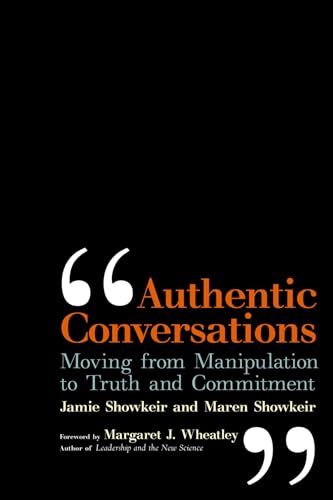
In this groundbreaking new book, Jamie and Maren Showkeir take something people typically think of as merely functional—ordinary conversation—and show how it can lead to a workforce that is engaged and energized or to one that is alienated and uninspired. All too often workplace conversations create what the authors call parent-child relationships. People hide facts, sugarcoat reality, and claim helplessness to try to control the interaction and get what they want. The Showkeirs demonstrate how we can move to honest and authentic interactions: adult conversations that create increased commitment, true accountability, and improved business performance. They offer examples of parent-child and adult-adult workplace conversations in a variety of settings and provide a hands-on guide, including sample scripts, for dealing with a host of potentially difficult conversations.
Die Inhaltsangabe kann sich auf eine andere Ausgabe dieses Titels beziehen.
Über die Autorin bzw. den Autor
James and Maren Showkeir are principals of henning-showkeir & associates, inc., whose clients include 3M, Ford Motor Company, Kaiser Permanente, British Airways, Coca-Cola, Hewlett-Packard, Levi Strauss, the Greenleaf Center for Servant-Leadership, and the Nature Conservancy.
James and Maren Showkeir are principals of henning-showkeir & associates, inc., whose clients include 3M, Ford Motor Company, Kaiser Permanente, British Airways, Coca-Cola, Hewlett-Packard, Levi Strauss, the Greenleaf Center for Servant-Leadership, and the Nature Conservancy.
Auszug. © Genehmigter Nachdruck. Alle Rechte vorbehalten.
“The Dangerous Book for Adults”
We were consulting with a large East Coast newspaper grappling with a multimillion-dollar shortfall and the plagues of the industry in general: declining circulation, shrinking advertising revenue, and increasing newsprint prices. The problems of this newspaper were compounded by changes in the region’s demographics, which raised questions about whether the paper’s content was relevant to the readers in their market. Layoffs seemed inevitable. Hundreds were likely to lose their jobs.
In preparation for a large group meeting about the crisis, we followed the publisher for an entire day as he met with small groups of employees from advertising, circulation, production, and the newsroom. Everyone asked similar questions: “What are you going to do about this crisis, Joe? How are you going to fix it?” They complained about being unable to be productive because they were so stressed about the possibility of losing their jobs. They angrily told Joe they blamed him and other senior managers for “getting us into this mess” and demanded to know what he was going to do about it.
Joe encouraged the employees to focus on the long term. “We will get reestablished,” he assured them. “We will develop new strategies to build circulation and advertising. We will find ways to make our stories more relevant to readers. We are negotiating with corporate for leniency regarding the profit demands.” All day long, we heard him give one reassuring message after another: “Don’t worry, I’m going to make you safe. Don’t worry, senior leaders will take care of it.”
Joe was a bright, capable, and caring man. He was passionate about his job and committed to his employees. He wanted to do the right things. But in our estimation, he was saying all the wrong things. His conversations were making the situation worse. By making promises he couldn’t possibly keep and sending a message to employees that they were off the hook for resolving a difficult situation, he was exacerbating the problems the company faced.
We gave him our frank assessment of the damage he had been doing. Joe, obviously taken aback, was thoughtful and silent as he contemplated our feedback.
We’ll get back to Joe’s story, but first let’s look at why we paid such close attention to the conversations he was having with the newspaper’s employees.
Conversations Create Culture
James A. Autry, businessman, author, and poet, says, “We do make things true by what we say.… Things and people are what we call them, because in the simplest terms, we are what we say, and others are what we say about them.”
Simply put, a conversation is an exchange between two or more individuals, but that simple definition obscures a conversation’s complexity. Words and language are powerful tools, and conversations are so commonplace in our daily lives that we don’t pause to contemplate their inherent power.
First, conversations reveal what we see in the world and what meaning we attach to what we see. Second, as Autry says, we name things and create reality. Third, we invite others to see what we see, the way we see it. And fourth, through conversations we either sustain or change the meaning of what we see. All these things play a commanding role in creating and defining an organization’s culture.
The term “culture” refers to the universal capacity that human beings have to classify, codify, and communicate their experiences symbolically. In other words, culture dictates our beliefs, behavior, language, and social interaction. Nonverbal communication and unwritten rules play a large role here.
Edgar Schein, a professor at the MIT Sloan School for management and the man credited with coining the term “corporate culture,” talks about culture as being a pattern of shared basic assumptions. Schein defined organizational culture as “the specific collection of values and norms that are shared by people and groups in an organization and that control the way they interact with each other and with stakeholders outside the organization.” He wrote that these norms “prescribe appropriate behavior by employees and control the behavior of organizational members towards one another.”
Culture tells us what is acceptable and unacceptable. It alerts us to whether it is okay to show up a little late for a meeting, how we should be dressed when we arrive, and whether bringing up difficult issues in the room will be viewed favorably. It influences how we treat each other, talk to each other, and is a factor in the way we view and interact with our coworkers and customers.
Culture shows up as a similarity in the way people behave at work, regardless of their rank, title, or serial number. As Margaret J. Wheatley writes in Leadership and the New Science, “I am often struck by eerily similar behaviors exhibited by people in an organization, whether I’m meeting with a factory floor employee or a senior executive. I might detect a recurring penchant for secrecy or for openness, for name-calling or for thoughtfulness. These recurring patterns of behavior are what many call the culture of an organization.”
Changing the Culture Requires New Conversations
The overarching creators and carriers of an organization’s culture are the conversations in which the members of that organization engage. The ways people see and talk about things such as cynicism, hope, helplessness, and resourcefulness, their customers, and the work itself reflect organizational culture. Statements about the culture are seen in what we say as well as through our behavior. Culture influences decisions such as whether to share or withhold information, whether it’s more important to defer to a person’s position instead of authentically stating a point of view, and whether we see our coworkers as collaborators or competitors.
In an organization where power is concentrated at the top, compliance is highly valued, and parent–child roles are established, the cultural norm looks like this: “When my boss tells me to do something, even if it doesn’t make sense to me, I don’t push back. Dissent marks me as uncooperative and threatens my future.” Or “When my morale is low, it is management’s job to figure out what’s wrong, find the solution, and implement changes. People’s unhappiness is a statement of faulty leadership.”
In an organization where business literacy, choice, and accountability are distributed widely and deeply, where flexibility and innovation are highly valued and the dominant roles are adult–adult, the culture norm is “When I see something is wrong, I want to attend to it. I am expected to attend to it and I am accountable for doing so. My boss and coworkers expect me to push back and challenge their thinking. Dissent and accountability are the lubricants of this organization.”
Conversation is the primary way of learning and sharing cultural norms, especially those ways that are informal and implicit. Messages are transmitted both in the words we use and in the relationship dynamics that drive how we talk to each other.
For this reason, common workplace conversations can sabotage any attempt at significant organizational change. How we talk to each other in business settings and the way we deliberate decisions are revealing. In addition, some of the most powerful conversations take place outside the boardrooms, the auditoriums, and the meeting rooms. They happen in restrooms, coffee rooms, during smoke breaks, in people’s offices, on the assembly line, and during chance...
„Über diesen Titel“ kann sich auf eine andere Ausgabe dieses Titels beziehen.
Suchergebnisse für Authentic Conversations: Moving from Manipulation to...

Beispielbild für diese ISBN
Authentic Conversations: Moving from Manipulation to Truth and Commitment
Anbieter: World of Books (was SecondSale), Montgomery, IL, USA
Verkäuferbewertung 5 von 5 Sternen

Paperback. Zustand: Good. In this groundbreaking new book, Jamie and Maren Showkeir take something people typically think of as merely functional-ordinary conversation-and show how it can lead to a workforce that is engaged and energized or to one that is alienated and uninspired. All too often workplace conversations create what the authors call parent-child relationships. People hide facts, sugarcoat reality, and claim helplessness to try to control the interaction and get what they want. The Showkeirs demonstrate how we can move to honest and authentic interactions: adult conversations that create increased commitment, true accountability, and improved business performance. They offer examples of parent-child and adult-adult workplace conversations in a variety of settings and provide a hands-on guide, including sample scripts, for dealing with a host of potentially difficult conversations. Artikel-Nr. 00084753942
Gebraucht kaufen
EUR 4,09
Versand gratis
Versand innerhalb von USA
Versand innerhalb von USA
Anzahl: 4 verfügbar
Beispielbild für diese ISBN
Authentic Conversations: Moving from Manipulation to Truth and Commitment
Verlag:
Berrett-Koehler Publishers (edition 1), 2008
ISBN 10: 1576755959
ISBN 13: 9781576755952
Gebraucht
Paperback
Anbieter: BooksRun, Philadelphia, PA, USA
Verkäuferbewertung 5 von 5 Sternen
Paperback. Zustand: Very Good. 1. It's a well-cared-for item that has seen limited use. The item may show minor signs of wear. All the text is legible, with all pages included. It may have slight markings and/or highlighting. Artikel-Nr. 1576755959-11-1
Gebraucht kaufen
EUR 5,28
Versand gratis
Versand innerhalb von USA
Versand innerhalb von USA
Anzahl: 1 verfügbar
Beispielbild für diese ISBN
Authentic Conversations: Moving from Manipulation to Truth and Commitment
Verlag:
Berrett-Koehler Publishers, 2008
ISBN 10: 1576755959
ISBN 13: 9781576755952
Gebraucht
Paperback
Anbieter: ThriftBooks-Dallas, Dallas, TX, USA
Verkäuferbewertung 5 von 5 Sternen
Paperback. Zustand: As New. No Jacket. Pages are clean and are not marred by notes or folds of any kind. ~ ThriftBooks: Read More, Spend Less. Artikel-Nr. G1576755959I2N00
Gebraucht kaufen
EUR 5,97
Versand gratis
Versand innerhalb von USA
Versand innerhalb von USA
Anzahl: 1 verfügbar
Beispielbild für diese ISBN
Authentic Conversations : Moving from Manipulation to Truth and Commitment
Verlag:
Berrett-Koehler Publishers, Incorporated, 2008
ISBN 10: 1576755959
ISBN 13: 9781576755952
Gebraucht
Softcover
Erstausgabe
Anbieter: Better World Books: West, Reno, NV, USA
Verkäuferbewertung 5 von 5 Sternen
Zustand: Very Good. 1st Edition. Former library copy. Pages intact with possible writing/highlighting. Binding strong with minor wear. Dust jackets/supplements may not be included. Includes library markings. Stock photo provided. Product includes identifying sticker. Better World Books: Buy Books. Do Good. Artikel-Nr. 11725712-6
Gebraucht kaufen
EUR 6,16
Versand gratis
Versand innerhalb von USA
Versand innerhalb von USA
Anzahl: 1 verfügbar
Beispielbild für diese ISBN
Authentic Conversations : Moving from Manipulation to Truth and Commitment
Verlag:
Berrett-Koehler Publishers, Incorporated, 2008
ISBN 10: 1576755959
ISBN 13: 9781576755952
Gebraucht
Softcover
Erstausgabe
Anbieter: Better World Books, Mishawaka, IN, USA
Verkäuferbewertung 5 von 5 Sternen
Zustand: Very Good. 1st Edition. Former library copy. Pages intact with possible writing/highlighting. Binding strong with minor wear. Dust jackets/supplements may not be included. Includes library markings. Stock photo provided. Product includes identifying sticker. Better World Books: Buy Books. Do Good. Artikel-Nr. 11725712-6
Gebraucht kaufen
EUR 6,16
Versand gratis
Versand innerhalb von USA
Versand innerhalb von USA
Anzahl: 1 verfügbar
Beispielbild für diese ISBN
Authentic Conversations: Moving from Manipulation to Truth and Commitment
Verlag:
Berrett-Koehler Publishers, 2008
ISBN 10: 1576755959
ISBN 13: 9781576755952
Gebraucht
Softcover
Signiert
Anbieter: Wonder Book, Frederick, MD, USA
Verkäuferbewertung 5 von 5 Sternen
Zustand: Good. Signed Copy . Signed by both authors on title page. Front cover creased. Artikel-Nr. B18OSa-00029
Gebraucht kaufen
EUR 6,40
Versand gratis
Versand innerhalb von USA
Versand innerhalb von USA
Anzahl: 1 verfügbar
Beispielbild für diese ISBN
Authentic Conversations: Moving from Manipulation to Truth and Commitment
Verlag:
Berrett-Koehler Publishers, 2008
ISBN 10: 1576755959
ISBN 13: 9781576755952
Gebraucht
Softcover
Anbieter: Wonder Book, Frederick, MD, USA
Verkäuferbewertung 5 von 5 Sternen
Zustand: Good. Good condition. A copy that has been read but remains intact. May contain markings such as bookplates, stamps, limited notes and highlighting, or a few light stains. Artikel-Nr. M09E-01212
Gebraucht kaufen
EUR 6,40
Versand gratis
Versand innerhalb von USA
Versand innerhalb von USA
Anzahl: 1 verfügbar
Beispielbild für diese ISBN
Authentic Conversations: Moving from Manipulation to Truth and Commitment
Verlag:
Berrett-Koehler Publishers, 2008
ISBN 10: 1576755959
ISBN 13: 9781576755952
Gebraucht
Softcover
Anbieter: Wonder Book, Frederick, MD, USA
Verkäuferbewertung 5 von 5 Sternen
Zustand: Good. Good condition. A copy that has been read but remains intact. May contain markings such as bookplates, stamps, limited notes and highlighting, or a few light stains. Bundled media such as CDs, DVDs, floppy disks or access codes may not be included. Artikel-Nr. I02M-00743
Gebraucht kaufen
EUR 6,40
Versand gratis
Versand innerhalb von USA
Versand innerhalb von USA
Anzahl: 1 verfügbar
Beispielbild für diese ISBN
Authentic Conversations: Moving from Manipulation to Truth and Commitment
Verlag:
Berrett-Koehler Publishers, 2008
ISBN 10: 1576755959
ISBN 13: 9781576755952
Gebraucht
Paperback
Anbieter: WorldofBooks, Goring-By-Sea, WS, Vereinigtes Königreich
Verkäuferbewertung 5 von 5 Sternen
Paperback. Zustand: Very Good. The book has been read, but is in excellent condition. Pages are intact and not marred by notes or highlighting. The spine remains undamaged. Artikel-Nr. GOR007381449
Gebraucht kaufen
EUR 8,87
EUR 6,59 Versand
Versand von Vereinigtes Königreich nach USA
Versand von Vereinigtes Königreich nach USA
Anzahl: 1 verfügbar
Beispielbild für diese ISBN
Authentic Conversations: Moving from Manipulation to Truth and Commitment
Verlag:
Berrett-Koehler Publishers, Incorporated, 2008
ISBN 10: 1576755959
ISBN 13: 9781576755952
Neu
Softcover
Anbieter: Majestic Books, Hounslow, Vereinigtes Königreich
Verkäuferbewertung 4 von 5 Sternen

Zustand: New. pp. 240. Artikel-Nr. 6675384
Neu kaufen
EUR 23,90
EUR 7,65 Versand
Versand von Vereinigtes Königreich nach USA
Versand von Vereinigtes Königreich nach USA
Anzahl: 1 verfügbar