
Verwandte Artikel zu Something to Live For: Finding Your Way in the Second...
Inhaltsangabe
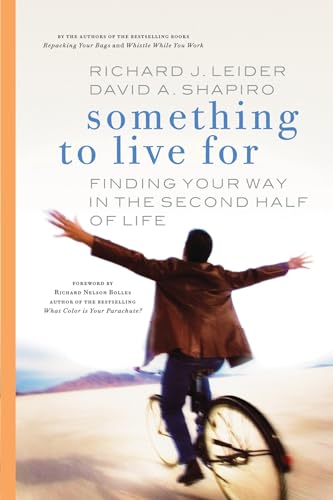
Using a compilation of stories, two authors reflect on how to find meaning and purpose in the second half of your life.
Drawing on ancient and contemporary wisdom, as well as modern research, Richard Leider and David Shapiro provide insightful ways of thinking and being that help us find meaning and purpose in the second half of life. This deeply reflective book uses a safari, (referencing a trip the authors took to Africa in 2006) as a metaphor to show how the second half of life can be a journey of discovery. In what may be their most personal book to date, Leider and Shapiro share dozens of moving stories, from both their own experiences and those of their safari companions, that offer sometimes surprising examples of lives well-lived, lives that exemplify the qualities of authenticity and wholeheartedness that they believe are essential to finding meaning and purpose in the second half of life. There are many pathways to putting our whole selves into life, especially during the second half, and in Something to Live For, Leider and Shapiro explore many routes to vital aging.
“If you want to be inspired, just read this book full of personal, practical, and surprising stories about what matters, what works—and what’s next.” —Walter F. Mondale, former Vice President, Senator and Ambassador
“I cannot think of a more important subject, or a more important book, than this one. In a world where so many feel set adrift on choppy seas, we need Something to Live For more than ever.” —Richard Bolles, author of What Color Is Your Parachute?
“Until now, we’ve lacked authoritative maps for the second half of life. This book provides such a map, and it’s a wonderful guide for everyone to read.” —Harry R. Moody, Director of Academic Affairs, AARP
Die Inhaltsangabe kann sich auf eine andere Ausgabe dieses Titels beziehen.
Über die Autorin bzw. den Autor
Ranked by Forbes magazine as one of the Top 5 Most Respected Executive Coaches, Richard is a pioneer in the field of coaching. Founder and Chairman of The Inventure Group, a coaching firm in Minneapolis, MN, Richard has a worldwide coaching practice with many leading executives and organizations. As a seminar leader, he has taught over 100,000 executives from 50 corporations. Richard is a popular speaker and a best-selling author and co-author of eight books, including The Power of Purpose and Repacking Your Bags, both considered classics in the life/work planning field. A Nationally Certified Master Career Counselor, Richard holds a Master’s degree in Counseling and is a Senior Fellow at the University of Minnesota’s Center for Spirituality and Healing. Along with his professional pursuits, he has been leading In- venture Expedition walking safaris for 25 years in Tanzania, East Africa. Believing that each of us is born with a purpose, Richard’s purpose is to help people “discover the power of purpose.”
David Shapiro is a philosopher, educator, and writer whose personal and professional interests revolve around questions of meaning and morality in life and work. He is a tenured faculty member in philosophy at Cascadia Community College outside Seattle, WA, and the co-author of three other books with Richard Leider, most recently, Claiming Your Place at the Fire: Living the Second Half of Your Life on Purpose (Berrett-Koehler, 2004.) Additionally, David is Education Director of the Northwest Center for Philosophy for Children, a nonprofit that brings philosophy and philosophers into schools and community organizations around the Pacific Northwest. He defines his purpose as “creating community through dialogue and reflection.”
Auszug. © Genehmigter Nachdruck. Alle Rechte vorbehalten.
hunting the invisible game
Who Do I Want to Be Now that I’m Grown Up?
How are we to see life? Is it an existence of meaningless movement from one moment to the next? Or is there a larger purpose in life, something to live for?
When we’re young, we think that when we’re all grown up, we’ll have all the answers. We’ll know what we want to do, how we want to do it, and with whom we want to do it.
But when we’re older, we realize it doesn’t work that way. The questions don’t go away, and the answers don’t magically appear. Just because we’re grown up doesn’t mean we’re finished growing.
Throughout our lives, we continue to ask these eternal questions: “Why am I here?” “What is my purpose?” “What am I living for?” And while we make these inquiries on and off from cradle to grave, they somehow become more pressing, more urgent, and certainly more poignant in the second half of our lives.
In the first half of life, the questions are framed by basic economic realities. Eventually, though, we reach a point—usually around midlife—where the answers are no longer obvious. Somewhat freed from the practical (although usually not the emotional) responsibilities of providing for our basic needs, we find ourselves having to come up with our own answers.
12
We reach a point in our lives when we might phrase the question like this: Who do I want to be now that I’m grown up?
Consequently, we struggle, living in the gap between who we are and what we do. Some of us experience daily life as energy-draining and spirit-crushing. Some remain in service to the story of the first half of our lives, when our souls have already moved on to the story of the second half. And so, the hunger for answers to the “Who do I want to be?” question grows stronger.
But where do the answers come from?
Modern media being what it is, especially in light of the mass of Baby Boomers entering this second half of life, potential responses abound. Advice about life is now so cheap and abundant, it floods us from email greetings, tea bags, coffee cups, and the sides of city buses: “Pursue goodness, and you will achieve great things.” “Achieving true success is being yourself.” “You can only be as happy as the least happy person in the house, and two bathrooms are mandatory.”
Few such aphorisms are worthless and many offer genuine insight. Yet, with so much coming at us, even the most profound wisdom rarely finds its way in. We filter our world by merely skimming the surface, reading capsule summaries. We might encounter the answers we are looking for if only we could step back and revisit the timeless rhythm of life.
In short, we might find our answers by revisiting the wisdom of our ancestors, specifically the hunters and gatherers that we are and always have been. What’s especially tricky, of course, is that what we’re seeking is far more elusive than what we, and traditional hunter-gathering people like the Hadzabe in Tanzania, have traditionally sought. It’s straightforward (though by no means simple) to hunt animals and gather foodstuffs. The search for the subtle something we are seeking is, as the Rumi poem suggests, at a level far beyond mere sustenance, or even wisdom.
13
What we are hunting is “the invisible game.” And we might think of this in both senses of the word “game”: we are hunting for an elusive creature, one that is difficult to even see, much less capture; but we are also hunting for an intangible game of sorts—the meaningful life game.
In our own hunt for the “invisible game,” we read extensively in psychology, philosophy, and ancient spiritual traditions. We interviewed over a hundred people from all walks of life, focusing on the question, “What do you live for?” And we traveled to Tanzania, East Africa, to learn from elders in traditional communities, notably to find out what the remaining hunter-gatherer peoples had to teach us about hunting the invisible game. We wanted to write about the simple, yet profound truths that would fit together, build upon each other, and tell a story about how human beings can find their way in the second half of life.
Our trip to Africa was an Inventure Expedition, a combination of outward exploration—adventure—and inward reflection—inventure. Our intention was to experience our own midlife odyssey. We wanted to deepen our conversation around the question, “Why do some people find something to live for in the second half, while others do not?” This was the invisible game we were hunting, and we learned to pursue the answers with the tenacity of the literal hunters with whom we were living.
And not surprisingly, some of the most profound experiences we had, and the answers they led us to, were not what we thought we were looking for at all.
How Do I Get Down?
On our pathway through life, some of the ways we take are superhighways, clogged with fellow travelers; others are roads less traveled. At times the way forward is quite clear; at other times, we are forced to navigate through uncharted territory.
14
Sometimes we’re on a path but don’t know it; other times, we may think we’re on a path but aren’t; sometimes we make the path as we go along; and then there are those times when we’re just plain lost.
Whatever the particulars, though, there does come a time—probably many times—in all of our lives, when we have to find our own path. We have to survey uncharted territory and figure out how to get where we want to go, even if we’re not entirely sure where that is.
This is the case as we grow older. The way from youth to midlife is pretty clear; the path forward from there is not so obvious. When we’re younger, we see the arc of our lives as an ascent. We “climb the ladder of success” in our careers; we rise “from the outhouse to the penthouse;” if we’re lucky and work hard, we’ll ascend “to the top of the heap.”
At midlife, though, our next pathway may be somewhat murky. After all, if you’ve made it as high as you’re going to get, the only way forward is down—and that may not appear to be an attractive option. Moreover, and more to the point, while descent is inevitable, the safe and rewarding route down can be very hard to find. When you’re climbing, the destination is easy to see; you just look up and put one foot in front of the other. You can see where you’re going; there are usually plenty of others headed in the same direction, and you have models of people who’ve already made it to be emulated.
On the way back down, though, it’s not the same. The eventual destination can be very difficult to see. When you look below, the path tends to be obscured. What was obvious on the way up isn’t so clear on the way down. Moreover, descending, you’re pretty much on your own. Each of us has to find his or her own way. And because of this, it’s much harder to get the kind of support that enabled us to ascend so easily in the first place.
15
Perhaps not surprisingly, this metaphorical journey is often illustrated in real life. Many of us have had a hiking experience similar to this one Dave describes.
s2We’ve arrived, after a long day’s drive, at our campground above the Serengeti, a high plateau overlooking vast grasslands of every conceivable shade of green and gold. It’s an amazing place that our guide and trip leader, David (Daudi) Peterson, refers to as...
„Über diesen Titel“ kann sich auf eine andere Ausgabe dieses Titels beziehen.
Suchergebnisse für Something to Live For: Finding Your Way in the Second...

Beispielbild für diese ISBN
Something to Live For: Finding Your Way in the Second Half of Life
Verlag:
Berrett-Koehler Publishers, 2008
ISBN 10: 1576754561
ISBN 13: 9781576754566
Gebraucht
Softcover
Anbieter: World of Books (was SecondSale), Montgomery, IL, USA
Verkäuferbewertung 5 von 5 Sternen

Zustand: Good. Item in good condition and has highlighting/writing on text. Used texts may not contain supplemental items such as CDs, info-trac etc. Artikel-Nr. 00099186466
Gebraucht kaufen
EUR 4,39
Versand gratis
Versand innerhalb von USA
Versand innerhalb von USA
Anzahl: 1 verfügbar
Beispielbild für diese ISBN
Something to Live For: Finding Your Way in the Second Half of Life
Verlag:
Berrett-Koehler Publishers (edition ), 2008
ISBN 10: 1576754561
ISBN 13: 9781576754566
Gebraucht
Paperback
Anbieter: BooksRun, Philadelphia, PA, USA
Verkäuferbewertung 5 von 5 Sternen
Paperback. Zustand: Fair. The item might be beaten up but readable. May contain markings or highlighting, as well as stains, bent corners, or any other major defect, but the text is not obscured in any way. Artikel-Nr. 1576754561-7-1
Gebraucht kaufen
EUR 4,40
Versand gratis
Versand innerhalb von USA
Versand innerhalb von USA
Anzahl: 1 verfügbar
Beispielbild für diese ISBN
Something to Live For: Finding Your Way in the Second Half of Life
Verlag:
Berrett-Koehler Publishers, 2008
ISBN 10: 1576754561
ISBN 13: 9781576754566
Gebraucht
Softcover
Anbieter: World of Books (was SecondSale), Montgomery, IL, USA
Verkäuferbewertung 5 von 5 Sternen
Zustand: Good. Item in good condition. Textbooks may not include supplemental items i.e. CDs, access codes etc. Artikel-Nr. 00106841469
Gebraucht kaufen
EUR 4,49
Versand gratis
Versand innerhalb von USA
Versand innerhalb von USA
Anzahl: 1 verfügbar
Beispielbild für diese ISBN
Something to Live for: Finding Your Way in the Second Half of Life
Verlag:
Berrett-Koehler Publishers, 2008
ISBN 10: 1576754561
ISBN 13: 9781576754566
Gebraucht
Paperback
Anbieter: ThriftBooks-Phoenix, Phoenix, AZ, USA
Verkäuferbewertung 5 von 5 Sternen
Paperback. Zustand: As New. No Jacket. Pages are clean and are not marred by notes or folds of any kind. ~ ThriftBooks: Read More, Spend Less. Artikel-Nr. G1576754561I2N00
Gebraucht kaufen
EUR 5,96
Versand gratis
Versand innerhalb von USA
Versand innerhalb von USA
Anzahl: 1 verfügbar
Beispielbild für diese ISBN
Something to Live for: Finding Your Way in the Second Half of Life
Verlag:
Berrett-Koehler Publishers, 2008
ISBN 10: 1576754561
ISBN 13: 9781576754566
Gebraucht
Paperback
Anbieter: ThriftBooks-Dallas, Dallas, TX, USA
Verkäuferbewertung 5 von 5 Sternen
Paperback. Zustand: As New. No Jacket. Pages are clean and are not marred by notes or folds of any kind. ~ ThriftBooks: Read More, Spend Less. Artikel-Nr. G1576754561I2N00
Gebraucht kaufen
EUR 5,98
Versand gratis
Versand innerhalb von USA
Versand innerhalb von USA
Anzahl: 1 verfügbar
Beispielbild für diese ISBN
Something to Live for: Finding Your Way in the Second Half of Life
Verlag:
Berrett-Koehler Publishers, 2008
ISBN 10: 1576754561
ISBN 13: 9781576754566
Gebraucht
Paperback
Anbieter: ThriftBooks-Dallas, Dallas, TX, USA
Verkäuferbewertung 5 von 5 Sternen
Paperback. Zustand: Very Good. No Jacket. May have limited writing in cover pages. Pages are unmarked. ~ ThriftBooks: Read More, Spend Less. Artikel-Nr. G1576754561I4N00
Gebraucht kaufen
EUR 5,98
Versand gratis
Versand innerhalb von USA
Versand innerhalb von USA
Anzahl: 1 verfügbar
Beispielbild für diese ISBN
Something to Live For : Finding Your Way in the Second Half of Life
Verlag:
Berrett-Koehler Publishers, Incorporated, 2008
ISBN 10: 1576754561
ISBN 13: 9781576754566
Gebraucht
Softcover
Anbieter: Better World Books: West, Reno, NV, USA
Verkäuferbewertung 5 von 5 Sternen
Zustand: Good. Pages intact with minimal writing/highlighting. The binding may be loose and creased. Dust jackets/supplements are not included. Stock photo provided. Product includes identifying sticker. Better World Books: Buy Books. Do Good. Artikel-Nr. 2076435-75
Gebraucht kaufen
EUR 6,00
Versand gratis
Versand innerhalb von USA
Versand innerhalb von USA
Anzahl: 1 verfügbar
Beispielbild für diese ISBN
Something to Live For : Finding Your Way in the Second Half of Life
Verlag:
Berrett-Koehler Publishers, Incorporated, 2008
ISBN 10: 1576754561
ISBN 13: 9781576754566
Gebraucht
Softcover
Anbieter: Better World Books, Mishawaka, IN, USA
Verkäuferbewertung 5 von 5 Sternen
Zustand: Good. Former library copy. Pages intact with minimal writing/highlighting. The binding may be loose and creased. Dust jackets/supplements are not included. Includes library markings. Stock photo provided. Product includes identifying sticker. Better World Books: Buy Books. Do Good. Artikel-Nr. 2076436-6
Gebraucht kaufen
EUR 6,00
Versand gratis
Versand innerhalb von USA
Versand innerhalb von USA
Anzahl: 1 verfügbar
Beispielbild für diese ISBN
Something to Live For : Finding Your Way in the Second Half of Life
Verlag:
Berrett-Koehler Publishers, Incorporated, 2008
ISBN 10: 1576754561
ISBN 13: 9781576754566
Gebraucht
Softcover
Anbieter: Better World Books Ltd, Dunfermline, Vereinigtes Königreich
Verkäuferbewertung 5 von 5 Sternen
Zustand: Very Good. Former library copy. Pages intact with possible writing/highlighting. Binding strong with minor wear. Dust jackets/supplements may not be included. Includes library markings. Stock photo provided. Product includes identifying sticker. Better World Books: Buy Books. Do Good. Artikel-Nr. GRP88907069
Gebraucht kaufen
EUR 8,39
EUR 5,85 Versand
Versand von Vereinigtes Königreich nach USA
Versand von Vereinigtes Königreich nach USA
Anzahl: 1 verfügbar
Beispielbild für diese ISBN
Something to Live for: Putting Your Whole Self into the Second Half of Life
Anbieter: Revaluation Books, Exeter, Vereinigtes Königreich
Verkäuferbewertung 5 von 5 Sternen
Paperback. Zustand: Brand New. illustrated edition. 166 pages. 9.00x6.00x0.75 inches. In Stock. Artikel-Nr. 1576754561
Neu kaufen
EUR 31,38
EUR 11,69 Versand
Versand von Vereinigtes Königreich nach USA
Versand von Vereinigtes Königreich nach USA
Anzahl: 1 verfügbar