
Verwandte Artikel zu Gangs of America: The Rise of Corporate Power and the...
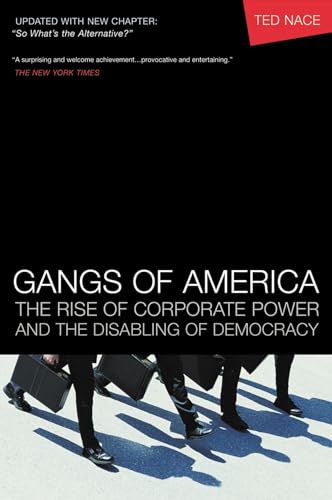
Gangs of America: The Rise of Corporate Power and the Disabling of Democracy (Bk Currents) - Softcover
Inhaltsangabe
“Gangs of America is a brilliant page-turner revealing how powerful, greedy corporations wage institutional terrorism.” —John Stauber, coauthor of Toxic Sludge Is Good for You!
The corporation has become the core institution of the modern world. Designed to seek profit and power, it has pursued both with endless tenacity, steadily bending the framework of law and even challenging the sovereign status of the state. Where did the corporation come from? How did it get so much power? What is its ultimate trajectory?
After he sold his successful computer book publishing business to a large corporation, Ted Nace felt increasingly driven to find answers to these questions. In Gangs of America he details the rise of corporate power in America through a series of fascinating stories, each organized around a different facet of the central question: “How did corporations get more rights than people?” Beginning with the origin of the corporation in medieval Great Britain, Nace traces both the events that shaped the evolution of corporate power and the colorful personalities who played major roles. Gangs of America is a uniquely accessible synthesis of the latest scholarly research, a compelling historical narrative, and a distinctive personal voice.
“A surprising and welcome achievement . . . provocative and entertaining.” —The New York Times
“A beautifully documented and readable history.” —Ben H. Bagdikian, author of The New Media Monopoly
“The essential guide to the history of the American corporation. Nace explodes the myth of inevitability surrounding the corporate takeover of our lives.” —Maria Elena Martinez, Executive director, CorpWatch
Die Inhaltsangabe kann sich auf eine andere Ausgabe dieses Titels beziehen.
Über die Autorin bzw. den Autor
While working for the u.s. forest service during high school, Ted Nace learned about the plans of several major corporations to develop coal strip mines and other energy projects near his hometown of Dickinson, North Dakota. During graduate school, Nace worked for the Environmental Defense Fund, where he helped develop computerized simulations that demonstrated the investor and ratepayer benefits of re- placing coal-fired power plants with alternative energy programs. The EDF simulations led to the cancellation of a multi-billion-dollar coal- based power complex proposed by two California utilities. After completing his graduate studies, Nace worked for the Dakota Resource Council, a citizens’ group concerned about the impacts of energy development on agriculture and rural communities.
Auszug. © Genehmigter Nachdruck. Alle Rechte vorbehalten.
Introduction
ON THE MORNING OF August 2, 2002, millions of Americans turned on their TVs to see an unusual spectacle: a high-level corporate executive in handcuffs, being paraded by law enforcement officials in front of the news media. The executive was Scott Sullivan, chief financial officer of the telecommunications firm WorldCom. Along with fellow executive David Myers, Sullivan was charged with hiding $3.85 billion in company expenses, conspiring to commit securities fraud, and filing false information with the Securities and Exchange Commission. The combined maximum penalties from the charges were sixty-five years. In response to the arrests, Attorney General John Ashcroft told reporters, “Corporate executives who cheat investors, steal savings, and squander pensions will meet the judgment they fear and the punishment they deserve.”
Now consider a different crime, committed by the leadership of General Motors together with Standard Oil of California, Firestone Tire and Rubber Company, B. F. Phillips Petroleum, and Mac Manufacturing. In 1936, the five companies formed National City Lines, a holding company that proceeded to buy electric trolley lines and tear up the tracks in cities across the nation. Each time it destroyed a local trolley system, National City would license the rights to operate a new system to a local franchisee, under the stipulation that the system convert to diesel-powered General Motors buses.
By 1949, more than one hundred electric transit systems in forty-five cities had been torn up and converted. In April of that year, a federal jury convicted GM and the other firms of conspiracy to commit antitrust violations. But the penalty turned out to be negligible. The judge set the fine at $5,000 for each company. H. C. Grossman, treasurer of General Motors and a key player in the scheme, was fined one dollar. After the conviction, the companies went back to purchasing transit systems, removing electric trolley lines, and replacing them with buses. By 1955, 88 percent of the country’s electric streetcar network was gone.
Both the Scott Sullivan case and the National City Lines case fit the traditional definition of crime: laws were broken, the legal system intervened. But the second case suggests that the larger the crime, the more the 2boundaries between “crime” and “business as usual” begin to blur. As Atlanta mayor and former United Nations ambassador Andrew Young once said, “Nothing is illegal if one hundred businessmen decide to do it.”
Young may have overstated things a bit, but the observation encapsulates a basic truth about American society. Business does tend to get its way, acting by means of a nebulous force known as “corporate power” that drives much of what happens in both the public and private spheres. But there are a few details to work out. What is the nature of this power? Exactly how does it work? Does the law instantly conform to the needs and wants of those one hundred businessmen? What happens when corporate America finds its wishes thwarted by constitutional barriers? Who decides what is “public” and what is “private?” Who defines the nature of “crime” versus “business as usual?”
IN ORDER TO ANSWER such questions, one challenge is merely to begin seeing a phenomenon that surrounds us so completely and continuously. I’ve spent most of my working life in the corporate world, founding and running a company that publishes how-to books about computers. In that world the corporation is the air you breathe. There is no questioning whether it is a good thing or a bad thing. It just is. Nor is there any thought about where the corporation—this particular institutional form—comes from. You assume that corporations have always been a natural part of the American system of “democracy and free enterprise.” But even as I pursued my business, questions lurked in the back of my mind, some of which had been triggered as early as my high school years.
I grew up in southwestern North Dakota, and my first summer job was building trails in the Badlands for the U.S. Forest Service. One day, I learned that a large energy corporation had applied to strip-mine a spot called the Burning Coal Vein, a rugged area where at night deep fissures emitted a glow caused by smoldering veins of coal, ignited long ago by lightning strikes or prairie fires. Along the hillsides, columnar junipers reminiscent of the trees in Van Gogh’s “Starry Night” stood like silent watchers draped in tunics. Piles of scoria—brilliant red, orange, and purple ceramic shards—covered the ground, the metamorphosed products of shale baked by the intense underground heat. It was like being in an immortal potter’s workshop, where every footstep made a tinkling sound as the scoria broke under your feet. That someone could dare propose 3destroying a place of such beauty in exchange for a few thousand tons of low-grade coal stunned me. But, of course, the entity planning the mine wasn’t a someone but a something—a corporation. Although people in the company may well have cared, the corporation itself didn’t.
After college, I started working as a community organizer for a group of farmers and ranchers in North Dakota who were opposed to a vast expansion of strip-mining being proposed by a number of large companies. The shadow cast by these corporations across farms and ranches was not just a metaphorical one. The machines used in strip mines are quite literally of an awesome physical scale. When I saw Jurassic Park I experienced a feeling of déja vu—it reminded me of being in a strip mine. To extract the coal underneath millions of acres of productive farmland and ranchland, the mining companies have to peel away the overlying layers of plant-nurturing soil, water-bearing aquifers, and rock. The peeling is done by immense, crane-like earth-eaters called draglines, which soar into the air the length of a football field. Like long-necked dinosaurs, the draglines make their way slowly amid ridges of rubble. Using tooth-edged buckets large enough to hold three Greyhound buses, they perform a drop-drag-lift-swivel maneuver, dropping the giant bucket, dragging it until it overflows, then suddenly jerking tons of dirt and rock high into the air, swiveling with surprising grace, and finally dumping the load onto the spoil piles. Especially at night, when intense lights illuminate the machinery and the rubble, the impression is hair-raising—a specter of monsters feeding upon the earth. And then you remember that the rubble being moved and dumped had been someone’s pasture, favorite hillside, or alfalfa field. Reclamation? The companies promised that they would restore the land, but given the semiarid conditions, the fragility of the soil, and the complexities of such critical factors as hydrology and salinity, such assurances rang hollow.
You couldn’t help but be affected by the courage of the families who carried on a daily existence next to the mines. I recall sitting in the kitchen of a wheat farmer named Werner Benfit and his elderly mother Anna, looking out at the advancing edge of North American Coal Company’s Indian Head Mine near Zap, an ordinary town except for its Dr. Seussian name. Even though the towering spoil piles of the mine had come literally to the edge of the Benfits’ property, chain-smoking Werner never lost his sense of humor. Anna brought out a plate of cookies and Werner told about the “suit” from North American Coal who had recently paid 4a visit. The executive had told Anna that she could name any price in the world for her land. “I don’t know about that,” replied Anna, “but do you think you could move...
„Über diesen Titel“ kann sich auf eine andere Ausgabe dieses Titels beziehen.
Suchergebnisse für Gangs of America: The Rise of Corporate Power and the...

Beispielbild für diese ISBN
Gangs of America: The Rise of Corporate Power and the Disabling of Democracy (Bk Currents)
Verlag:
Berrett-Koehler Publishers (edition 60166th), 2005
ISBN 10: 1576753190
ISBN 13: 9781576753194
Gebraucht
Paperback
Anbieter: BooksRun, Philadelphia, PA, USA
Verkäuferbewertung 5 von 5 Sternen

Paperback. Zustand: Very Good. 60166th. It's a well-cared-for item that has seen limited use. The item may show minor signs of wear. All the text is legible, with all pages included. It may have slight markings and/or highlighting. Artikel-Nr. 1576753190-11-1
Gebraucht kaufen
EUR 4,72
Versand gratis
Versand innerhalb von USA
Versand innerhalb von USA
Anzahl: 1 verfügbar
Beispielbild für diese ISBN
Gangs of America: The Rise of Corporate Power and the Disabling of Democracy (Bk Currents)
Verlag:
Berrett-Koehler Publishers (edition 60166th), 2005
ISBN 10: 1576753190
ISBN 13: 9781576753194
Gebraucht
Paperback
Anbieter: BooksRun, Philadelphia, PA, USA
Verkäuferbewertung 5 von 5 Sternen
Paperback. Zustand: Fair. 60166th. The item might be beaten up but readable. May contain markings or highlighting, as well as stains, bent corners, or any other major defect, but the text is not obscured in any way. Artikel-Nr. 1576753190-7-18-13
Gebraucht kaufen
EUR 5,32
Versand gratis
Versand innerhalb von USA
Versand innerhalb von USA
Anzahl: 1 verfügbar
Beispielbild für diese ISBN
Gangs of America; The Rise of Corporate Power and the Disabling of Democracy
Anbieter: World of Books (was SecondSale), Montgomery, IL, USA
Verkäuferbewertung 5 von 5 Sternen
Paperback. Zustand: Good. "Gangs of America is a brilliant page-turner revealing how powerful, greedy corporations wage institutional terrorism."-John Stauber, coauthor of Toxic Sludge Is Good for You! The corporation has become the core institution of the modern world. Designed to seek profit and power, it has pursued both with endless tenacity, steadily bending the framework of law and even challenging the sovereign status of the state. Where did the corporation come from? How did it get so much power? What is its ultimate trajectory? After he sold his successful computer book publishing business to a large corporation, Ted Nace felt increasingly driven to find answers to these questions. In Gangs of America he details the rise of corporate power in America through a series of fascinating stories, each organized around a different facet of the central question: "How did corporations get more rights than people?" Beginning with the origin of the corporation in medieval Great Britain, Nace traces both the events that shaped the evolution of corporate power and the colorful personalities who played major roles. Gangs of America is a uniquely accessible synthesis of the latest scholarly research, a compelling historical narrative, and a distinctive personal voice. "A surprising and welcome achievement. provocative and entertaining." -The New York Times "A beautifully documented and readable history."-Ben H. Bagdikian, author of The New Media Monopoly "The essential guide to the history of the American corporation. Nace explodes the myth of inevitability surrounding the corporate takeover of our lives."-Maria Elena Martinez, Executive director, CorpWatch. Artikel-Nr. 00105217310
Gebraucht kaufen
EUR 5,50
Versand gratis
Versand innerhalb von USA
Versand innerhalb von USA
Anzahl: 1 verfügbar
Beispielbild für diese ISBN
Gangs of America : The Rise of Corporate Power and the Disabling of Democracy
Verlag:
Berrett-Koehler Publishers, Incorporated, 2005
ISBN 10: 1576753190
ISBN 13: 9781576753194
Gebraucht
Softcover
Anbieter: Better World Books, Mishawaka, IN, USA
Verkäuferbewertung 5 von 5 Sternen
Zustand: Good. Pages intact with minimal writing/highlighting. The binding may be loose and creased. Dust jackets/supplements are not included. Stock photo provided. Product includes identifying sticker. Better World Books: Buy Books. Do Good. Artikel-Nr. 5005303-6
Gebraucht kaufen
EUR 6,35
Versand gratis
Versand innerhalb von USA
Versand innerhalb von USA
Anzahl: 1 verfügbar
Beispielbild für diese ISBN
Gangs of America : The Rise of Corporate Power and the Disabling of Democracy
Verlag:
Berrett-Koehler Publishers, Incorporated, 2005
ISBN 10: 1576753190
ISBN 13: 9781576753194
Gebraucht
Softcover
Anbieter: Better World Books, Mishawaka, IN, USA
Verkäuferbewertung 5 von 5 Sternen
Zustand: Very Good. Former library copy. Pages intact with possible writing/highlighting. Binding strong with minor wear. Dust jackets/supplements may not be included. Includes library markings. Stock photo provided. Product includes identifying sticker. Better World Books: Buy Books. Do Good. Artikel-Nr. GRP81860194
Gebraucht kaufen
EUR 6,35
Versand gratis
Versand innerhalb von USA
Versand innerhalb von USA
Anzahl: 2 verfügbar
Beispielbild für diese ISBN
Gangs of America: The Rise of Corporate Power and the Disabling of Democracy
Verlag:
Berrett-Koehler Publishers, 2005
ISBN 10: 1576753190
ISBN 13: 9781576753194
Gebraucht
Softcover
Anbieter: Wonder Book, Frederick, MD, USA
Verkäuferbewertung 5 von 5 Sternen
Zustand: Good. Good condition. A copy that has been read but remains intact. May contain markings such as bookplates, stamps, limited notes and highlighting, or a few light stains. Artikel-Nr. X14I-00095
Gebraucht kaufen
EUR 6,42
Versand gratis
Versand innerhalb von USA
Versand innerhalb von USA
Anzahl: 2 verfügbar
Beispielbild für diese ISBN
Gangs of America: The Rise of Corporate Power and the Disabling of Democracy
Verlag:
Berrett-Koehler Publishers, 2005
ISBN 10: 1576753190
ISBN 13: 9781576753194
Gebraucht
Paperback
Anbieter: ThriftBooks-Phoenix, Phoenix, AZ, USA
Verkäuferbewertung 5 von 5 Sternen
Paperback. Zustand: Very Good. No Jacket. May have limited writing in cover pages. Pages are unmarked. ~ ThriftBooks: Read More, Spend Less. Artikel-Nr. G1576753190I4N00
Gebraucht kaufen
EUR 6,71
Versand gratis
Versand innerhalb von USA
Versand innerhalb von USA
Anzahl: 1 verfügbar
Beispielbild für diese ISBN
Gangs of America: The Rise of Corporate Power and the Disabling of Democracy
Verlag:
Berrett-Koehler Publishers, 2005
ISBN 10: 1576753190
ISBN 13: 9781576753194
Gebraucht
Paperback
Anbieter: ThriftBooks-Atlanta, AUSTELL, GA, USA
Verkäuferbewertung 5 von 5 Sternen
Paperback. Zustand: Good. No Jacket. Pages can have notes/highlighting. Spine may show signs of wear. ~ ThriftBooks: Read More, Spend Less. Artikel-Nr. G1576753190I3N00
Gebraucht kaufen
EUR 6,71
Versand gratis
Versand innerhalb von USA
Versand innerhalb von USA
Anzahl: 1 verfügbar
Beispielbild für diese ISBN
Gangs of America: The Rise of Corporate Power and the Disabling of Democracy
Verlag:
Berrett-Koehler Publishers, 2005
ISBN 10: 1576753190
ISBN 13: 9781576753194
Gebraucht
Paperback
Anbieter: ThriftBooks-Phoenix, Phoenix, AZ, USA
Verkäuferbewertung 5 von 5 Sternen
Paperback. Zustand: Good. No Jacket. Pages can have notes/highlighting. Spine may show signs of wear. ~ ThriftBooks: Read More, Spend Less. Artikel-Nr. G1576753190I3N00
Gebraucht kaufen
EUR 6,71
Versand gratis
Versand innerhalb von USA
Versand innerhalb von USA
Anzahl: 1 verfügbar
Beispielbild für diese ISBN
Gangs of America: The Rise of Corporate Power and the Disabling of Democracy
Verlag:
Berrett-Koehler Publishers, 2005
ISBN 10: 1576753190
ISBN 13: 9781576753194
Gebraucht
Paperback
Anbieter: ThriftBooks-Dallas, Dallas, TX, USA
Verkäuferbewertung 5 von 5 Sternen
Paperback. Zustand: Good. No Jacket. Pages can have notes/highlighting. Spine may show signs of wear. ~ ThriftBooks: Read More, Spend Less. Artikel-Nr. G1576753190I3N00
Gebraucht kaufen
EUR 6,71
Versand gratis
Versand innerhalb von USA
Versand innerhalb von USA
Anzahl: 1 verfügbar