
Verwandte Artikel zu Ideas are Free: How the Idea Revolution is Liberating...
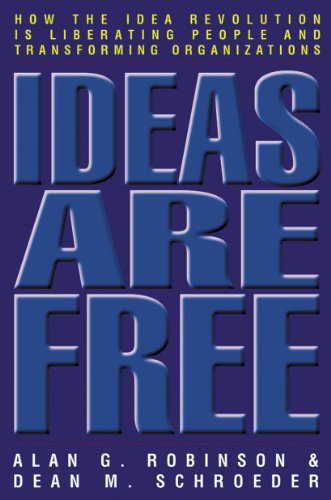
Ideas are Free: How the Idea Revolution is Liberating People and Transforming Organizations - Hardcover
Inhaltsangabe
The definitive guide to maximizing ideas from employees presents true stories of management encouraging workers to share their ideas with profitable results for everyone.
Die Inhaltsangabe kann sich auf eine andere Ausgabe dieses Titels beziehen.
Über die Autorin bzw. den Autor
Alan G. Robinson is coauthor of the bestseller Corporate Creativity and teaches at the Isenberg School of Management at the University of Massachusetts.
Dean M. Schroeder is currently the Herbert and Agnes Schulz Professor at the College of Business Administration at Valparaiso University.
Auszug. © Genehmigter Nachdruck. Alle Rechte vorbehalten.
THE IDEA REVOLUTION
What will future generations say about the way we practice management today? What will they consider our most conspicuous failure?
We believe they will accuse us of having squandered one of the most significant resources available to us: employee ideas. Every day, all over the world, millions of working people see problems and opportunities that their managers do not. With little chance to do anything about them, they are forced to watch helplessly as their organizations waste money, disappoint and lose customers, and miss opportunity after opportunity that to them are all too apparent. The result is performance far lower than it should be and employees who do not respect or trust management and who are not fully engaged with their work.
At the same time, their managers are under constant pressure to do more with less. But with so much of their time consumed by “firefighting” and trying to meet short-term demands, they have little or no time to think about how to build their organizations’ capabilities. They are chronically short of the resources they need to keep performance at current levels, much less improve it. They wonder how to motivate their employees, who don’t seem as involved in their work as they should be. In short, a great many managers today find their work stressful and unfulfilling. Because there seems to be no alternative, both managers and employees become jaded, and they accept the situation as the way things have to be.
But a quiet revolution is under way—an idea revolution—led by managers and supervisors who, in a small but growing number of companies, have learned how to listen systematically to their employees. With each implemented idea, performance improves in some way. Some time or money is saved, someone’s job becomes a little easier, the customer experience is enhanced, or the organization is improved in some other way. With large numbers of ideas coming in, performance improves dramatically. And as employees see their ideas used, they know they are having an impact on their organization and become engaged in their work.
Why do we call this movement a revolution? We do so because it liberates people and transforms the way that organizations are run. It changes the nature of the relationship between managers and their employees. As Ray Winter, then president of BIC Corporation, observed about the effect of his company’s idea system on the corporate culture:
This system has taught my managers real respect for their employees. My managers have learned that their employees can make them look awfully good, if they only let them.
This comment could easily be taken to mean that it does not take much—other than receptiveness on the part of management—to get large numbers of ideas from employees. But, just as it did the other companies we have studied, it took BIC years of experimentation and learning to discover how to tap this potential. There is a lot to learn, much of which goes against the initial assumptions most managers make about why people give ideas and which ideas are important.
WHAT’S IN AN IDEA?
Ideas are the engine of progress. They improve people’s lives by creating better ways to do things. They build and grow successful organizations and keep them healthy and prosperous. Without the ability to get new ideas, an organization stagnates and declines and eventually will be eliminated by competitors who do have fresh ideas.
An idea begins when a person becomes aware of a problem or opportunity, however small. Every day, regular employees—the people who do the office work, make the products, and serve the customers—see plenty of problems and opportunities and come up with good ideas about how to address them:
When accounting for oil purchases, a staffer in a regional distribution center of Deutsche Post, the German post office, noticed that the company was paying too much for the engine oil for its trucks. Drivers were buying oil at roadside service stations, paying the equivalent of $8.50 per liter. After some research, he found that Deutsche Post could buy the oil in bulk for a quarter of the price and proposed that it do so. At the time of this writing, the idea was being implemented at distribution centers across Germany. With tens of thousands of diesel trucks and vans on the road, it will no doubt save millions of euros every year.4
At Good Shepherd Services, a not-for-profit health care organization with a nursing home in northern Wisconsin, a group of employees learned in a training session that dementia patients often see areas of black flooring as holes and avoid them. Instead of using alarm bracelets or restraints to keep such patients from wandering into unsafe areas, the group suggested simply to paint the floor black in front of the doorways to these areas. The idea worked, and it not only reduced patient stress but saved staff considerable time because they no longer had to respond to alarms.
At LaSalle Bank, one of the largest banks in the United States, whenever someone requested a new laser printer, they were given the standard model specified by the purchasing department. One day, an employee unpacking his new printer noticed that it included an expensive internal disk drive, which no one would ever use. With all the printers the bank purchased each year, his idea to eliminate this feature saved a considerable sum of money.
At a Massachusetts Department of Correction facility, a guard proposed a change in the way pictures were taken of new inmates. Instead of using film, why not use digital cameras and store the images in a database? Across the department’s sixteen correctional facilities, this idea saved $56,000 the first year in film alone.5
An office worker in a Florida branch of a national temporary-placement firm realized that there was a problem with her company’s screening practices. At the time, it was paying an outside vendor to test applicants for literacy, numeracy, and computer skills. Those who passed were then given a drug test and criminal background check, which some 70 percent failed. Why not do the drug testing and criminal background check first, she asked? When the idea was implemented nationwide, the savings were huge.
At Winnebago Industries, the recreational vehicle maker, an assembly worker pointed out that the 10 percent of customers who ordered the deluxe sound system option were getting additional speakers they never used. No one had told the crews on the main assembly line that installed the built-in speakers for the regular sound systems to skip the vehicles that would be having the deluxe speakers installed later. The regular speakers embedded in the walls were never connected. They were seen but not heard. Although the savings from this idea were significant, the main benefit was that customers stopped bringing vehicles back to the dealers and asking them to fix speakers that were not working.
None of these ideas required particular insight or much creativity, or required much in the way of time or resources to implement. (In the case of Deutsche Post, oil suppliers were so eager for the business, they were willing to install the bulk tanks for free.) To the people who came up with them, they were simply common sense.
Every employee idea, no matter how small, improves an organization in some way. It is when managers are able to get large numbers of such ideas that the full power of the idea revolution is unleashed.6
HOW IDEAS DRIVE A CULTURE OF HIGH PERFORMANCE
There is a clear link between an organization’s ability to tap ideas and its overall performance. Consider the following examples:
Boardroom Inc., a Connecticut publisher, averaged 104 ideas per employee in 2002. Its sales per...
„Über diesen Titel“ kann sich auf eine andere Ausgabe dieses Titels beziehen.
Suchergebnisse für Ideas are Free: How the Idea Revolution is Liberating...

Beispielbild für diese ISBN
IDEAS ARE FREE
Anbieter: World of Books (was SecondSale), Montgomery, IL, USA
Verkäuferbewertung 5 von 5 Sternen

Hardback. Zustand: Good. Artikel-Nr. 00097547618
Gebraucht kaufen
EUR 4,52
Versand gratis
Versand innerhalb von USA
Versand innerhalb von USA
Anzahl: 2 verfügbar
Beispielbild für diese ISBN
Ideas Are Free : How the Idea Revolution Is Liberating People and Transforming Organizations
Verlag:
Berrett-Koehler Publishers, Incorporated, 2004
ISBN 10: 1576752828
ISBN 13: 9781576752821
Gebraucht
Hardcover
Anbieter: Better World Books, Mishawaka, IN, USA
Verkäuferbewertung 5 von 5 Sternen
Zustand: Good. Pages intact with minimal writing/highlighting. The binding may be loose and creased. Dust jackets/supplements are not included. Stock photo provided. Product includes identifying sticker. Better World Books: Buy Books. Do Good. Artikel-Nr. 3757650-6
Gebraucht kaufen
EUR 6,35
Versand gratis
Versand innerhalb von USA
Versand innerhalb von USA
Anzahl: 1 verfügbar
Beispielbild für diese ISBN
Ideas Are Free : How the Idea Revolution Is Liberating People and Transforming Organizations
Verlag:
Berrett-Koehler Publishers, Incorporated, 2004
ISBN 10: 1576752828
ISBN 13: 9781576752821
Gebraucht
Hardcover
Anbieter: Better World Books, Mishawaka, IN, USA
Verkäuferbewertung 5 von 5 Sternen
Zustand: Very Good. Former library copy. Pages intact with possible writing/highlighting. Binding strong with minor wear. Dust jackets/supplements may not be included. Includes library markings. Stock photo provided. Product includes identifying sticker. Better World Books: Buy Books. Do Good. Artikel-Nr. GRP63417062
Gebraucht kaufen
EUR 6,35
Versand gratis
Versand innerhalb von USA
Versand innerhalb von USA
Anzahl: 3 verfügbar
Beispielbild für diese ISBN
Ideas Are Free: How the Idea Revolution Is Liberating People and Transforming Organizations
Verlag:
Berrett-Koehler Publishers, 2004
ISBN 10: 1576752828
ISBN 13: 9781576752821
Gebraucht
Hardcover
Anbieter: ThriftBooks-Dallas, Dallas, TX, USA
Verkäuferbewertung 5 von 5 Sternen
Hardcover. Zustand: Very Good. No Jacket. May have limited writing in cover pages. Pages are unmarked. ~ ThriftBooks: Read More, Spend Less. Artikel-Nr. G1576752828I4N00
Gebraucht kaufen
EUR 6,50
Versand gratis
Versand innerhalb von USA
Versand innerhalb von USA
Anzahl: 1 verfügbar
Beispielbild für diese ISBN
Ideas Are Free: How the Idea Revolution Is Liberating People and Transforming Organizations
Verlag:
Berrett-Koehler Publishers, 2004
ISBN 10: 1576752828
ISBN 13: 9781576752821
Gebraucht
Hardcover
Anbieter: ThriftBooks-Atlanta, AUSTELL, GA, USA
Verkäuferbewertung 5 von 5 Sternen
Hardcover. Zustand: Very Good. No Jacket. May have limited writing in cover pages. Pages are unmarked. ~ ThriftBooks: Read More, Spend Less. Artikel-Nr. G1576752828I4N00
Gebraucht kaufen
EUR 6,50
Versand gratis
Versand innerhalb von USA
Versand innerhalb von USA
Anzahl: 1 verfügbar
Beispielbild für diese ISBN
Ideas Are Free: How the Idea Revolution Is Liberating People and Transforming Organizations
Verlag:
Berrett-Koehler Publishers, 2004
ISBN 10: 1576752828
ISBN 13: 9781576752821
Gebraucht
Hardcover
Anbieter: ThriftBooks-Reno, Reno, NV, USA
Verkäuferbewertung 5 von 5 Sternen
Hardcover. Zustand: Very Good. No Jacket. May have limited writing in cover pages. Pages are unmarked. ~ ThriftBooks: Read More, Spend Less. Artikel-Nr. G1576752828I4N00
Gebraucht kaufen
EUR 6,50
Versand gratis
Versand innerhalb von USA
Versand innerhalb von USA
Anzahl: 1 verfügbar
Foto des Verkäufers
Ideas Are Free: How the Idea Revolution Is Liberating People and Transforming Organizations
Verlag:
Berrett-Koehler Publishers, 2004
ISBN 10: 1576752828
ISBN 13: 9781576752821
Gebraucht
Hardcover
Signiert
Anbieter: ThriftBooksVintage, Tukwila, WA, USA
Verkäuferbewertung 5 von 5 Sternen
Hardcover. Zustand: Good. Zustand des Schutzumschlags: Good. Dust jacket has minor scuffing and edgewear. Boards are slightly bowing. Binding is sound. Text is clean and unmarked. This could have light cosmetic flaws, but remains in good condition. The book is signed by Author. Dust jacket condition is Good. Secure packaging for safe delivery. signed by author. Artikel-Nr. 3581474644
Gebraucht kaufen
EUR 21,12
Versand gratis
Versand innerhalb von USA
Versand innerhalb von USA
Anzahl: 1 verfügbar
Beispielbild für diese ISBN
Ideas are Free: How the Idea Revolution is Liberating People and Transforming Organizations
Anbieter: AwesomeBooks, Wallingford, Vereinigtes Königreich
Verkäuferbewertung 5 von 5 Sternen
Hardcover. Zustand: Very Good. Ideas are Free: How the Idea Revolution is Liberating People and Transforming Organizations This book is in very good condition and will be shipped within 24 hours of ordering. The cover may have some limited signs of wear but the pages are clean, intact and the spine remains undamaged. This book has clearly been well maintained and looked after thus far. Money back guarantee if you are not satisfied. See all our books here, order more than 1 book and get discounted shipping. . Artikel-Nr. 7719-9781576752821
Gebraucht kaufen
EUR 18,89
EUR 4,86 Versand
Versand von Vereinigtes Königreich nach USA
Versand von Vereinigtes Königreich nach USA
Anzahl: 1 verfügbar
Beispielbild für diese ISBN
Ideas are Free: How the Idea Revolution is Liberating People and Transforming Organizations
Verlag:
Berrett-Koehler 01/04/2004, 2004
ISBN 10: 1576752828
ISBN 13: 9781576752821
Gebraucht
Hardcover
Anbieter: Bahamut Media, Reading, Vereinigtes Königreich
Verkäuferbewertung 4 von 5 Sternen

Hardcover. Zustand: Very Good. Shipped within 24 hours from our UK warehouse. Clean, undamaged book with no damage to pages and minimal wear to the cover. Spine still tight, in very good condition. Remember if you are not happy, you are covered by our 100% money back guarantee. Artikel-Nr. 6545-9781576752821
Gebraucht kaufen
EUR 18,89
EUR 8,23 Versand
Versand von Vereinigtes Königreich nach USA
Versand von Vereinigtes Königreich nach USA
Anzahl: 1 verfügbar
Beispielbild für diese ISBN
Ideas Are Free: How the Idea Revolution Is Liberating People and Transforming Organizations
Anbieter: Revaluation Books, Exeter, Vereinigtes Königreich
Verkäuferbewertung 5 von 5 Sternen
Hardcover. Zustand: Brand New. 288 pages. 9.25x6.25x1.00 inches. In Stock. Artikel-Nr. 1576752828
Neu kaufen
EUR 45,69
EUR 14,73 Versand
Versand von Vereinigtes Königreich nach USA
Versand von Vereinigtes Königreich nach USA
Anzahl: 1 verfügbar