
Verwandte Artikel zu The Answer to How Is Yes: Acting on What Matters
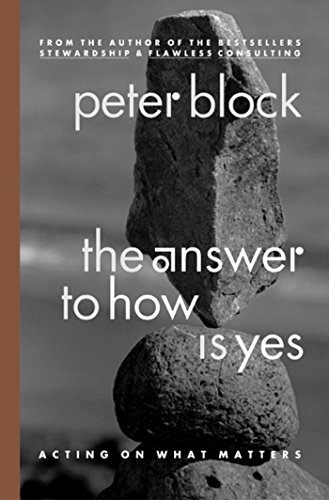
Inhaltsangabe
Modern culture’s worship of “how-to” pragmatism has turned us into instruments of efficiency and commerce—but we’re doing more and more about things that mean less and less. We constantly ask “how? and still struggle to find purpose and act on what matters. Instead of acting on what we know to be of importance, we wait for bosses to change, we seek the latest fad, we invest in one more degree. Asking how keeps us safe—instead of being led by our hearts into uncharted territory, we keep our heads down and stick to the rules. But we are gaining the world and losing our souls.
Peter Block puts the “how-to” craze in perspective and presents a guide to the difficult and life-granting journey of bringing what we know is of personal value into an indifferent or even hostile corporate and cultural landscape. He raises our awareness of the trade-offs we’ve made in the name of practicality and expediency, and offers hope for a way of life in which we’re motivated not by what “works,” but by the things that truly matter in life—idealism, intimacy, depth and engagement.
Die Inhaltsangabe kann sich auf eine andere Ausgabe dieses Titels beziehen.
Über die Autorin bzw. den Autor
Peter Block is an author, speaker, and a partner in Designed Learning, a training company that offers consulting skills workshops. He is the author of three bestselling books: Flawless Consulting: A Guide to Getting Your Expertise Used, The Empowered Manager: Positive Political Skills at Work, and Stewardship: Choosing Service Over Self-Interest. His most recent book is Flawless Consulting Fieldbook & Companion: A Guide to Understanding Your Expertise.
Auszug. © Genehmigter Nachdruck. Alle Rechte vorbehalten.
introduction: acting on what matters.
There is depth in the question “How do I do this?“ that is worth exploring. The question is a defense against the action. It is a leap past the question of purpose, past the question of intentions, and past the drama of responsibility. The question “How?“—more than any other question— looks for the answer outside of us. It is an indirect expression of our doubts. . . .
“Choosing Freedom, Service, and Adventure,“
—Peter Block, Stewardship, (p. 234)
There is something in the persistent question How? that expresses each person’s struggle between having confidence in their capacity to live a life of purpose and yielding to the daily demands of being practical. It is entirely possible to spend our days engaged in activities that work well for us and achieve our objectives, and still wonder whether we are really making a difference in the world. My premise is that this culture, and we as members of it, have yielded too easily to what is doable and practical and popular. In the process we have sacrificed the pursuit of what is in our hearts. We find ourselves giving in to our doubts, and settling for what we know how to do, or can soon learn how to do, instead of pursuing what most matters to us and living with the adventure and anxiety that this requires.
The idea that asking how to do something may be an obstacle rather than an enabler ended my 1993 book, Stewardship. In the final chapter, there is the suggestion that How? is a symbol of our caution and reinforces the belief that, no matter what the question, there is an answer out there that I need and will make the difference. I pick How? as a symbol simply because it is far and away the most common question I hear. It has always struck me that I can write or speak the most radical thoughts imaginable. I can advocate revolution, the end of leadership, the abolition of appraising each other, the empowerment of the least among us, the end of life on the planet as we know it, and no one ever argues with me. The only questions I hear are “How do you get there from here? Where has this worked? What would it cost and what is the return on investment?“ This has led me to the belief that the questions about How? are more interesting than any answer to them might be. They stand for some deeper concerns. So in this book, the starting point is to question the questions.
2
What Is Worth Doing
We often avoid the question of whether something is worth doing by going straight to the question “How do we do it?“ In fact, when we believe that something is definitely not worth doing, we are particularly eager to start asking How? We can look at what is worth doing at many different levels: As an individual I can wonder whether I can be myself and do what I want and still make a living. For an organization I can ask for whose sake does this organization exist and does it exist for any larger purpose than to survive and be economically successful? As a society, have we replaced a sense of community and civic engagement for economic well being and the pursuit of our private ambition?
Too often when a discussion is dominated by questions of How? we risk overvaluing what is practical and doable and postpone the questions of larger purpose and collective well being. With the question How? we risk aspiring to goals that are defined for us by the culture and by our institutions, at the expense of pursuing purposes and intentions that arise from within ourselves.
If we were really committed to the pursuit of what matters, we might be well served to hold a moratorium on the question How? There is an image I first heard from Jim Walker, a change-oriented executive and good soul, who was put in charge of a struggling AT&T business some years ago. He used to ask, “What do you do when you find yourself in a hole?“ His answer was, “The first thing you do is stop digging.“ That stuck with me. Most of the time, when something I am trying does not work, I simply try harder. If I am trying to control a business, a project, or a relationship and it is failing, then I doggedly do more of what is not working.
3
If we could agree that for six months we would not ask How? , something in our lives, our institutions, and our culture might shift for the better. It would force us to engage in conversations about why we do what we do, as individuals and as institutions. It would create the space for longer discussions about purpose, about what is worth doing. It would refocus our attention on deciding what is the right question, rather than what is the right answer.
It would also force us to act as if we already knew how—we just have to figure out what is worth doing. It would give priority to aim over speed. At some point we would either find the right question or grow weary of its pursuit, and we would be pulled into meaningful action, despite our uncertainty and our caution about being wrong. It would support us in acting now, rather than waiting until the timing was right, and the world was ready for us. We might put aside our wish for safety and instead view our life as a purpose-filled experiment whose intention is more for learning than for achieving and more for relationship than for power, speed, or efficiency.
This might elevate the state of not knowing to being an acceptable condition of our existence rather than a problem to be solved, and we might realize that real service and contribution come more from the choice of a worthy destination than from limiting ourselves to engaging in what we know will work.
4
The How? of Why
This book is a discussion of what it takes to live a life in pursuit of what matters. It is an effort to ensure that what we are effective and good at doing is worth doing. The book also raises the question What are we waiting for? By this time we have all been immersed in visioning, guided imagination, and becoming the possibility. We have been mentored and coached and been a mentor and coach to others. So, if we are waiting for more knowledge, more skills, more support from the world around us, we are waiting too long.
In the face of the struggle to know what matters to us, and to act on it, we have to be gentle with ourselves. We live in a culture that lavishes all of its rewards on what works, a culture that seems to value what works more than it values what matters. I am using the phrase “what works“ to capture our love of practicality and our attraction to what is concrete and measurable. The phrase “what matters“ is shorthand for our capacity to dream, to reclaim our freedom, to be idealistic, and to give our lives to those things which are vague, hard to measure, and invisible. Now, you might say that what actually matters most to you are those things that are measurable, concrete, and do in fact “work.“ I would not argue with you, but would urge you to explore how focusing too quickly and exclusively on what works can have the effect of distracting us from our deeper purpose and sense of fully living the life we have in mind. In other words, my wish is that we exchange what we know how to do for what means most to us.
How? The Statement
In any of its hundreds of variations when we ask How? we are really making a statement: What we lack is the right tool. The right methodology. We are mechanics who cannot find the right wrench. The question How? not only expresses doubt about whether we know enough and are enough; it also affirms the belief that what works is the defining question, a major source of our identity.
5
The question declares that we, as a culture, and I, as a human being, are fundamentally about getting things done.
If...
„Über diesen Titel“ kann sich auf eine andere Ausgabe dieses Titels beziehen.
Suchergebnisse für The Answer to How Is Yes: Acting on What Matters

Beispielbild für diese ISBN
The Answer to How is Yes: Stop Looking for Help in All the Wrong Places
Anbieter: World of Books (was SecondSale), Montgomery, IL, USA
Verkäuferbewertung 5 von 5 Sternen

Paperback. Zustand: Good. Modern culture's worship of "how-to" pragmatism has turned us into instruments of efficiency and commerce-but we're doing more and more about things that mean less and less. We constantly ask "how? and still struggle to find purpose and act on what matters. Instead of acting on what we know to be of importance, we wait for bosses to change, we seek the latest fad, we invest in one more degree. Asking how keeps us safe-instead of being led by our hearts into uncharted territory, we keep our heads down and stick to the rules. But we are gaining the world and losing our souls. Peter Block puts the "how-to" craze in perspective and presents a guide to the difficult and life-granting journey of bringing what we know is of personal value into an indifferent or even hostile corporate and cultural landscape. He raises our awareness of the trade-offs we've made in the name of practicality and expediency, and offers hope for a way of life in which we're motivated not by what "works," but by the things that truly matter in life-idealism, intimacy, depth and engagement. Artikel-Nr. 00090882792
Gebraucht kaufen
EUR 3,72
Versand gratis
Versand innerhalb von USA
Versand innerhalb von USA
Anzahl: 18 verfügbar
Beispielbild für diese ISBN
The Answer to How is Yes: Stop Looking for Help in All the Wrong Places
Anbieter: World of Books (was SecondSale), Montgomery, IL, USA
Verkäuferbewertung 5 von 5 Sternen
Paperback. Zustand: Very Good. Modern culture's worship of "how-to" pragmatism has turned us into instruments of efficiency and commerce-but we're doing more and more about things that mean less and less. We constantly ask "how? and still struggle to find purpose and act on what matters. Instead of acting on what we know to be of importance, we wait for bosses to change, we seek the latest fad, we invest in one more degree. Asking how keeps us safe-instead of being led by our hearts into uncharted territory, we keep our heads down and stick to the rules. But we are gaining the world and losing our souls. Peter Block puts the "how-to" craze in perspective and presents a guide to the difficult and life-granting journey of bringing what we know is of personal value into an indifferent or even hostile corporate and cultural landscape. He raises our awareness of the trade-offs we've made in the name of practicality and expediency, and offers hope for a way of life in which we're motivated not by what "works," but by the things that truly matter in life-idealism, intimacy, depth and engagement. Artikel-Nr. 00109235513
Gebraucht kaufen
EUR 3,72
Versand gratis
Versand innerhalb von USA
Versand innerhalb von USA
Anzahl: 2 verfügbar
Beispielbild für diese ISBN
The Answer to How Is Yes Actin
Verlag:
Berrett-Koehler Publishers, 2003
ISBN 10: 1576752712
ISBN 13: 9781576752715
Gebraucht
Softcover
Anbieter: World of Books (was SecondSale), Montgomery, IL, USA
Verkäuferbewertung 5 von 5 Sternen
Zustand: Acceptable. Item in acceptable condition! Textbooks may not include supplemental items i.e. CDs, access codes etc. Artikel-Nr. 00109636422
Gebraucht kaufen
EUR 3,72
Versand gratis
Versand innerhalb von USA
Versand innerhalb von USA
Anzahl: 1 verfügbar
Foto des Verkäufers
The Answer to How Is Yes: Acting on What Matters
Verlag:
Berrett-Koehler Publishers, 2003
ISBN 10: 1576752712
ISBN 13: 9781576752715
Gebraucht
Softcover
Anbieter: Dream Books Co., Denver, CO, USA
Verkäuferbewertung 5 von 5 Sternen
Zustand: good. Gently used with minimal wear on the corners and cover. A few pages may contain light highlighting or writing, but the text remains fully legible. Dust jacket may be missing, and supplemental materials like CDs or codes may not be included. May be ex-library with library markings. Ships promptly! Artikel-Nr. DBV.1576752712.G
Gebraucht kaufen
EUR 3,80
Versand gratis
Versand innerhalb von USA
Versand innerhalb von USA
Anzahl: 1 verfügbar
Foto des Verkäufers
The Answer to How Is Yes: Acting on What Matters
Verlag:
Berrett-Koehler Publishers, 2003
ISBN 10: 1576752712
ISBN 13: 9781576752715
Gebraucht
Softcover
Anbieter: Dream Books Co., Denver, CO, USA
Verkäuferbewertung 5 von 5 Sternen
Zustand: acceptable. This copy has clearly been enjoyedâ"expect noticeable shelf wear and some minor creases to the cover. Binding is strong, and all pages are legible. May contain previous library markings or stamps. Artikel-Nr. DBV.1576752712.A
Gebraucht kaufen
EUR 3,80
Versand gratis
Versand innerhalb von USA
Versand innerhalb von USA
Anzahl: 1 verfügbar
Beispielbild für diese ISBN
The Answer to How Is Yes: Acting on What Matters
Verlag:
Berrett-Koehler Publishers (edition 1), 2003
ISBN 10: 1576752712
ISBN 13: 9781576752715
Gebraucht
Paperback
Anbieter: BooksRun, Philadelphia, PA, USA
Verkäuferbewertung 5 von 5 Sternen
Paperback. Zustand: Very Good. 1. It's a well-cared-for item that has seen limited use. The item may show minor signs of wear. All the text is legible, with all pages included. It may have slight markings and/or highlighting. Artikel-Nr. 1576752712-11-1
Gebraucht kaufen
EUR 4,54
Versand gratis
Versand innerhalb von USA
Versand innerhalb von USA
Anzahl: 2 verfügbar
Beispielbild für diese ISBN
The Answer to How Is Yes: Acting on What Matters
Verlag:
Berrett-Koehler Publishers (edition 1), 2003
ISBN 10: 1576752712
ISBN 13: 9781576752715
Gebraucht
Paperback
Anbieter: BooksRun, Philadelphia, PA, USA
Verkäuferbewertung 5 von 5 Sternen
Paperback. Zustand: Very Good. 1. It's a well-cared-for item that has seen limited use. The item may show minor signs of wear. All the text is legible, with all pages included. It may have slight markings and/or highlighting. Artikel-Nr. 1576752712-8-1
Gebraucht kaufen
EUR 4,79
Versand gratis
Versand innerhalb von USA
Versand innerhalb von USA
Anzahl: 1 verfügbar
Beispielbild für diese ISBN
The Answer to How Is Yes: Acting on What Matters
Verlag:
Berrett-Koehler Publishers, 2003
ISBN 10: 1576752712
ISBN 13: 9781576752715
Gebraucht
Paperback
Anbieter: ThriftBooks-Dallas, Dallas, TX, USA
Verkäuferbewertung 5 von 5 Sternen
Paperback. Zustand: Good. No Jacket. Pages can have notes/highlighting. Spine may show signs of wear. ~ ThriftBooks: Read More, Spend Less. Artikel-Nr. G1576752712I3N00
Gebraucht kaufen
EUR 5,99
Versand gratis
Versand innerhalb von USA
Versand innerhalb von USA
Anzahl: 1 verfügbar
Beispielbild für diese ISBN
The Answer to How Is Yes: Acting on What Matters
Verlag:
Berrett-Koehler Publishers, 2003
ISBN 10: 1576752712
ISBN 13: 9781576752715
Gebraucht
Paperback
Anbieter: ThriftBooks-Dallas, Dallas, TX, USA
Verkäuferbewertung 5 von 5 Sternen
Paperback. Zustand: Good. No Jacket. Former library book; Pages can have notes/highlighting. Spine may show signs of wear. ~ ThriftBooks: Read More, Spend Less. Artikel-Nr. G1576752712I3N10
Gebraucht kaufen
EUR 5,99
Versand gratis
Versand innerhalb von USA
Versand innerhalb von USA
Anzahl: 1 verfügbar
Beispielbild für diese ISBN
The Answer to How Is Yes: Acting on What Matters
Verlag:
Berrett-Koehler Publishers, 2003
ISBN 10: 1576752712
ISBN 13: 9781576752715
Gebraucht
Paperback
Anbieter: ThriftBooks-Atlanta, AUSTELL, GA, USA
Verkäuferbewertung 5 von 5 Sternen
Paperback. Zustand: Good. No Jacket. Pages can have notes/highlighting. Spine may show signs of wear. ~ ThriftBooks: Read More, Spend Less. Artikel-Nr. G1576752712I3N00
Gebraucht kaufen
EUR 5,99
Versand gratis
Versand innerhalb von USA
Versand innerhalb von USA
Anzahl: 1 verfügbar