
Verwandte Artikel zu Things a Computer Scientist Rarely Talks About: Volume...
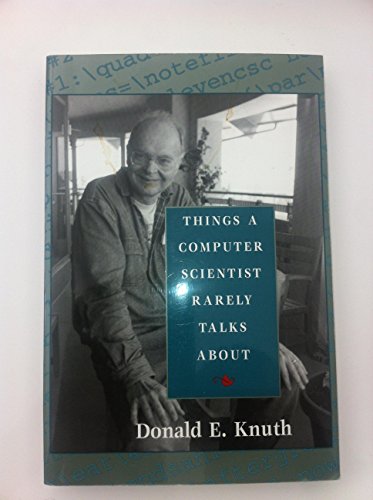
Things a Computer Scientist Rarely Talks About: Volume 136 (Center for the Study of Language and Information - Lecture Notes, Band 136) - Softcover
Inhaltsangabe
How does a computer scientist understand infinity? What can probability theory teach us about free will? Can mathematical notions be used to enhance one's personal understanding of the Bible?
Perhaps no one is more qualified to address these questions than Donald E. Knuth, whose massive contributions to computing have led others to nickname him "The Father of Computer Science"—and whose religious faith led him to understand a fascinating analysis of the Bible called the 3:16 project. In this series of six spirited, informal lectures, Knuth explores the relationships between his vocation and his faith, revealing the unique perspective that his work with computing has lent to his understanding of God.
His starting point is the 3:16 project, an application of mathematical "random sampling" to the books of the Bible. The first lectures tell the story of the project's conception and execution, exploring its many dimensions of language translation, aesthetics, and theological history. Along the way, Knuth explains the many insights he gained from such interdisciplinary work. These theological musings culminate in a surprising final lecture tackling the ideas of infinity, free will, and some of the other big questions that lie at the juncture of theology and computation.
Things a Computer Scientist Rarely Talks About, with its charming and user-friendly format—each lecture ends with a question and answer exchange, and the book itself contains more than 100 illustrations—is a readable and intriguing approach to a crucial topic, certain to edify both those who are serious and curious about their faiths and those who look at the science of computation and wonder what it might teach them about their spiritual world.
Includes "Creativity, Spirituality, and Computer Science," a panel discussion featuring Harry Lewis, Guy L. Steele, Jr., Manuela Veloso, Donald E. Knuth, and Mitch Kapor.
Perhaps no one is more qualified to address these questions than Donald E. Knuth, whose massive contributions to computing have led others to nickname him "The Father of Computer Science"—and whose religious faith led him to understand a fascinating analysis of the Bible called the 3:16 project. In this series of six spirited, informal lectures, Knuth explores the relationships between his vocation and his faith, revealing the unique perspective that his work with computing has lent to his understanding of God.
His starting point is the 3:16 project, an application of mathematical "random sampling" to the books of the Bible. The first lectures tell the story of the project's conception and execution, exploring its many dimensions of language translation, aesthetics, and theological history. Along the way, Knuth explains the many insights he gained from such interdisciplinary work. These theological musings culminate in a surprising final lecture tackling the ideas of infinity, free will, and some of the other big questions that lie at the juncture of theology and computation.
Things a Computer Scientist Rarely Talks About, with its charming and user-friendly format—each lecture ends with a question and answer exchange, and the book itself contains more than 100 illustrations—is a readable and intriguing approach to a crucial topic, certain to edify both those who are serious and curious about their faiths and those who look at the science of computation and wonder what it might teach them about their spiritual world.
Includes "Creativity, Spirituality, and Computer Science," a panel discussion featuring Harry Lewis, Guy L. Steele, Jr., Manuela Veloso, Donald E. Knuth, and Mitch Kapor.
Die Inhaltsangabe kann sich auf eine andere Ausgabe dieses Titels beziehen.
Über die Autorin bzw. den Autor
Donald E. Knuth is a Professor Emeritus of The Art of Computer Programming at Stanford University and author of The Art of Computer Programming. These lectures were originally presented at the Massachusetts Institute of Technology and broadcast live on the Internet.
Von der hinteren Coverseite
How does a computer scientist understand infinity? What can probability theory teach us about free will? Can mathematical notions be used to enhance one's personal understanding of the Bible?
Perhaps no one is more qualified to address these questions than Donald E. Knuth, whose massive contributions to computing have led others to nickname him "The Father of Computer Science"--and whose religious faith led him to understand a fascinating analysis of the Bible called the 3:16 project. In this series of six spirited, informal lectures, Knuth explores the relationships between his vocation and his faith, revealing the unique perspective that his work with computing has lent to his understanding of God. His starting point is the 3:16 project, an application of mathematical "random sampling" to the books of the Bible. The first lectures tell the story of the project's conception and execution, exploring its many dimensions of language translation, aesthetics, and theological history. Along the way, Knuth explains the many insights he gained from such interdisciplinary work. These theological musings culminate in a surprising final lecture tackling the ideas of infinity, free will, and some of the other big questions that lie at the juncture of theology and computation. Things a Computer Scientist Rarely Talks About, with its charming and user-friendly format--each lecture ends with a question and answer exchange, and the book itself contains more than 100 illustrations--is a readable and intriguing approach to a crucial topic, certain to edify both those who are serious and curious about their faiths and those who look at the science of computation and wonder what it might teach them about their spiritual world. Includes "Creativity, Spirituality, and Computer Science," a panel discussion featuring Harry Lewis, Guy L. Steele, Jr., Manuela Veloso, Donald E. Knuth, and Mitch Kapor.Aus dem Klappentext
How does a computer scientist understand infinity? What can probability theory teach us about free will? Can mathematical notions be used to enhance one's personal understanding of the Bible?
Perhaps no one is more qualified to address these questions than Donald E. Knuth, whose massive contributions to computing have led others to nickname him "The Father of Computer Science"&;and whose religious faith led him to understand a fascinating analysis of the Bible called the 3:16 project. In this series of six spirited, informal lectures, Knuth explores the relationships between his vocation and his faith, revealing the unique perspective that his work with computing has lent to his understanding of God.
His starting point is the 3:16 project, an application of mathematical "random sampling" to the books of the Bible. The first lectures tell the story of the project's conception and execution, exploring its many dimensions of language translation, aesthetics, and theological history. Along the way, Knuth explains the many insights he gained from such interdisciplinary work. These theological musings culminate in a surprising final lecture tackling the ideas of infinity, free will, and some of the other big questions that lie at the juncture of theology and computation.
Things a Computer Scientist Rarely Talks About, with its charming and user-friendly format&;each lecture ends with a question and answer exchange, and the book itself contains more than 100 illustrations&;is a readable and intriguing approach to a crucial topic, certain to edify both those who are serious and curious about their faiths and those who look at the science of computation and wonder what it might teach them about their spiritual world.
Includes "Creativity, Spirituality, and Computer Science," a panel discussion featuring Harry Lewis, Guy L. Steele, Jr., Manuela Veloso, Donald E. Knuth, and Mitch Kapor.
Perhaps no one is more qualified to address these questions than Donald E. Knuth, whose massive contributions to computing have led others to nickname him "The Father of Computer Science"&;and whose religious faith led him to understand a fascinating analysis of the Bible called the 3:16 project. In this series of six spirited, informal lectures, Knuth explores the relationships between his vocation and his faith, revealing the unique perspective that his work with computing has lent to his understanding of God.
His starting point is the 3:16 project, an application of mathematical "random sampling" to the books of the Bible. The first lectures tell the story of the project's conception and execution, exploring its many dimensions of language translation, aesthetics, and theological history. Along the way, Knuth explains the many insights he gained from such interdisciplinary work. These theological musings culminate in a surprising final lecture tackling the ideas of infinity, free will, and some of the other big questions that lie at the juncture of theology and computation.
Things a Computer Scientist Rarely Talks About, with its charming and user-friendly format&;each lecture ends with a question and answer exchange, and the book itself contains more than 100 illustrations&;is a readable and intriguing approach to a crucial topic, certain to edify both those who are serious and curious about their faiths and those who look at the science of computation and wonder what it might teach them about their spiritual world.
Includes "Creativity, Spirituality, and Computer Science," a panel discussion featuring Harry Lewis, Guy L. Steele, Jr., Manuela Veloso, Donald E. Knuth, and Mitch Kapor.
„Über diesen Titel“ kann sich auf eine andere Ausgabe dieses Titels beziehen.
Suchergebnisse für Things a Computer Scientist Rarely Talks About: Volume...

Beispielbild für diese ISBN
Things a Computer Scientist Rarely Talks About
ISBN 10: 157586326X
ISBN 13: 9781575863269
Gebraucht
Softcover
Anbieter: Better World Books, Mishawaka, IN, USA
Verkäuferbewertung 5 von 5 Sternen

Zustand: Very Good. Pages intact with possible writing/highlighting. Binding strong with minor wear. Dust jackets/supplements may not be included. Stock photo provided. Product includes identifying sticker. Better World Books: Buy Books. Do Good. Artikel-Nr. 8572482-6
Gebraucht kaufen
EUR 8,97
Versand gratis
Versand innerhalb von USA
Versand innerhalb von USA
Anzahl: 1 verfügbar
Beispielbild für diese ISBN
Things a Computer Scientist Rarely Talks about (Center for the Study of Language and Information Publication Lecture Notes)
Verlag:
University of Chicago Press, 2003
ISBN 10: 157586326X
ISBN 13: 9781575863269
Gebraucht
Paperback
Anbieter: AwesomeBooks, Wallingford, Vereinigtes Königreich
Verkäuferbewertung 5 von 5 Sternen
Paperback. Zustand: Very Good. Things a Computer Scientist Rarely Talks about (Center for the Study of Language and Information Publication Lecture Notes) This book is in very good condition and will be shipped within 24 hours of ordering. The cover may have some limited signs of wear but the pages are clean, intact and the spine remains undamaged. This book has clearly been well maintained and looked after thus far. Money back guarantee if you are not satisfied. See all our books here, order more than 1 book and get discounted shipping. . Artikel-Nr. 7719-9781575863269
Gebraucht kaufen
EUR 17,99
EUR 4,79 Versand
Versand von Vereinigtes Königreich nach USA
Versand von Vereinigtes Königreich nach USA
Anzahl: 1 verfügbar
Beispielbild für diese ISBN
Things a Computer Scientist Rarely Talks about (Center for the Study of Language and Information Publication Lecture Notes)
Verlag:
University of Chicago Press 22/10/2003, 2003
ISBN 10: 157586326X
ISBN 13: 9781575863269
Gebraucht
Paperback
Anbieter: Bahamut Media, Reading, Vereinigtes Königreich
Verkäuferbewertung 4 von 5 Sternen

Paperback. Zustand: Very Good. Shipped within 24 hours from our UK warehouse. Clean, undamaged book with no damage to pages and minimal wear to the cover. Spine still tight, in very good condition. Remember if you are not happy, you are covered by our 100% money back guarantee. Artikel-Nr. 6545-9781575863269
Gebraucht kaufen
EUR 17,99
EUR 8,12 Versand
Versand von Vereinigtes Königreich nach USA
Versand von Vereinigtes Königreich nach USA
Anzahl: 1 verfügbar
Beispielbild für diese ISBN
Things a Computer Scientist Rarely Talks About
Verlag:
Center for the Study of Language and Information, 2003
ISBN 10: 157586326X
ISBN 13: 9781575863269
Neu
PAP
Anbieter: PBShop.store UK, Fairford, GLOS, Vereinigtes Königreich
Verkäuferbewertung 5 von 5 Sternen
PAP. Zustand: New. New Book. Shipped from UK. Established seller since 2000. Artikel-Nr. GB-9781575863269
Neu kaufen
EUR 27,93
EUR 4,84 Versand
Versand von Vereinigtes Königreich nach USA
Versand von Vereinigtes Königreich nach USA
Anzahl: 2 verfügbar
Beispielbild für diese ISBN
Things a Computer Scientist Rarely Talks About
Verlag:
Center for the Study of Language & Information, 2003
ISBN 10: 157586326X
ISBN 13: 9781575863269
Neu
Softcover
Anbieter: Majestic Books, Hounslow, Vereinigtes Königreich
Verkäuferbewertung 4 von 5 Sternen
Zustand: New. pp. 269. Artikel-Nr. 6674477
Neu kaufen
EUR 30,54
EUR 7,56 Versand
Versand von Vereinigtes Königreich nach USA
Versand von Vereinigtes Königreich nach USA
Anzahl: 3 verfügbar
Beispielbild für diese ISBN
Things a Computer Scientist Rarely Talks About (Center for the Study of Language and Information - Lecture Notes)
Verlag:
Stanford Univ Center for the Study, 2003
ISBN 10: 157586326X
ISBN 13: 9781575863269
Neu
Paperback
Anbieter: Revaluation Books, Exeter, Vereinigtes Königreich
Verkäuferbewertung 5 von 5 Sternen
Paperback. Zustand: Brand New. 269 pages. 8.50x5.75x0.75 inches. In Stock. Artikel-Nr. __157586326X
Neu kaufen
EUR 27,53
EUR 11,63 Versand
Versand von Vereinigtes Königreich nach USA
Versand von Vereinigtes Königreich nach USA
Anzahl: 2 verfügbar
Beispielbild für diese ISBN
Things a Computer Scientist Rarely Talks About (Volume 136) (Lecture Notes)
Verlag:
Center for the Study of Language and Inf, 2003
ISBN 10: 157586326X
ISBN 13: 9781575863269
Neu
Softcover
Anbieter: Ria Christie Collections, Uxbridge, Vereinigtes Königreich
Verkäuferbewertung 5 von 5 Sternen
Zustand: New. In English. Artikel-Nr. ria9781575863269_new
Neu kaufen
EUR 33,25
EUR 10,90 Versand
Versand von Vereinigtes Königreich nach USA
Versand von Vereinigtes Königreich nach USA
Anzahl: Mehr als 20 verfügbar
Beispielbild für diese ISBN
Things a Computer Scientist Rarely Talks about
Verlag:
Centre for the Study of Language & Information, 2003
ISBN 10: 157586326X
ISBN 13: 9781575863269
Neu
Softcover
Anbieter: Kennys Bookstore, Olney, MD, USA
Verkäuferbewertung 5 von 5 Sternen
Zustand: New. How does a computer scientist understand infinity? What can probability theory teach us about free will? This book contains six informal lectures by computer scientist Donald E. Knuth exploring the relationship between his vocation and his faith. Series: Center for the Study of Language and Information Publication Lecture Notes. Num Pages: 269 pages, 102 illustrations. BIC Classification: UBJ; UY. Category: (P) Professional & Vocational. Dimension: 224 x 153 x 17. Weight in Grams: 436. . 2003. New edition. Paperback. . . . . Books ship from the US and Ireland. Artikel-Nr. V9781575863269
Neu kaufen
EUR 39,89
EUR 9,23 Versand
Versand innerhalb von USA
Versand innerhalb von USA
Anzahl: Mehr als 20 verfügbar
Foto des Verkäufers
Knuth, D: Things a Computer Scientist Rarely Talks about
Verlag:
Centre for the Study of Language & Information, 2003
ISBN 10: 157586326X
ISBN 13: 9781575863269
Neu
Softcover
Anbieter: moluna, Greven, Deutschland
Verkäuferbewertung 5 von 5 Sternen
Zustand: New. KlappentextrnrnHow does a computer scientist understand infinity? What can probability theory teach us about free will? This book contains six informal lectures by computer scientist Donald E. Knuth exploring the relationship between his vocatio. Artikel-Nr. 867691402
Neu kaufen
EUR 31,93
EUR 48,99 Versand
Versand von Deutschland nach USA
Versand von Deutschland nach USA
Anzahl: 2 verfügbar
Foto des Verkäufers
Things a Computer Scientist Rarely Talks About
Verlag:
Centre for the Study of Language & Information, 2003
ISBN 10: 157586326X
ISBN 13: 9781575863269
Neu
Taschenbuch
Anbieter: preigu, Osnabrück, Deutschland
Verkäuferbewertung 5 von 5 Sternen
Taschenbuch. Zustand: Neu. Things a Computer Scientist Rarely Talks About | Donald E. Knuth | Taschenbuch | Lecture Notes | Einband - flex.(Paperback) | Englisch | 2003 | Centre for the Study of Language & Information | EAN 9781575863269 | Verantwortliche Person für die EU: Libri GmbH, Europaallee 1, 36244 Bad Hersfeld, gpsr[at]libri[dot]de | Anbieter: preigu. Artikel-Nr. 128941121
Neu kaufen
EUR 36,50
EUR 70,00 Versand
Versand von Deutschland nach USA
Versand von Deutschland nach USA
Anzahl: 1 verfügbar