
Verwandte Artikel zu Sensory-directed Flavor Analysis (Food Science And...
Inhaltsangabe
Today, flavor chemists can generate copious amounts of data in a short time with relatively little effort using automated solid phase micro-extraction, Gerstel-Twister® and other extraction techniques in combination with gas chromatographic (GC) analysis. However, more data does not necessarily mean better understanding. In fact, the ability to extract, isolate, and concentrate potential flavor-important chemicals from complex food systems has surpassed the ability to understand how the chemical data relates to flavor.
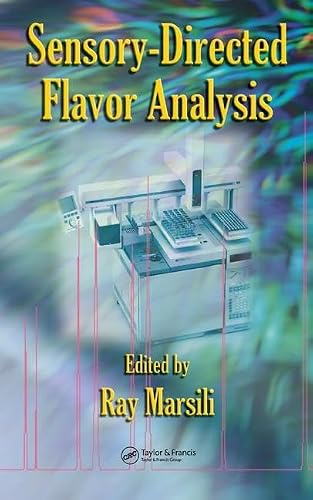
Sensory-Directed Flavor Analysis helps chemists unlock the flavor secrets that may be hiding in their chromatograms by translating cold hard numbers into a better understanding of the sense of smell and taste. The author integrates the two disciplines of sensory science and analytical chemistry, encouraging sensory scientists to incorporate more analytical data while encouraging analytical chemists to include more sensory techniques. Using more ancillary techniques helps each discipline elucidate how various chemical constituents influence food flavor and appeal. The book discusses important enabling technologies and analytical methods including GC-olfactometry (GC-O), combination GC-O and multi-dimensional GC, the application of odor activity values (OAVs), and recombination studies, as well as solid-phase dynamic extraction and preseparation techniques. A broad array of applications, in addition to dozens of tables, graphs, gas chromatograms, and pictures, are included throughout the book.
Highlighting the advantages and disadvantages and the appropriate circumstances for each method of analysis, Sensory-Directed Flavor Analysis offers flavor scientists an essential reference to deepen their understanding of the function of chemicals on the perception of taste.
Die Inhaltsangabe kann sich auf eine andere Ausgabe dieses Titels beziehen.
Über die Autorin bzw. den Autor
Ray Marsili
„Über diesen Titel“ kann sich auf eine andere Ausgabe dieses Titels beziehen.
Suchergebnisse für Sensory-directed Flavor Analysis (Food Science And...

Beispielbild für diese ISBN
Sensory-Directed Flavor Analysis. (=Food Science and Technology)
Anbieter: Antiquariat Thomas Haker GmbH & Co. KG, Berlin, Deutschland
Verkäuferbewertung 5 von 5 Sternen

Hardcover. Zustand: Sehr gut. 2nd ed. 288 S.; Ill. Very good. Shrink wrapped. Sprache: Englisch Gewicht in Gramm: 685. Artikel-Nr. 818586
Gebraucht kaufen
EUR 14,40
EUR 20,00 Versand
Versand von Deutschland nach USA
Versand von Deutschland nach USA
Anzahl: 2 verfügbar
Foto des Verkäufers
Marsili, R: Sensory-Directed Flavor Analysis
Anbieter: moluna, Greven, Deutschland
Verkäuferbewertung 5 von 5 Sternen
Gebunden. Zustand: New. Artikel-Nr. 904351889
Neu kaufen
EUR 346,57
EUR 48,99 Versand
Versand von Deutschland nach USA
Versand von Deutschland nach USA
Anzahl: Mehr als 20 verfügbar
Foto des Verkäufers
Sensory-Directed Flavor Analysis
Anbieter: AHA-BUCH GmbH, Einbeck, Deutschland
Verkäuferbewertung 5 von 5 Sternen
Buch. Zustand: Neu. Neuware - Today, flavor chemists can generate copious amounts of data in a short time with relatively little effort using automated solid phase micro-extraction, Gerstel-Twister® and other extraction techniques in combination with gas chromatographic (GC) analysis. However, more data does not necessarily mean better understanding. In fact, the ability to extract, isolate, and concentrate potential flavor-important chemicals from complex food systems has surpassed the ability to understand how the chemical data relates to flavor.Sensory-Directed Flavor Analysis helps chemists unlock the flavor secrets that may be hiding in their chromatograms by translating cold hard numbers into a better understanding of the sense of smell and taste. The author integrates the two disciplines of sensory science and analytical chemistry, encouraging sensory scientists to incorporate more analytical data while encouraging analytical chemists to include more sensory techniques. Using more ancillary techniques helps each discipline elucidate how various chemical constituents influence food flavor and appeal. The book discusses important enabling technologies and analytical methods including GC-olfactometry (GC-O), combination GC-O and multi-dimensional GC, the application of odor activity values (OAVs), and recombination studies, as well as solid-phase dynamic extraction and preseparation techniques. A broad array of applications, in addition to dozens of tables, graphs, gas chromatograms, and pictures, are included throughout the book.Highlighting the advantages and disadvantages and the appropriate circumstances for each method of analysis, Sensory-Directed Flavor Analysis offers flavor scientists an essential reference to deepen their understanding of the function of chemicals on the perception of taste. Artikel-Nr. 9781574445688
Neu kaufen
EUR 441,52
EUR 35,00 Versand
Versand von Deutschland nach USA
Versand von Deutschland nach USA
Anzahl: 2 verfügbar
Beispielbild für diese ISBN
Sensory-Directed Flavor Analysis
Anbieter: Revaluation Books, Exeter, Vereinigtes Königreich
Verkäuferbewertung 5 von 5 Sternen
Hardcover. Zustand: Brand New. 2nd edition. 288 pages. 8.75x6.00x0.75 inches. In Stock. Artikel-Nr. x-1574445685
Neu kaufen
EUR 524,02
EUR 14,57 Versand
Versand von Vereinigtes Königreich nach USA
Versand von Vereinigtes Königreich nach USA
Anzahl: 2 verfügbar
Beispielbild für diese ISBN
Sensory-Directed Flavor Analysis
Anbieter: Kennys Bookstore, Olney, MD, USA
Verkäuferbewertung 5 von 5 Sternen
Zustand: New. Helps chemists unlock the flavor secrets that may be hiding in their chromatograms by translating cold hard numbers into a better understanding of the sense of smell and taste. This book discusses technologies and analytical methods including GC-olfactometry (GC-O) and combination GC-O and multi-dimensional GC. Editor(s): Marsili, Ray. Series: Food Science and Technology. Num Pages: 288 pages, 102 black & white illustrations, 58 black & white tables, 4 black & white halftones. BIC Classification: TDCT. Category: (P) Professional & Vocational. Dimension: 229 x 152 x 23. Weight in Grams: 544. . 2006. 1st Edition. hardcover. . . . . Books ship from the US and Ireland. Artikel-Nr. V9781574445688
Neu kaufen
EUR 569,31
EUR 9,23 Versand
Versand innerhalb von USA
Versand innerhalb von USA
Anzahl: 20 verfügbar