
Verwandte Artikel zu Communication Miracles at Work: Effective Tools and...
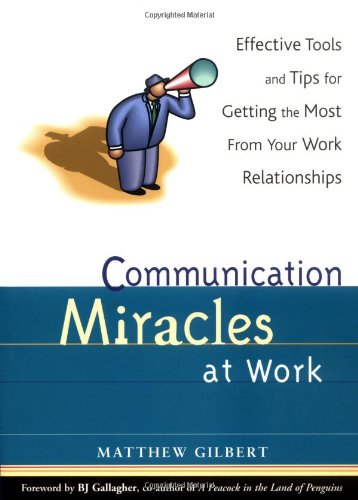
Communication Miracles at Work: Effective Tools and Tips for Getting the Most from Your Work Relationships - Softcover
Inhaltsangabe
Communication Miracles at Work is about experiencing breakthrough moments of connectedness and understanding with coworkers, managers, staff members, and clients. Developed out of Matthew Gilbert's experience as an employee, communication consultant, manager, and facilitator, Communication Miracles at Work will help readers develop effective communication and relationshipbuilding skills for achieving workplace harmony.
Topics include the "corporate culture" and how it enhances or hinders the ability of people to get along, the role of stress in ineffective communication, issues of gender in talking and listening, and how to use good communication in everyday situations. Readers are carefully guided toward seeing their own personal obstacles around communicating and are given effective tools on how to make almost any workplace encounter an opportunity for personal and spiritual growth.
This book is for anyone who wants to have a better daytoday experience at work, reaching out to people wherever they are on the corporate ladder, from those just entering the workforce to more experienced workers to managers and CEOs.
Die Inhaltsangabe kann sich auf eine andere Ausgabe dieses Titels beziehen.
Über die Autorin bzw. den Autor
Matthew Gilbert was the managing;executive editor of a publishing trade magazine for six years and has been a manager and consultant for many small companies. He has written extensively on business, psychology, and spirituality and is the author of Communication Miracles at Work and Take This Job and Love It. Gilbert is now the editorinchief at the Institute of Noetic Sciences and lives in California with his wife and their two cats.
Auszug. © Genehmigter Nachdruck. Alle Rechte vorbehalten.
Communication Miracles at Work
Effective Tools and Tips for Getting the Most from your Work Relationships
By Mathew GilbertRed Wheel/Weiser, LLC
Copyright © 2002 Mathew Gilbert
All rights reserved.
ISBN: 978-1-57324-802-0All rights reserved.
Contents
| Foreword by BJ Gallagher | |
| Introduction | |
| CHAPTER ONE Workplace Cultures | |
| CHAPTER TWO Why Am I So Mad? | |
| CHAPTER THREE The Gender Factor | |
| CHAPTER FOUR Getting Along with coworkers | |
| CHAPTER FIVE Communicating Up and Down the Ladder | |
| CHAPTER SIX Treating Customers as Human Beings | |
| CHAPTER SEVEN Working in Groups | |
| CHAPTER EIGHT What the Best Companies Are Doing | |
| CHAPTER NINE Who Do You Want Be? | |
| Resources | |
| Acknowledgments | |
| Index | |
| About the Author |
CHAPTER 1
"Thinking about corporate culture might sound somewhat 'touchy feely,' but Iwould argue that few characteristics are more important to a company's success."
—The Motley Fool, a financial website
"We must learn to live together as brothers or perish together as fools."
—Martin Luther King. Jr.
Workplace Cultures
Before exploring workplace communication or the potential for miracles, let'sfirst talk about the workplace itself and how it has (and hasn't) changed overthe years. If you watch old movies, for example, you'll notice that mostcompanies were depicted as pretty straitlaced, with lots of earnest men in theirstarched white shirts and conservative ties performing their narrow butimportant roles with a steadfast commitment. There were specific rules, chainsof command, and the general drone of commerce without much variation. It was atime when companies like Ford, IBM, and General Electric ruled the Westernworld, where you took what these paternal giants gave you and were happy just tobe a productive cog in the economic machine.
No more.
Today, with more women in the workforce, more autonomy for employees, partneringand teamwork, flextime and job shares, and growing multicultural diversity, theworkplace bears little resemblance to the one to which our fathers made alifetime commitment. Workplaces are changing with the times, spurred also by aflood of new strategies for getting more out of less: hierarchy leveling,quality circles, theories Y and Z, "best practices," and the list goes on. Thegoal of these strategies has been to improve workplace performance while givingmanagement—and employees—more of that they need.
And yet despite all that effort and adaptation and, for many workers, growingwages, job satisfaction remains surprisingly low:
• A study completed in 2000 by The Conference Board, a nonprofit membershiporganization for business executives, found that almost half of all workersweren't happy with their jobs.
• A recent study of 1000 workers commissioned by Headhunter.net found that 78percent of them would take a new position if the right opportunity came along,while 48 percent were actively looking for a new job.
• The Bureau of Labor Statistics reports that American workers hold on averagenine different jobs before the age of thirty-two (which isn't all that amazingif you think about how many restaurant jobs you had before the age of twenty!).
According to these and other reports, the most frequently cited reasons that weleave our jobs, or would like to, include a lack of recognition, salary issues,a weak sense of purpose or mission, few opportunities for advancement, andinsufficient training. Many people surveyed also reported a drop in satisfactionwith their workplace relationships, historically a key component of jobenjoyment.
And yet workplace benefits have never been more generous. Companies are goingout of their way to meet their employees' needs, sometimes out of a true senseof giving, sometimes as a desperate measure to keep staff, and sometimes as aresponse when cries for change can no longer be ignored. Many of these changesare designed to help working folks better integrate their personal lives withtheir professional lives. And still they don't seem to be enough.
What's going on here? From what well does such deep dissatisfaction draw?
Sure, there are legitimate problems in our workplaces, many of which will bediscussed in the pages that follow. Workplace stress, much of it fueled bydysfunctional relationships and communication breakdowns, has never been higher.But maybe we're asking for too much from our jobs. Should work be all things toall people? Can it be? Are acknowledgment, a big paycheck, limitless potential,and limited hassles more than any company should be expected to give?
Wanting It All
In 1943, psychologist Abraham Maslow presented his famous "hierarchy of needs"theory. At the bottom of the pyramid are the basics: food, water, shelter. Thenthere is safety and security (money). Next come social needs (a sense ofbelonging, love), then ego needs (self-esteem, respect from others), and finallyself-actualization—achieving our highest potential. It was a process he feltthat all human beings are born to follow, the natural stages of humanmaturation. But is it a process that stops at the office door? Perhaps it'sunrealistic to think that we can meet all our higher needs at our jobs. Thereare many who believe that our expectations have simply become too high, that ourjobs were never meant to provide much more than a fair wage and a reasonablypleasant place to work.
This claim was best expressed in a provocative article entitled "The Myth of JobHappiness" In Workforce, a magazine for "human resource" professionals. Itquoted both an author and a professor defending the notion that the problem ofworkplace dissatisfaction lies not with the companies but with their workers.The author, Dave Arnott (who wrote Corporate Cults: The Insidious Lure of theAll-Consuming Organization), believes that "employees are expecting the wrongthings from the workplace. They are expecting emotional satisfaction from work,not just financial satisfaction."
Professor of leisure studies Benjamin Hunnicutt goes even further, stating,"It's a myth that we can find identity, meaning, and community at work." Hecalls this the "Mary Tyler Moore myth," a reference to the optimistic heroine oftelevision sitcom fame. "In reality," he says, "employees find dullards andirrational bosses" because the politics of work "is about control."
Well, he's right up to a point. But the whole purpose of what came to be calledby management theorists the "human relations movement" was to counteract thetask-oriented models of workplace performance with a more people-centeredperspective. And while it's also true that work has taken up more and more spacein our lives, what's wrong with a company with a healthy sense of community,where people working together can stretch for something larger than the nextpaycheck? Our jobs shouldn't supplant a healthy life outside of work wherefamily, friends, and being in nature take precedent, but if we leave too much ofourselves at home, our performance at work can only suffer, and so too will thecompany that employs us.
And don't assume that companies or groups whose primary mission is to save theworld have it any easier. These workplaces can be just as dysfunctional as...
„Über diesen Titel“ kann sich auf eine andere Ausgabe dieses Titels beziehen.
Suchergebnisse für Communication Miracles at Work: Effective Tools and...

Beispielbild für diese ISBN
Communication Miracles at Work: Effective Tools and Tips for Getting the Most from Your Work Relationships
Anbieter: World of Books (was SecondSale), Montgomery, IL, USA
Verkäuferbewertung 5 von 5 Sternen

Paperback. Zustand: Good. Communication Miracles at Work is about experiencing breakthrough moments of connectedness and understanding with coworkers, managers, staff members, and clients. Developed out of Matthew Gilbert's experience as an employee, communication consultant, manager, and facilitator, Communication Miracles at Work will help readers develop effective communication and relationshipbuilding skills for achieving workplace harmony.Topics include the corporate culture and how it enhances or hinders the ability of people to get along, the role of stress in ineffective communication, issues of gender in talking and listening, and how to use good communication in everyday situations. Readers are carefully guided toward seeing their own personal obstacles around communicating and are given effective tools on how to make almost any workplace encounter an opportunity for personal and spiritual growth.This book is for anyone who wants to have a better daytoday experience at work, reaching out to people wherever they are on the corporate ladder, from those just entering the workforce to more experienced workers to managers and CEOs. Artikel-Nr. 00098691650
Gebraucht kaufen
EUR 5,67
Versand gratis
Versand innerhalb von USA
Versand innerhalb von USA
Anzahl: 2 verfügbar
Beispielbild für diese ISBN
Communication Miracles at Work : Effective Tools and Tips for Getting the Most from Your Work Relationships
Verlag:
Mango Media, 2002
ISBN 10: 1573248029
ISBN 13: 9781573248020
Gebraucht
Softcover
Erstausgabe
Anbieter: Better World Books, Mishawaka, IN, USA
Verkäuferbewertung 5 von 5 Sternen
Zustand: Fine. 1st. Used book that is in almost brand-new condition. May contain a remainder mark. Better World Books: Buy Books. Do Good. Artikel-Nr. 17924324-20
Gebraucht kaufen
EUR 6,17
Versand gratis
Versand innerhalb von USA
Versand innerhalb von USA
Anzahl: 1 verfügbar
Beispielbild für diese ISBN
Communication Miracles at Work : Effective Tools and Tips for Getting the Most from Your Work Relationships
Verlag:
Mango Media, 2002
ISBN 10: 1573248029
ISBN 13: 9781573248020
Gebraucht
Softcover
Erstausgabe
Anbieter: Better World Books: West, Reno, NV, USA
Verkäuferbewertung 5 von 5 Sternen
Zustand: Very Good. 1st. Former library copy. Pages intact with possible writing/highlighting. Binding strong with minor wear. Dust jackets/supplements may not be included. Includes library markings. Stock photo provided. Product includes identifying sticker. Better World Books: Buy Books. Do Good. Artikel-Nr. 8887023-75
Gebraucht kaufen
EUR 6,17
Versand gratis
Versand innerhalb von USA
Versand innerhalb von USA
Anzahl: 1 verfügbar
Beispielbild für diese ISBN
Communication Miracles at Work : Effective Tools and Tips for Getting the Most from Your Work Relationships
Verlag:
Mango Media, 2002
ISBN 10: 1573248029
ISBN 13: 9781573248020
Gebraucht
Softcover
Erstausgabe
Anbieter: Better World Books, Mishawaka, IN, USA
Verkäuferbewertung 5 von 5 Sternen
Zustand: Very Good. 1st. Pages intact with possible writing/highlighting. Binding strong with minor wear. Dust jackets/supplements may not be included. Stock photo provided. Product includes identifying sticker. Better World Books: Buy Books. Do Good. Artikel-Nr. 8439984-6
Gebraucht kaufen
EUR 6,17
Versand gratis
Versand innerhalb von USA
Versand innerhalb von USA
Anzahl: 1 verfügbar
Beispielbild für diese ISBN
Communication Miracles at Work: Effective Tools and Tips for Getting the Most from Your Work Relationships
Anbieter: ThriftBooks-Dallas, Dallas, TX, USA
Verkäuferbewertung 5 von 5 Sternen
Paperback. Zustand: Good. No Jacket. Pages can have notes/highlighting. Spine may show signs of wear. ~ ThriftBooks: Read More, Spend Less. Artikel-Nr. G1573248029I3N00
Gebraucht kaufen
EUR 6,29
Versand gratis
Versand innerhalb von USA
Versand innerhalb von USA
Anzahl: 1 verfügbar
Beispielbild für diese ISBN
Communication Miracles at Work: Effective Tools and Tips for Getting the Most from Your Work Relationships
Verlag:
Conari Press (edition First Edition), 2002
ISBN 10: 1573248029
ISBN 13: 9781573248020
Neu
Paperback
Erstausgabe
Anbieter: BooksRun, Philadelphia, PA, USA
Verkäuferbewertung 5 von 5 Sternen
Paperback. Zustand: New. First Edition. The item is brand new, never used or read. It's in perfect condition and may include supplements and/or access codes or come shrink-wrapped. Artikel-Nr. 1573248029-10-1
Beispielbild für diese ISBN
Communication Miracles at Work: Effective Tools and Tips for Getting the Most from Your Work Relationships
Anbieter: Anybook.com, Lincoln, Vereinigtes Königreich
Verkäuferbewertung 5 von 5 Sternen
Zustand: Poor. This is an ex-library book and may have the usual library/used-book markings inside.This book has soft covers. In poor condition, suitable as a reading copy. Please note the Image in this listing is a stock photo and may not match the covers of the actual item,350grams, ISBN:9781573248020. Artikel-Nr. 5973360
Gebraucht kaufen
EUR 9,99
EUR 15,55 Versand
Versand von Vereinigtes Königreich nach USA
Versand von Vereinigtes Königreich nach USA
Anzahl: 1 verfügbar
Beispielbild für diese ISBN
Communication Miracles at Work: Effective Tools and Tips for Getting the Most from Your Work Relationships
Anbieter: Revaluation Books, Exeter, Vereinigtes Königreich
Verkäuferbewertung 5 von 5 Sternen
Paperback. Zustand: Brand New. 246 pages. 6.75x5.00x0.50 inches. In Stock. Artikel-Nr. 1573248029
Neu kaufen
EUR 21,66
EUR 11,92 Versand
Versand von Vereinigtes Königreich nach USA
Versand von Vereinigtes Königreich nach USA
Anzahl: 1 verfügbar