
Verwandte Artikel zu Meatonomics: How the Rigged Economics of Meat and Dairy...
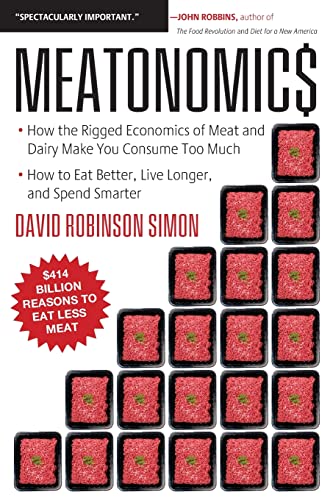
Meatonomics: How the Rigged Economics of Meat and Dairy Make You Consume Too Much―and How to Eat Better, Live Longer, and Spend Smarter (Men Birthday Gift, for Readers of Comfortably Unaware) - Softcover
Inhaltsangabe
Stop Being Manipulated by the Animal Foods Industry
Stop the meat industry from eating into your wallet. Few Americans are aware of the realities of the economic system that supports our country's supply of animal foods. Yet these forces affect us in ways we can hardly imagine. Though we only fork over a few dollars per pound of meat products at the grocery store, we end up paying much more than that in tax dollar-fueled government subsidies—$38 billion more, to be exact. And that's just one layer of hidden costs. But with the help of sustainability advocate and author David Robinson Simon's Meatonomics, we can come up with informed, lasting solutions.
Improve your health, your life—and the world. Animal food producers influence our buying choices with artificially low prices, misleading messages, and heavy legislation and regulation control. But learning how these forces work can help you improve both your personal life and the world in so many important ways. Life-changing foods like those in a plant-based diet will do more than just improve your waistline. The information in Meatonomics can help you save money, lose weight, live longer, boost your health, protect animals and the planet from abuse, and preserve rural communities worldwide.
Learn to make better, more informed decisions on what to buy and how to eat. In Meatonomics, Dr. David Robinson Simon uses his excellent truth-finding skills, garnered from his expertise as a lawyer, to show you:
- How government marketing is influencing what we think of as healthy eating
- Just how much of our money is being burnt through by the meat production industry
- What we can do to change ourselves and our country for the better
If you were fascinated by sustainable food and healthy eating books like Proteinaholic, Eating Animals, or How Not to Die, you'll be empowered to overcome the meat industry's manipulation with Meatonomics.
Die Inhaltsangabe kann sich auf eine andere Ausgabe dieses Titels beziehen.
Über die Autorin bzw. den Autor
David Robinson Simon is a lawyer and advocate for sustainable consumption. He works as general counsel for a healthcare company and serves on the board of the APRL Fund, a nonprofit dedicated to protecting animals.
David received his B.A. from U.C. Berkeley and his J.D. from the University of Southern California. He is also the author of New Millennium Law Dictionary, a full English legal dictionary. He lives in Southern California with his partner, artist Tania Marie, and their rabbit, tortoise, and two cats.
Auszug. © Genehmigter Nachdruck. Alle Rechte vorbehalten.
MEATONOMICS
How the Rigged Economics of Meat and Dairy Make You Consume Too Much-and How to Eat Better, Live Longer, and Spend Smarter
By David Robinson SimonRed Wheel/Weiser, LLC
Copyright © 2013 David Robinson Simon
All rights reserved.
ISBN: 978-1-57324-620-0All rights reserved.
Contents
Author's Note,
Introduction,
Part I: Influencing the Consumer,
1. The Brave New World of Government Marketing,
2. Massaging the Message: Shaping Consumer Beliefs,
3. Sausage Making and Lawmaking: Influence in the Political Process,
4. Regulatory Conflict and Consumer Confusion,
Part II: The Hidden Costs of Meatonomics,
5. Feeding at the Subsidy Trough,
6. Diseases and Doctor Bills,
7. The Sustainability Challenge,
8. The Costs of Cruelty,
9. Fishing Follies,
10. Recipes for Change,
Acknowledgments,
Appendix A: Animal Foods and Human Health,
Appendix B: Summary of the Annual Externalized Costs of US Animal Food,
Production (in billions),
Appendix C: Economic Effects of Proposed Meat Tax and Support Changes,
Appendix D: Factory Farming Practices,
Endnotes,
Index,
CHAPTER 1
The Brave New World of Government Marketing
In his 1932 novel Brave New World, Aldous Huxley imagined a future in whichhumans exist solely to support the economy and are conditioned from birth to buythings. Government bureaucrats manipulate the sheep-like citizens with drugs andslogans to make them consume as much as possible. In Huxley's vision, 26th-centuryconsumers learn that "ending is better than mending" and "the morestitches, the less riches"—that is, buying new things is better than fixing oldones. But for US consumers, this eerie futuristic fantasy—with government usingmarketing slogans and other undue influence to drive consumption—has arrived afew centuries early. This chapter explores government marketing as a feature ofmeatonomics and considers its consequences for consumers.
Checkoff Programs: Unseen and Unknown, But Felt Everywhere
In the Brave New World of the 21st century—where big box stores and mega marketsdominate the landscape—our government uses innocuous-sounding "checkoff"programs to encourage us to buy more animal foods and other goods. Themechanism's name persists from a time when the assessments were voluntary andproducers willing to opt in participated by simply checking a box. Nowadays, theprograms are tax-like and mandatory, even though the benign checkoff monikerremains.
The way they work is simple: Congress slaps a small assessment (less than 1percent of wholesale price) on certain commodities, and the collected funds areused to pay for research and marketing programs that boost the goods' sales. Sowhen animal food producers collect $1 per head of cattle, $0.40 per $100 ofpork, or $0.15 per 100 pounds of dairy, they pass those funds on to nationalmarketing organizations. The proceeds are allocated among state and regionalindustry organizations throughout the country. There aren't many Boston TeaParty–like protests when it comes to making the payments—probably because mostconsumers don't know about checkoffs and most producers think their trade groupsput the money to good use. These trade groups don't equivocate much about whatthey do or why they exist. The Kentucky Cattlemen's Association, for example,keeps it simple, saying its business purpose is "Promotion of the beefindustry."
Although few Americans have heard of checkoff programs, we've all heard or seenthe catchy, feel-good slogans they've generated:
Beef. It's What's for Dinner.
Milk. It Does a Body Good.
Pork. The Other White Meat.
Written, spoken, or sung—and flashed across every medium, including print,radio, TV, and the Internet—these statements have bombarded American consumersfor decades. The echo of one particularly snappy jingle that went with aubiquitous 1990s commercial—"The Incredible, Edible Egg"—still rattles in mybrain. And while that phrase and many others predate social networking, theypersist because their sticky messaging fits in perfectly with today's meme-saturated,web-dominated world. Like an ink stamp, these messages imprintthemselves with authority on our subconscious and become part of our beliefsystem. What's for dinner? Without even knowing why, many think, Beef.
Across the board, animal food checkoff programs are remarkably effective atmaking us buy more than we would otherwise. According to the USDA, for eachdollar of checkoff funds spent promoting animal foods, "the return on investmentcan range as high as $18." The beef checkoff program raises sales by $5 percheckoff dollar spent. The pork checkoff program drives $14 in sales per dollarspent. While it may not boast a memorable motto, the lamb checkoff provides anunusually huge boost, driving additional sales of $38, or seven extra pounds oflamb, for each dollar spent on promotion. But the biggest winner might be thedairy industry, which recently boasted that over a year and a half, checkoffefforts contributed to more than 7 billion additional pounds of milk sold.That's an extra forty-seven servings of dairy per person in the United States—aboveand beyond the hundreds of servings we would have consumed anyway duringthe period. Clearly, milk is up to more than just doing a body good.
All told, these programs provide funding of $557 million yearly for animal foodproducers to promote their goods. This massive, government-mandated marketingbudget gives the meatonomic system something few other microeconomic systemshave: an exceedingly deep marketing war chest, deployed to boost sales of allgoods from all producers in the program. A few other commodities, like cottonand soybeans, have checkoff programs of their own. Yet in every other industry,except for those lucky enough to have a checkoff program, individualcorporations must fork out their own funds to increase sales rather than rely ongovernment programs to prop up their numbers. With meatonomics, on the otherhand, the effect of checkoff programs is that we all buy more of nearly everyconceivable animal food than we would otherwise. Like a diner with an insatiableappetite, the animal food industry relishes the higher sales that result. Dairypromoters brag that since their checkoff program started in 1983, annual percapita consumption of milk "has climbed 12 percent to 620 pounds."
Some say checkoff programs have been unfairly linked to government and areactually just the tools of good old-fashioned capitalism. They argue thesecheckoff arrangements involve only private firms who pool advertising monieswithout government participation, and their mission and methods are no differentfrom those of any private advertiser. However, the US Supreme Court decisivelyrejected this position in a 2005 case involving the beef checkoff. In Johanns v.Livestock Marketing Association, beef industry participants who disagreed withthe message of the latest beef campaign claimed that being forced to fund itviolated their right of free speech. The Supreme Court disagreed, holding themessage was actually government speech (a form of speech the government can makeothers support). The court said:
The message set out in the beef promotions is from beginning to end the messageestablished by the Federal Government.... Congress and the Secretary [of theUSDA] have set out the overarching message and some of its elements, and theyhave left the development of the remaining...
„Über diesen Titel“ kann sich auf eine andere Ausgabe dieses Titels beziehen.
Suchergebnisse für Meatonomics: How the Rigged Economics of Meat and Dairy...

Beispielbild für diese ISBN
Meatonomics: How the Rigged Economics of the Meat and Dairy Industries are Encouraging You to Consume Way More Than You Should-and How to Eat Better, Live Longer, and Spend Smarter
Verlag:
Turner Publishing Company, 2013
ISBN 10: 1573246204
ISBN 13: 9781573246200
Gebraucht
Paperback
Anbieter: World of Books (was SecondSale), Montgomery, IL, USA
Verkäuferbewertung 5 von 5 Sternen

Paperback. Zustand: Good. MEATONOMICS is the first book to fully explore the murky economics underlying animal food production and its revelations are shocking. Like Freakonomics, it demonstrates how seemingly bizarre economic forces impact our everyday lives - how we're all subject to incentives no matter how counter-intuitive they may appear. Artikel-Nr. 00097100178
Gebraucht kaufen
EUR 4,75
Versand gratis
Versand innerhalb von USA
Versand innerhalb von USA
Anzahl: 3 verfügbar
Beispielbild für diese ISBN
Meatonomics : How the Rigged Economics of Meat and Dairy Make You Consume Too Much?and How to Eat Better, Live Longer, and Spend Smarter (Men Birthday Gift, for Readers of Comfortably Unaware)
Anbieter: Better World Books, Mishawaka, IN, USA
Verkäuferbewertung 5 von 5 Sternen
Zustand: Good. Former library copy. Pages intact with minimal writing/highlighting. The binding may be loose and creased. Dust jackets/supplements are not included. Includes library markings. Stock photo provided. Product includes identifying sticker. Better World Books: Buy Books. Do Good. Artikel-Nr. 4150636-75
Gebraucht kaufen
EUR 6,20
Versand gratis
Versand innerhalb von USA
Versand innerhalb von USA
Anzahl: 2 verfügbar
Beispielbild für diese ISBN
Meatonomics : How the Rigged Economics of Meat and Dairy Make You Consume Too Much?and How to Eat Better, Live Longer, and Spend Smarter (Men Birthday Gift, for Readers of Comfortably Unaware)
Anbieter: Better World Books, Mishawaka, IN, USA
Verkäuferbewertung 5 von 5 Sternen
Zustand: Very Good. Former library copy. Pages intact with possible writing/highlighting. Binding strong with minor wear. Dust jackets/supplements may not be included. Includes library markings. Stock photo provided. Product includes identifying sticker. Better World Books: Buy Books. Do Good. Artikel-Nr. 14069506-6
Gebraucht kaufen
EUR 6,20
Versand gratis
Versand innerhalb von USA
Versand innerhalb von USA
Anzahl: 2 verfügbar
Beispielbild für diese ISBN
Meatonomics : How the Rigged Economics of Meat and Dairy Make You Consume Too Much?and How to Eat Better, Live Longer, and Spend Smarter (Men Birthday Gift, for Readers of Comfortably Unaware)
Anbieter: Better World Books, Mishawaka, IN, USA
Verkäuferbewertung 5 von 5 Sternen
Zustand: Very Good. Pages intact with possible writing/highlighting. Binding strong with minor wear. Dust jackets/supplements may not be included. Stock photo provided. Product includes identifying sticker. Better World Books: Buy Books. Do Good. Artikel-Nr. 14265706-6
Gebraucht kaufen
EUR 6,20
Versand gratis
Versand innerhalb von USA
Versand innerhalb von USA
Anzahl: 1 verfügbar
Beispielbild für diese ISBN
Meatonomics : How the Rigged Economics of Meat and Dairy Make You Consume Too Much?and How to Eat Better, Live Longer, and Spend Smarter (Men Birthday Gift, for Readers of Comfortably Unaware)
Anbieter: Better World Books, Mishawaka, IN, USA
Verkäuferbewertung 5 von 5 Sternen
Zustand: Good. Pages intact with minimal writing/highlighting. The binding may be loose and creased. Dust jackets/supplements are not included. Stock photo provided. Product includes identifying sticker. Better World Books: Buy Books. Do Good. Artikel-Nr. 8204443-6
Gebraucht kaufen
EUR 6,20
Versand gratis
Versand innerhalb von USA
Versand innerhalb von USA
Anzahl: 1 verfügbar
Beispielbild für diese ISBN
Meatonomics: How the Rigged Economics of Meat and Dairy Make You Consume Too Much?and How to Eat Better, Live Longer, and Spend Smarter (Men Bir
Anbieter: ThriftBooks-Dallas, Dallas, TX, USA
Verkäuferbewertung 5 von 5 Sternen
Paperback. Zustand: Very Good. No Jacket. Missing dust jacket; May have limited writing in cover pages. Pages are unmarked. ~ ThriftBooks: Read More, Spend Less. Artikel-Nr. G1573246204I4N01
Gebraucht kaufen
EUR 6,44
Versand gratis
Versand innerhalb von USA
Versand innerhalb von USA
Anzahl: 1 verfügbar
Beispielbild für diese ISBN
Meatonomics: How the Rigged Economics of Meat and Dairy Make You Consume Too Much?and How to Eat Better, Live Longer, and Spend Smarter (Men Bir
Anbieter: ThriftBooks-Dallas, Dallas, TX, USA
Verkäuferbewertung 5 von 5 Sternen
Paperback. Zustand: Very Good. No Jacket. May have limited writing in cover pages. Pages are unmarked. ~ ThriftBooks: Read More, Spend Less. Artikel-Nr. G1573246204I4N00
Gebraucht kaufen
EUR 6,44
Versand gratis
Versand innerhalb von USA
Versand innerhalb von USA
Anzahl: 1 verfügbar
Beispielbild für diese ISBN
Meatonomics: How the Rigged Economics of Meat and Dairy Make You Consume Too Much?and How to Eat Better, Live Longer, and Spend Smarter (Men Bir
Anbieter: ThriftBooks-Atlanta, AUSTELL, GA, USA
Verkäuferbewertung 5 von 5 Sternen
Paperback. Zustand: Very Good. No Jacket. Former library book; May have limited writing in cover pages. Pages are unmarked. ~ ThriftBooks: Read More, Spend Less. Artikel-Nr. G1573246204I4N10
Gebraucht kaufen
EUR 6,44
Versand gratis
Versand innerhalb von USA
Versand innerhalb von USA
Anzahl: 1 verfügbar
Beispielbild für diese ISBN
Meatonomics: How the Rigged Economics of Meat and Dairy Make You Consume Too Much?and How to Eat Better, Live Longer, and Spend Smarter (Men Bir
Anbieter: ThriftBooks-Atlanta, AUSTELL, GA, USA
Verkäuferbewertung 5 von 5 Sternen
Paperback. Zustand: Very Good. No Jacket. May have limited writing in cover pages. Pages are unmarked. ~ ThriftBooks: Read More, Spend Less. Artikel-Nr. G1573246204I4N00
Gebraucht kaufen
EUR 6,44
Versand gratis
Versand innerhalb von USA
Versand innerhalb von USA
Anzahl: 1 verfügbar
Beispielbild für diese ISBN
Meatonomics: How the Rigged Economics of Meat and Dairy Make You Consume Too Much?and How to Eat Better, Live Longer, and Spend Smarter (Men Birthday Gift, for Readers of Comfortably Unaware)
Anbieter: WorldofBooks, Goring-By-Sea, WS, Vereinigtes Königreich
Verkäuferbewertung 5 von 5 Sternen
Paperback. Zustand: Good. The book has been read but remains in clean condition. All pages are intact and the cover is intact. Some minor wear to the spine. Artikel-Nr. GOR010013113
Gebraucht kaufen
EUR 3,97
EUR 6,69 Versand
Versand von Vereinigtes Königreich nach USA
Versand von Vereinigtes Königreich nach USA
Anzahl: 1 verfügbar