
Verwandte Artikel zu Communication Miracles for Couples: Easy and Effective...
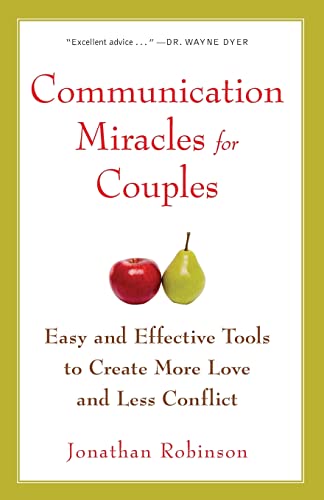
Communication Miracles for Couples: Easy and Effective Tools to Create More Love and Less Conflict - Softcover
Inhaltsangabe
Restore Your Relationship, Enhance Your Marriage
New York Times Bestseller
#1 Bestseller in Marriage & Family, Family Relationships, and Divorce
Cultivate effective communication and a lasting relationship. Communication Miracles for Couples by psychotherapist, popular professional speaker, and bestselling author Jonathan Robinson has helped hundreds of thousands of couples repair their relationships and their marriages. Continuously in print since 1997, Communication Miracles for Couples has sold over 100,000 copies. Whether you are looking to enhance your relationship or want to resolve existing conflict, successful techniques taught by Jonathan Robinson can help you develop effective communication and a lasting relationship with a spouse or partner.
Honeymoon gift, anniversary gift, or just a gift for him or her. Create lasting harmony and keep love alive with Jonathan Robinson's powerful and effective methods for relationship communication. He has reached over 250 million people around the world with his practical methods, and his work has been translated into 47 languages. Learn how to enhance your relationship by learning to communicate with less blame and more understanding.
Find a deeper happiness in your relationship:
- Feel totally loved
- Never argue again
- Have your partner really hear you
- Repair broken trust
If you have read books such as 4 Essential Keys to Effective Communication in Love, Life, Work─Anywhere; The 5 Love Languages; Mindful Relationship Habits; Communication in Marriage; or Couple Skills; you will love what Jonathan Robinson’s Communication Miracles for Couples does for your relationship.
Die Inhaltsangabe kann sich auf eine andere Ausgabe dieses Titels beziehen.
Über die Autorin bzw. den Autor
Jonathan Robinson is a psychotherapist, best-selling author and a professional speaker from Northern California. He has reached over 250 million people around the world with his practical methods, and his work has been translated into 47 languages. Articles about Jonathan have appeared in USA TODAY, Newsweek, and the Los Angeles Times, as well as dozens of other publications. In addition, Mr. Robinson has made numerous appearances on the Oprah show and CNN, as well as other national TV talk shows. He has spent over 35 years studying the most practical and powerful methods for personal and professional development.
Mr. Robinson's first book, The Experience of God, included interviews with such notable people as the late Mother Teresa, the Dalai Lama, Deepak Chopra, Scott Peck, and over 30 other well-known seekers. Jonathan's second book, Life's Big Questions, became a New York Times bestseller, as did his book Communication Miracles for Couples. Mr. Robinson's other books include: Instant Insight; Real Wealth; Shortcuts to Bliss; Shortcuts to Success, The Complete Idiot's Guide to Awakening Your Spirituality, and Terror Proof Your Mind and Money.
As a professional speaker, Mr. Robinson has spoken to many of the Fortune 500 companies. He is known for providing his audiences with immediately useful and powerful information, presented in an entertaining and motivating manner.
Auszug. © Genehmigter Nachdruck. Alle Rechte vorbehalten.
Communication Miracles for Couples
Easy and Effective Ways to Create More Love and Less Conflict
By Jonathan RobinsonRed Wheel/Weiser, LLC
Copyright © 1997 Jonathan Robinson
All rights reserved.
ISBN: 978-1-57324-583-8All rights reserved.
Contents
| Introduction | |
| What Is a Communication Miracle? | |
| Part One: Creating Intimacy | |
| 1. What We All Want (But Never Ask For) | |
| 2. Charming Your Partner's Heart | |
| 3. Creating Love Beyond Words | |
| Part Two: Avoiding Fights | |
| 4. Would You Rather Be Right or Be Loved? | |
| 5. How to Never Argue Again | |
| 6. Speaking Your Vulnerable Truth | |
| 7. The Best Way to Create Lasting Harmony | |
| Part Three: Solving Problems Without Bruising Egos | |
| 8. How to Get Your Partner to Really Hear You | |
| 9. How to Get Your Partner to Really Change | |
| 10. Negotiating Your Way Past Any Problem | |
| 11. Repairing Broken Trust | |
| 12. Keeping Love Alive Long-Term | |
| 13. Exercises for Communication Mastery | |
| 14. Reminder Cards | |
| Acknowledgments |
CHAPTER 1
What We All Want (But Never Ask For)
No act of kindness, no matter how small, is ever wasted.
—AESOP
In order to get the most out of your car, it helps to know what it needs to operateeffectively. You need to know what fuel and oil it uses, and how to get things fixed whenit's not running right. The same is true for human beings. Luckily, at our core, all humanbeings are pretty much the same. We all want the three As: acknowledgment,appreciation, and acceptance. In fact, the three As are like high-octane gasoline thatmakes the human personality run. They are the essential ingredients that convey lovefrom one person to another. Without them we become defensive and refuse to let anyonein. If you want to have a great relationship, you will first have to satisfy your partner'sneeds for acknowledgment, appreciation, and acceptance. And the more effectively youcan help him feel loved, the more loving he will be toward you.
I've created a metaphor that I find helpful in explaining how the human personality works. Icall it "the self-esteem bank account." I define self-esteem as the degree to which aperson feels good about herself in any given moment. Let's say the average person hasabout ten "dollars" in her self-esteem bank account. When people have only two dollars intheir bank account, they become violent. In newspapers, we read about people who wentberserk when someone simply looked at them the wrong way. These people were at two"dollars" of self-esteem. When people are at zero "dollars" of self-esteem, they often try tokill themselves. With only ten "dollars" of self-esteem, we're highly motivated to not lose orspend any of our meager supply. Yet, the way we tend to go about protecting our accountis almost always ineffective.
When couples are having difficulty, they inevitably blame their partner. Blame is a way oftrying to "take" self-esteem "dollars" from your partner and give them to yourself.Unfortunately, this results in your partner feeling attacked, who then proceeds to blameand insult you in self-defense: "You think I'm selfish, you should look in the mirror. You'rethe one who everyone thinks is selfish!" The cycle goes on. Have you ever been in one ofthese downward spirals? I sure have. It's no fun at all. Neither partner ends up getting thelove and respect they really want.
Even if your partner is very upset, the key to get him to be able to hear you is to give himplenty of acknowledgment, appreciation, and acceptance. The three As are like depositsfor your partner's self-esteem bank account. When you give your mate the three As, hisself-esteem bank "balance" temporarily goes up. As his bank balance goes up, he willnaturally become more loving, more giving, and better able to listen. Therefore, when yourpartner is feeling stressed, the best thing you can do is make a "deposit" into hisselfesteem bank account. Almost like magic, he will become more agreeable toward you.As he is better able to listen to you with love, you'll feel better too. The destructive cyclewill be over.
Bob and Jill came to see me for counseling as a last measure before filing for divorce. Boband Jill were what I call "subtle blamers." They never shouted or called each other names,but the underlying intention was still to "score points" at their partner's expense. Iexplained to them the concept of the self-esteem bank account, but Jill would still makeher subtle, blaming statements. Each time she did, I would stop her and ask, "Do you thinkBob is more or less likely to listen to you after blaming him like that?" It soon becameobvious to Jill why Bob "never listened" to her.
Jill asked me, "Well, how can I get Bob to hear me?" I told her that Bob will need at leastsome funds in his selfesteem bank account before he can risk listening to you. Isuggested she first acknowledge or fully validate Bob's experience of her. Normally, whenBob told her his point of view or how he felt, Jill would say how wrong and ridiculous hewas. This invalidation of Bob's feelings and reality just made him shut down more. So Iasked Jill, "What's the positive intention behind Bob trying to explain his actions to you?"She responded, "He wants to show me how he's right and I'm always wrong." Thisstatement made me aware Jill was lacking funds in her own self-esteem account, sinceshe was feeling blamed. Therefore, I acknowledged and validated her experience. I said,"I understand you feel blamed by him and I bet that doesn't feel very good." Once I hadacknowledged her experience, she was open to hearing what I had to say.
If, in the previous example, I had told Jill she was wrong about Bob's intention, she wouldnot have been open to hearing me. It's a little-known fact that human beings are equippedwith a secret device in their brain called a "blame detector." When anyone tries to blameus or make us wrong, even in the most subtle manner, our blame detector alarm istriggered. When our alarm goes off, it automatically shuts down the ability of our ears tohear whatever anyone says to us. Had I made Jill wrong for what she said, her ears wouldhave shut down, and I would have been wasting my breath to say anything more. Whenpeople have low funds in their self-esteem account, they need to have their version ofthings be acknowledged before they can hear what you have to say. Acknowledging theirview of things is not the same as agreeing with them—or suggesting they're right andyou're wrong. It simply means you validate their personal experience. You accept thatwhat they say is the truth as they see it.
Once I had acknowledged Jill's view of Bob, I repeated the question, "What do you thinkwas Bob's positive intention of explaining his actions to you?" This time she said, "What doyou mean by positive intention?" I explained that a person's positive intention is what theyultimately want from an action they take. Jill thought about it and finally said, "I guess he'sexplaining himself so I will stop blaming him and finally accept him as he is." Bingo! I toldher that what everyone ultimately wants is to feel acknowledged, appreciated, andaccepted, and the more you give these three...
„Über diesen Titel“ kann sich auf eine andere Ausgabe dieses Titels beziehen.
Suchergebnisse für Communication Miracles for Couples: Easy and Effective...

Beispielbild für diese ISBN
Communication Miracles for Couples: Easy and Effective Tools to Create More Love and Less Conflict
Anbieter: World of Books (was SecondSale), Montgomery, IL, USA
Verkäuferbewertung 5 von 5 Sternen

Paperback. Zustand: Very Good. New York Times Bestseller and #1 Bestseller in Family Relationships, Divorce ─ Restore Your Relationship, Enhance Your MarriageCultivate effective communication and a lasting relationship. Communication Miracles for Couples by psychotherapist, popular professional speaker, and bestselling author Jonathan Robinson has helped hundreds of thousands of couples repair their relationships and their marriages. Continuously in print since 1997, Communication Miracles for Couples has sold over 100,000 copies. Whether you are looking to enhance your relationship or want to resolve existing conflict, successful techniques taught by Jonathan Robinson can help you develop effective communication and a lasting relationship with a spouse or partner.Honeymoon gift, anniversary gift, or just a gift for him or her. Create lasting harmony and keep love alive with Jonathan Robinson's powerful and effective methods for relationship communication. He has reached over 250 million people around the world with his practical methods, and his work has been translated into 47 languages. Learn how to enhance your relationship by learning to communicate with less blame and more understanding.Find a deeper happiness in your relationship: Feel totally lovedNever argue againHave your partner really hear youRepair broken trustIf you have read books such as 4 Essential Keys to Effective Communication in Love, Life, Work─Anywhere; The 5 Love Languages; Mindful Relationship Habits; Communication in Marriage; or Couple Skills; you will love what Jonathan Robinson's Communication Miracles for Couples does for your relationship. Artikel-Nr. 00104695873
Gebraucht kaufen
EUR 3,81
Versand gratis
Versand innerhalb von USA
Versand innerhalb von USA
Anzahl: 12 verfügbar
Beispielbild für diese ISBN
Communication Miracles for Couples: Easy and Effective Tools to Create More Love and Less Conflict
Anbieter: World of Books (was SecondSale), Montgomery, IL, USA
Verkäuferbewertung 5 von 5 Sternen
Paperback. Zustand: Good. New York Times Bestseller and #1 Bestseller in Family Relationships, Divorce ─ Restore Your Relationship, Enhance Your MarriageCultivate effective communication and a lasting relationship. Communication Miracles for Couples by psychotherapist, popular professional speaker, and bestselling author Jonathan Robinson has helped hundreds of thousands of couples repair their relationships and their marriages. Continuously in print since 1997, Communication Miracles for Couples has sold over 100,000 copies. Whether you are looking to enhance your relationship or want to resolve existing conflict, successful techniques taught by Jonathan Robinson can help you develop effective communication and a lasting relationship with a spouse or partner.Honeymoon gift, anniversary gift, or just a gift for him or her. Create lasting harmony and keep love alive with Jonathan Robinson's powerful and effective methods for relationship communication. He has reached over 250 million people around the world with his practical methods, and his work has been translated into 47 languages. Learn how to enhance your relationship by learning to communicate with less blame and more understanding.Find a deeper happiness in your relationship: Feel totally lovedNever argue againHave your partner really hear youRepair broken trustIf you have read books such as 4 Essential Keys to Effective Communication in Love, Life, Work─Anywhere; The 5 Love Languages; Mindful Relationship Habits; Communication in Marriage; or Couple Skills; you will love what Jonathan Robinson's Communication Miracles for Couples does for your relationship. Artikel-Nr. 00101450637
Gebraucht kaufen
EUR 3,81
Versand gratis
Versand innerhalb von USA
Versand innerhalb von USA
Anzahl: 15 verfügbar
Beispielbild für diese ISBN
Communication Miracles for Couples: Easy and Effective Tools to Create More Love and Less Conflict
Anbieter: World of Books (was SecondSale), Montgomery, IL, USA
Verkäuferbewertung 5 von 5 Sternen
Paperback. Zustand: Fair. New York Times Bestseller and #1 Bestseller in Family Relationships, Divorce ─ Restore Your Relationship, Enhance Your MarriageCultivate effective communication and a lasting relationship. Communication Miracles for Couples by psychotherapist, popular professional speaker, and bestselling author Jonathan Robinson has helped hundreds of thousands of couples repair their relationships and their marriages. Continuously in print since 1997, Communication Miracles for Couples has sold over 100,000 copies. Whether you are looking to enhance your relationship or want to resolve existing conflict, successful techniques taught by Jonathan Robinson can help you develop effective communication and a lasting relationship with a spouse or partner.Honeymoon gift, anniversary gift, or just a gift for him or her. Create lasting harmony and keep love alive with Jonathan Robinson's powerful and effective methods for relationship communication. He has reached over 250 million people around the world with his practical methods, and his work has been translated into 47 languages. Learn how to enhance your relationship by learning to communicate with less blame and more understanding.Find a deeper happiness in your relationship: Feel totally lovedNever argue againHave your partner really hear youRepair broken trustIf you have read books such as 4 Essential Keys to Effective Communication in Love, Life, Work─Anywhere; The 5 Love Languages; Mindful Relationship Habits; Communication in Marriage; or Couple Skills; you will love what Jonathan Robinson's Communication Miracles for Couples does for your relationship. Artikel-Nr. 00104365685
Gebraucht kaufen
EUR 3,81
Versand gratis
Versand innerhalb von USA
Versand innerhalb von USA
Anzahl: 3 verfügbar
Beispielbild für diese ISBN
Communication Miracles for Couples: Easy and Effective Tools to Create More Love and Less Conflict
Verlag:
Conari Press (edition 3), 2012
ISBN 10: 1573245836
ISBN 13: 9781573245838
Gebraucht
Paperback
Anbieter: BooksRun, Philadelphia, PA, USA
Verkäuferbewertung 5 von 5 Sternen
Paperback. Zustand: Very Good. 3. It's a well-cared-for item that has seen limited use. The item may show minor signs of wear. All the text is legible, with all pages included. It may have slight markings and/or highlighting. Artikel-Nr. 1573245836-11-1
Gebraucht kaufen
EUR 4,25
Versand gratis
Versand innerhalb von USA
Versand innerhalb von USA
Anzahl: 1 verfügbar
Beispielbild für diese ISBN
Communication Miracles for Couples: Easy and Effective Tools to Create More Love and Less Conflict
Anbieter: ThriftBooks-Reno, Reno, NV, USA
Verkäuferbewertung 5 von 5 Sternen
Paperback. Zustand: Very Good. No Jacket. May have limited writing in cover pages. Pages are unmarked. ~ ThriftBooks: Read More, Spend Less. Artikel-Nr. G1573245836I4N00
Gebraucht kaufen
EUR 5,95
Versand gratis
Versand innerhalb von USA
Versand innerhalb von USA
Anzahl: 1 verfügbar
Beispielbild für diese ISBN
Communication Miracles for Couples: Easy and Effective Tools to Create More Love and Less Conflict
Anbieter: ThriftBooks-Dallas, Dallas, TX, USA
Verkäuferbewertung 5 von 5 Sternen
Paperback. Zustand: Very Good. No Jacket. May have limited writing in cover pages. Pages are unmarked. ~ ThriftBooks: Read More, Spend Less. Artikel-Nr. G1573245836I4N00
Gebraucht kaufen
EUR 5,95
Versand gratis
Versand innerhalb von USA
Versand innerhalb von USA
Anzahl: 2 verfügbar
Beispielbild für diese ISBN
Communication Miracles for Couples: Easy and Effective Tools to Create More Love and Less Conflict
Anbieter: ThriftBooks-Phoenix, Phoenix, AZ, USA
Verkäuferbewertung 5 von 5 Sternen
Paperback. Zustand: Good. No Jacket. Pages can have notes/highlighting. Spine may show signs of wear. ~ ThriftBooks: Read More, Spend Less. Artikel-Nr. G1573245836I3N00
Gebraucht kaufen
EUR 5,95
Versand gratis
Versand innerhalb von USA
Versand innerhalb von USA
Anzahl: 1 verfügbar
Beispielbild für diese ISBN
Communication Miracles for Couples: Easy and Effective Tools to Create More Love and Less Conflict
Anbieter: ThriftBooks-Dallas, Dallas, TX, USA
Verkäuferbewertung 5 von 5 Sternen
Paperback. Zustand: Good. No Jacket. Pages can have notes/highlighting. Spine may show signs of wear. ~ ThriftBooks: Read More, Spend Less. Artikel-Nr. G1573245836I3N00
Gebraucht kaufen
EUR 5,95
Versand gratis
Versand innerhalb von USA
Versand innerhalb von USA
Anzahl: 1 verfügbar
Beispielbild für diese ISBN
Communication Miracles for Couples: Easy and Effective Tools to Create More Love and Less Conflict
Anbieter: ThriftBooks-Atlanta, AUSTELL, GA, USA
Verkäuferbewertung 5 von 5 Sternen
Paperback. Zustand: Good. No Jacket. Pages can have notes/highlighting. Spine may show signs of wear. ~ ThriftBooks: Read More, Spend Less. Artikel-Nr. G1573245836I3N00
Gebraucht kaufen
EUR 5,95
Versand gratis
Versand innerhalb von USA
Versand innerhalb von USA
Anzahl: 1 verfügbar
Beispielbild für diese ISBN
Communication Miracles for Couples: Easy and Effective Tools to Create More Love and Less Conflict
Anbieter: ThriftBooks-Atlanta, AUSTELL, GA, USA
Verkäuferbewertung 5 von 5 Sternen
Paperback. Zustand: Very Good. No Jacket. May have limited writing in cover pages. Pages are unmarked. ~ ThriftBooks: Read More, Spend Less. Artikel-Nr. G1573245836I4N00
Gebraucht kaufen
EUR 5,95
Versand gratis
Versand innerhalb von USA
Versand innerhalb von USA
Anzahl: 2 verfügbar