
Verwandte Artikel zu Breast Cancer: 50 Essential Things to Do (Breast Cancer...
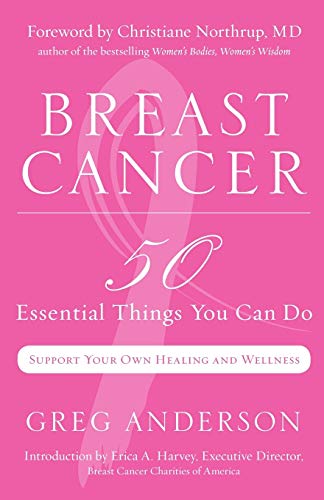
Breast Cancer: 50 Essential Things to Do (Breast Cancer Gift for Women, For Readers of Dear Friend) - Softcover
Inhaltsangabe
A Fully Integrative Approach to Breast Cancer
Your roadmap for facing breast cancer. While recovery and survival rates for breast cancer have improved, the shock and confusion that comes with a diagnosis remains overwhelming, as does choosing a plan of treatment. With so many options out there, each one backed by experts claiming it to be the best, it’s difficult to know the best option for you. This is where an integrated approach comes in, and Greg Anderson, founder of the Cancer Recovery Foundation, is here to help.
A combination of healing tactics. In utilizing a variety of tools for healing, you maximize opportunity for healing. As someone who has been a cancer patient himself, Anderson knows the feeling of being overwhelmed by the possibilities. Because of this, he helps readers form a plan that combines the best of the best: nutrition, exercise, mind/body approaches, and social support along with conventional medical care.
Implement a recovery plan. As a recognized pioneer in the field of integrated cancer care, Anderson offers critical information and advice to readers about the major issues they will face as a patient following a breast cancer diagnosis. Knowing the uncertainty that accompanies the journey, Anderson doesn’t just offer his readers advice, he guides them toward making a concrete, comprehensive recovery plan.
Read Breast Cancer: 50 Essential Things to Do by Greg Anderson and discover:
- A guide to health and healing from one of the world’s leading wellness authorities
- An approach to recovery that calls into question Western medicine’s tendency to overtreat
- Advice for cultivating physical, emotional, and spiritual health
Readers of books such as Dr. Susan Love's Breast Book, Radical Remission, and Heal Breast Cancer Naturally will find a further source of hope and healing in Breast Cancer: 50 Essential Things to Do.
Die Inhaltsangabe kann sich auf eine andere Ausgabe dieses Titels beziehen.
Über die Autorin bzw. den Autor
Greg Anderson is a recognized pioneer in the field of integrated cancer care, and founder and CEO of Cancer Recovery Foundation International, a global affiliation of national charities now operating in the US, Canada, the UK, France, Germany, and Australia.
Anderson is widely recognized as one of the world’s leading wellness authorities. He is the author of eight books which have been translated into 29 languages.
Visit him at: www.CancerRecovery.org
Auszug. © Genehmigter Nachdruck. Alle Rechte vorbehalten.
BREAST CANCER
50 Essential Things You Can Do
By GREG ANDERSONRed Wheel/Weiser, LLC
Copyright © 2011 Greg Anderson
All rights reserved.
ISBN: 978-1-57324-536-4All rights reserved.
Contents
| Foreword by Christiane Northrup, MD | |
| Getting the Most from This Book by Erica A. Harvey | |
| Preface | |
| Acknowledgments | |
| Part One: Understanding the Incredible Journey | |
| Chapter 1 The Emerging Model of Breast Cancer Care | |
| Chapter 2 Sources of Health and Healing | |
| Chapter 3 Medicine: Consider the Whole | |
| Chapter 4 Caution Signs on the Incredible Journey | |
| Chapter 5 The Vitamin D Promise: Actual Prevention, Not Early Detection | |
| Part Two: Integrated Breast Cancer Care | |
| Chapter 6 The Holistic Model | |
| Chapter 7 The 50 Essential Things You Can Do | |
| The First Step on the Incredible Journey: Understand Your Diagnosis | |
| #1 Focus | |
| #2 Put Yourself in Charge | |
| #3 Ask Your Doctor These Questions | |
| #4 Obtain a Second Opinion | |
| #5 Become an e-Patient | |
| #6 Reframe the Statistics | |
| The Second Step on the Incredible Journey: Plan Your Treatment | |
| #7 Understand Your Conventional Treatment Options | |
| #8 Gauge Your Confidence in Your Medical Team | |
| #9 Seek Conviction versus Wishful Thinking | |
| #10 Reflect on the Treatment Decision | |
| #11 Decide! | |
| #12 Give Only Informed Consent | |
| The Third Step on the Incredible Journey: Manage Your Treatment | |
| #13 Believe in Your Treatment | |
| #14 Overcome Fatigue and Nausea | |
| #15 Make the Most of Your Appointments | |
| #16 Monitor Your Progress | |
| The Fourth Step on the Incredible Journey: Heal Your Lifestyle | |
| #17 Live Well | |
| #18 Operate Under New Assumptions | |
| #19 Schedule Your Wellness | |
| #20 Eliminate Active and Passive Smoking | |
| #21 Adopt This Nutritional Strategy | |
| #22 Purchase Real Food | |
| #23 Hydrate | |
| #24 Know Why You Eat | |
| #25 Determine Your Nutritional Supplement Program | |
| #26 Take One Low-Dose Aspirin Each Day | |
| #27 Make Exercise Part of Your Recovery Program | |
| #28 Sleep More | |
| #29 Find Positive Support | |
| The Fifth Step on the Incredible Journey: Heal with Your Mind | |
| #30 Analyze Your Beliefs | |
| #31 Reframe Breast Cancer | |
| #32 Evaluate Your Self-Talk | |
| #33 Choose a Daily Affirmation | |
| #34 Manage Your Toxic Stress | |
| #35 Visualize Health and Healing | |
| #36 Maximize Mind, Body, and Treatment | |
| The Sixth Step on the Incredible Journey: Embrace Your New Life | |
| #37 Understand the Message of Illness | |
| #38 Live Now | |
| #39 Take Time to Play | |
| #40 Laugh to Foster Healing | |
| #41 Evaluate Your Relationships | |
| #42 Get Beyond "Why?" | |
| #43 Practice Gentle Self-Discipline | |
| #44 Choose Your Emotional Style | |
| The Seventh Step on the Incredible Journey: Nurture Your Spirit | |
| #45 See Life through Spiritual Eyes | |
| #46 Value Personal Spiritual Growth | |
| #47 Make Forgiveness a Way of Life | |
| #48 Exude Gratitude | |
| #49 Practice Unconditional Loving | |
| #50 Share This Hope | |
| Epilogue: You Have a Future | |
| Appendixes | |
| Food as Medicine Appendixes | |
| Appendix 1: Sample Menus | |
| Appendix 2: Clean Out Your Pantry and Refrigerator | |
| Appendix 3: Cook and Shop Healthfully | |
| Appendix 4: The Real Food Shopping List | |
| Complementary Treatment Modalities Appendixes | |
| Appendix 5: Meditation and Visualization | |
| Appendix 6: Yoga | |
| Appendix 7: Bodywork | |
| Appendix 8: Energy Work | |
| Appendix 9: Naturopathic Medicine | |
| Appendix 10: Traditional Chinese Medicine | |
| Resources |
CHAPTER 1
The Emerging Model of Breast Cancer Care
It's not all about the treatment.
Several years ago, I received a call from Ruth, a medical doctor who was part of a familypractice based near Chicago, Illinois. About two years earlier, she was diagnosed withbreast cancer. Things were not going well. "I need other options," she said.
As we talked, Ruth first shared how she'd recently become exceedingly depressed andquit her work to have time to heal. However, she was now stuck, overwhelmed by thethought that she may not live to see her two children become adults. She hoped I mightshare with her more details of the recent findings I'd reported at a conference she'dattended.
From the perspective of orthodox medicine, Ruth was strictly following protocol, doingeverything perfectly. This included a mastectomy followed by both chemotherapy andradiation. She'd recently switched from tamoxifen to raloxifene because the reduced risksof adverse effects, especially blood clots, seemed to dictate that change to her. Aftertalking for about twenty minutes, Ruth agreed to complete the Cancer Recovery Group'sstandard intake form and email it back to me. A follow-up appointment was set for twoweeks.
Except for too much refined sugar in her diet, Ruth's responses to our questionnaire werestandard. Our second phone call was anything but.
She first needed to talk about her surgeon, a man to whom she had often referred her ownpatients. They were professional colleagues, and their spouses even knew one another,she told me. Then Ruth angrily and tearfully unloaded.
"After my diagnosis was confirmed," said Ruth, "our entire relationship changed. Now Iwas told exactly what to do, to share the intimate details of my life, to describe mysymptoms and even my monthly menstrual cycles and private sexual behavior. I wasstripped naked, both physically and emotionally. I was just another patient. I saw theprivileged status of doctor ripped away from me. To the medical system, I was nowreduced to just another Stage II infiltrating ductal carcinoma. I was expected to do as Iwas told. And beyond genetic mutations, my doctors could provide no insights into why Icontracted this god-awful disease."
The Question of Cause
There is no one cause for all breast cancers. Nor is there just one treatment...
„Über diesen Titel“ kann sich auf eine andere Ausgabe dieses Titels beziehen.
Suchergebnisse für Breast Cancer: 50 Essential Things to Do (Breast Cancer...

Beispielbild für diese ISBN
Breast Cancer: 50 Essential Things to Do (Breast Cancer Gift for Women, For Readers of Dear Friend)
Anbieter: World of Books (was SecondSale), Montgomery, IL, USA
Verkäuferbewertung 5 von 5 Sternen

Zustand: Good. Item in good condition. Textbooks may not include supplemental items i.e. CDs, access codes etc. Artikel-Nr. 00097079660
Gebraucht kaufen
EUR 4,56
Versand gratis
Versand innerhalb von USA
Versand innerhalb von USA
Anzahl: 2 verfügbar
Beispielbild für diese ISBN
Breast Cancer: 50 Essential Things to Do (Breast Cancer Gift for Women, For Readers of Dear Friend)
Verlag:
Conari Press (edition ), 2011
ISBN 10: 1573245364
ISBN 13: 9781573245364
Gebraucht
Paperback
Anbieter: BooksRun, Philadelphia, PA, USA
Verkäuferbewertung 5 von 5 Sternen
Paperback. Zustand: Very Good. It's a well-cared-for item that has seen limited use. The item may show minor signs of wear. All the text is legible, with all pages included. It may have slight markings and/or highlighting. Artikel-Nr. 1573245364-11-1
Gebraucht kaufen
EUR 4,57
Versand gratis
Versand innerhalb von USA
Versand innerhalb von USA
Anzahl: 1 verfügbar
Beispielbild für diese ISBN
Breast Cancer : 50 Essential Things to Do (Breast Cancer Gift for Women, for Readers of Dear Friend)
Anbieter: Better World Books, Mishawaka, IN, USA
Verkäuferbewertung 5 von 5 Sternen
Zustand: Very Good. Former library copy. Pages intact with possible writing/highlighting. Binding strong with minor wear. Dust jackets/supplements may not be included. Includes library markings. Stock photo provided. Product includes identifying sticker. Better World Books: Buy Books. Do Good. Artikel-Nr. GRP73154730
Gebraucht kaufen
EUR 6,19
Versand gratis
Versand innerhalb von USA
Versand innerhalb von USA
Anzahl: 1 verfügbar
Beispielbild für diese ISBN
Breast Cancer : 50 Essential Things to Do (Breast Cancer Gift for Women, for Readers of Dear Friend)
Anbieter: Better World Books, Mishawaka, IN, USA
Verkäuferbewertung 5 von 5 Sternen
Zustand: Good. Former library copy. Pages intact with minimal writing/highlighting. The binding may be loose and creased. Dust jackets/supplements are not included. Includes library markings. Stock photo provided. Product includes identifying sticker. Better World Books: Buy Books. Do Good. Artikel-Nr. 4549634-75
Gebraucht kaufen
EUR 6,19
Versand gratis
Versand innerhalb von USA
Versand innerhalb von USA
Anzahl: 1 verfügbar
Beispielbild für diese ISBN
Breast Cancer: 50 Essential Things to Do (Breast Cancer Gift for Women, for Readers of Dear Friend)
Anbieter: ThriftBooks-Dallas, Dallas, TX, USA
Verkäuferbewertung 5 von 5 Sternen
Paperback. Zustand: Very Good. No Jacket. May have limited writing in cover pages. Pages are unmarked. ~ ThriftBooks: Read More, Spend Less. Artikel-Nr. G1573245364I4N00
Gebraucht kaufen
EUR 6,55
Versand gratis
Versand innerhalb von USA
Versand innerhalb von USA
Anzahl: 1 verfügbar
Beispielbild für diese ISBN
Breast Cancer: 50 Essential Things to Do (Breast Cancer Gift for Women, for Readers of Dear Friend)
Anbieter: ThriftBooks-Reno, Reno, NV, USA
Verkäuferbewertung 5 von 5 Sternen
Paperback. Zustand: Very Good. No Jacket. May have limited writing in cover pages. Pages are unmarked. ~ ThriftBooks: Read More, Spend Less. Artikel-Nr. G1573245364I4N00
Gebraucht kaufen
EUR 6,55
Versand gratis
Versand innerhalb von USA
Versand innerhalb von USA
Anzahl: 1 verfügbar
Beispielbild für diese ISBN
Breast Cancer: 50 Essential Things to Do (Breast Cancer Gift for Women, for Readers of Dear Friend)
Anbieter: ThriftBooks-Atlanta, AUSTELL, GA, USA
Verkäuferbewertung 5 von 5 Sternen
Paperback. Zustand: Very Good. No Jacket. May have limited writing in cover pages. Pages are unmarked. ~ ThriftBooks: Read More, Spend Less. Artikel-Nr. G1573245364I4N00
Gebraucht kaufen
EUR 6,55
Versand gratis
Versand innerhalb von USA
Versand innerhalb von USA
Anzahl: 1 verfügbar
Foto des Verkäufers
Breast Cancer: 50 Essential Things to Do: 50 Essential Things to Do (Breast Cancer Gift for Women, For Readers of Dear Friend)
Anbieter: WeBuyBooks, Rossendale, LANCS, Vereinigtes Königreich
Verkäuferbewertung 5 von 5 Sternen
Paperback. Zustand: Very Good. Most items will be dispatched the same or the next working day. A copy that has been read, but is in excellent condition. Pages are intact and not marred by notes or highlighting. The spine remains undamaged. Artikel-Nr. rev2966572490
Gebraucht kaufen
EUR 4,73
EUR 7,14 Versand
Versand von Vereinigtes Königreich nach USA
Versand von Vereinigtes Königreich nach USA
Anzahl: 1 verfügbar
Beispielbild für diese ISBN
Breast Cancer: 50 Essential Things to Do
Anbieter: medimops, Berlin, Deutschland
Verkäuferbewertung 5 von 5 Sternen
Zustand: good. Befriedigend/Good: Durchschnittlich erhaltenes Buch bzw. Schutzumschlag mit Gebrauchsspuren, aber vollständigen Seiten. / Describes the average WORN book or dust jacket that has all the pages present. Artikel-Nr. M01573245364-G
Gebraucht kaufen
EUR 4,37
EUR 10,00 Versand
Versand von Deutschland nach USA
Versand von Deutschland nach USA
Anzahl: 2 verfügbar
Foto des Verkäufers
Breast Cancer : 50 Essential Things to Do (Breast Cancer Gift for Women, for Readers of Dear Friend)
Verlag:
Turner Publishing Company Okt 2011, 2011
ISBN 10: 1573245364
ISBN 13: 9781573245364
Neu
Taschenbuch
Anbieter: AHA-BUCH GmbH, Einbeck, Deutschland
Verkäuferbewertung 5 von 5 Sternen
Taschenbuch. Zustand: Neu. Neuware - A Fully Integrative Approach to Breast CancerYour roadmap for facing breast cancer. While recovery and survival rates for breast cancer have improved, the shock and confusion that comes with a diagnosis remains overwhelming, as does choosing a plan of treatment. With so many options out there, each one backed by experts claiming it to be the best, it¿s difficult to know the best option for you. This is where an integrated approach comes in, and Greg Anderson, founder of the Cancer Recovery Foundation, is here to help.A combination of healing tactics. In utilizing a variety of tools for healing, you maximize opportunity for healing. As someone who has been a cancer patient himself, Anderson knows the feeling of being overwhelmed by the possibilities. Because of this, he helps readers form a plan that combines the best of the best: nutrition, exercise, mind/body approaches, and social support along with conventional medical care.Implement a recovery plan. As a recognized pioneer in the field of integrated cancer care, Anderson offers critical information and advice to readers about the major issues they will face as a patient following a breast cancer diagnosis. Knowing the uncertainty that accompanies the journey, Anderson doesn¿t just offer his readers advice, he guides them toward making a concrete, comprehensive recovery plan.Read Breast Cancer: 50 Essential Things to Do by Greg Anderson and discover:- A guide to health and healing from one of the world¿s leading wellness authorities- An approach to recovery that calls into question Western medicine¿s tendency to overtreat- Advice for cultivating physical, emotional, and spiritual healthReaders of books such as Dr. Susan Love's Breast Book, Radical Remission, and Heal Breast Cancer Naturally will find a further source of hope and healing in Breast Cancer: 50 Essential Things to Do. Artikel-Nr. 9781573245364
Neu kaufen
EUR 25,23
EUR 35,00 Versand
Versand von Deutschland nach USA
Versand von Deutschland nach USA
Anzahl: 2 verfügbar