
Verwandte Artikel zu The Little Book of Letting Go: A Revolutionary 30-Day...
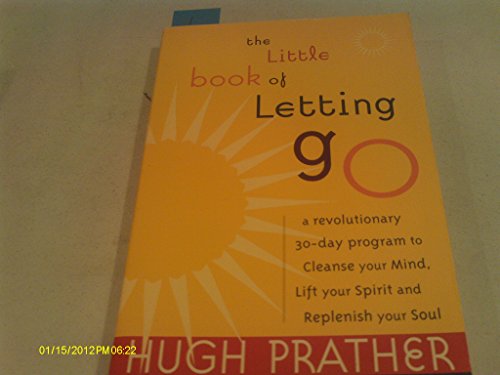
The Little Book of Letting Go: A Revolutionary 30-Day Program to Cleanse Your Mind, Lift Your Spirit and Replenish Your Soul (For Readers of Letting Go or The Art of Letting Go) - Softcover
Inhaltsangabe
"Letting go is the bottom-line key to happiness," states Hugh Prather. And in The Little Book of Letting Go, he offers a simple three-step process for shedding prejudices, preconceptions, and prejudgments and facing each moment with openness and enthusiasm. Prather first explains why it is essential to learn to let go and then outlines a 30-day plan for spiritual renewal. Finally, he offers specific techniques for getting a grip on habitual reactions, the need to control, and the addiction to conflict.
Die Inhaltsangabe kann sich auf eine andere Ausgabe dieses Titels beziehen.
Über die Autorin bzw. den Autor
Hugh Prather is the author of 16 books, including Spiritual Notes to Myself, Love and Courage, The Little Book of Letting Go, How to Live in the World and Still Be Happy, and Shining Through. As a minister and radio talk-show host, he counsels couples, singles, teenagers, and families in crisis.
Auszug. © Genehmigter Nachdruck. Alle Rechte vorbehalten.
the Little book of Letting go
A Revolutionary 30 Day Program to Cleanse Your Mind, Lift your Spirit, and Replenish your Soul
By HUGH PRATHERRed Wheel/Weiser, LLC
Copyright © 2000 Hugh Prather
All rights reserved.
ISBN: 978-1-57324-503-6All rights reserved.
Contents
| List of Illustrative Stories | |
| Foreword by Gerald G. Jampolsky, M.D. | |
| One Letting Go: The Basics | |
| Two Letting Go of Mental Pollutants | |
| Three Letting Go of Emotion Fixation | |
| Four Letting Go of Misery | |
| Five Letting Go of Prediction and Control | |
| Six Letting Go of Inner Conflict | |
| Seven Letting Go of "Honesty" | |
| Eight Letting Go of the Ego Mind | |
| Nine Letting Go of "Spiritual" Specialness | |
| Ten Letting Go | |
| List of Releases | |
| About the Author |
CHAPTER 1
Letting Go: The Basics
Within the human heart, we all feel the call to be simple, to be present, to bereal. Yet throughout the day, the world urges us to be at war with ourselves andeach other: "Be resentful about the past." "Be anxious about the future." "Behungry for what you don't see." "Be dissatisfied with what you do see." "Beguilty." "Be important." "Be bored." "Be right." Little else in nature exhibitsthis need to be more than it is. The simplicity of rain, the clarity of a star,the effortlessness of a bird, the single-mindedness of an ant—all are just whatthey are.
Underwear on the floor can break up a marriage. Yet the eyes of puppies light upwhen they see boxers or briefs. To them, dirty socks are not reasons for fightsbut reasons for play. Obviously, most little animals are hooked on somethingquite divine. Something within them releases enormous freedom. I suggest thatsomething is simplicity and purity, and that we can experience the possibilitiesof this natural state as well. A mind that learns to let go gradually returns toits inherent wholeness, happiness, and simplicity.
For example, the people who are in our lives today, are in our lives today—whatcould be simpler than this? Yet so often we react to those we encounter with amind churning in conflict: we don't want them here; we can think of other peoplewe would rather have here; we're not even sure we want to be here; when willthis be over; why does this always happen to us; and on and on. When we becomepreoccupied with what we want or don't want from someone, or what we do or don'tapprove of, we fail to see that person's goodness, malice, gentleness, sadness,or anything else that is present. This habitual reaction to other people and toeverything else in life needlessly complicates our lives and blocks simpleenjoyment and peace.
Big Truck
When Gayle's and my son, John, was two years old, we lived in Santa Fe, NewMexico. One day he and I were standing on a street corner, waiting for the lightto change, when a semi slowly began rounding the corner just as the walk lightcame on. Suddenly I was caught up in the delay this truck was causing by passingin front of us. Then I heard John say, "Big truck." I looked down and his eyeswere wide with amazement. I looked at this enormous semi passing so close wecould have reached it in one step. And I said, "Big truck." Because now I reallysaw it. It seemed like the mother ship in a Star Wars movie.
Maybe I'd been thinking that the truck shouldn't have been there or that what Ihad to do was more important than what the truck driver had to do. Whatever itwas, that thought was all it took to keep me from enjoying just standing besidemy son and holding his hand. Just one unnecessary thought. Little children havevery few, if any, unnecessary thoughts, and that's why they are usually focused,present, and happy.
A mother bird sees a snake climbing her tree and thinks "snake." Immediately shestarts dive-bombing it. I have seen what a bird can do to a snake that doesn'tclimb down fast enough. However, it's clear what would happen to her babies ifthat same mother bird saw the snake and thought, "I do more good in the worldthan that snake." Or, "I don't like that snake; it's slimy looking." Or, "Asnake in the grass has no business being in a tree." Or, "I'm going to give thatsnake a piece of my mind."
Not only do we give people a piece of our mind, we give them a piece of ourhappiness, wholeness, focus, and sometimes, a piece of our health.
Our lives are filled with useless battles because our minds are filled withuseless thoughts. We never finish thinking about anything. We carry aroundunhappy scenes from the past as if they were still happening, and we chew on thememory of whatever we just did. This glut of thoughts profoundly affects theworld we perceive and the life we live. A man who sees his mother in every womanhe meets can't see the women he meets. This one unnecessary thought lands him insolitary confinement and assures he will die alone. A mother who can't accepther son-in-law into her heart because he has "a lot of metal" (say, doubleearrings, a nose stud, and something rumored to be somewhere else) merelyattacks her own capacity to love and be happy. She doesn't change the son-in-lawand she doesn't eradicate her daughter's love for him. Yet this one unnecessarythought means her daughter will not have the mother she needs.
These last two are somewhat poisonous examples of what happens when we don't letgo. Yet throughout each day, failure to let go can eat up every small chance wehave to be happy. Just trying to write this page has been a typical example.
Weenies
About an hour ago, our son Jordan asked me if I could fix him "weenies the wayMother fixes them." I stopped writing and headed into the kitchen where John,who is now twenty, asked me if I could look at a business proposal he had outlinedfor his managerial accounting class. Gayle, being a banker's daughter,ordinarily would handle this one too, but she's at Trader Joe's buying organicyogurt.
"As soon as I fix Jordan's weenies," I said.
"Oh," John said, "would you fix me some too?"
"Yes," I said, through only gently clenched teeth.
Seasoned with my ambivalence over having been asked to stop writing aboutkindness and peace and actually practice them, the free-range weenies soon weresimmering away in free-range chicken broth—oxymorons cooking in an oxymoronwatched over by a large oxymoron.
So there I was thinking about how I wasn't getting to do what I wanted to do;wondering where Gayle and I went wrong if our boys couldn't fix their ownweenies; thinking it was a good thing we were on record against forcing kids tobe vegetarians; and debating whether a dead free-range chicken was morespiritual than a dead chicken.
In a sense, we all have two minds—one whole and peaceful, the other, fragmentedand busy. I was definitely in my busy mind. Just then I remembered Gayle's finalwords as she headed out the door: "I think we should say in the book, 'Make yourstate of mind more important than what you are doing.'"
Oh.
And maybe apply that to ourselves as well?
I have practiced letting go enough to know that it feels a whole lot better thannot letting go. Although my mental state wasn't too bad, it was not whole,happy, or at peace. Why must even this little bit of misery be endured? Whycan't a couple of small tasks be done happily?
My mistake was the one Gayle indicated. I had made...
„Über diesen Titel“ kann sich auf eine andere Ausgabe dieses Titels beziehen.
Suchergebnisse für The Little Book of Letting Go: A Revolutionary 30-Day...

Beispielbild für diese ISBN
The Little Book of Letting Go: A Revolutionary 30-Day Program to Cleanse Your Mind, Lift Your Spirit and Replenish Your Soul (For Readers of Letting Go or The Art of Letting Go)
Verlag:
Conari Press (edition ), 2000
ISBN 10: 1573245038
ISBN 13: 9781573245036
Gebraucht
Paperback
Anbieter: BooksRun, Philadelphia, PA, USA
Verkäuferbewertung 5 von 5 Sternen

Paperback. Zustand: Very Good. It's a well-cared-for item that has seen limited use. The item may show minor signs of wear. All the text is legible, with all pages included. It may have slight markings and/or highlighting. Artikel-Nr. 1573245038-8-6
Gebraucht kaufen
EUR 4,56
Versand gratis
Versand innerhalb von USA
Versand innerhalb von USA
Anzahl: 1 verfügbar
Beispielbild für diese ISBN
The Little Book of Letting Go: A Revolutionary 30-Day Program to Cleanse Your Mind, Lift Your Spirit and Replenish Your Soul (For Readers of Letting Go or The Art of Letting Go)
Anbieter: ThriftBooks-Phoenix, Phoenix, AZ, USA
Verkäuferbewertung 5 von 5 Sternen
Paperback. Zustand: Very Good. No Jacket. May have limited writing in cover pages. Pages are unmarked. ~ ThriftBooks: Read More, Spend Less. Artikel-Nr. G1573245038I4N00
Gebraucht kaufen
EUR 6,06
Versand gratis
Versand innerhalb von USA
Versand innerhalb von USA
Anzahl: 1 verfügbar
Beispielbild für diese ISBN
The Little Book of Letting Go: A Revolutionary 30-Day Program to Cleanse Your Mind, Lift Your Spirit and Replenish Your Soul (For Readers of Letting Go or The Art of Letting Go)
Anbieter: ThriftBooks-Reno, Reno, NV, USA
Verkäuferbewertung 5 von 5 Sternen
Paperback. Zustand: Very Good. No Jacket. May have limited writing in cover pages. Pages are unmarked. ~ ThriftBooks: Read More, Spend Less. Artikel-Nr. G1573245038I4N00
Gebraucht kaufen
EUR 6,06
Versand gratis
Versand innerhalb von USA
Versand innerhalb von USA
Anzahl: 1 verfügbar
Beispielbild für diese ISBN
The Little Book of Letting Go: A Revolutionary 30-Day Program to Cleanse Your Mind, Lift Your Spirit and Replenish Your Soul (For Readers of Letting Go or The Art of Letting Go)
Anbieter: ThriftBooks-Dallas, Dallas, TX, USA
Verkäuferbewertung 5 von 5 Sternen
Paperback. Zustand: Very Good. No Jacket. May have limited writing in cover pages. Pages are unmarked. ~ ThriftBooks: Read More, Spend Less. Artikel-Nr. G1573245038I4N00
Gebraucht kaufen
EUR 6,07
Versand gratis
Versand innerhalb von USA
Versand innerhalb von USA
Anzahl: 1 verfügbar
Beispielbild für diese ISBN
The Little Book of Letting Go: A Revolutionary 30-Day Program to Cleanse Your Mind, Lift Your Spirit and Replenish Your Soul (For Readers of Letting Go or The Art of Letting Go)
Anbieter: ThriftBooks-Atlanta, AUSTELL, GA, USA
Verkäuferbewertung 5 von 5 Sternen
Paperback. Zustand: Very Good. No Jacket. May have limited writing in cover pages. Pages are unmarked. ~ ThriftBooks: Read More, Spend Less. Artikel-Nr. G1573245038I4N00
Gebraucht kaufen
EUR 6,07
Versand gratis
Versand innerhalb von USA
Versand innerhalb von USA
Anzahl: 2 verfügbar
Beispielbild für diese ISBN
The Little Book of Letting Go : A Revolutionary 30-Day Program to Cleanse Your Mind, Lift Your Spirit and Replenish Your Soul (for Readers of Letting Go or the Art of Letting Go)
Anbieter: Better World Books, Mishawaka, IN, USA
Verkäuferbewertung 5 von 5 Sternen
Zustand: Good. Pages intact with minimal writing/highlighting. The binding may be loose and creased. Dust jackets/supplements are not included. Stock photo provided. Product includes identifying sticker. Better World Books: Buy Books. Do Good. Artikel-Nr. 2699983-75
Gebraucht kaufen
EUR 6,17
Versand gratis
Versand innerhalb von USA
Versand innerhalb von USA
Anzahl: 3 verfügbar
Beispielbild für diese ISBN
The Little Book of Letting Go: A Revolutionary 30-Day Program to Cleanse Your Mind, Lift Your Spirit and Replenish Your Soul
Anbieter: Wonder Book, Frederick, MD, USA
Verkäuferbewertung 5 von 5 Sternen
Zustand: Very Good. Very Good condition. A copy that may have a few cosmetic defects. May also contain light spine creasing or a few markings such as an owner's name, short gifter's inscription or light stamp. Artikel-Nr. Q01G-01732
Gebraucht kaufen
EUR 6,41
Versand gratis
Versand innerhalb von USA
Versand innerhalb von USA
Anzahl: 4 verfügbar
Beispielbild für diese ISBN
The Little Book of Letting Go: A Revolutionary 30-Day Program to Cleanse Your Mind, Lift Your Spirit and Replenish Your Soul
Anbieter: Wonder Book, Frederick, MD, USA
Verkäuferbewertung 5 von 5 Sternen
Zustand: Good. Good condition. A copy that has been read but remains intact. May contain markings such as bookplates, stamps, limited notes and highlighting, or a few light stains. Artikel-Nr. O07O-01000
Gebraucht kaufen
EUR 6,41
Versand gratis
Versand innerhalb von USA
Versand innerhalb von USA
Anzahl: 1 verfügbar
Beispielbild für diese ISBN
Little Book of Letting Go: A Revolutionary 30-day Program to Cleanse the Mind, Release the Spirit and Lift the Soul
Anbieter: AwesomeBooks, Wallingford, Vereinigtes Königreich
Verkäuferbewertung 5 von 5 Sternen
Paperback. Zustand: Very Good. Little Book of Letting Go: A Revolutionary 30-day Program to Cleanse the Mind, Release the Spirit and Lift the Soul This book is in very good condition and will be shipped within 24 hours of ordering. The cover may have some limited signs of wear but the pages are clean, intact and the spine remains undamaged. This book has clearly been well maintained and looked after thus far. Money back guarantee if you are not satisfied. See all our books here, order more than 1 book and get discounted shipping. Artikel-Nr. 7719-9781573245036
Gebraucht kaufen
EUR 3,76
EUR 4,91 Versand
Versand von Vereinigtes Königreich nach USA
Versand von Vereinigtes Königreich nach USA
Anzahl: 2 verfügbar
Beispielbild für diese ISBN
The Little Book of Letting Go: A Revolutionary 30-Day Program to Cleanse Your Mind, Lift Your Spirit and Replenish Your Soul (For Readers of Letting Go or The Art of Letting Go)
Anbieter: WorldofBooks, Goring-By-Sea, WS, Vereinigtes Königreich
Verkäuferbewertung 5 von 5 Sternen
Paperback. Zustand: Very Good. The book has been read, but is in excellent condition. Pages are intact and not marred by notes or highlighting. The spine remains undamaged. Artikel-Nr. GOR001607094
Gebraucht kaufen
EUR 4,56
EUR 6,67 Versand
Versand von Vereinigtes Königreich nach USA
Versand von Vereinigtes Königreich nach USA
Anzahl: 2 verfügbar