
Verwandte Artikel zu Good Life, Good Death: One of the Last Reincarnated...
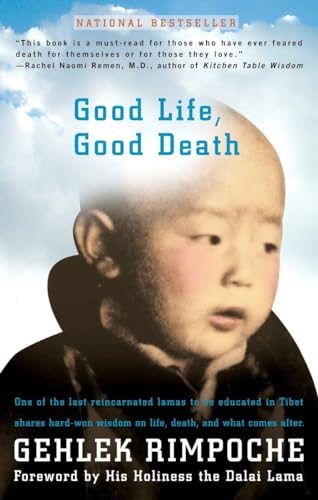
Good Life, Good Death: One of the Last Reincarnated Lamas to Be Educated in Tibet Shares Hard-Won Wisdom on Life, Death, and What Comes After - Softcover
Inhaltsangabe
"This book is a must-read for those who have ever feared death for themselves or for those they love." -Rachel Naomi Remen, M.D., author of Kitchen Table Wisdom
By the late Gehlek Rimpoche, the bestselling book that changed the way we think about death
Who are we? Where did we come from? Where are we going? How do we get there? Many have asked these questions, and many have attempted to answer them. But there is another question Good Life, Good Death asks us to contemplate: how does the idea of life after death affect how we live our lives? Gelek Rimpoche tells stories of the mystical Tibet he lived in, as well as the contemporary America he is now a citizen of, and shares the wisdom of the great masters. He asks us to open our minds and see if we can entertain a bigger picture of life after life, even for a moment. He makes the connection between powerful emotions such as anger, obsession, jealousy and pride, and our past as well as our future.
Die Inhaltsangabe kann sich auf eine andere Ausgabe dieses Titels beziehen.
Über die Autorin bzw. den Autor
Rimpoche N. Gehlek was trained by the same teachers who taught the Dalai Lama, and was fully educated in Tibet. He is a favorite speaker at the Omega Institute, the Open Center, and countless spiritual centers around the world. His students cover the full range: Buddhists, Hollywood actors, esteemed composers and musicians.
Tenzin Gyatso, His Holiness the Fourteenth Dalai Lama, is the spiritual and temporal leader of the Tibetan people. His tireless efforts on behalf of human rights and world peace have brought him international recognition. He is the recipient of the Wallenberg Award (conferred by the U.S. Congressional Human Rights Foundation), the Albert Schweitzer Award, and the Nobel Peace Prize.
Auszug. © Genehmigter Nachdruck. Alle Rechte vorbehalten.
“Gehlek’s book is lighthearted and down-to-earth.”
—The Cleveland Plain Dealer
“His teachings are helpful to all.”
—The Denver Post
“Insightful . . . Gehlek is a felicitous writer, especially gifted with analogy. Readers will cheer about this fresh voice.”
—Publishers Weekly (starred review)
“Gehlek Rimpoche’s wisdom on life, death and reincarnation will focus your energies on the importance of coming to terms with your negative emotions. It will also help you travel well through life by practicing patience.”
—Spirituality & Health
“Gehlek Rimpoche’s mix of astute psychological insight, extraordinary intellect, and great compassion—plus his delightful wit—make him a wonderful, wise spiritual friend and guide.”
—Tara Bennett-Goleman, author of Emotional Alchemy, and Daniel Goleman, author of Emotional Intelligence
“Gehlek Rimpoche is a heartfelt, tender teacher with a vast analytic mind.”
—Allen Ginsberg
“Gehlek Rimpoche . . . is a great teacher.”
—Robert A. F. Thurman, professor of religion, Columbia University
“No clichés here. Just straight talk infused with humor, humility and a well-seasoned wisdom born of a broad classical training and worldly experience. His lineage is impeccable and true. His simple words speak to the jewel in our hearts.”
—Richard Gere
“Gehlek Rimpoche is one of the wisest, most cheerful people I know. He is a beautiful and gracious spirit who carries the great wisdom of Tibet. We are fortunate to have him teaching in the West.”
—Jack Kornfield, bestselling author of After the Ecstasy, the Laundry
Gehlek Rimpoche’s teaching is concise and soulful; here, tradition is saved only to strengthen the daily path of liberation. Answering Allen Ginsberg’s query, Rimpoche once observed that poetry is compassion. We may learn from Rimpoche’s writings that compassion is also poetry.”
—Francesco Clemente
“Gehlek Rimpoche is one of the great originals alive today—luminous in his wisdom, compassionate in his unstinting care and support, and a very funny man to boot. He is the Buddha nature in a warm and whimsical package.”
—Jean Houston, Ph.D.
“Probably the best available teacher of Tibetan Buddhism in the West. He combines a complete grasp of the teachings of this tradition with an openness and kindness that has endeared him to all those fortunate enough to have come to know him.”
—Philip Glass
“Gehlek Rimpoche is a brilliant scholar of Tibetan Buddhism. Educated in Tibet’s largest monastery—Drepung—he fled to India in 1959, and in the decades since, has become one of the most important and insightful teachers of Tibetan Buddhism in the West.”
—Melvyn C. Goldstein, John Reynolds Harkness Professor and Chair of Anthropology, and director, Center for Research on Tibet, Case Western Reserve University
“Gehlek Rimpoche was trained by the greatest teachers of the last generation of Buddhist masters in Tibet. He has brought their teachings to America, where he is passing on their wisdom to a new generation, with eloquence, wit, and insight.”
—Donald Lopez, Carl W. Belser Professor of Buddhist and Tibetan Studies, University of Michigan
CONTENTS
FOREWORD
Reincarnation is something we Tibetans tend to take for granted. We are brought up with the idea that the kind of life we have now is a result of how we have behaved in the past, and that the kind of life we will live in the future depends on how we conduct ourselves now. I feel this is in many ways a very practical approach because it places firmly in our own hands responsibility for the kind of person we are now and the kind of person we may become. What’s more, it gives us a reason for making this very life as meaningful as possible. How should we go about doing this? I believe that cultivating compassion is one of the principal things that make our lives worthwhile. It is the source of all lasting happiness and joy. And it is the foundation of a good heart, the heart of one who acts out of a desire to help others.
Through kindness, through affection, through honesty, through truth, and through justice toward all others, we ensure our own benefit. This is not a matter for complicated theorizing. It is a matter of common sense. Consideration of others is worthwhile, because our happiness is inextricably bound up with the happiness of others. If society suffers, we ourselves suffer. And it is clear that the more our hearts and minds are afflicted with ill will, the more miserable we become. We cannot escape the necessity of love and compassion. As long as we have compassion for others and conduct ourselves with restraint—out of a sense of responsibility—there is no doubt we will be happy.
Of course, confidence in the way we have lived our lives is also one of the principal factors that will help us to remain calm and undisturbed at the time of death. The more we have made our lives meaningful, the less we will regret at the time of death. Therefore, the way we feel when we come to die is very much dependent on the way we have lived. If our daily life has been positive and meaningful, when the end comes, even though we do not wish for it, we will be able to accept it as a part of our life. We will have no regrets.
Nawang Gehlek Rimpoche has made these questions the theme of this book Good Life, Good Death. He is well qualified to discuss them. As a recognized reincarnate lama, he completed his traditional Buddhist training as a monk in Tibet prior to the Chinese takeover. In exile in India, he lived the life of a married man, doing valuable work in broadcasting and publishing Tibetan Buddhist texts. Since becoming an American resident, he has been able to put his clear understanding of the English language and the modern world to good effect when invited to teach about his own tradition. As this book makes clear, he is able to share some of the insights and benefits of the teachings of Tibetan Buddhism with modern readers in terms that they can easily understand and put into practice. I am sure that readers interested in the Tibetan approach to inner peace will find much here to attract and inspire them.
—Tenzin Gyatso,
The Fourteenth Dalai Lama
June 16, 2001
INTRODUCTION
Over the years, I have probably had more fun with Gehlek Rimpoche than with almost any lama I have known. Extremely bright and perceptive, he has a great sense of humor, and just loves to chat, whether in Tibetan or English. He is also very good-natured and generous to a fault, not minding at all when the joke’s on him. I have also learned a great deal from him, about all levels of the Buddha Dharma, which he lives and breathes. It’s in his mind as a philosophy, in his culture as a way of life, and in his blood as an art of living and dying well—that is, virtuously for the sake of others and pleasantly for his own sake.
Rimpoche was brought up in one of the most upper-crust families in Tibet, belonging to the family of the Great Thirteenth Dalai Lama, Thubten Gyatso (1876–1933), the “first family” of that...
„Über diesen Titel“ kann sich auf eine andere Ausgabe dieses Titels beziehen.
Weitere beliebte Ausgaben desselben Titels

Suchergebnisse für Good Life, Good Death: One of the Last Reincarnated...

Beispielbild für diese ISBN
Good Life, Good Death: One of the Last Reincarnated Lamas to Be Educated in Tibet Shares Hard-Won Wisdom on Life, Death, and What Comes After
Verlag:
Penguin Publishing Group, 2002
ISBN 10: 1573229520
ISBN 13: 9781573229524
Gebraucht
Softcover
Anbieter: World of Books (was SecondSale), Montgomery, IL, USA
Verkäuferbewertung 5 von 5 Sternen

Zustand: Good. Item in good condition. Textbooks may not include supplemental items i.e. CDs, access codes etc. Artikel-Nr. 00062387241
Gebraucht kaufen
EUR 4,07
Versand gratis
Versand innerhalb von USA
Versand innerhalb von USA
Anzahl: 4 verfügbar
Foto des Verkäufers
Good Life, Good Death: One of the Last Reincarnated Lamas to Be Educated in Tibet Shares Hard-Won Wisdom on Life, Death, and What Comes After
Verlag:
Penguin Publishing Group, 2002
ISBN 10: 1573229520
ISBN 13: 9781573229524
Gebraucht
Softcover
Anbieter: Dream Books Co., Denver, CO, USA
Verkäuferbewertung 5 von 5 Sternen
Zustand: good. Gently used with minimal wear on the corners and cover. A few pages may contain light highlighting or writing, but the text remains fully legible. Dust jacket may be missing, and supplemental materials like CDs or codes may not be included. May be ex-library with library markings. Ships promptly! Artikel-Nr. DBV.1573229520.G
Gebraucht kaufen
EUR 4,08
Versand gratis
Versand innerhalb von USA
Versand innerhalb von USA
Anzahl: 1 verfügbar
Beispielbild für diese ISBN
Good Life, Good Death: One of the Last Reincarnated Lamas to Be Educated in Tibet Shares Hard-Won Wisdom on Life, Death, and What Comes After
Verlag:
Penguin Publishing Group (edition Reprint), 2002
ISBN 10: 1573229520
ISBN 13: 9781573229524
Gebraucht
Paperback
Anbieter: BooksRun, Philadelphia, PA, USA
Verkäuferbewertung 5 von 5 Sternen
Paperback. Zustand: Very Good. Reprint. It's a well-cared-for item that has seen limited use. The item may show minor signs of wear. All the text is legible, with all pages included. It may have slight markings and/or highlighting. Artikel-Nr. 1573229520-11-1
Gebraucht kaufen
EUR 4,39
Versand gratis
Versand innerhalb von USA
Versand innerhalb von USA
Anzahl: 1 verfügbar
Beispielbild für diese ISBN
Good Life, Good Death: One of the Last Reincarnated Lamas to Be Educated in Tibet Shares Hard-Won Wisdom on Life, Death, and What Comes After
Verlag:
Penguin Publishing Group, 2002
ISBN 10: 1573229520
ISBN 13: 9781573229524
Gebraucht
Paperback
Anbieter: ThriftBooks-Dallas, Dallas, TX, USA
Verkäuferbewertung 5 von 5 Sternen
Paperback. Zustand: Very Good. No Jacket. May have limited writing in cover pages. Pages are unmarked. ~ ThriftBooks: Read More, Spend Less. Artikel-Nr. G1573229520I4N00
Gebraucht kaufen
EUR 5,75
Versand gratis
Versand innerhalb von USA
Versand innerhalb von USA
Anzahl: 1 verfügbar
Beispielbild für diese ISBN
Good Life, Good Death: One of the Last Reincarnated Lamas to Be Educated in Tibet Shares Hard-Won Wisdom on Life, Death, and What Comes After
Verlag:
Penguin Publishing Group, 2002
ISBN 10: 1573229520
ISBN 13: 9781573229524
Gebraucht
Paperback
Anbieter: ThriftBooks-Phoenix, Phoenix, AZ, USA
Verkäuferbewertung 5 von 5 Sternen
Paperback. Zustand: Very Good. No Jacket. May have limited writing in cover pages. Pages are unmarked. ~ ThriftBooks: Read More, Spend Less. Artikel-Nr. G1573229520I4N00
Gebraucht kaufen
EUR 5,75
Versand gratis
Versand innerhalb von USA
Versand innerhalb von USA
Anzahl: 1 verfügbar
Beispielbild für diese ISBN
Good Life, Good Death: One of the Last Reincarnated Lamas to Be Educated in Tibet Shares Hard-Won Wisdom on Life, Death, and What Comes After
Verlag:
Penguin Publishing Group, 2002
ISBN 10: 1573229520
ISBN 13: 9781573229524
Gebraucht
Paperback
Anbieter: ThriftBooks-Atlanta, AUSTELL, GA, USA
Verkäuferbewertung 5 von 5 Sternen
Paperback. Zustand: Very Good. No Jacket. May have limited writing in cover pages. Pages are unmarked. ~ ThriftBooks: Read More, Spend Less. Artikel-Nr. G1573229520I4N00
Gebraucht kaufen
EUR 5,75
Versand gratis
Versand innerhalb von USA
Versand innerhalb von USA
Anzahl: 1 verfügbar
Beispielbild für diese ISBN
Good Life, Good Death: One of the Last Reincarnated Lamas to Be Educated in Tibet Shares Hard-Won Wisdom on Life, Death, and What Comes After
Verlag:
Penguin Publishing Group, 2002
ISBN 10: 1573229520
ISBN 13: 9781573229524
Gebraucht
Paperback
Anbieter: ThriftBooks-Reno, Reno, NV, USA
Verkäuferbewertung 5 von 5 Sternen
Paperback. Zustand: Very Good. No Jacket. May have limited writing in cover pages. Pages are unmarked. ~ ThriftBooks: Read More, Spend Less. Artikel-Nr. G1573229520I4N00
Gebraucht kaufen
EUR 5,75
Versand gratis
Versand innerhalb von USA
Versand innerhalb von USA
Anzahl: 1 verfügbar
Beispielbild für diese ISBN
Good Life, Good Death: One of the Last Reincarnated Lamas to Be Educated in Tibet Shares Hard-Won Wisdom on Life, Death, and What Comes After
Verlag:
Penguin Publishing Group, 2002
ISBN 10: 1573229520
ISBN 13: 9781573229524
Gebraucht
Softcover
Anbieter: Wonder Book, Frederick, MD, USA
Verkäuferbewertung 5 von 5 Sternen
Zustand: Very Good. Very Good condition. A copy that may have a few cosmetic defects. May also contain light spine creasing or a few markings such as an owner's name, short gifter's inscription or light stamp. Artikel-Nr. L07R-00835
Gebraucht kaufen
EUR 6,17
Versand gratis
Versand innerhalb von USA
Versand innerhalb von USA
Anzahl: 1 verfügbar
Beispielbild für diese ISBN
Good Life, Good Death : One of the Last Reincarnated Lamas to Be Educated in Tibet Shares Hard-Won Wisdom on Life, Death, and What Comes After
Verlag:
Penguin Publishing Group, 2002
ISBN 10: 1573229520
ISBN 13: 9781573229524
Gebraucht
Softcover
Anbieter: Better World Books, Mishawaka, IN, USA
Verkäuferbewertung 5 von 5 Sternen
Zustand: Good. Reprint. Pages intact with minimal writing/highlighting. The binding may be loose and creased. Dust jackets/supplements are not included. Stock photo provided. Product includes identifying sticker. Better World Books: Buy Books. Do Good. Artikel-Nr. 2075929-6
Gebraucht kaufen
EUR 9,71
Versand gratis
Versand innerhalb von USA
Versand innerhalb von USA
Anzahl: 1 verfügbar
Beispielbild für diese ISBN
Good Life, Good Death : One of the Last Reincarnated Lamas to Be Educated in Tibet Shares Hard-Won Wisdom on Life, Death, and What Comes After
Verlag:
Penguin Publishing Group, 2002
ISBN 10: 1573229520
ISBN 13: 9781573229524
Gebraucht
Softcover
Anbieter: Better World Books: West, Reno, NV, USA
Verkäuferbewertung 5 von 5 Sternen
Zustand: Very Good. Reprint. Pages intact with possible writing/highlighting. Binding strong with minor wear. Dust jackets/supplements may not be included. Stock photo provided. Product includes identifying sticker. Better World Books: Buy Books. Do Good. Artikel-Nr. 6140193-20
Gebraucht kaufen
EUR 9,71
Versand gratis
Versand innerhalb von USA
Versand innerhalb von USA
Anzahl: 1 verfügbar