
Verwandte Artikel zu Affinity
Inhaltsangabe
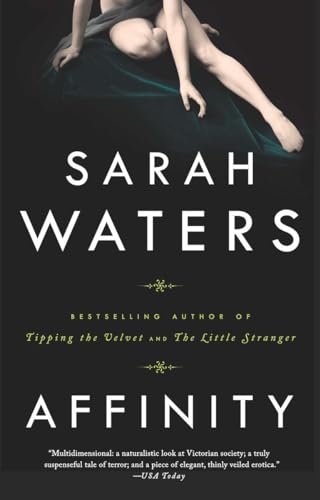
Visiting a grim London prison as part of rehabilitative charity work, an upper-class woman recovering from a suicide attempt is drawn into the Victorian world of enigmatic spiritualist and inmate Selina Dawes and is persuaded to help her escape. By the author of Tipping the Velvet. Reprint.
Die Inhaltsangabe kann sich auf eine andere Ausgabe dieses Titels beziehen.
Über die Autorinnen und Autoren
Sarah Waters is the New York Times&;bestselling author of The Paying Guests, The Little Stranger,The Night Watch, Fingersmith, Affinity, and Tipping the Velvet. She has three times been short-listed for the Man Booker Prize, has twice been a finalist for the Orange Prize, and was named one of Granta&;s best young British novelists, among other distinctions. Waters lives in London.
Sarah Waters is the author of Tipping the Velvet, a New York TimesNotable Book; Affinity, which won her the Sunday Times Young Writer of the Year Award;Fingersmith and The Night Watch, both of which were shortlisted for both the Orange Prize and the Man Booker Prize; andThe Little Stranger, which was shortlisted for the Man Booker Prize, a finalist for the Shirley Jackson Award and aNew York Times Notable Book. She has also been named one of Granta's best young British novelists. She lives in London.
Auszug. © Genehmigter Nachdruck. Alle Rechte vorbehalten.
Part One
24 September 1874
Pa used to say that any piece of history might be made into a tale: it was only a question of deciding where the tale began, and where it ended. That, he said, was all his skill. And perhaps, after all, the histories he dealt with were rather easy to sift like that, to divide up and classify—the great lives, the great works, each one of them neat and gleaming and complete, like metal letters in a box of type.
I wish that Pa was with me now. I would ask him how he would start to write the story I have embarked upon to-day. I would ask him how he would neatly tell the story of a prison—of Millbank Prison—which has so many separate lives in it, and is so curious a shape, and must be approached, so darkly, through so many gates and twisting passages. Would he start it with the building of the gaols themselves? I cannot do that, for though I was told the date of it this morning I have forgotten it now; besides which, Millbank is so solid and so antique, I can’t believe that there was ever a time when it did not sit upon that dreary spot beside the Thames, casting its shadow on the black earth there. He might begin it, then, with Mr Shillitoe’s visit to this house, three weeks ago; or, he might begin it at seven this morning, when Ellis first brought me my grey suit and my coat—no, of course he would not start the story there, with a lady and her servant, and petticoats and loose hair.
He would start it, I think, at the gate of Millbank, the point that every visitor must pass when they arrive to make their tour of the gaols. Let me begin my record there, then: I am being greeted by the prison porter, who is marking my name off in some great ledger; now a warder is leading me through a narrow arch, and I am about to step across the grounds towards the prison proper—
Before I can do that, however, I am obliged to pause a little to fuss with my skirts, which are plain, but wide, and have caught upon some piece of jutting iron or brick. I daresay Pa would not have bothered with the detail of the skirts; I will, however, for it is in lifting my eyes from my sweeping hem that I first see the pentagons of Millbank—and the nearness of them, and the suddenness of that gaze, makes them seem terrible. I look at them, and feel my heart beat hard, and I am afraid.
I had a plan of Millbank’s buildings from Mr Shillitoe a week ago, and have had it pinned, since then, on the wall beside this desk. The prison, drawn in outline, has a curious kind of charm to it, the pentagons appearing as petals on a geometric flower—or, as I have sometimes thought, they are like the coloured zones on the chequer-boards we used to paint when we were children. Seen close, of course, Millbank is not charming. Its scale is vast, and its lines and angles, when realised in walls and towers of yellow brick and shuttered windows, seem only wrong or perverse. It is as if the prison had been designed by a man in the grip of a nightmare or a madness—or had been made expressly to drive its inmates mad. I think it would certainly drive me mad, if I had to work as a warder there. As it was, I walked flinchingly beside the man who led me, and paused once to glance behind me, then to gaze at the wedge of sky that showed above. The inner gate at Millbank is set at the junction of two of the pentagons and so, to reach it, one must walk along a narrowing slip of gravel, and feel the walls on either side of one advancing, like the clashing rocks of the Bosporous. The shadows there, flung from the jaundiced bricks, are the colour of bruises. The soil in which the walls are set is damp and dark as tobacco.
This soil makes the air there very sour; it grew sourer still, as I was shown into the gaol and had the gate made fast behind me. My heart beat even harder then, and continued to thump while I was made to sit in a plain little room, watching warders cross the open door, seeing them frown and murmur. When Mr Shillitoe came to me at last, I took his hand. I said, ‘I am glad to see you! I had begun to worry that the men might take me for a convict just arrived, and lead me to a cell, and leave me there!’ He laughed. There were never confusions like that, he said, at Millbank.
We walked together then, into the prison buildings: for he thought it best to take me straight to the female gaol, to the office of the governess or principal matron there, Miss Haxby. We walked, and he explained our route to me, and I tried to match it with my memory of my paper plan; but the organisation of the prison, of course, is so peculiar, I soon grew lost. The pentagons that hold the men, I know we did not enter. We only passed the gates that lead to those gaols from the hexagon-shaped building at the prison’s middle, the building in which they have their store-rooms, and the surgeon’s house, and Mr Shillitoe’s own offices, and the offices of all his clerks, and the infirmaries and chapel. ‘For you see,’ he said to me once, nodding through a window at a set of yellow smoking chimneys he said were fed by the fires of the prison laundry, ‘you see, we are quite a little city here! Quite self-sustaining. We should do very well, I always think, under a siege.’
He spoke rather proudly, but smiled at his own pride; and I smiled when he did. But if I had grown fearful, having the light and air shut out behind me at the inner gate, then now, as we passed further into the gaol, and that gate was put behind us at the end of a dim and complicated path I should never be able to retrace alone—now, I grew nervous again. Last week, sorting through the papers in Pa’s study, I came across a volume of the prison drawings of Piranesi, and spent an anxious hour, studying them, thinking of all the dark and terrible scenes I might be confronted with to-day. Of course, there was nothing to match the things I had imagined. We passed only along a succession of neat, whitewashed corridors, and were greeted at the junction of these by warders, in dark prison coats. But, the very neatness and the sameness of the corridors and the men made them troubling: I might have been taken on the same plain route ten times over, I should never have known it. Unnerving, too, is the dreadful clamour of the place. Where the warders stand there are gates, that must be unfastened, and swung on grinding hinges, and slammed and bolted; and the empty passages, of course, echo with the sounds of other gates, and other locks and bolts, distant and near. The prison seems caught, in consequence, at the heart of some perpetual private storm, that left my ears ringing.
We walked until we reached an antique, studded door that had a wicket in it, which proved to be the entrance to the female gaol. Here we were greeted by a matron, who made Mr Shillitoe a curtsey; and, she being the first woman I had encountered there, I made sure to study her carefully. She was youngish, pale, and quite unsmiling, and dressed in what I was soon to see was the uniform of the place: a grey wool dress, a mantle of black, a grey straw bonnet trimmed with blue, and stout black flat-heeled boots. When she saw me gazing at her she curtseyed again—Mr Shillitoe saying, ‘This is Miss Ridley, our chief matron here’, and then, to her: ‘This is Miss Prior, our new Visitor.’
She walked before us, and there came a steady chink, chink of metal; and I saw then that, like the warders, she wore a wide belt of leather with a buckle of brass and, suspended from the buckle, a chain of polished prison keys.
She took us, via more featureless corridors, to a spiral staircase that wound upwards through a tower; it is at the top of the tower, in a bright, white, circular room, filled with windows, that Miss Haxby has her office. ‘You will see the logic of the design of this,’ said Mr...
„Über diesen Titel“ kann sich auf eine andere Ausgabe dieses Titels beziehen.
Suchergebnisse für Affinity

Beispielbild für diese ISBN
Affinity
Anbieter: World of Books (was SecondSale), Montgomery, IL, USA
Verkäuferbewertung 5 von 5 Sternen

Zustand: Acceptable. Item in acceptable condition! Textbooks may not include supplemental items i.e. CDs, access codes etc. Artikel-Nr. 00098051525
Gebraucht kaufen
EUR 3,67
Versand gratis
Versand innerhalb von USA
Versand innerhalb von USA
Anzahl: 9 verfügbar
Foto des Verkäufers
Affinity
Anbieter: Dream Books Co., Denver, CO, USA
Verkäuferbewertung 5 von 5 Sternen
Zustand: acceptable. This copy has clearly been enjoyedâ"expect noticeable shelf wear and some minor creases to the cover. Binding is strong, and all pages are legible. May contain previous library markings or stamps. Artikel-Nr. DBV.1573228737.A
Gebraucht kaufen
EUR 3,69
Versand gratis
Versand innerhalb von USA
Versand innerhalb von USA
Anzahl: 2 verfügbar
Beispielbild für diese ISBN
Affinity
Anbieter: Wonder Book, Frederick, MD, USA
Verkäuferbewertung 5 von 5 Sternen
Zustand: Good. Good condition. A copy that has been read but remains intact. May contain markings such as bookplates, stamps, limited notes and highlighting, or a few light stains. Artikel-Nr. K04D-01266
Gebraucht kaufen
EUR 6,23
Versand gratis
Versand innerhalb von USA
Versand innerhalb von USA
Anzahl: 2 verfügbar
Beispielbild für diese ISBN
Affinity
Anbieter: ThriftBooks-Dallas, Dallas, TX, USA
Verkäuferbewertung 5 von 5 Sternen
Paperback. Zustand: Good. No Jacket. Former library book; Pages can have notes/highlighting. Spine may show signs of wear. ~ ThriftBooks: Read More, Spend Less. Artikel-Nr. G1573228737I3N10
Gebraucht kaufen
EUR 6,28
Versand gratis
Versand innerhalb von USA
Versand innerhalb von USA
Anzahl: 1 verfügbar
Beispielbild für diese ISBN
Affinity
Anbieter: ThriftBooks-Dallas, Dallas, TX, USA
Verkäuferbewertung 5 von 5 Sternen
Paperback. Zustand: Fair. No Jacket. Readable copy. Pages may have considerable notes/highlighting. ~ ThriftBooks: Read More, Spend Less. Artikel-Nr. G1573228737I5N00
Gebraucht kaufen
EUR 6,28
Versand gratis
Versand innerhalb von USA
Versand innerhalb von USA
Anzahl: 1 verfügbar
Beispielbild für diese ISBN
Affinity
Anbieter: ThriftBooks-Dallas, Dallas, TX, USA
Verkäuferbewertung 5 von 5 Sternen
Paperback. Zustand: Good. No Jacket. Pages can have notes/highlighting. Spine may show signs of wear. ~ ThriftBooks: Read More, Spend Less. Artikel-Nr. G1573228737I3N00
Gebraucht kaufen
EUR 6,28
Versand gratis
Versand innerhalb von USA
Versand innerhalb von USA
Anzahl: 1 verfügbar
Beispielbild für diese ISBN
Affinity
Anbieter: ThriftBooks-Reno, Reno, NV, USA
Verkäuferbewertung 5 von 5 Sternen
Paperback. Zustand: Fair. No Jacket. Readable copy. Pages may have considerable notes/highlighting. ~ ThriftBooks: Read More, Spend Less. Artikel-Nr. G1573228737I5N00
Gebraucht kaufen
EUR 6,28
Versand gratis
Versand innerhalb von USA
Versand innerhalb von USA
Anzahl: 1 verfügbar
Beispielbild für diese ISBN
Affinity
Anbieter: ThriftBooks-Phoenix, Phoenix, AZ, USA
Verkäuferbewertung 5 von 5 Sternen
Paperback. Zustand: Good. No Jacket. Pages can have notes/highlighting. Spine may show signs of wear. ~ ThriftBooks: Read More, Spend Less. Artikel-Nr. G1573228737I3N00
Gebraucht kaufen
EUR 6,28
Versand gratis
Versand innerhalb von USA
Versand innerhalb von USA
Anzahl: 1 verfügbar
Beispielbild für diese ISBN
Affinity
Anbieter: ThriftBooks-Phoenix, Phoenix, AZ, USA
Verkäuferbewertung 5 von 5 Sternen
Paperback. Zustand: Fair. No Jacket. Readable copy. Pages may have considerable notes/highlighting. ~ ThriftBooks: Read More, Spend Less. Artikel-Nr. G1573228737I5N00
Gebraucht kaufen
EUR 6,28
Versand gratis
Versand innerhalb von USA
Versand innerhalb von USA
Anzahl: 1 verfügbar
Beispielbild für diese ISBN
Affinity
Anbieter: ThriftBooks-Reno, Reno, NV, USA
Verkäuferbewertung 5 von 5 Sternen
Paperback. Zustand: Good. No Jacket. Pages can have notes/highlighting. Spine may show signs of wear. ~ ThriftBooks: Read More, Spend Less. Artikel-Nr. G1573228737I3N00
Gebraucht kaufen
EUR 6,28
Versand gratis
Versand innerhalb von USA
Versand innerhalb von USA
Anzahl: 1 verfügbar